
Common ivy (Hedera helix, )
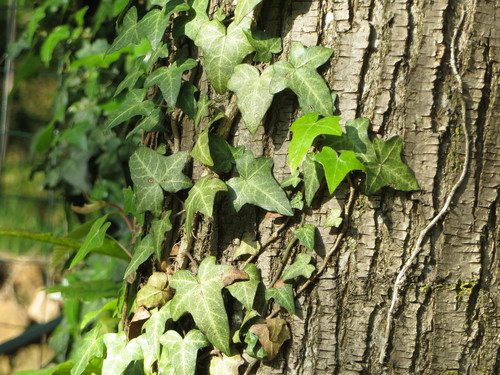
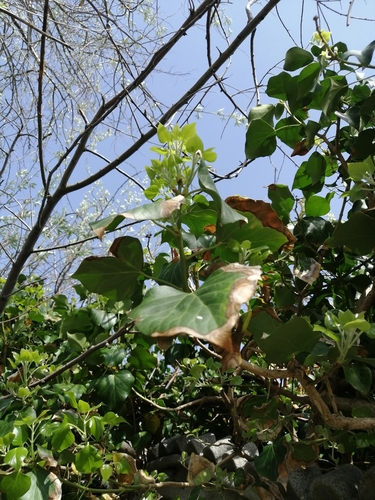
Common ivy (Hedera helix L., 1753) is an evergreen woody climber in the Araliaceae, native to Europe and western Asia as far as Iran. It starts out as a creeping ground cover, then climbs trunks, walls and banks by adventitious rootlets; the brighter-lit adult shoots carry the autumn flowers and the black winter berries.
Read moreEnglish ivy, European ivy and Ivy
Place in indirect light or in a shaded room.
Global distribution
POWO/WCVP place Hedera helix in Europe, the Mediterranean and western Asia as far as Iran. In mainland France it is treated as native, not as an invasive alien species; invasive status mainly concerns regions outside its native range.
- Native5
- Introduced2
- Invasive1
- Mainland France
- United Kingdom
- Germany
- Spain
- Turkey
- Morocco
- New Zealand
- Oregon
Hexagons: sourced regions. Green dots: native range. Statuses according to POWO (Kew).
Identity
Common ivy is Hedera helix L., an accepted species in the genus Hedera, family Araliaceae. POWO/WCVP trace the name to Species Plantarum of 1753, class the plant as a climber of the temperate biome and give its native range as Mediterranean and temperate Europe eastward into western Asia. 1 2
In English, common ivy, English ivy and plain ivy all point to this one plant. None of them should be mixed up with ground ivy (Glechoma hederacea), a member of the mint family, Lamiaceae, or with pothos, sometimes sold as devil's ivy. 3 4
The references used here treat Hedera helix as native to mainland France, with no invasive alien status there. Native status in one country says nothing about its behavior elsewhere: outside its native range, notably in North America and Oceania, it spreads aggressively in several regions. 1 5
Recognition
An evergreen woody climber, ivy can stay low as ground cover or climb unaided. Juvenile stems put out short adventitious rootlets that grip bark, walls, posts and rock, which does not make the plant a parasite. 6 7
Leaf shape depends on the age of the shoot. Juvenile stems carry alternate, leathery, glossy leaves, often palmately lobed with 3–5 lobes. Adult shoots, which reach more light, turn bushy, stop clinging and bear less divided leaves, ovate to rhombic. 3 7
Small yellowish green flowers sit in rounded umbels. They open mainly in late summer and autumn on adult shoots, followed by black fruit in winter. For identification, that combination of lobed juvenile foliage, less lobed adult shoots and black berries is far more reliable than any single leaf. 6 3
Useful taxonomy
The stable accepted name is Hedera helix L. Taxonomic databases list a few homotypic or historical synonyms, among them Hedera communis Gray, Hedera poetica Salisb. and Hedera poetarum Bertol. They matter for reading old floras, not for sorting everyday garden plants. 1 4
Closely related ivies cause the most practical confusion. Hedera hibernica and Hedera colchica can be sold or planted for the same purposes, yet they are not simple synonyms of H. helix. Cultivar and garden-form names should therefore stay tied to a precise botanical label. 6
POWO also accepts two infraspecific forms, Hedera helix f. helix and Hedera helix f. poetarum. For non-specialists, these ranks are best not read as garden "varieties": potted ivy at the nursery is almost always a cultivar. 1
Habitat and range
According to POWO, the native range is European and western Asian, with France among the native regions. Trefle data add many French vernacular names and confirm native presence in France in the distribution records consulted. 1 4
Within that range, ivy occupies woods, woodland edges, hedgerows, banks and old walls. The CNPF describes it as an evergreen climber of part shade or shade that only flowers and fruits properly once it reaches more light. That explains why a dark carpet of ivy often stays purely vegetative. 8
Beyond its native range, the same growth habit becomes a regional ecological risk. Oregon State reports escapes into natural areas through fruit dispersal and notes Oregon's quarantine on H. helix and H. hibernica. Status therefore depends on place: native in France, potentially invasive where it has been introduced. 5
Life cycle, uses and management
Growth usually begins with a creeping stage: young stems cover the ground and root at the nodes. When they meet a vertical surface, they climb by their rootlets and can reach several meters. The RHS gives 8–12 m (26–40 ft) as a typical ultimate garden height, while forestry sources and local trait data allow maxima approaching 30 m (100 ft) on a favorable support. 6 8
Its main uses are ornamental and ecological: shade ground cover, green walls and fences, bank cover, and shelter and food for wildlife. The RHS lists it among plants for pollinators, and BWARS records the ivy bee, Colletes hederae, visiting Hedera helix. Birds also feed on the winter berries, which are not edible for people. 6 9 10
On trees, ivy is no parasite: it has its own roots in the soil, and the rootlets only hold it in place. Management is still needed on young trees, weakened trees, thin branches or crowns already in decline, where the extra weight and shade can make matters worse. 8
Walls call for a distinction between sound and fragile masonry. Historic England's report on historic walls finds the question nuanced: ivy can protect or damage depending on the condition of the stonework. In practice, keep it off cracked mortar, weak renders, gutters and roofs, and trim it regularly. 11 6
Toxicity and precautions
The ASPCA lists English ivy (Hedera helix) as toxic to dogs, cats and horses. The toxic principle it names is a group of triterpenoid saponins, including hederagenin, causing vomiting, abdominal pain, hypersalivation and diarrhea; the ASPCA also notes that the foliage is more toxic than the berries. 10
People need to take care too. NC State lists the leaves and berries as toxic to humans, with medium severity, possible digestive and neurological effects after ingestion, and contact dermatitis from the sap or allergens. The RHS adds "harmful if eaten" and recommends gloves or other protection when handling. 7 6
That rules out any food use, any practical medicinal advice and any downplaying of the berries. The medicinal uses mentioned in some taxonomic databases or traditions come without the dose, extract, preparation or clinical context a recommendation would require. 1
Cultivars, look-alikes and related plants
Nurseries offer a great many cultivars of Hedera helix. RHS data consulted confirm, among others, 'Arborescens', 'Glacier', 'Goldchild', 'Needlepoint', 'Ivalace', 'Teardrop' and 'Ovata' as accepted names. Variegated forms should be judged on the actual plant, since low light and green reversions can change how a pot looks. 6
'Arborescens' stands apart: it is an adult, shrubby, non-climbing form. The RHS points out that cuttings taken from adult growth can produce bushy plants that do not cling. This is why two genetically close ivies can grow in very different ways. 6
Frequent mix-ups fall into three groups: other Hedera such as H. hibernica and H. colchica; plants called "ivy" that are not Hedera, such as Glechoma hederacea; and indoor climbers such as pothos. The scientific name, the Araliaceae family, the clinging rootlets and the autumn umbels lead back to the right identification. 1 3
Main sources
- Plants of the World Online / Kew, Hedera helix L.
- Royal Horticultural Society, Hedera helix common ivy
- Tela Botanica eFlore, Hedera helix L.
- NC State Extension Gardener Plant Toolbox, English Ivy
- ASPCA, English Ivy toxicity entry
- Historic England, Ivy on Walls: Interim Summary Report
- CNPF Hauts-de-France Normandie, Le Lierre grimpant
- BWARS, Colletes hederae
- Oregon State University Landscape Plants, Hedera helix
Frequently asked questions
Is common ivy poisonous?
Yes. The ASPCA lists Hedera helix as toxic to dogs, cats and horses; NC State and the RHS also flag a risk to people through ingestion and skin contact.
Does ivy kill trees?
It is not a parasite: its rootlets mainly serve as anchors. Young trees, weakened trees and the weight in the crown still need watching.
Does ivy damage walls?
On sound masonry, heritage sources describe an effect that can be protective; on cracked mortar or a fragile surface, the rootlets can exploit and widen existing defects.
Why won't my ivy flower?
Flowers form on adult shoots with good light. A shaded carpet, a hard-pruned plant or one still in its juvenile phase may stay vegetative.
Is ivy invasive?
Within its native range, which includes mainland France, it is treated as a native plant rather than an invasive alien species. It can become invasive where it has been introduced, as in Oregon.
Can you grow ivy indoors?
Yes, especially compact cultivars in pots or hanging baskets, but it prefers cool, bright conditions without dry heat, plus regular trimming.
Similar plants
Botanical data compiled from reference sources (RHS, Kew Gardens, POWO). This profile is for guidance only and is not a substitute for advice from a botanist or veterinarian if you have concerns about toxicity.