
Western redcedar (Thuja plicata, )
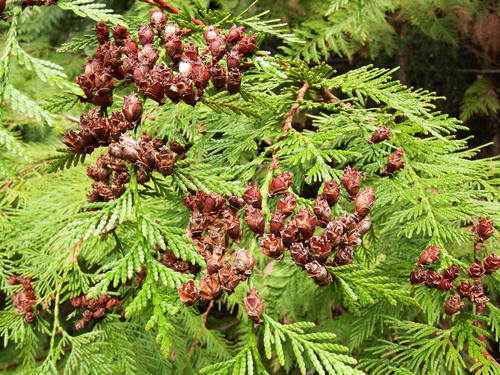
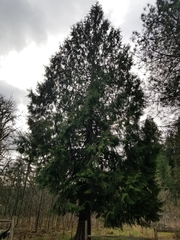
Western redcedar (Thuja plicata) is an evergreen conifer in the Cupressaceae family, native to the North American Pacific coast from southern Alaska to northern California. The largest species of Thuja, it can exceed 60 m (197 ft) in the wild and live for more than a millennium. Coastal First Nations regard it as a tree of life, using its wood for canoes and totem poles, bark for clothing and branches for basketry.
Read moreWestern redcedar, Western red cedar, Pacific red cedar, Giant cedar, Giant arborvitae and Canoe cedar
Allow a few hours of direct sun per day, preferably morning or evening.
Full sun to partial shade; tolerates woodland shade


© photo
(c) Nicholas Sly, some rights reserved (CC BY-NC), uploaded by Nicholas Sly · cc-by-nc
Deniz Wilson · cc0
Corinne Helmer · cc0
Taken Jul 1, 1994 by Daniel Barthelemy (cc-by-nc)
Taken Aug 14, 2022 by raphaelh (cc-by-sa)
Taken Jun 1, 2022 by JYCO (cc-by-sa)
Taken Aug 12, 2020 by syryll ofiana (cc-by-sa)
© copyright of the Board of Trustees of the Royal Botanic Gardens, Kew.


Global distribution
Thuja plicata is native from southern Alaska to northern California along the Cascades and coastal mountains, with a separate inland population in British Columbia and northern Idaho and Montana. It is also widely introduced in Europe as an ornamental and hedging tree.
Identity
Western redcedar (Thuja plicata Donn ex D.Don, 1824), also called giant arborvitae and canoe cedar, is an evergreen conifer in the Cupressaceae family. It is the largest Thuja, exceeding 60 m (197 ft) in old Pacific coastal forests, compared with roughly 20 m (66 ft) at most for Thuja occidentalis. 1 9
Despite the names western red cedar, Pacific red cedar and giant cedar, it is not a true cedar. Those trees belong to Cedrus in the separate Pinaceae family. The Latin epithet plicata, meaning folded in pleats, describes the flat, overlapping arrangement of its scale-like leaves along flattened sprays. 4 9
Coastal First Nations regard this species as a tree of life. Its rot-resistant wood supplied dugout canoes and totem poles, and its fibrous bark provided clothing, rope and mats. Wooden artifacts made from the tree and dating back several thousand years have been found at former coastal settlements. 9
Recognition
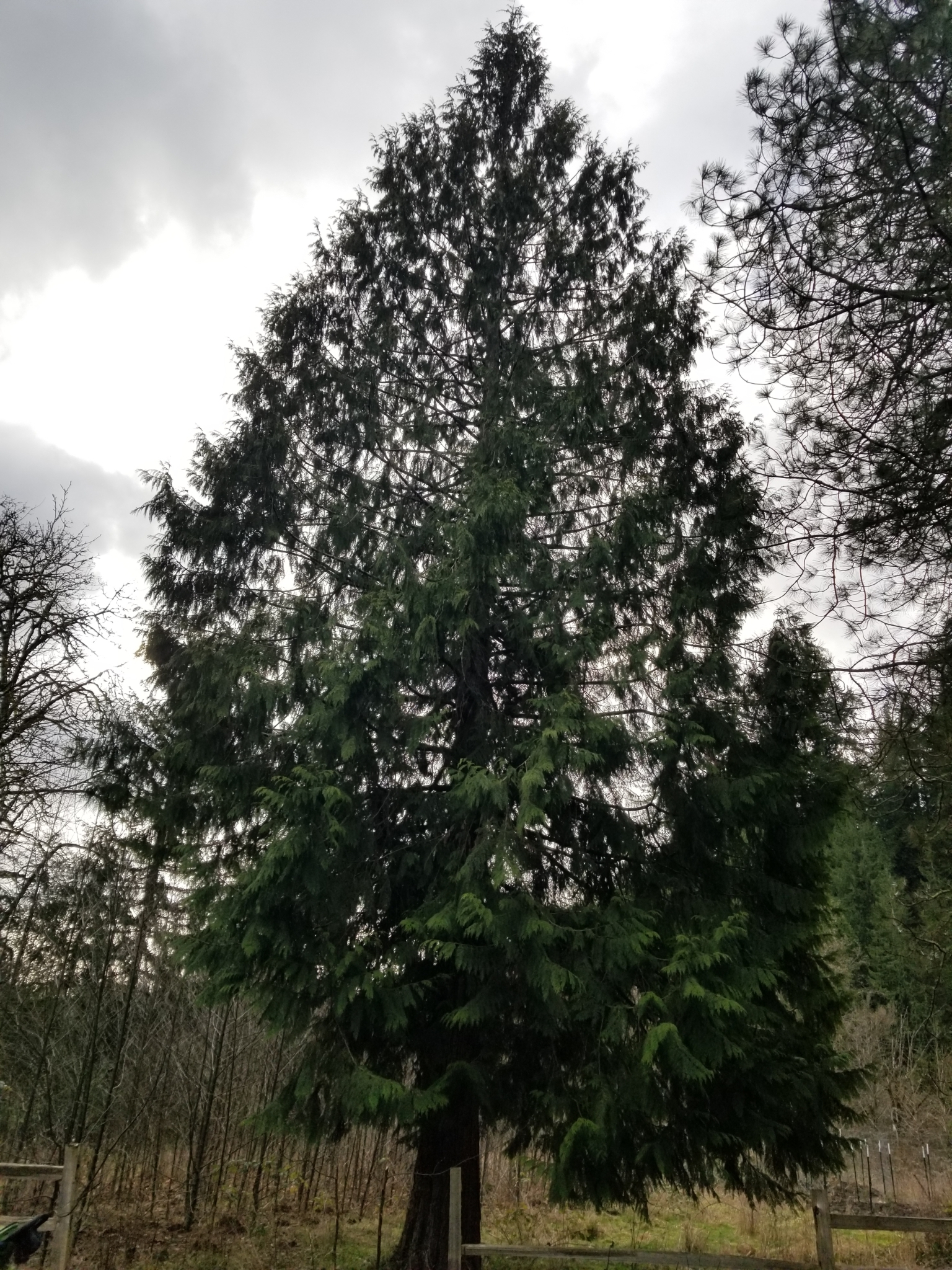
A narrow pyramidal crown rises above a trunk often swollen and fluted at the base in older trees. Cultivated trees commonly reach 20–40 m (66–131 ft), while the tallest wild specimens exceed 60 m (197 ft). Trunk diameter can approach 7 m (23 ft). 2 3
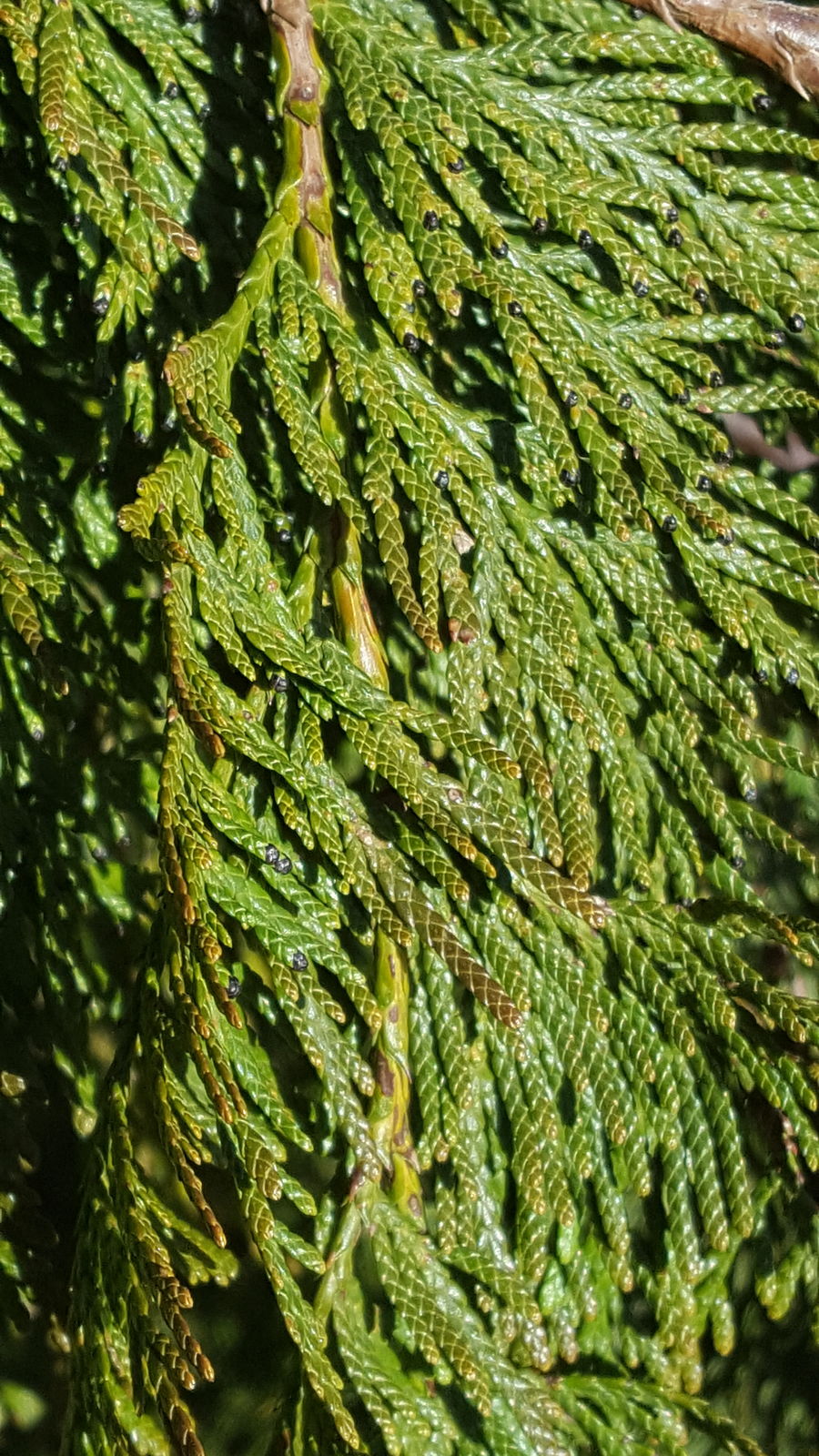
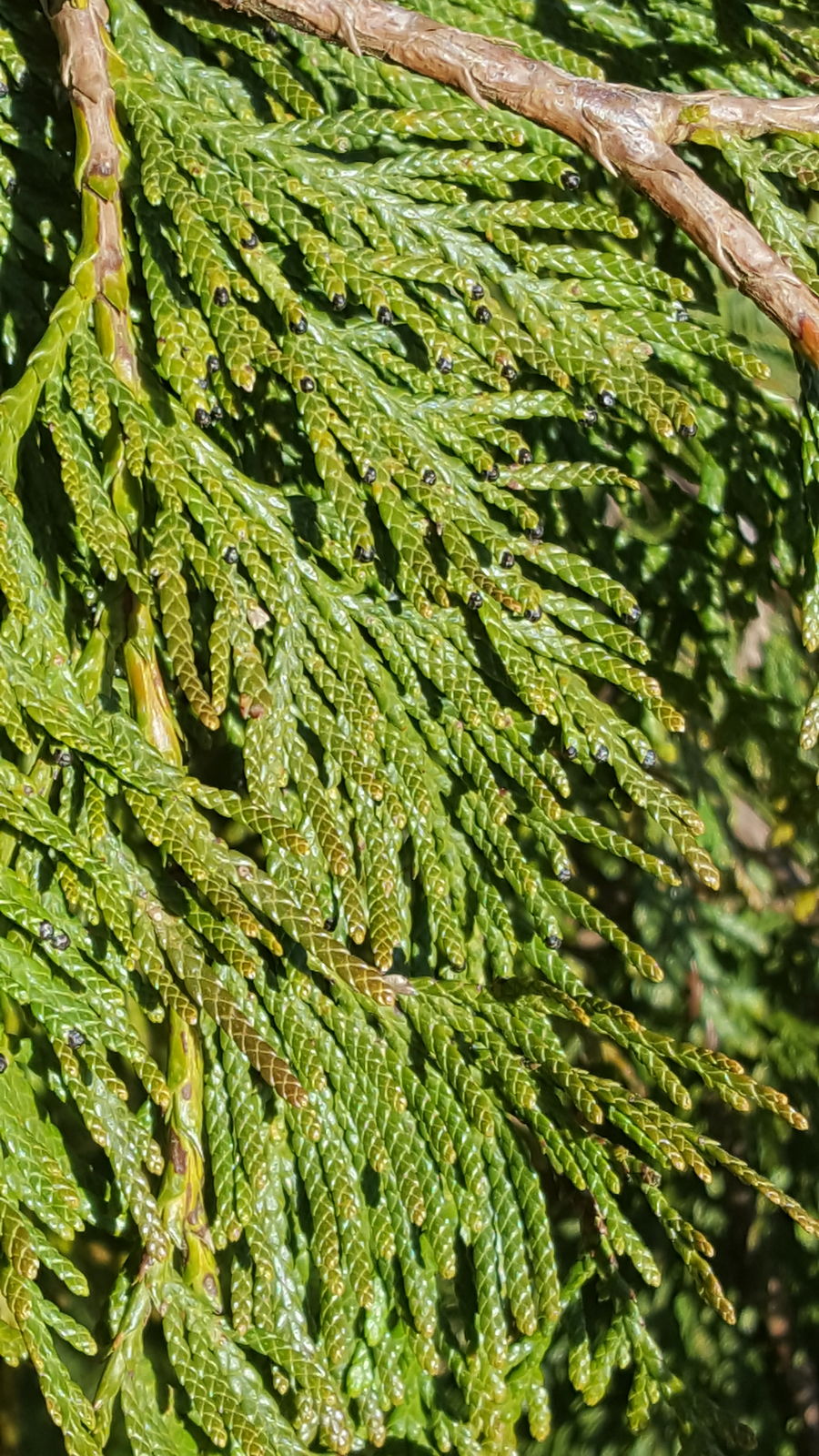
Glossy green scales release an aromatic scent when crushed. The flat sprays droop at their tips before turning slightly upward, an outline sometimes compared with joined hands. White butterfly-shaped markings underneath help distinguish the species from Thuja occidentalis, in which this pattern is much less pronounced. 4 5
Upright, rosebud-shaped cones measure around 1–1.8 cm (0.4–0.7 in) and contain only eight to twelve thin scales. Initially green, they turn light brown at maturity, about six months after spring pollination. Their elongated shape offers a useful identification feature alongside the foliage markings. 9 3
Useful taxonomy
For Western redcedar, Kew accepts Thuja plicata Donn ex D.Don, published in 1824. Several historical names remain in older botanical and horticultural literature:
- Thuja gigantea Nutt., a historical synonym
- Thuja menziesii Douglas ex Endl.
- Thuja lobbii K.Koch
- Libocedrus gigantea H.Low ex Gordon
- Thuja occidentalis var. plicata (Donn ex D.Don) Loudon ex Hoopes
Using the accepted scientific name avoids another layer of horticultural ambiguity. Many hedging cultivars, including the widely sold hybrid Green Giant, appear under a trade name that does not always state their precise botanical origin. 1 8
Other members of Thuja include the smaller, more continental-cold-tolerant Thuja occidentalis and Japanese Thuja standishii. Their scale-like foliage is similar, but among these three Western redcedar is the species associated with the mild, very wet maritime climate of the Pacific Northwest. 1
Habitat and range
From southern Alaska to northern California, Western redcedar follows the Cascades and coastal mountains. A separate inland population occurs in British Columbia and northern Idaho and Montana. Within this range it occurs in areas receiving more than 71 cm (28 in) of annual precipitation. 6 9
Shade tolerance lets seedlings establish beneath a forest canopy. The tree becomes a climax species in humid coastal forests alongside western hemlock and Douglas fir. It also occupies moist valley bottoms and streambanks, reaching about 1,100 m (3,610 ft) and extending higher on sunny slopes. 9 1
The International Union for Conservation of Nature lists the species as Least Concern. Its population is considered stable despite intensive commercial forestry across much of its native range. 7
Life cycle and reproduction
Spring winds carry pollen from small male cones to female cones on the same tree: the species is monoecious. Female cones ripen in late summer, roughly six months after pollination, changing from green to light brown before opening to release small winged seeds. 9 3
Longevity can exceed a thousand years in old Pacific coastal forests; one of the oldest verified trees reportedly reached about 1,460 years. Heartwood produces fungicidal thujaplicins, but only in older trees, leaving young plants much more vulnerable to decay. 9
Seedlings do not reproduce a cultivar such as Green Giant faithfully. Semi-ripe cuttings taken in late summer are therefore preferred for cultivar propagation, taking several weeks to several months to root. Seed propagation is reserved for the species and requires cold stratification, with emergence often uneven. 5
Uses and risks
Light, soft, straight-grained wood with remarkable decay resistance has long supplied canoes, roof shingles and fence posts, and now exterior cladding. Its density is about 30% lower than boatbuilding timbers such as mahogany, and it is also valued for guitar soundboards. 9
For Pacific coastal First Nations, the tree supplied much of everyday material life: trunks for dugout canoes and totem poles, fibrous bark for clothes, rope, mats and watertight baskets. Bark was traditionally removed in long strips by women, who sometimes climbed more than 10 m (33 ft) above ground. 9
Foliage is not classified as toxic to cats and dogs. Sawdust and bark, however, contain plicatic acid and thujone and are documented allergens. About 5% of exposed woodworkers develop occupational asthma, a risk associated with export restrictions on this timber in the United States. 9
Varieties, look-alikes and related plants
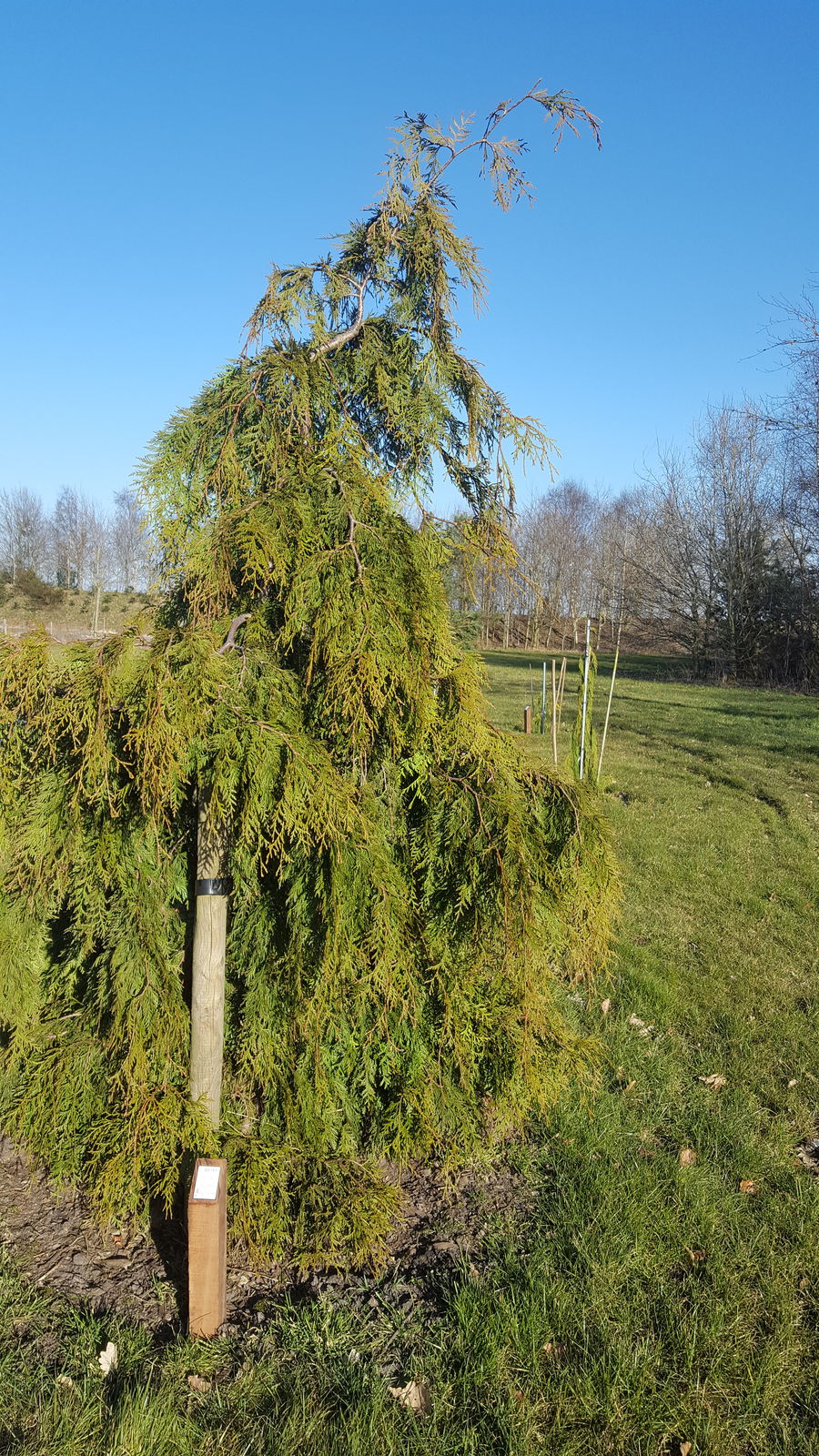
Hedging selections offer several contrasting habits. 'Atrovirens' has dense dark green foliage for compact hedges; 'Excelsa' is vigorous and suited to tall, fast screens. 'Zebrina' has creamy yellow stripes, while 'Whipcord' retains threadlike, hanging juvenile foliage. The hybrid 'Green Giant', crossed with Thuja standishii, dominates the North American market for fast-growing hedges. 3 4
The main look-alike is Thuja occidentalis, much smaller at maturity, with finer, more upright sprays and lower soil-moisture requirements. Chamaecyparis lawsoniana has similar scale-like foliage but a different crushed-leaf scent and round cones rather than rosebud-shaped ones.
Size quickly helps in the field: a tree taller than 40 m (131 ft) cannot be Thuja occidentalis, which rarely exceeds about 20 m (66 ft). Rosebud-shaped cones immediately separate Western redcedar from Chamaecyparis lawsoniana.
Main sources
- Plants of the World Online / Kew, Thuja plicata Donn ex D.Don
- Royal Horticultural Society, Thuja plicata details
- Missouri Botanical Garden Plant Finder, Thuja plicata
- NC State Extension Gardener Plant Toolbox, Thuja plicata
- Plants For A Future, Thuja plicata
- USDA PLANTS Database, Thuja plicata (THPL) plant profile
- IUCN Red List of Threatened Species, Thuja plicata assessment
- Tela Botanica / bdtfx reference database, Thuja plicata
- Wikipedia (en), Thuja plicata
Frequently asked questions
Is Western redcedar a true cedar?
No. Despite its common name, it belongs to Thuja in the Cupressaceae family. True cedars, Cedrus, belong to the separate Pinaceae family.
Is Thuja plicata toxic to cats and dogs?
The foliage is not classified as toxic to cats or dogs. Sawdust and bark contain aromatic compounds and thujone, however, and remain irritating; occupational asthma is reported among people working the wood.
How does it differ from Thuja occidentalis?
Western redcedar grows much larger, with broader, drooping sprays. Thuja occidentalis stays smaller and better tolerates continental cold, with finer, more upright foliage.
Why is Western redcedar called the First Nations tree of life?
Its light, rot-resistant wood supplied dugout canoes and totem poles, while fibrous bark provided clothing, rope and mats. This central role in Pacific coastal material life earned it that name.
How long does Western redcedar live?
Some trees exceed a thousand years in old Pacific coastal forests. One of the oldest verified individuals had a recorded age of about 1,460 years.
How is Western redcedar propagated?
Take semi-ripe cuttings in late summer to preserve cultivar characteristics reliably. The species can also be grown from seed after cold stratification.
Is Western redcedar invasive?
It is not documented as an invasive species. It is mainly deliberately planted for hedges and screens, particularly the hybrid Green Giant, without concerning naturalization reported beyond its native range.
Similar plants
If you are unsure about a plant’s toxicity, ask a botanist or veterinarian for advice.