
Large-leaved lime (Tilia platyphyllos, )
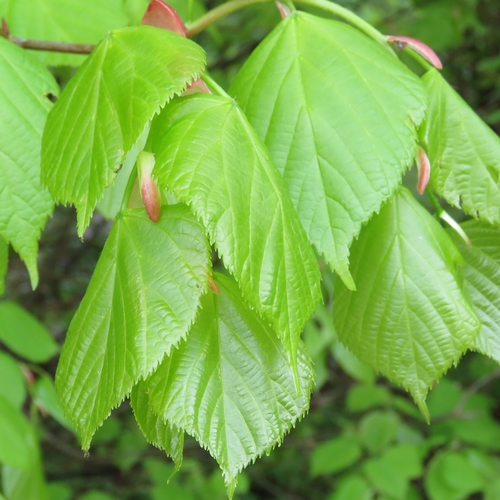
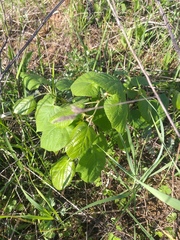
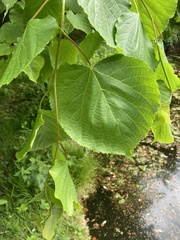
Large-leaved lime (Tilia platyphyllos Scop., 1771) is a large deciduous tree in the Malvaceae family, native to much of temperate Europe, often on limestone. Larger leaves with evenly downy undersides, earlier flowering and thick fruit with five prominent ribs distinguish it from Tilia cordata.
Read moreLarge-leaved lime, Broad-leaved lime and Large-leaved linden

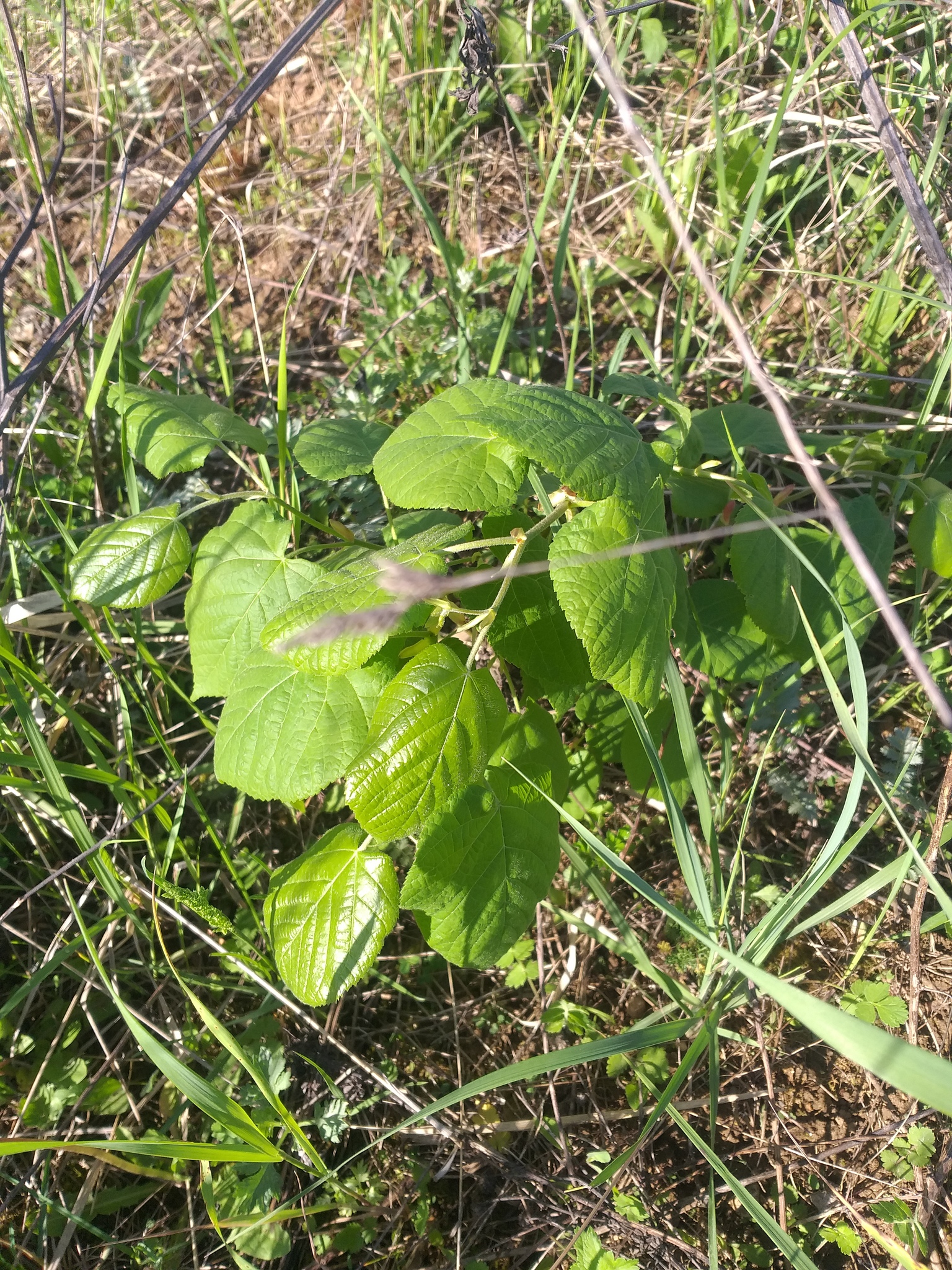



© photo
(c) Andy Slater, some rights reserved (CC BY), uploaded by Andy Slater · cc-by
Dmitriy Bochkov · cc-by
Nick Butcher · cc-by
Taken Apr 6, 2020 by laetitia vallee (cc-by-sa)
Taken Jun 2, 2021 by Ifrah Tabassum (cc-by-sa)
Taken Jun 9, 2021 by Dave Scaife (cc-by-sa)
Taken Nov 12, 2021 by Syl Fred (cc-by-sa)
Taken Dec 8, 2021 by Monteiro Henrique (cc-by-sa)
© copyright of the Board of Trustees of the Royal Botanic Gardens, Kew.




Global distribution
POWO/WCVP records Tilia platyphyllos as native from Europe to northern Iran, with five recognized subspecies differing mainly in leaf hairs. It is native to southwestern Great Britain but naturally absent from Scotland and Ireland, where it is only naturalized. In France, it occurs mainly in the eastern half of the country, the Pyrenees and Corsica, and is absent from the Mediterranean south.
- Native5
- Introduced2
- Metropolitan France
- United Kingdom
- Central Europe
- Balkans and Turkey
- Northern Iran
- Scotland
- Ireland
Hexagons: regions where the plant occurs. Green dots: native range.1
Identity
Large-leaved lime (Tilia platyphyllos Scop., 1771), also known as broad-leaved lime and large-leaved linden, was described by the Italian botanist Giovanni Antonio Scopoli from Carniola, now part of Slovenia. It is an accepted species in the genus Tilia, within the Malvaceae family. 1 6
Larger leaves and fruit with prominent ribs offer a quick way to separate this tree from small-leaved lime, Tilia cordata. The epithet platyphyllos comes from Greek platys, broad, and phyllon, leaf, directly describing that contrast. The German name Sommerlinde, summer lime, contrasts with Winterlinde, the later-flowering small-leaved lime. 2 5
Recognition
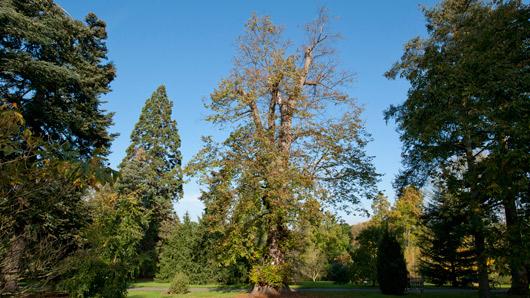
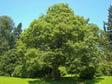
A narrowly domed crown characterizes mature Tilia platyphyllos. Open-grown trees commonly reach 20–25 m (65–80 ft), with records of up to 40 m (130 ft) in the largest specimens; Tilia cordata generally reaches 20–30 m (65–100 ft). Young twigs are reddish and slightly downy, becoming hairless with age. Smooth gray bark on young trunks develops into dark brown, fissured outer bark with a network of crossing ridges. 6 2
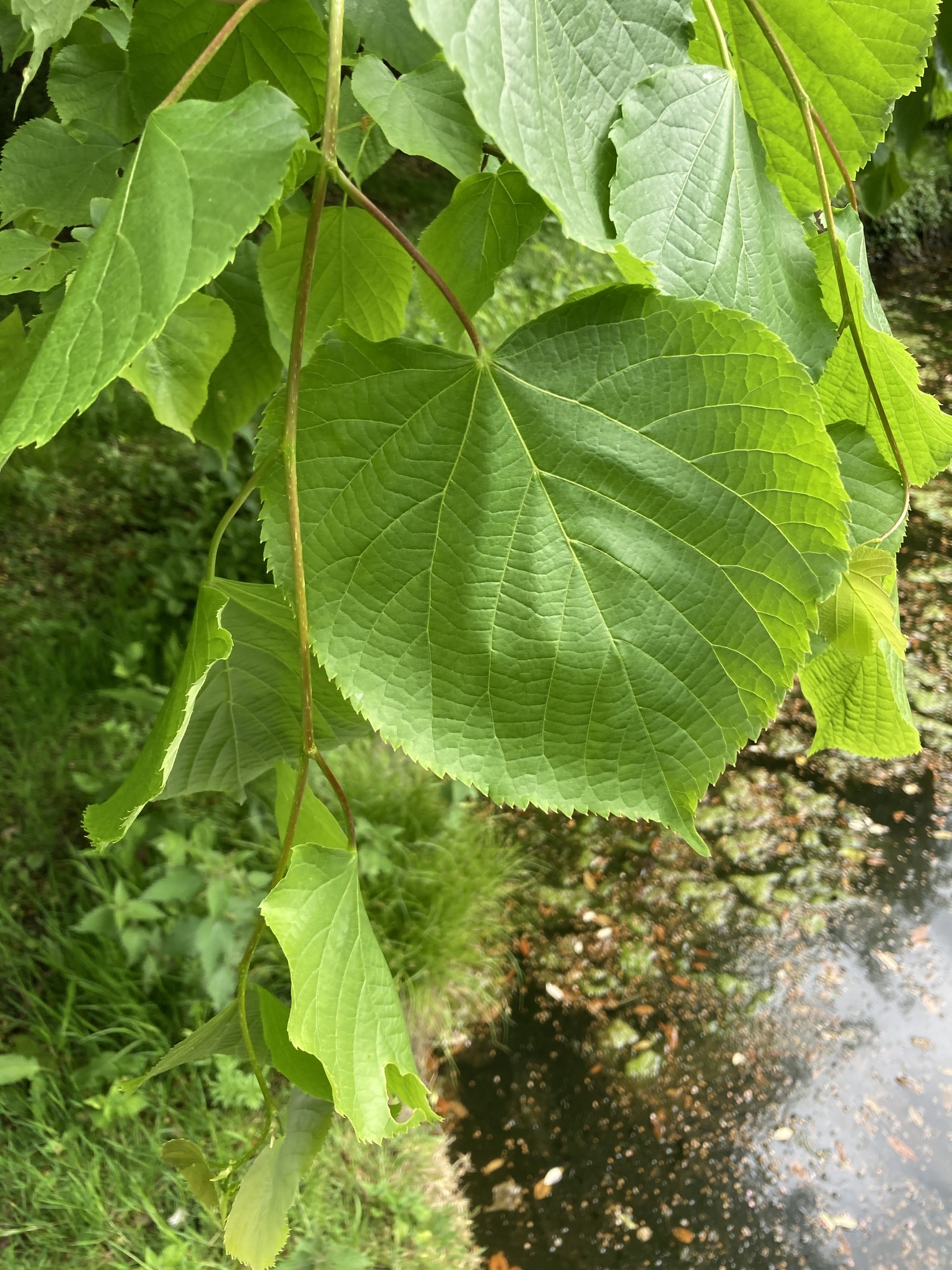
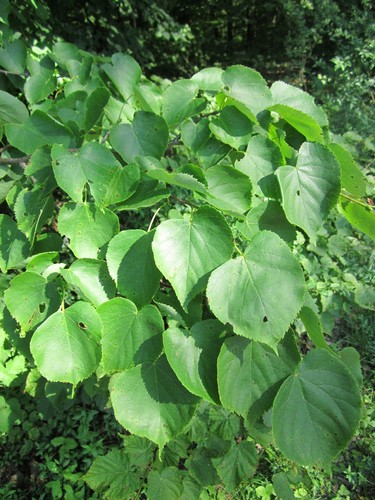
Obliquely heart-shaped leaves measure 6–9 cm (2.5–3.5 in), exceptionally 15 cm (6 in). Whitish down across the underside of the blade is the most useful identification feature, whereas Tilia cordata has only rusty or reddish-brown tufts at the vein junctions. Checking the underside is therefore more informative than judging the outline alone. 8 6
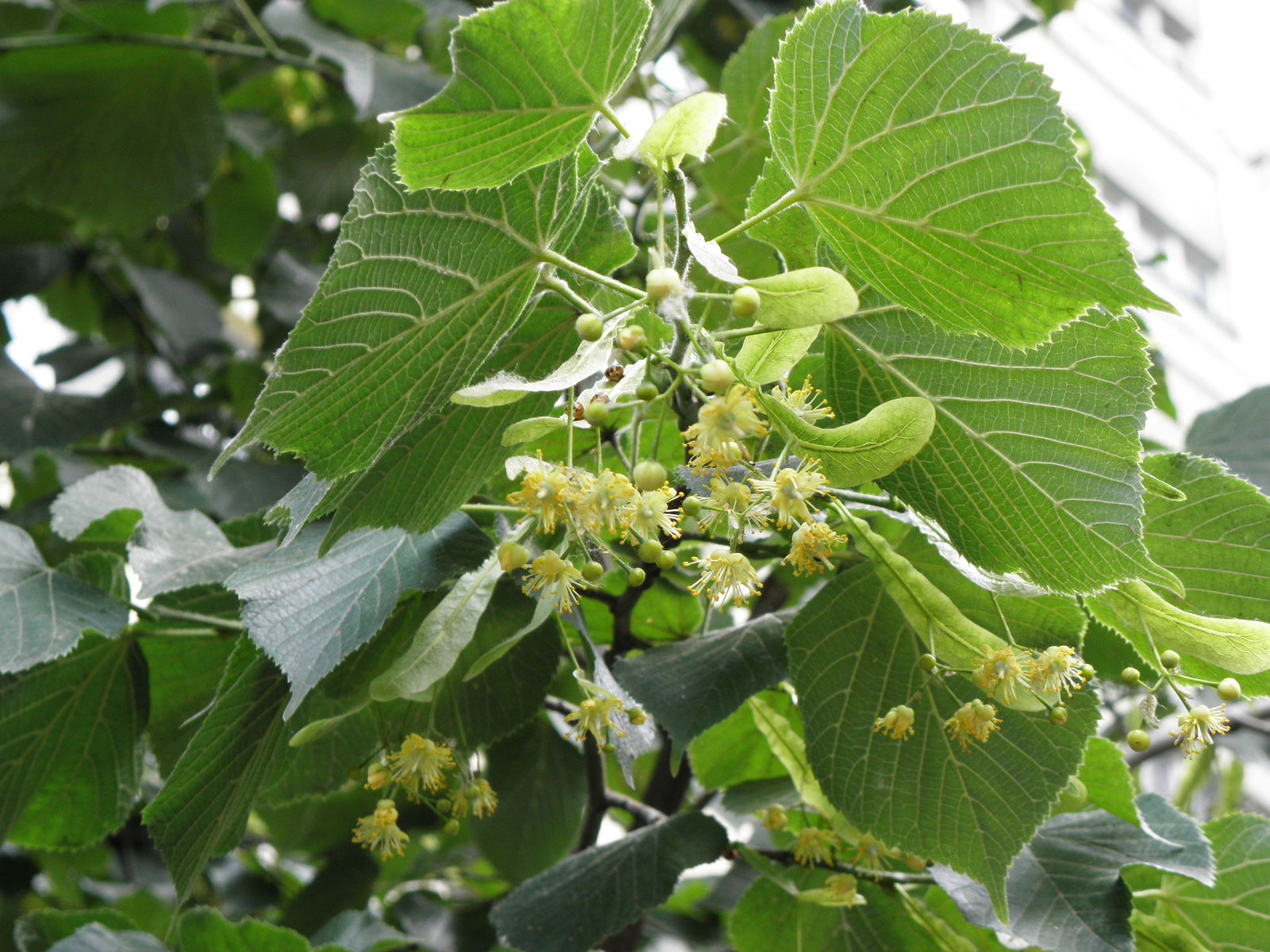
Drooping cymes contain 2–5 fragrant, pale yellow flowers, accompanied by an oblong pale green bract. Flowering precedes Tilia cordata by one or two weeks. More abundant nectar also attracts some butterflies, including the white-letter hairstreak. The round fruit has a thick, woody shell with five strongly raised ribs. Small-leaved lime instead has thin fruit without prominent ribs, a difference that remains visible long after flowering. 6 2
Taxonomy and names
Five subspecies are recognized by POWO/WCVP under the accepted name Tilia platyphyllos Scop., distinguished chiefly by leaf hairs. They comprise the typical subsp. platyphyllos; the more northern subsp. cordifolia; subsp. corinthiaca from the Balkans and Turkey; subsp. pseudorubra, hairless on both leaf surfaces; and subsp. sitnensis, endemic to Slovakia. 1
Older botanical and horticultural works use Tilia grandifolia and Tilia officinarum for this same species. These names do not replace the accepted Tilia platyphyllos. Its family is now Malvaceae, although the former family name Tiliaceae persisted for many years in horticulture. 4 6
Crosses between large-leaved and small-leaved lime produce Tilia × europaea. This hybrid is planted in urban avenues far more often than either pure parent. Abundant aphid honeydew and numerous shoots at the trunk base help reveal it, explaining why many street limes are strictly neither Tilia platyphyllos nor Tilia cordata. 6 2
Habitat and range
Temperate Europe through northern Iran forms the native range of Tilia platyphyllos in POWO/WCVP. Within Great Britain it is native to the southwest, on soils derived from limestone. It is naturally absent from Scotland and Ireland, where its occurrence is due to naturalization. 1
French populations occur chiefly in the eastern half of the country, the Pyrenees and Corsica. They reach 1,800 m (5,900 ft) in limestone mountain forests and gorges. The species is naturally absent from the Mediterranean south, where it is planted. Limestone shapes this distribution: on acid bedrock, other broadleaved trees take its place and it does not establish spontaneously. Wild stands are relatively uncommon, while hedges and avenues contain many planted trees. 8 5
Plantings beyond the native range are widespread in temperate parks and streets, including North America, where this is not a naturally occurring species. Its dual presence as a wild limestone tree and an urban ornamental contributes to confusion with Tilia cordata and the hybrid Tilia × europaea, which better tolerates compacted urban soils. 6 2
History and culture
Neolithic rope makers could obtain strong cordage by notching the bark near the base of a young lime, pulling it free and retting it for about a month. Soaking released tough fibers that could then be twisted into rope. This use predates the tree’s ornamental role in Europe by a considerable span of time. 8
Village life in Gaul traditionally centered on a lime tree. Among Germanic peoples, it was often revered even more than oak: judicial assemblies met beneath a justice lime, which frequently also served as a gathering place and dance floor. More than 850 place names in western Germany recall this judicial tradition. 8
Uses and risks
Dried-flower tea has a longer documented history in France than other uses of Tilia platyphyllos, ahead of honey and spring sap. The herbal sources consulted describe a light infusion as sedative, while warning that an overly strong or long-brewed infusion can instead cause insomnia. Beekeepers also value lime honey from the early, nectar-rich flowering. 8 4
Young leaves are eaten raw in salads for their slightly mucilaginous texture. Sap collected in spring can be drunk fresh or concentrated into syrup. The sources consulted record no known toxicity to humans, cats or dogs, distinguishing this tree from many ornamentals with poisonous parts. 4 8
Soft, pale lime wood is easy to work and valued for carving. However, it rots readily and eventually breaks when left exposed to weather. Its poor durability outdoors explains why traditional uses concentrated on indoor objects rather than structural timber. 8
Varieties, look-alikes and related plants
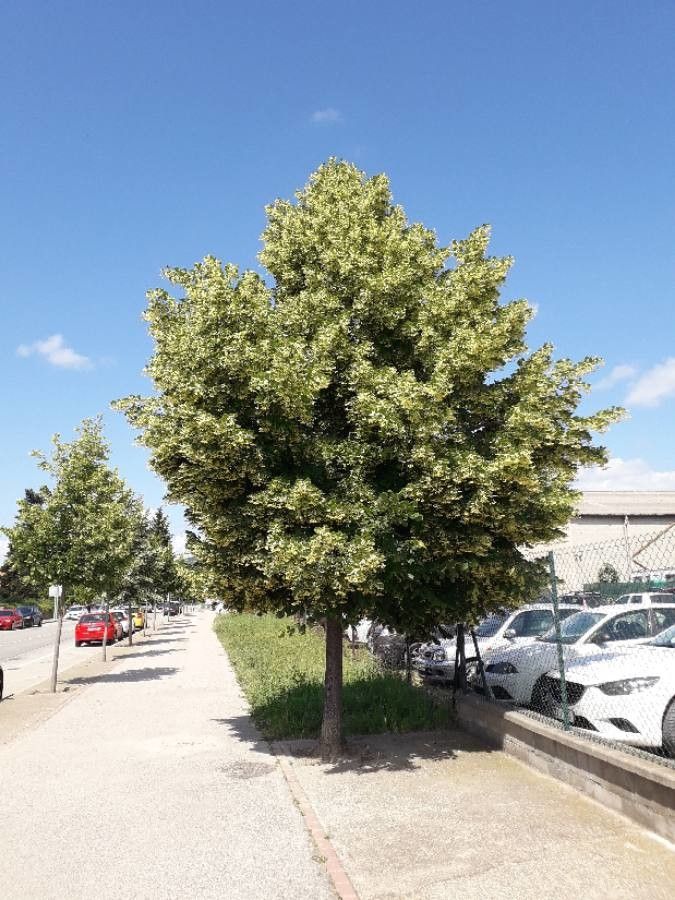
Cultivars of large-leaved lime include 'Rubra', whose bright red young winter twigs earned it the RHS Award of Garden Merit. Nurseries often pollard it to display the colored growth. 'Aurea' has golden-tinted foliage, 'Laciniata' has deeply divided leaf blades, and 'Örebro' offers a narrow columnar crown useful where avenue space is limited. 3 6
Small-leaved lime, Tilia cordata, causes the most frequent confusion. Its leaves are smaller, rusty hair tufts are confined to vein junctions, flowering is later and the fruit is thin without prominent ribs. Many street trees are actually Tilia × europaea, recognizable by often abundant aphid honeydew and numerous basal shoots. Neither pure parent combines those two traits as conspicuously. 6 2
The sacred Garoé tree of the Canary Islands was long described as a lime in popular accounts, supposedly producing water during drought years. Botanical identification places it instead in Ocotea foetens, a laurel endemic to the Canary Islands. It is unrelated to Tilia platyphyllos, despite the persistent story. 8
Main sources
- Plants of the World Online / Kew, Tilia platyphyllos Scop.
- Royal Horticultural Society, Tilia platyphyllos - large-leaved lime
- Royal Horticultural Society, Tilia platyphyllos 'Rubra' - red-twigged lime
- Plants For A Future, Tilia platyphyllos database entry
- Tela Botanica / eFlore, Tilia platyphyllos overview
- Trees and Shrubs Online, Tilia platyphyllos
- USDA GRIN Taxonomy, Tilia platyphyllos
- French Wikipedia, large-leaved lime, history and legend section
Frequently asked questions
Is large-leaved lime toxic?
No known toxicity to humans, cats or dogs is recorded in the sources consulted. Young leaves are eaten raw, and dried flowers are used for tea, a documented traditional use.
How can I distinguish Tilia platyphyllos from Tilia cordata?
Large-leaved lime has larger leaves with evenly downy undersides, earlier flowering and thick fruit with five very prominent ribs. Tilia cordata has smaller leaves, rusty hair tufts limited to vein junctions and thin fruit without clear ribs.
Are urban lime trees always Tilia platyphyllos?
No. Many avenues contain Tilia × europaea, the natural hybrid between Tilia platyphyllos and Tilia cordata. Abundant honeydew and numerous basal shoots help identify it.
Can large-leaved lime flowers be used for tea?
Yes, this is the longest documented traditional use in France. Freshly dried flowers make a light, sedative infusion; an overly strong or long-brewed infusion may instead cause insomnia.
Is large-leaved lime native to France?
Yes, but only in part of the country. POWO/WCVP includes France in the native range. The tree occurs mainly in eastern France, the Pyrenees and Corsica; it is naturally absent from the Mediterranean south, where it is chiefly planted.
Why are lime trees associated with village justice?
Among Germanic peoples, judicial assemblies met beneath a lime tree in the village center. This documented justice-tree tradition often overlapped with its use as a meeting place or dance floor.
Similar plants
If you are unsure about a plant’s toxicity, ask a botanist or veterinarian for advice.