
Star jasmine (Trachelospermum jasminoides, )
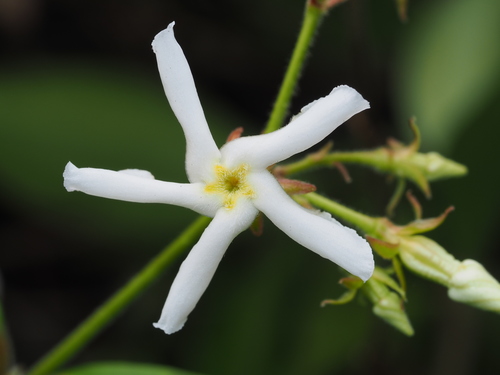
Star jasmine (Trachelospermum jasminoides (Lindl.) Lem., 1851) is an evergreen vine in the Apocynaceae family, native to eastern Asia. It climbs by twining around a support, with glossy foliage and strongly fragrant white flowers covering walls, trellises and facades in late spring.
Read moreStar jasmine, Confederate jasmine, Confederate jessamine and Chinese star jasmine
Allow a few hours of direct sun per day, preferably morning or evening.
Full sun to bright partial shade, according to RHS and Missouri Botanical Garden
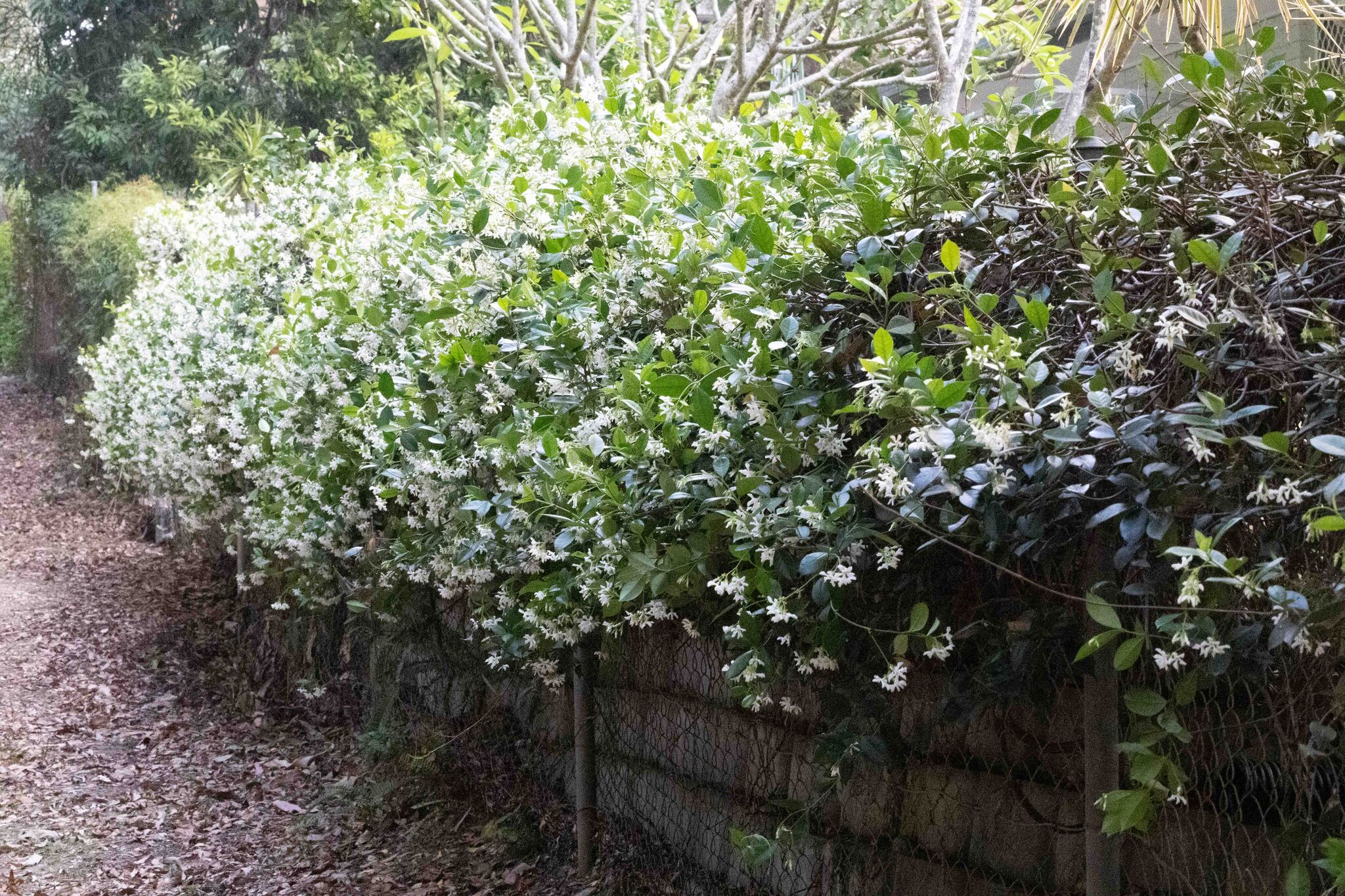
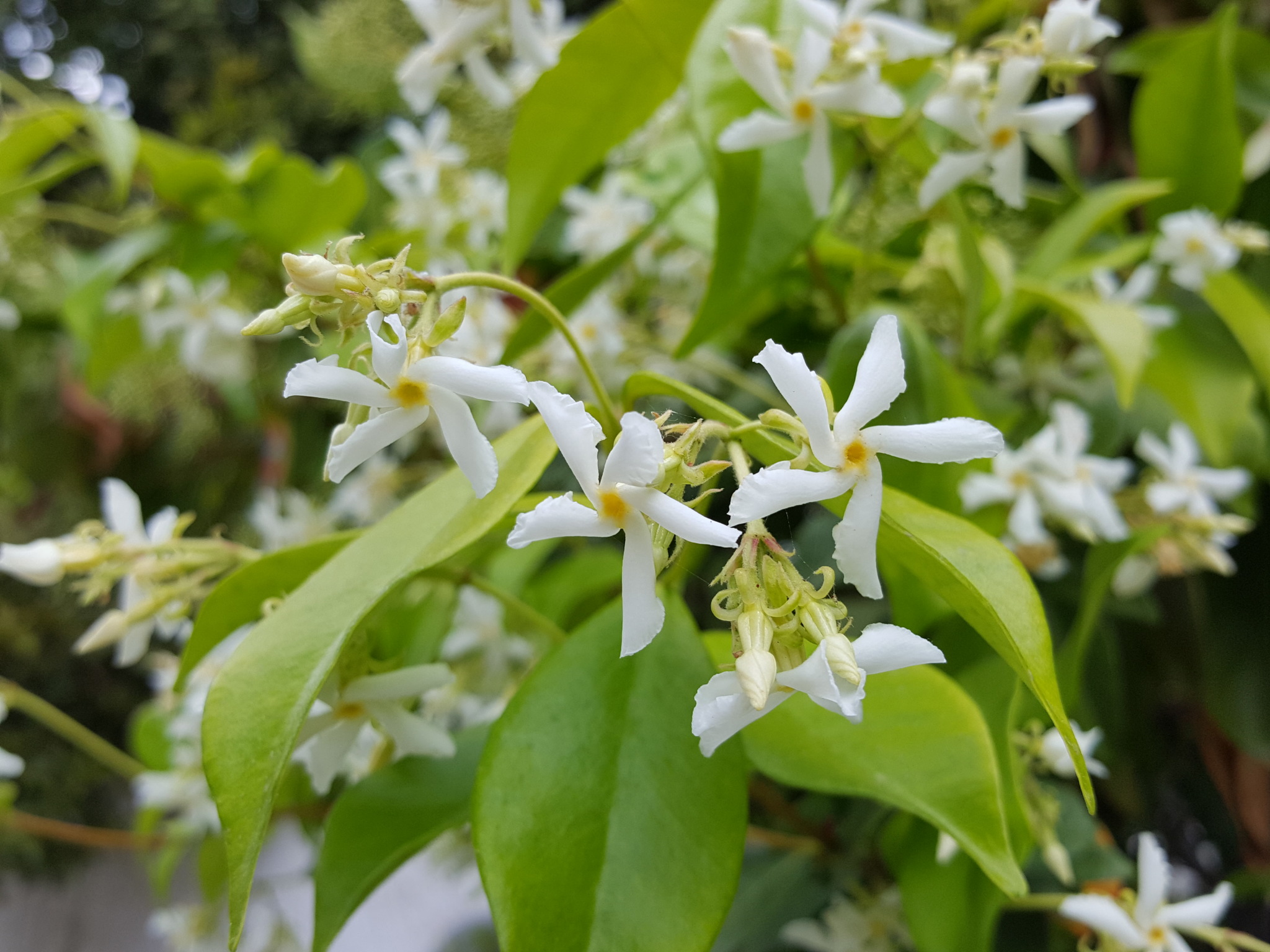


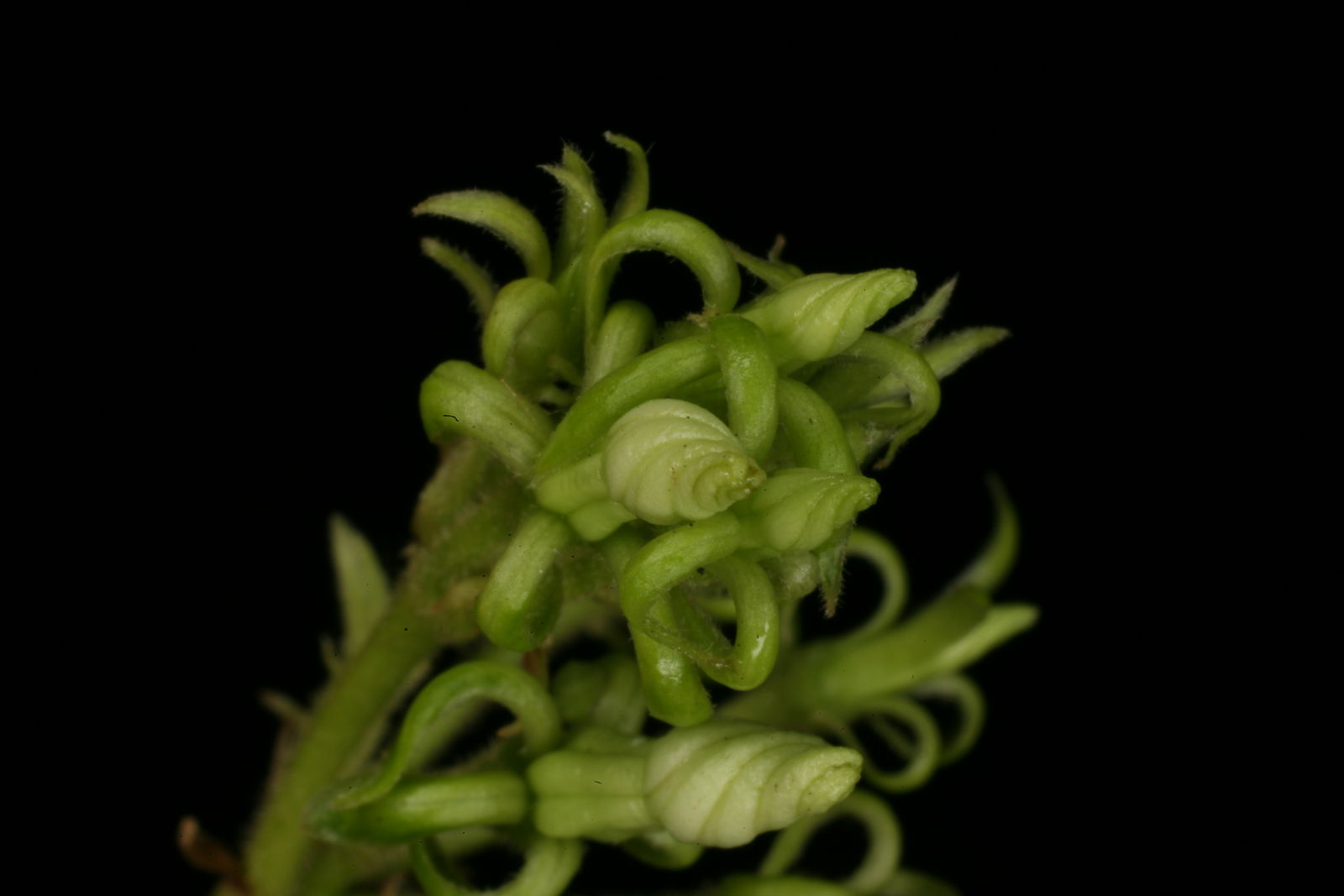
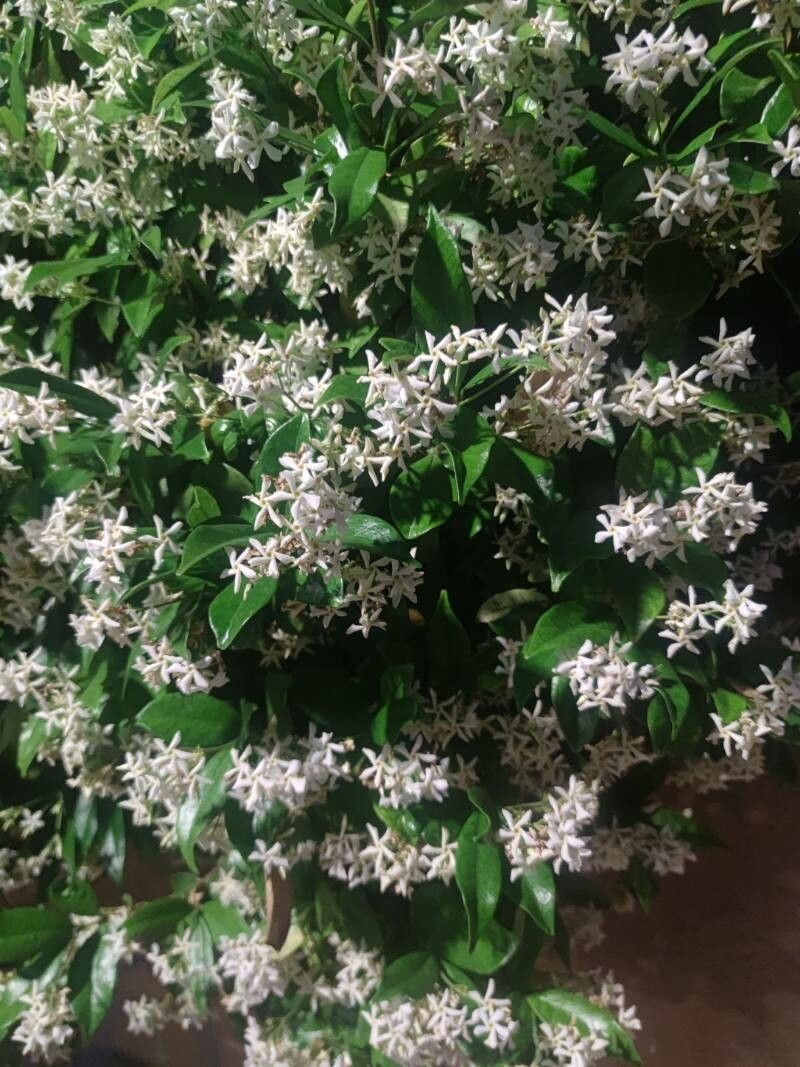
© photo
(c) 羅忠良, some rights reserved (CC BY-NC), uploaded by 羅忠良 · cc-by-nc
Lewis · CC BY-NC
Todd Boland · cc-by
Taken May 21, 2022 by huy HO (cc-by-sa)
Taken Jun 18, 2021 by Boumlik Messaïli (cc-by-sa)
Taken May 24, 2022 by A. M. Espinosa Deliria (cc-by-sa)
Taken Aug 4, 2019 by Peanut (cc-by-sa)
Taken Feb 6, 2021 by faycal salim (cc-by-sa)
© copyright of the Board of Trustees of the Royal Botanic Gardens, Kew.




Global distribution
WCVP places the native range of Trachelospermum jasminoides in south-central and southern China, southern Japan and south to Vietnam. It is widely cultivated beyond that range, especially in Mediterranean climates and the southern United States, where the name Confederate jasmine remains common.
- Native4
- Introduced1
- China
- Korea
- Japan
- Vietnam
- Southern United States
Hexagons: regions where the plant occurs. Green dots: native range.1
Identity
Star jasmine (Trachelospermum jasminoides (Lindl.) Lem., 1851) is an evergreen vine in the genus Trachelospermum, family Apocynaceae. Despite its name, it is unrelated to true jasmines in the genus Jasminum, which belong to Oleaceae. These separate families produce remarkably similar fragrances. The ASPCA lists star jasmine as non-toxic to dogs, cats and horses, a point often checked before planting near pets. 1 7 6
John Lindley, a British botanist, described the species as Rhyncospermum jasminoides in 1846. His material came from plants collected by Robert Fortune near Shanghai and sent to London in 1844. Charles Lemaire transferred it to Trachelospermum in 1851, five years after the first description, establishing the scientific name still used today. 7 2
The Greek words trákhêlos (neck) and spérma (seed) underlie the genus name, referring to the elongated, narrowed seeds with their tuft of hairs. The epithet jasminoides describes resemblance to jasmine in scent and flower shape, rather than botanical kinship. 7
Recognition
Twining stems allow star jasmine to climb a thin support without tendrils or clinging holdfasts. Without something to grasp, stems trail over the ground and form dense groundcover. Woody stems commonly reach 1–6 m (3–20 ft), with established plants sometimes exceeding 8–10 m (26–33 ft) according to the RHS. Opposite, leathery leaves are oval to narrowly elliptical and 2–10 cm (0.8–4 in) long. Their glossy dark green summer color often becomes bronze after a cold winter. 3 7
Cutting a stem or leaf releases white, milky latex, a feature shared with many Apocynaceae. Fragrant white flowers about 2.5 cm (1 in) across appear in small cymes in leaf axils or at stem tips. Missouri Botanical Garden describes a late-spring peak followed by scattered summer flowers. 7 4
Five strongly twisted lobes form each flower, like a propeller turning counterclockwise, creating the star pattern behind the common name. Fruits are rarely seen in cultivation: paired, elongated follicles open to release seeds with long, silky tufts. 7
Useful taxonomy
The accepted name in Plants of the World Online is Trachelospermum jasminoides (Lindl.) Lem. Its basionym is Rhyncospermum jasminoides Lindl., published in 1846. The most frequent horticultural confusion involves Trachelospermum asiaticum, a related species with smaller, less fragrant, often creamy-yellow flowers and generally greater cold hardiness. 1 2
Regional floras describe several botanical varieties, including Trachelospermum jasminoides var. pubescens Makino, described in Japan for its hairier shoots. These variations do not change the basic growing requirements: support, light and well-drained soil. 7
A scientific binomial provides a more dependable reference than a sales label. Common names vary across countries and sellers, while the Latin name remains fixed. A balcony plant sold simply as “star jasmine” might be Trachelospermum jasminoides or a true Jasminum, with different needs and hardiness. 1
Habitat and range
For star jasmine, WCVP places the native range in south-central and southern China, southern Japan, Korea and south to Vietnam. There it grows at forest edges, naturally climbing tree trunks and rocky faces. 1 7
In China, the name luoshi, “network on stone,” describes the close mesh of stems that covers rocks and walls. This capacity to cling without deep roots helps explain its widespread urban use to green facades with little ground-level footprint. 7
Beyond its native range, Trachelospermum jasminoides is widely grown in Mediterranean climates and the southern United States, where Confederate jasmine and Confederate jessamine are common names. It is used on walls, as dense groundcover or on trellises, rather than as a plant extensively naturalized in forests. 4 3
Life cycle and flowering
Whether potted or planted in the ground, star jasmine spends its first season mainly establishing roots. Growth remains slow until stems are guided toward a support. Once attached, it gradually covers a wall or trellis over two to four years, depending on climate and watering. 5 3
Late spring is the main flowering season, often peaking in May and June in suitable Northern Hemisphere climates, with scattered flowers continuing into summer. Fragrant blooms attract pollinating insects, offering a modest ecological benefit alongside the plant’s chiefly ornamental role. 7 4
Semi-ripe cuttings taken in late summer and layering are the main methods of propagation. Stems naturally tend to root where they touch the ground. Seed propagation is possible, but a seedling takes much longer to cover a support than a cutting or layer with an already formed root system. 5
Uses and risks
Walls, trellises, pergolas and fences are the main ornamental settings for star jasmine in mild climates; it also forms dense groundcover or a specimen planting. It tolerates calcareous soil, sand and loam provided drainage is good. 3 4
Traditional Chinese herbal medicine uses leafy stems for rheumatic pain, pharyngitis and sciatica, with reported analgesic and antibacterial properties. These uses belong to a local pharmacopoeia and do not replace medical advice for someone growing it as an ornamental. 5 7
On animal safety, the ASPCA lists Trachelospermum jasminoides as non-toxic to dogs, cats and horses. The documented contact risk comes from milky latex released by cut stems or leaves, which can irritate skin or eyes, as in many Apocynaceae. 6 7
Cold is the main limit to cultivation. Above-ground growth may freeze at −7 °C (19 °F), while a sheltered rootstock can withstand brief spells around −10 to −15 °C (14 to 5 °F) and regrow the following spring. 7
Varieties, look-alikes and related plants
Variegated cultivars such as Variegatum and Tricolor are selected foliage forms rather than separate species. They are often somewhat less vigorous than the botanical type. Star of Toscana and Waterwheel are horticultural selections grown for their habit or regular flowering. 3
Among related plants, Trachelospermum asiaticum is the most frequent look-alike, with smaller, less fragrant flowers but generally greater hardiness. Confusion also arises with true Jasminum jasmines, which share the fragrance but neither the botanical family nor fruit structure. 1 7
A shared wall may carry star jasmine alongside Clematis armandi or Jasminum officinale. All three are fragrant evergreen or semi-evergreen climbers, but they flower at different times and have different pruning needs. Mixing up their schedules can remove already formed buds and reduce the next flowering.
Main sources
- Plants of the World Online / Kew, Trachelospermum jasminoides (Lindl.) Lem.
- International Plant Names Index, Trachelospermum jasminoides
- Royal Horticultural Society, Trachelospermum jasminoides - star jasmine
- Missouri Botanical Garden, Trachelospermum jasminoides
- Plants For A Future, Trachelospermum jasminoides
- ASPCA, star jasmine toxicity entry
- Wikipedia (French), Trachelospermum jasminoides
- Wikidata, Trachelospermum jasminoides
Frequently asked questions
Is star jasmine a true jasmine?
No. Star jasmine belongs to Apocynaceae, while true jasmines in the genus Jasminum belong to Oleaceae. The common name refers only to the similar fragrance and flower shape.
Is star jasmine toxic to pets?
The ASPCA lists Trachelospermum jasminoides as non-toxic to dogs, cats and horses. Its milky sap can nevertheless irritate skin or eyes on contact, as in other Apocynaceae.
What is the lowest temperature star jasmine can tolerate?
In a sheltered position, the plant tolerates brief cold spells around −10 to −15 °C (14 to 5 °F). Above-ground foliage may be killed at −7 °C (19 °F), with possible regrowth from the base.
How can I distinguish star jasmine from Trachelospermum asiaticum?
Trachelospermum asiaticum has smaller, less fragrant flowers, often tinged creamy yellow, and tolerates colder conditions than Trachelospermum jasminoides.
Can star jasmine be eaten or brewed as tea?
No ordinary food use is recommended. Leafy stems are used in traditional Chinese herbal medicine for rheumatic pain; this does not replace medical advice.
Does star jasmine need a support?
Yes, to climb. It twines around trellises or thin wire by itself; without support, it trails along the ground and forms dense groundcover.
Similar plants
If you are unsure about a plant’s toxicity, ask a botanist or veterinarian for advice.