
Lesser trefoil (Trifolium dubium, )
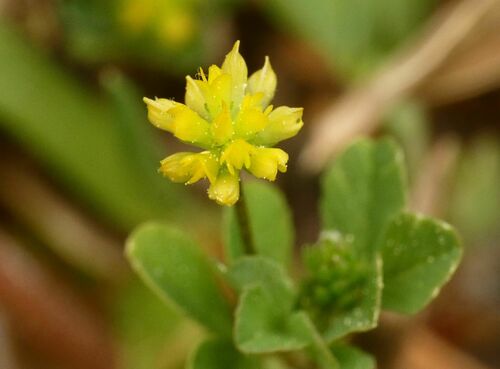
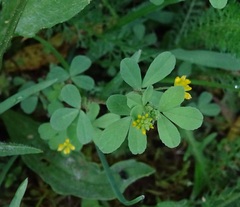
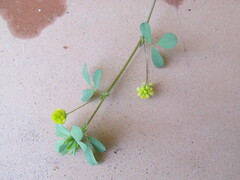
Lesser trefoil (Trifolium dubium) is a small annual legume in the Fabaceae family, widespread across Europe, including France. It forms low patches with tiny yellow flowers in lawns, meadows and roadsides. This nontoxic nitrogen-fixing plant is one of the main candidates for the traditional Irish shamrock.
Read moreLesser trefoil, Little hop clover, Small hop clover, Yellow suckling clover, Suckling clover and Lesser hop trefoil
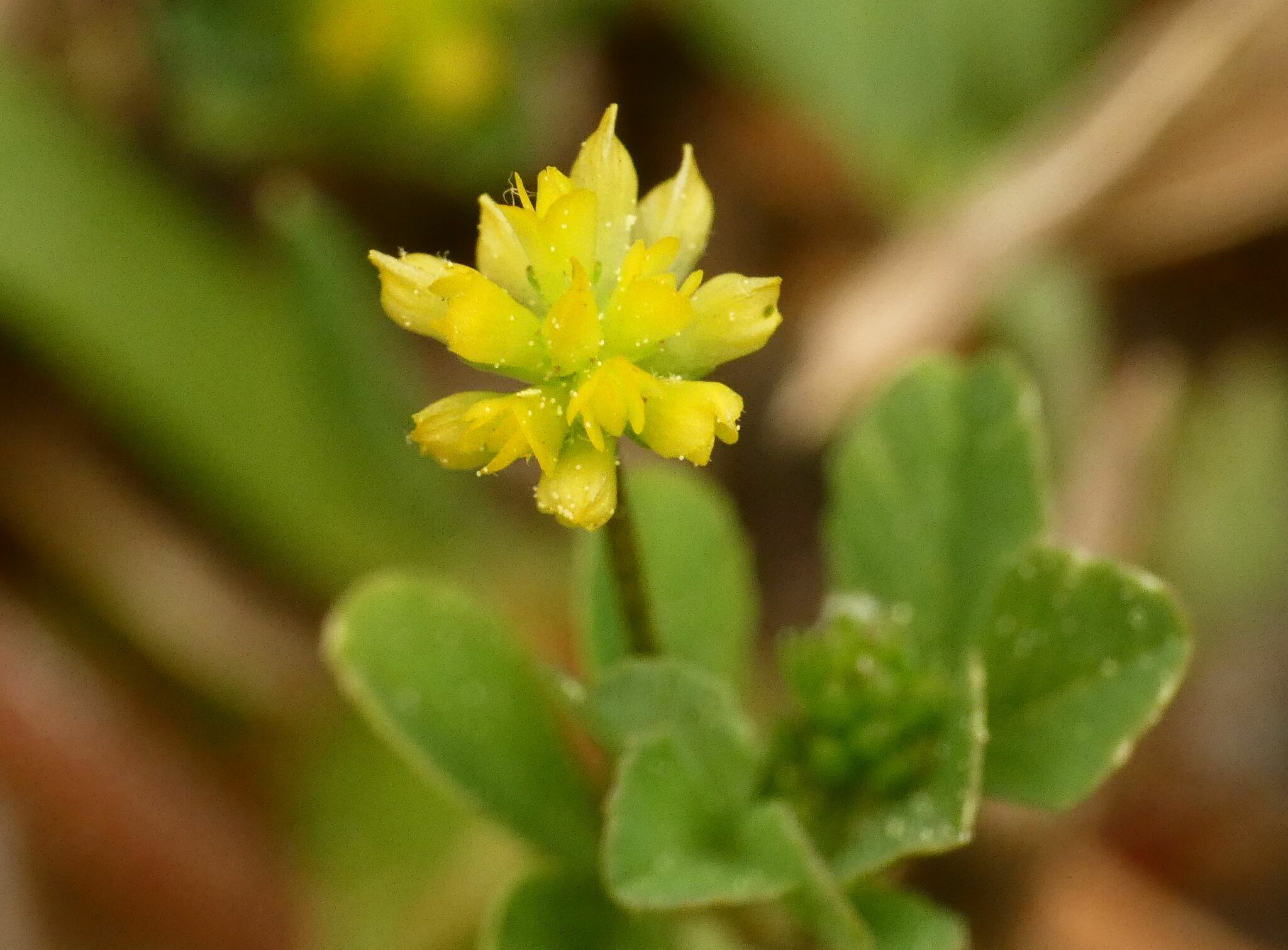


© photo
(c) davidenrique, some rights reserved (CC BY-NC-SA), uploaded by davidenrique · cc-by-nc-sa
Y. Liu · cc-by
zebedeugalinha · cc-by
Taken May 9, 2014 by Tela Botanica − Dominique REMAUD (cc-by-sa)
Taken May 3, 2014 by Tela Botanica − Françoise CARLE (cc-by-sa)
Taken May 31, 1853 by Tela Botanica − Herbier PONTARLIER-MARICHAL (cc-by-sa)
Taken Jul 15, 2021 by Alice ha (cc-by-sa)
© copyright of the Board of Trustees of the Royal Botanic Gardens, Kew.


Global distribution
The native range extends from Macaronesia and Europe to the Mediterranean basin and Caucasus. Very common in mainland France, lesser trefoil has naturalized widely outside this range, especially in North America, Australia and New Zealand. These introduced populations are distinct from its native range.
- Native5
- Introduced3
- Mainland France
- United Kingdom
- Ireland
- Spain
- Germany
- United States
- Australia
- New Zealand
Hexagons: regions where the plant occurs. Green dots: native range.1
Identity
Lesser trefoil (Trifolium dubium Sibth., 1794), also called suckling clover or lesser hop trefoil, is a small annual legume in the genus Trifolium, family Fabaceae. The epithet dubium, meaning doubtful, reflects the difficulty of distinguishing it from other small yellow-flowered clovers and black medic sharing the same lawns. 1 2
Lawns, meadows and roadsides support this modest wild plant, rather than an ornamental selection. Its tiny yellow heads and slender stems make it easy to overlook, yet it is one of the leading candidates for the shamrock, the clover associated with Ireland. 2 4
Recognition
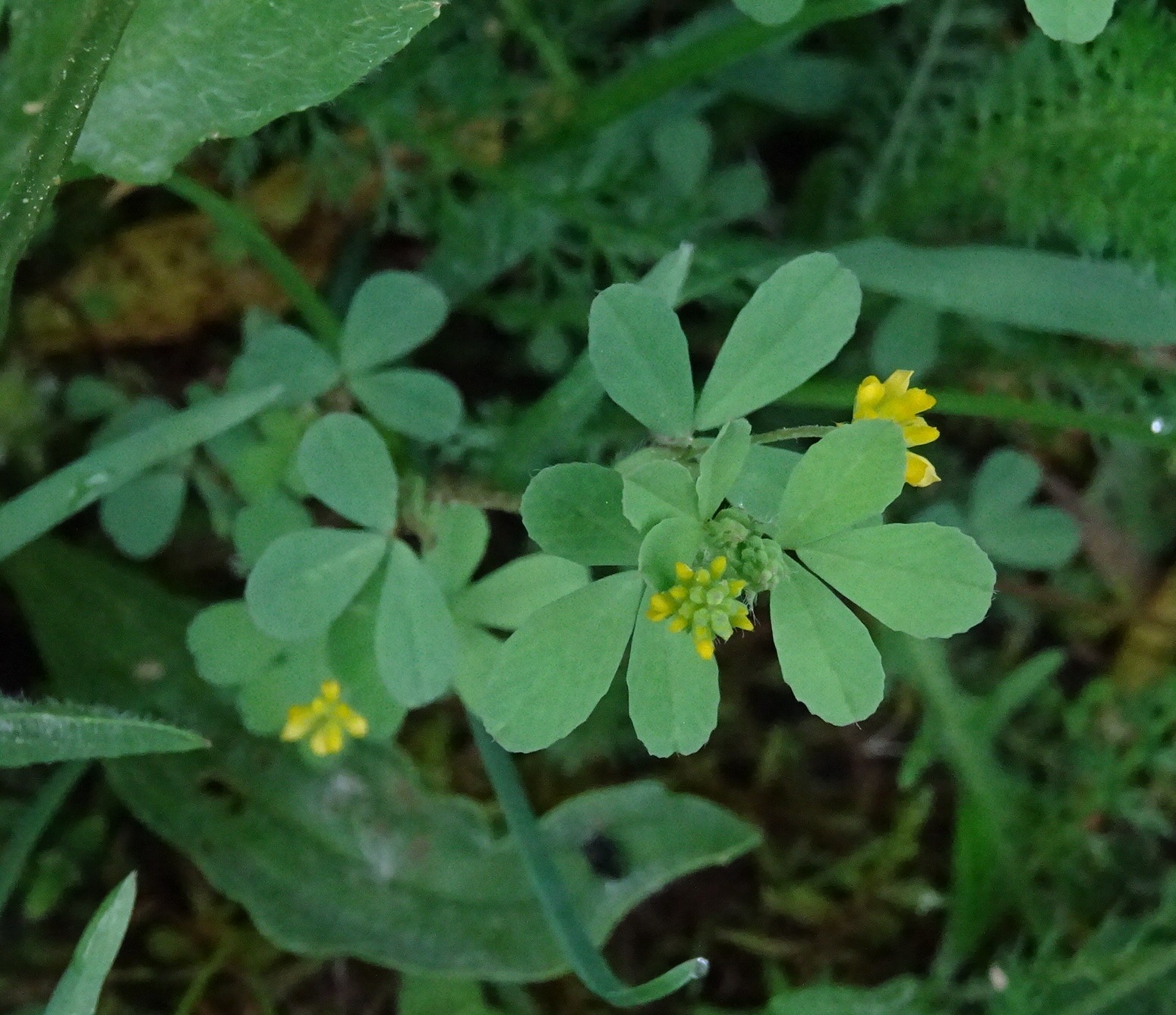
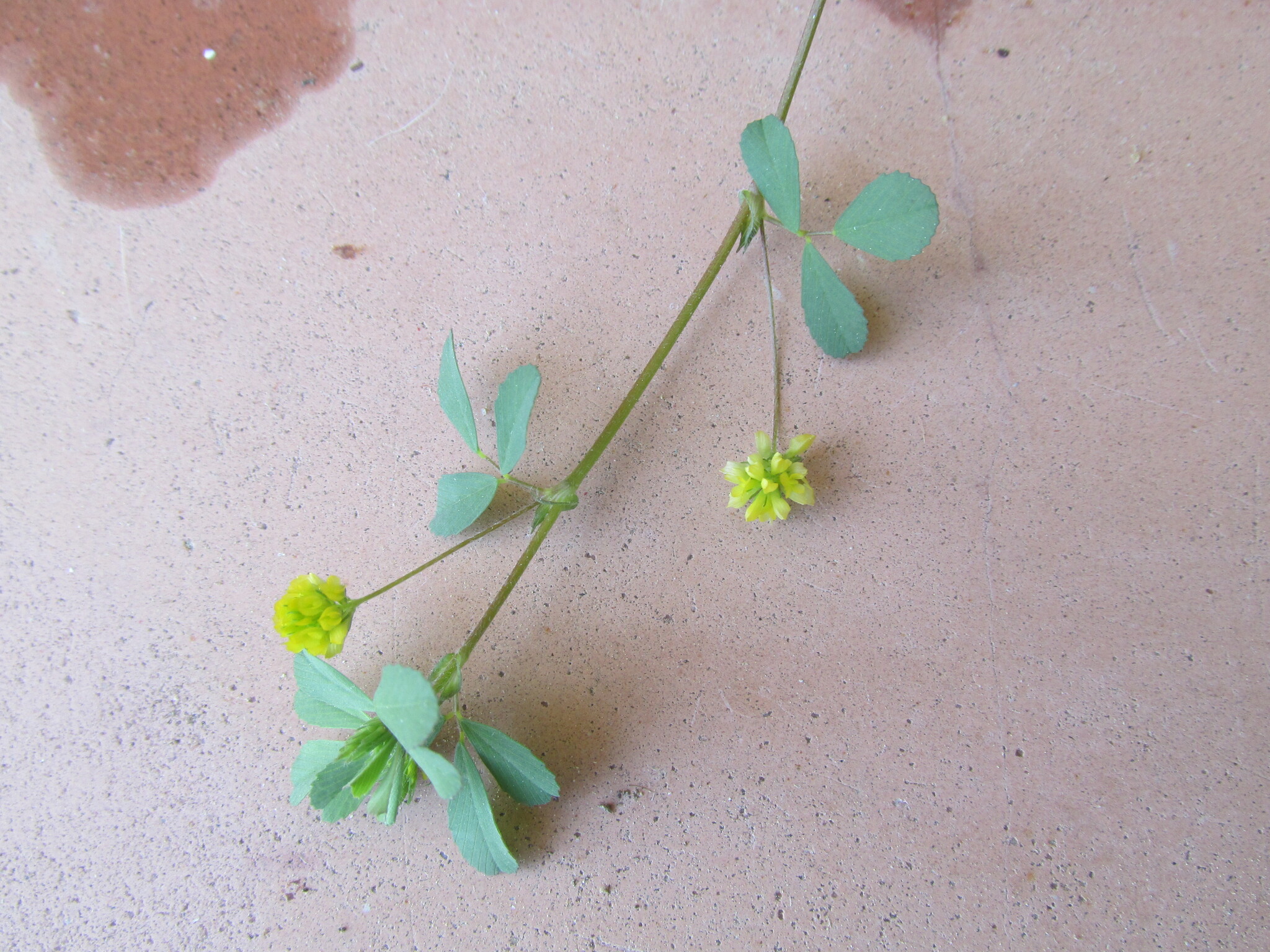
Slender stems initially lie along the ground before turning upward, giving Trifolium dubium a height of 10–40 cm (4–16 in). This annual has trifoliate leaves with obovate leaflets 0.8–1.1 cm (0.3–0.4 in) long. The central leaflet has a short stalk, distinguishing it from the two stalkless lateral leaflets. 4 5
Flower heads offer the most useful detail: each yellow rounded head measures 8–9 mm (about 0.3 in) and contains 3–20 tiny flowers, with corollas about 4 mm (0.16 in) long. Fading flowers turn brown but stay attached over the pod, giving older heads their characteristic scorched appearance. 5 4
A minute, single-seeded pod sits beneath each faded flower. In the temperate Northern Hemisphere, flowering extends from May to October in short lawns and moist meadows, where the plant tolerates mowing and trampling. 3 6
Useful taxonomy
John Sibthorp described the species as Trifolium dubium Sibth. in 1794. Its large genus has a long naming history, and older botanical literature uses several synonyms:
- Trifolium minus Sm., an older species name
- Trifolium filiforme subsp. dubium (Sibth.) Gams, a subspecies combination
- Chrysaspis dubia (Sibth.) Greene, a combination in another genus
- Trifolium flavum C.Presl, another historical name
- Amarenus flavus (C.Presl) Fourr., an alternative generic placement
For identification, the accepted scientific name Trifolium dubium provides a stable reference. Common names for small yellow clovers vary between regions and sometimes cover neighboring species. 1 7
Habitat and range
Macaronesia and Europe, extending to the Mediterranean basin and Caucasus, make up the native range of lesser trefoil. Very common in mainland France, it grows in lawns, grazed meadows, turf and roadsides on moist, humus-rich soils. 1 6
Bright sites suit this small meadow legume, along with soil that does not dry excessively. It reaches roughly 1,500 m (4,900 ft) in mountain regions but soon disappears under dense shade. 5 4
Its wide occurrence and easy transport with forage seed have helped lesser trefoil naturalize in North America, Australia and New Zealand. These introduced populations must be distinguished from the native Euro-Mediterranean range. 7 4
Life cycle and reproduction
Each lesser trefoil plant completes a strictly annual cycle. Seeds germinate in spring or fall, plants flower in the same year, then die after setting seed. The entire cycle takes one season, and seeds persist through winter in the soil. 3 4
Bees and other insects visit the small yellow flowers, but reproduction relies chiefly on self-pollination. The plant can therefore set abundant seed even without pollinators. Every fertilized flower develops a tiny single-seeded pod hidden within the brown corolla. 5 3
Nitrogen-fixing bacteria occupy root nodules in a symbiosis typical of legumes. This process enriches soil and helps explain the frequent occurrence of lesser trefoil in nutrient-poor lawns, which it improves without fertilizer. In gardens, reproduction is simply by spontaneous seeding: leaving a few plants to set seed sustains a population from year to year. 4 6
Uses and risks
Ecology and agriculture account for the main value of Trifolium dubium. Livestock graze it as a forage legume, and its nitrogen fixation benefits meadows and flowering lawns. Its cultural prominence comes from its candidacy as the Irish shamrock; botanical surveys have ranked it first among clovers sold under that name. 2 4
Toxicity is not a notable concern: lesser trefoil is considered nontoxic, is not listed as dangerous to cats or dogs, and herbivores eat its above-ground parts. Livestock warrant one qualification. Like other clovers, very abundant pure pasture can cause bloat in ruminants, a minor risk linked to quantity rather than a toxin. 3 4
Varieties, look-alikes and related plants
Wild populations supply lesser trefoil, which has no horticultural cultivars. It may be included in flowering-meadow seed mixtures, but there are no named ornamental selections comparable to cultivated clovers. Check the scientific name Trifolium dubium before sowing, since small yellow clover seed is often mislabeled. 7
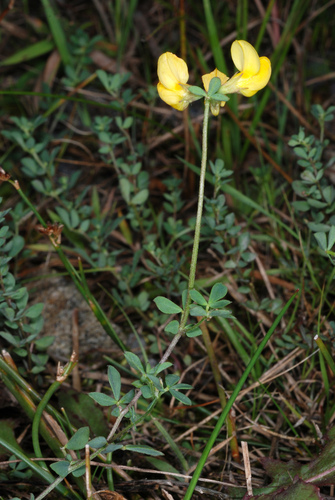
Three neighboring species are especially easy to confuse with lesser trefoil:
- Medicago lupulina, black medic, with spirally coiled pods that turn black;
- Trifolium campestre, hop trefoil, with larger yellow heads that resemble a hop cone;
- Trifolium micranthum, slender trefoil, even more delicate and bearing fewer-flowered heads.
Confirm lesser trefoil by combining the small yellow heads, 8–9 mm (about 0.3 in) across, the browned corollas retained over straight single-seeded pods, and the briefly stalked central leaflet. Together these features are more dependable than flower color alone. 5 1
Main sources
- Plants of the World Online / Kew, Trifolium dubium Sibth.
- Encyclopaedia Britannica, suckling clover
- Plants For A Future, Trifolium dubium
- NC State Extension, Trifolium dubium
- Tela Botanica, Trifolium dubium Sibth.
- INPN / MNHN, Trifolium dubium Sibth., 1794 - Lesser trefoil
- USDA PLANTS Database, Trifolium dubium Sibth.
Frequently asked questions
Is lesser trefoil toxic?
No. Trifolium dubium is not listed as toxic to cats or dogs and is a forage legume grazed by livestock. Like other clovers, it may cause bloat in ruminants grazing very abundant pure stands.
Is lesser trefoil the true Irish shamrock?
It is one of the main candidates. Several botanical surveys have placed Trifolium dubium ahead of white clover among plants sold as shamrock, although no single species is universally accepted.
How can I distinguish lesser trefoil from black medic?
Both have small yellow flower heads. Black medic (Medicago lupulina) produces spirally coiled pods that turn black, whereas lesser trefoil retains its browned corolla over a straight, single-seeded pod.
Does lesser trefoil improve the soil?
Yes. Like other legumes, it fixes atmospheric nitrogen through bacteria in its root nodules, naturally enriching poor lawns and meadows without fertilizer.
Should I remove lesser trefoil from my lawn?
Removal is unnecessary. Lesser trefoil stays low, tolerates mowing, provides flowers for bees and enriches the turf. It can be retained in a low-maintenance flowering lawn.
When does lesser trefoil flower?
In the temperate Northern Hemisphere, flowering runs from May to October, peaking in early summer. Its tiny yellow heads turn brown as they fade and remain attached until the seeds ripen.
How does lesser trefoil differ from hop trefoil?
Hop trefoil (Trifolium campestre) has larger, fuller yellow flower heads that resemble a hop cone as they fade. Lesser trefoil is more slender and has much smaller heads.
Similar plants
If you are unsure about a plant’s toxicity, ask a botanist or veterinarian for advice.