
Common bird's-foot trefoil (Lotus corniculatus, )
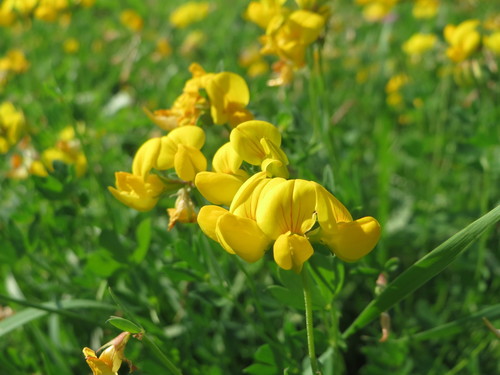
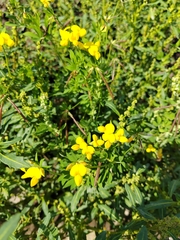
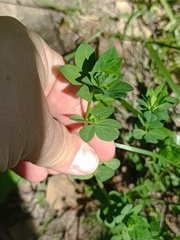
Common bird's-foot trefoil (Lotus corniculatus) is a low-growing perennial legume in the Fabaceae, widely grown as forage and common in temperate Eurasian grasslands. Its yellow, pea-shaped flowers develop into slender pods that radiate from the stem tip like a bird's foot. A solid stem distinguishes it from greater bird's-foot trefoil, a related species of wetter soils.
Read moreCommon bird's-foot trefoil and Eggs and bacon
Place in full sun, with intense direct light all day long.
Full sun; tolerates light partial shade
© photo
(c) Andreas Rockstein, some rights reserved (CC BY-SA) · cc-by-sa
Ульяна Ярцева · cc-by
Vladimir Atachkin · cc-by
(c) Tom Scavo, some rights reserved (CC BY) · cc-by
(c) Douglas Goldman, some rights reserved (CC BY-SA) · cc-by-sa
Global distribution
Common bird's-foot trefoil is native to temperate Eurasia, Macaronesia and northeastern tropical Africa. Forage cultivation has given it a nearly worldwide distribution, with escapes becoming locally invasive outside its native range.
- Native3
- Introduced1
- Invasive2
- France
- United Kingdom
- Ireland
- Canada
- United States
- Australia
Hexagons: regions where the plant occurs. Green dots: native range.2
Identity
Common bird's-foot trefoil (Lotus corniculatus L., 1753) is a low-growing perennial in the pea family, Fabaceae. The genus name traces back to Greek lotos, a word the ancient Greeks applied to several plants. The epithet corniculatus comes from Latin cornu, meaning horn: the slender pods resemble little horns when they gather in a star at the top of a stalk. 4 2
French vernacular names such as pied-de-poule, sabot-de-la-mariée, trèfle cornu and cornette refer to the flower's small, slipper-shaped keel, its lower petal structure. The familiar English name eggs and bacon instead evokes the yellow and orange coloring of the flowers. These names describe different features of the same meadow legume. 4 3
Widespread in temperate Europe, bird's-foot trefoil has no close botanical connection with the ornamental aquatic lotus despite the shared name. The two belong to different families and live in very different habitats, so the genus name alone can be misleading. 1
Recognition
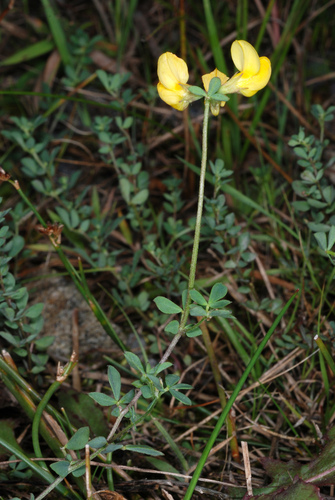
Most plants stand 5–30 cm (2–12 in) tall, although stems supported by neighboring vegetation can reach 50 cm (20 in). A taproot descends as much as 1 m (3 ft) into the soil, allowing access to moisture in dry, poor ground after some other forage legumes have exhausted shallower reserves. Its low stature does not reflect the extent of its root system. 4 3
The hairless, angular stems are solid or only slightly hollow. This distinguishes the plant from greater bird's-foot trefoil (Lotus pedunculatus), a relative of wetter ground with a conspicuously hollow stem. Pinching a stem provides a simple field comparison: solid or nearly so in L. corniculatus, clearly hollow in L. pedunculatus. 4
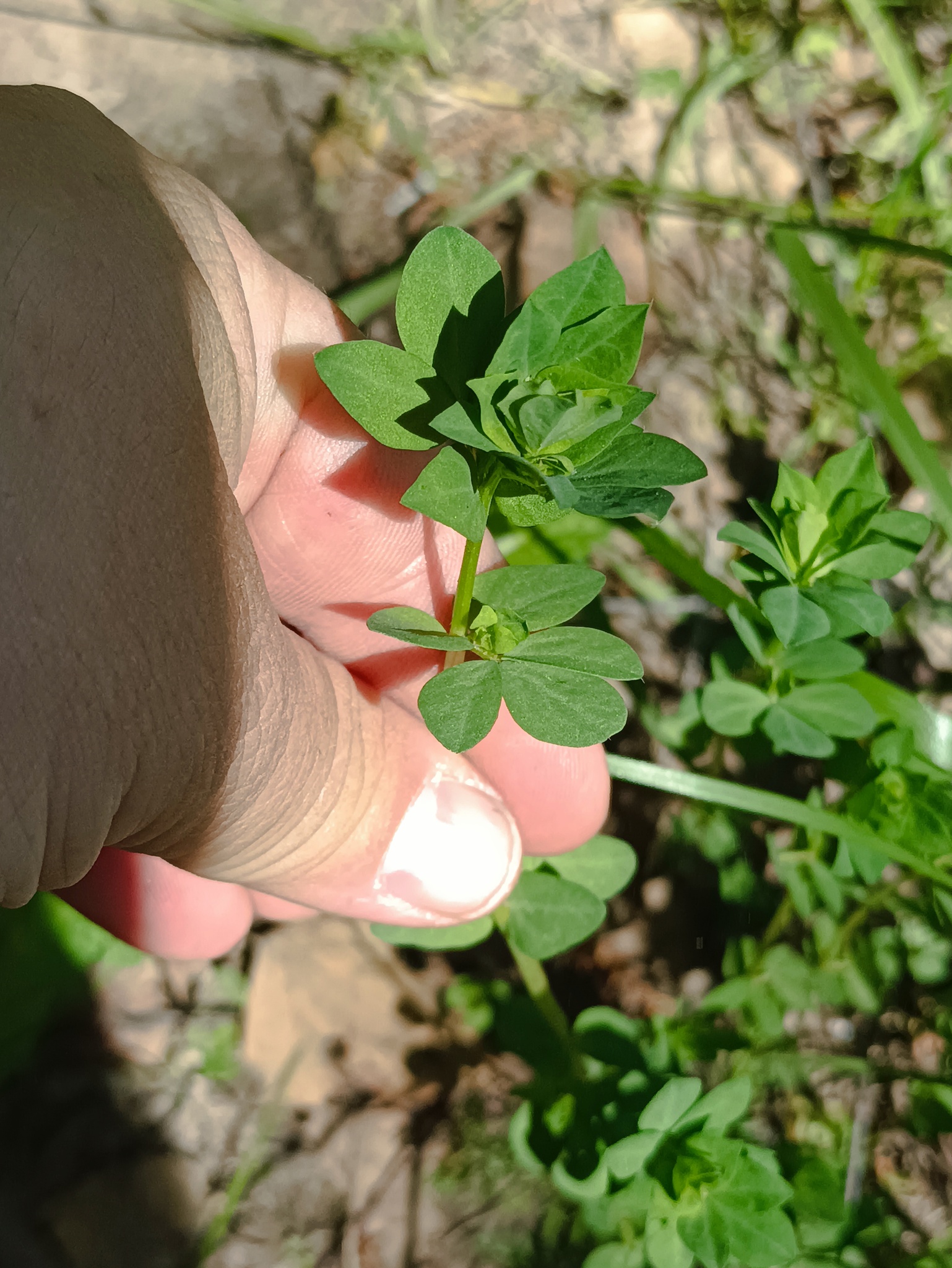
Each alternate leaf has five true leaflets: three terminal leaflets sit above a basal pair that resembles stipules. The actual stipules are tiny and gland-like. This five-part outline separates bird’s-foot trefoil from Hippocrepis comosa, whose leaves have at least nine leaflets. 4
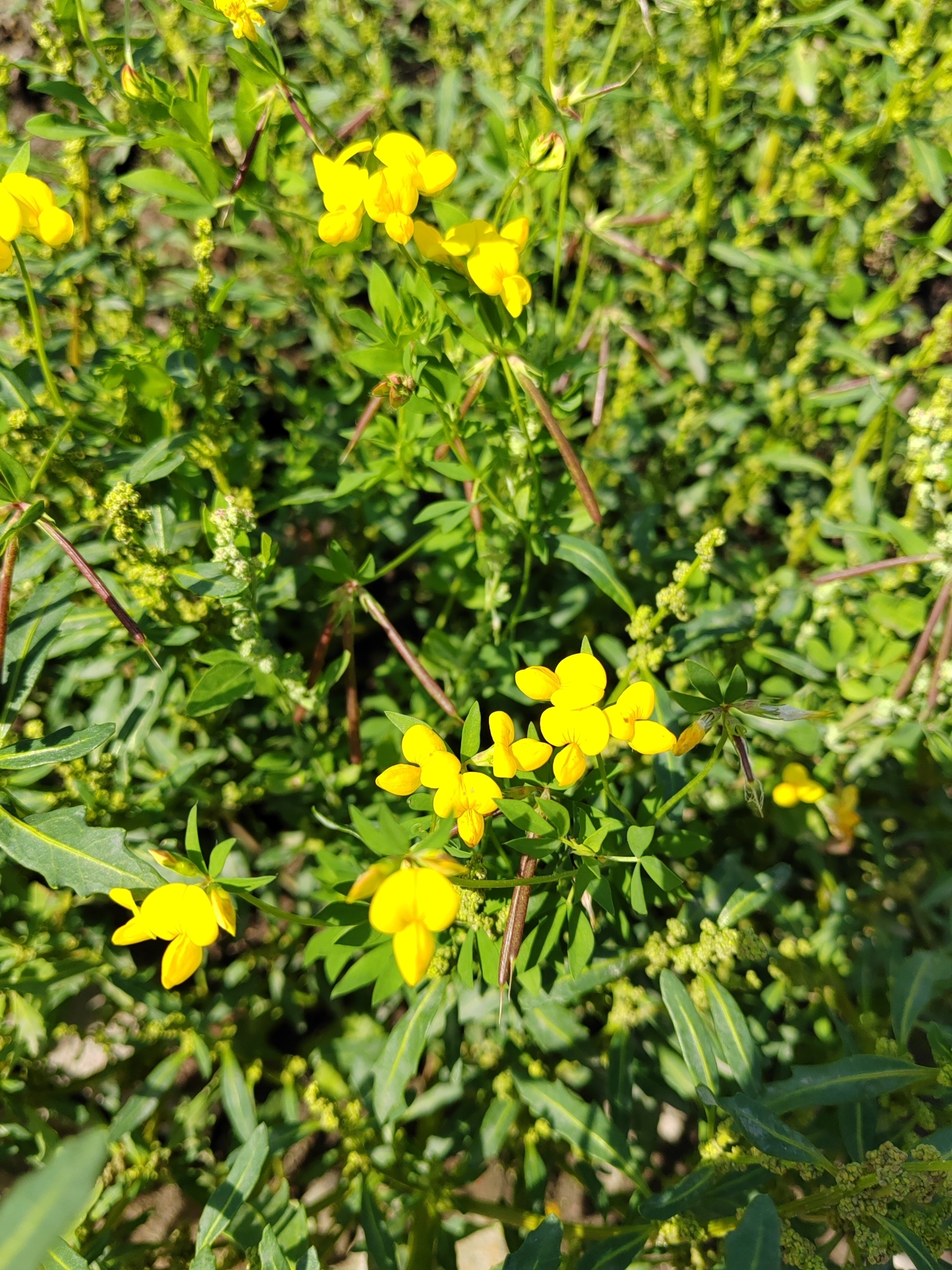
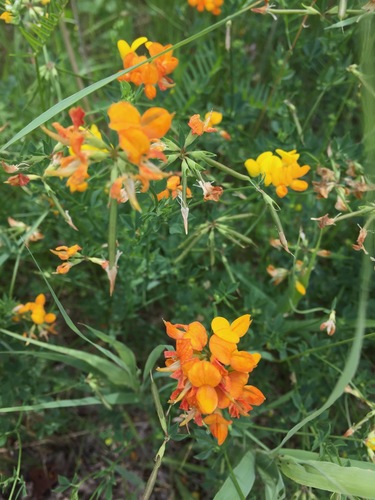
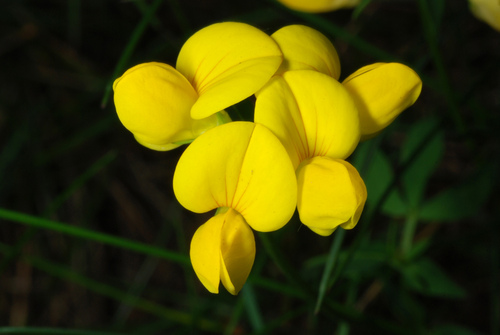
A long flower stalk carries an umbel of one to nine yellow, pea-shaped flowers, about 15 mm (0.6 in) long and sometimes veined red. In the temperate Northern Hemisphere setting described, flowering runs from May to September; timing elsewhere depends on climate and hemisphere. Several slender pods radiating from the stalk tip create the bird's-foot silhouette behind the English name. 4 3
Useful taxonomy
Published in 1753, Lotus corniculatus L. is the name accepted by Plants of the World Online, within the genus Lotus and family Fabaceae. The species includes recognized subspecies such as Lotus corniculatus subsp. corniculatus, subsp. delortii and subsp. preslii. These infraspecific names help explain some of the variation encountered in floras and regional accounts. 2 3
The name Lotus corniculatus var. japonicus, also known as Lotus japonicus, has particular significance in research. This model plant is used in legume genomics: its diploid genome of approximately 470 Mb and short life cycle of two to three months make it useful for studying symbiosis with nitrogen-fixing bacteria. The historical name should be read in that research context. 4
Using the full name, Lotus corniculatus L., avoids confusion with other members of Lotus. The genus contains several dozen species whose agricultural uses differ, so information about one member cannot automatically be applied to another. 6
Habitat and distribution
Its native range covers temperate Eurasia, Macaronesia and northeastern tropical Africa. Forage cultivation has since carried bird's-foot trefoil to most continents. The distinction between native populations and plants introduced for pasture is essential when interpreting its broad present-day distribution. 2 1
Typical habitats include meadows, grassy waste ground, pathsides, roadsides and former gravel pits, often on neutral to calcareous alluvial or clay soils. It tolerates close grazing, moderate trampling and mowing, which helps explain its persistence in intensively grazed grasslands as well as less managed open ground. 4 3
Escapes from forage cultivation colonize open habitats in North America and Australia, where the species can become locally invasive. The cited account describes prescribed fire as ineffective against established populations and generally recommends herbicide control instead. This is a regional management context, not a universal instruction for every meadow in which the plant occurs. 3
Life cycle and reproduction
Flowering extends from May to September in the source's temperate Northern Hemisphere context, with local timing governed by climate. Bumblebees are the main flower visitors. In France, the plant also supports caterpillars of about a dozen butterfly species, including four blues, some of which are threatened. These French observations do not imply that the same butterfly community occurs throughout its global range. 4 3
A fertilized flower produces a slender pod. At maturity, its valves split and twist, ejecting the seeds. Dispersal therefore involves more than seeds falling by gravity. Several pods clustered at the flower-stalk tip create the familiar bird’s-foot outline that remains after flowering. 4
Agricultural establishment uses direct sowing, either alone or mixed with pasture grasses. Germination and establishment are slower than in clover. Nearly 30 varieties are recorded in the European catalog, including about a dozen in the French catalog; these figures concern those registration systems rather than cultivar availability in every English-speaking country. 4
Uses and risks
Bird's-foot trefoil is grown as forage for grazing, hay and silage. Unlike alfalfa or clover, it does not cause bloat in ruminants, an agricultural advantage that makes it a useful additional legume in long-lived mixed pastures. Its value in such mixtures depends on the intended pasture use rather than flower color alone. 3 4
Root symbiosis with rhizobium bacteria fixes atmospheric nitrogen and enriches the soil. The resulting biomass can serve as green manure. Other recorded uses include wildflower mixtures and stabilizing slopes against erosion, although those uses should be considered alongside its introduced or invasive status in the region concerned. 4
The leaves contain cyanogenic glycosides, which can release hydrogen cyanide when tissues are crushed, as well as condensed tannins. Forage use and the absence of bloat in ruminants do not establish universal safety for every plant part, preparation or animal species. Plants For A Future identifies hazards from cyanogenic glycosides in the plant, beyond concentrated herbal tea alone. Historical use of dried flowers as a sedative is not a recommendation for consumption. Avoid concentrated preparations, and do not transfer human doses to animals. 3 4
Varieties, look-alikes and related plants
The most frequent comparison is with greater bird's-foot trefoil (Lotus pedunculatus), which favors wetter soils and has clearly hollow stems. Stems of bird's-foot trefoil remain solid or only slightly hollow. Pinching the stem offers a practical distinction between these two closely similar yellow-flowered legumes. 4
Hippocrepis comosa has similar yellow flowers, but its compound leaves contain at least nine leaflets, compared with five in bird's-foot trefoil. Counting them provides a visible distinction without a hand lens, particularly when flower color alone gives little help. 4
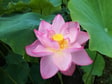
The name Lotus also invites confusion with the sacred lotus (Nelumbo nucifera), an ornamental aquatic plant. Both names descend from Greek lotos, but they designate entirely different families: Fabaceae for bird's-foot trefoil and Nelumbonaceae for sacred lotus. Their shared word is not evidence of a close relationship. 4 1
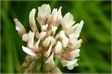
Some clovers (Trifolium), also members of Fabaceae, have superficially similar foliage. The arrangement of the leaflets and the radiating, bird's-foot cluster of pods provide firmer distinctions than the general impression of a small green pasture plant. 3
Main sources
- Wikidata, Lotus corniculatus (Q29907)
- Plants of the World Online / Kew, Lotus corniculatus L.
- Wikipedia EN, Lotus corniculatus
- Wikipedia FR, Lotier corniculé
- USDA PLANTS Database, Lotus corniculatus profile
- Integrated Taxonomic Information System, Lotus corniculatus L.
- Plants For A Future, Lotus corniculatus database entry
Frequently asked questions
Is bird's-foot trefoil toxic?
The plant contains cyanogenic glycosides; its forage use does not establish universal safety. Risk depends on preparation, exposure and the species concerned. Historical use as herbal tea is not a recommendation to consume it, and the hazard should not be presented as limited to concentrated tea.
Why is it called bird's-foot trefoil?
The slender pods form a radiating cluster like a bird’s foot. The epithet corniculatus comes from Latin cornu, horn, referring to the little hornlike pods gathered at the stem tip.
Is bird's-foot trefoil the same lotus as the aquatic flower?
No. The genus name shares the Greek root lotos with the aquatic lotus, Nelumbo nucifera, but the plants belong to entirely different families: Fabaceae and Nelumbonaceae.
Is bird's-foot trefoil useful for livestock?
Yes. It is high-quality forage that, unlike alfalfa or clover, does not cause bloat in ruminants, making it a valued legume in mixed pasture.
How does bird's-foot trefoil differ from greater bird's-foot trefoil?
Its stem is solid or only slightly hollow, while greater bird’s-foot trefoil, Lotus pedunculatus, has a clearly hollow stem and favors wetter soils.
Does bird's-foot trefoil attract pollinators?
Yes. Bumblebees are its main flower visitors. In France it also supports caterpillars of about a dozen butterfly species, including several blues, some of which are threatened.
Similar plants
If you are unsure about a plant’s toxicity, ask a botanist or veterinarian for advice.