
Muscadine grape (Vitis rotundifolia, )
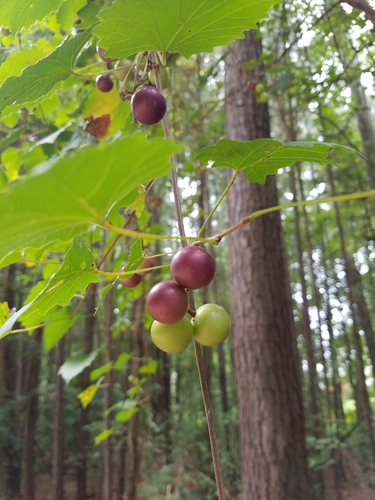
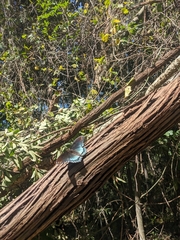
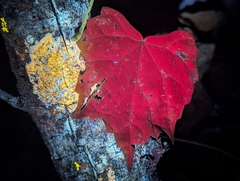
Muscadine grape (Vitis rotundifolia) is a deciduous woody climber in the Vitaceae family, native to the southeastern and south-central United States. Simple tendrils, attached bark, and thick-skinned berries distinguish it from other grapes. Its natural resistance to phylloxera and Pierce’s disease also makes it valuable in viticulture.
Read moreMuscadine grape, Muscadine, Scuppernong, Bullace grape and Bullit grape
Allow a few hours of direct sun per day, preferably morning or evening.
Full sun; a support is needed for good fruiting


© photo
Ava · cc0
Nonbinary-Naturalist · cc0
Alan Rockefeller · cc-by-sa
Taken Jul 8, 2022 by Krzysztof Golucki (cc-by-sa)
Taken Aug 17, 2019 by Jean-Daniel BLARD (cc-by-sa)




Global distribution
Vitis rotundifolia is native to the southeastern and south-central United States, from the Atlantic coast to Texas and Oklahoma, with an extension into northern Mexico sometimes reported. It has been widely grown for fruit there since the 16th century. Elsewhere it occurs mainly in grape collections, with no documented invasive naturalization.
Identity
Muscadine grape (Vitis rotundifolia Michx., 1803) is a deciduous woody climber in the genus Vitis, family Vitaceae. It belongs to the subgenus Muscadinia, the only group of American grapes with 40 chromosomes, compared with 38 in wine grape, Vitis vinifera, and other members of the genus. This chromosome difference greatly limits natural crossing between the groups. 1 3
The epithet rotundifolia points to a useful identifying feature: almost circular leaves without the deep lobes of more familiar grapevines. Grown in the southeastern United States since the 16th century, the species gave rise to Scuppernong, an emblematic cultivar designated North Carolina’s official state fruit in 2001. 8 2
Recognition
Three features distinguish muscadine grape from conventional grapevines. Its tendrils are always simple, never forked, whereas most other Vitis have two-branched tendrils. Young shoots have smooth, greenish bark that becomes vertically ridged and brown with age, but never peels into the long strips seen on other grapes. 2
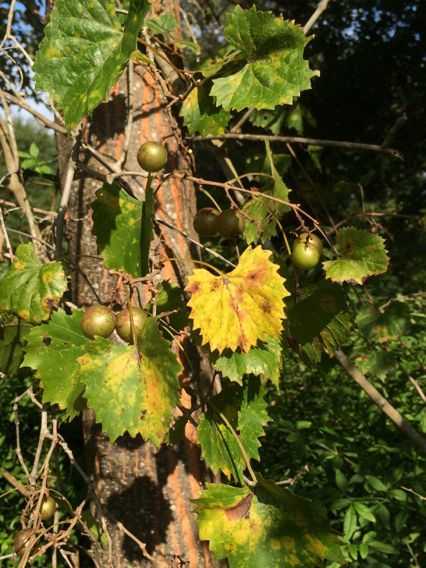
Almost circular, glossy leaves measure 6–12 cm (2.5–5 in) across, with regularly toothed margins and no deep lobes. Tiny greenish to whitish flowers open in May–June, grouped in short panicles in the leaf axils. 4 2
A thick-skinned berry 1–2.5 cm (0.4–1 in) across detaches easily from its stalk when ripe. Unlike grapes with compact bunches, muscadines are therefore often picked berry by berry, or harvested by shaking the vine so ripe fruit falls onto a sheet. 3
Useful taxonomy
POWO/WCVP accepts Vitis rotundifolia Michx. Several other names have been applied to this plant or related forms and should be distinguished from the reference botanical name:
- Vitis vulpina var. rotundifolia (Michx.) Regel, botanical synonym
- Vitis vinifera var. rotundifolia (Michx.) Kuntze, botanical synonym
- Vitis rotundifolia var. munsoniana (J.H.Simpson ex Planch.) M.O.Moore, botanical synonym
- Muscadinia rotundifolia (Michx.) Small, botanical synonym
Treatment of munsoniana remains debated: some classifications recognize it as a variety of Vitis rotundifolia, others as a separate species confined to Florida. The accepted scientific name remains the stable reference for purchasing or identifying a plant. 1
Habitat and range
Across its native southeastern and south-central US range, Vitis rotundifolia extends from the Atlantic coast to Texas and Oklahoma, with an extension into northern Mexico sometimes reported. 1 4
Open woodland, thickets, and riverbanks provide its habitat, on rich and often sandy soils in a warm, humid climate. It climbs host trees, sometimes reaching 25 m (82 ft). The tree provides access to canopy light; the vine does not parasitize its support. 4 2
Beyond its native range, muscadine grape occurs chiefly in grape collections or deliberate fruit cultivation, with no documented invasive naturalization in Europe. 1
Life cycle and reproduction
Wild Vitis rotundifolia is functionally dioecious: individual plants bear male flowers or female flowers with incomplete reproductive organs. Without a nearby pollinator, an isolated female may flower every year without fruiting. Modern cultivars overcome this with perfect, self-fertile flowers. 3
May–June flowering is followed by slow fruit development: allow 100–120 days between fruit set and harvest, which falls between August and October depending on climate. 3
Propagation mainly uses hardwood cuttings taken in December–January, or seed given six weeks of cold stratification. Cuttings preserve the parent cultivar’s characteristics; seedlings vary and are mainly useful for developing new selections. 4
Annual pruning takes place only during full winter dormancy. Cutting too late, once sap is flowing, causes heavy bleeding that unnecessarily weakens the vine without seriously endangering it. 4
Uses and risks
Fresh fruit, juice, jelly, and wine are the main uses of muscadine grape, continuing a southeastern US tradition dating to the 16th century. Young leaves and tendrils are also cooked, including as wrappers for food. 8 4
Despite widespread beliefs about resveratrol in red grapes, studies of muscadines find little or none of this compound. Their berries, especially the seeds, instead concentrate tannins, anthocyanins, and other flavonoids. 4
Dogs must be kept away from grapes and raisins of every Vitis species, including muscadines. The ASPCA lists grapes as toxic; tartaric acid is suspected of causing kidney failure in dogs, which do not metabolize it. 5
Varieties, look-alikes and related plants
About a hundred cultivars are grown in the southern United States. Scuppernong, the historic bronze North Carolina cultivar, remains a cultural reference; Carlos and Noble dominate juice and wine production. Fry and Magnolia are chiefly table grapes with large, thin-skinned fruit. 8 2
Other American and European grapes, such as Vitis labrusca and Vitis vinifera, are the main look-alikes. They have more deeply lobed leaves, forked rather than simple tendrils, and bark that peels in strips. Muscadine grape’s natural resistance to phylloxera and Pierce’s disease, two major threats to other vines, also makes it a sought-after genetic resource for grafting and breeding. 3 6
Main sources
- Plants of the World Online / Kew, Vitis rotundifolia Michx.
- NC State Extension Plant Toolbox, Vitis rotundifolia (muscadine)
- University of Florida IFAS Extension, The Muscadine Grape (HS100)
- Plants For A Future, Vitis rotundifolia
- ASPCA, People Foods to Avoid Feeding Your Pets (grapes and raisins)
- USDA PLANTS Database, Vitis rotundifolia (VIRO3) profile
- Atlas of Florida Plants, Vitis rotundifolia
- Encyclopaedia Britannica, muscadine grape
Frequently asked questions
Is muscadine grape a conventional table grape?
No. Vitis rotundifolia belongs to the subgenus Muscadinia, with 40 chromosomes rather than the 38 found in conventional grapes of the subgenus Euvitis, such as Vitis vinifera. This difference greatly limits natural crossing between the groups.
Why do some muscadine grape vines never bear fruit?
Wild plants are functionally dioecious, bearing male flowers or female flowers with incomplete reproductive organs. An isolated female without a nearby male pollinator or self-fertile cultivar may flower without ever setting fruit.
Is muscadine grape toxic to dogs?
Yes, like all Vitis grapes. The ASPCA lists grapes and raisins as toxic to dogs. Tartaric acid, which dogs do not metabolize, is suspected of causing kidney failure.
What is scuppernong?
Scuppernong is the historic bronze cultivar of Vitis rotundifolia from North Carolina. Its name came to describe a whole type of pale muscadine, and it has been the official state fruit since 2001.
How can I distinguish muscadine grape from other vines?
Look for three features: tendrils that are always simple, never forked; nearly round leaves with shallow lobes; and bark that remains smooth and attached rather than peeling in strips.
Is muscadine grape more disease-resistant than other grapevines?
Yes, in several major respects. It naturally resists phylloxera and Pierce’s disease, two problems that limit Vitis vinifera cultivation in the southeastern United States, although it remains susceptible to soil nematodes.
Can muscadine grape grow in France?
It tolerates warm, humid conditions resembling those of the southeastern United States. In France, it remains more common in grape collections than in mainstream fruit production.
Similar plants
If you are unsure about a plant’s toxicity, ask a botanist or veterinarian for advice.