
Ginger (Zingiber officinale, )


Ginger (Zingiber officinale) is an herbaceous perennial in the Zingiberaceae family, cultivated for millennia for its aromatic, pungent rhizome. No clearly wild population has been confirmed, despite a presumed native range from the eastern Himalayas to southern China. Trade in its spice has shaped maritime routes since antiquity.
Read moreGinger, Garden ginger, Cooking ginger and Ginger root
Give plenty of ambient light without direct sun on the leaves.
Partial shade to gentle full sun


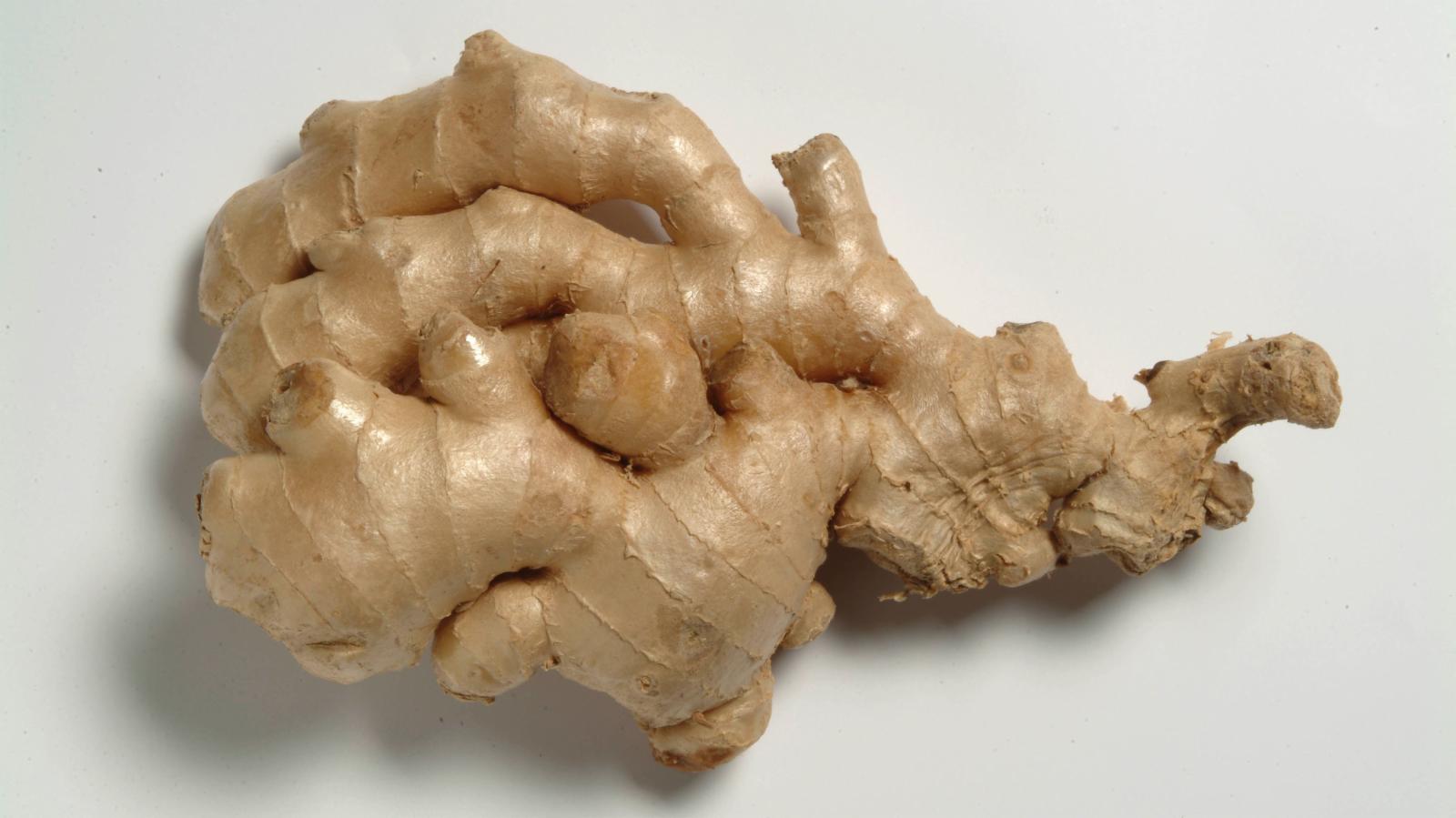
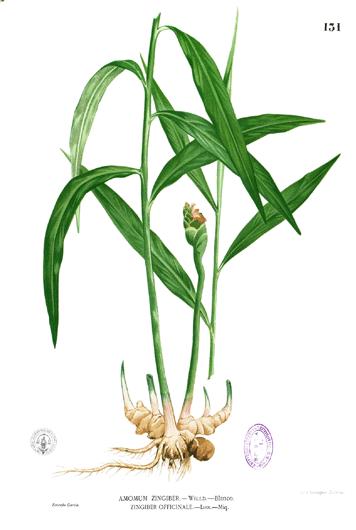
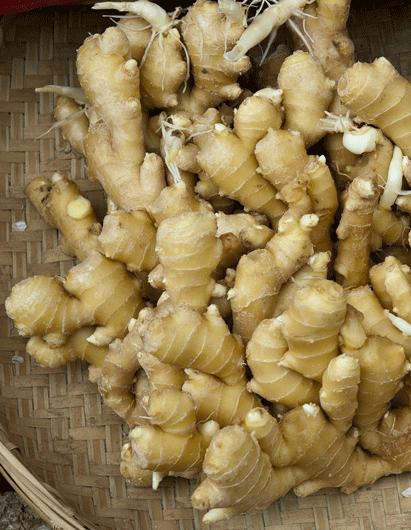
© photo
Wikimedia Commons · CC BY-SA or Public Domain
Taken Feb 19, 2021 by Onita Goldman-Richards (cc-by-sa)
Taken Feb 2, 2022 by oueslati akrem (cc-by-sa)
Taken Nov 22, 2021 by Michael Bienke (cc-by-sa)
Taken Mar 14, 2020 by araujo joao (cc-by-sa)
Taken Apr 25, 2009 by Daniel Barthelemy (cc-by-sa)
© copyright of the Board of Trustees of the Royal Botanic Gardens, Kew.


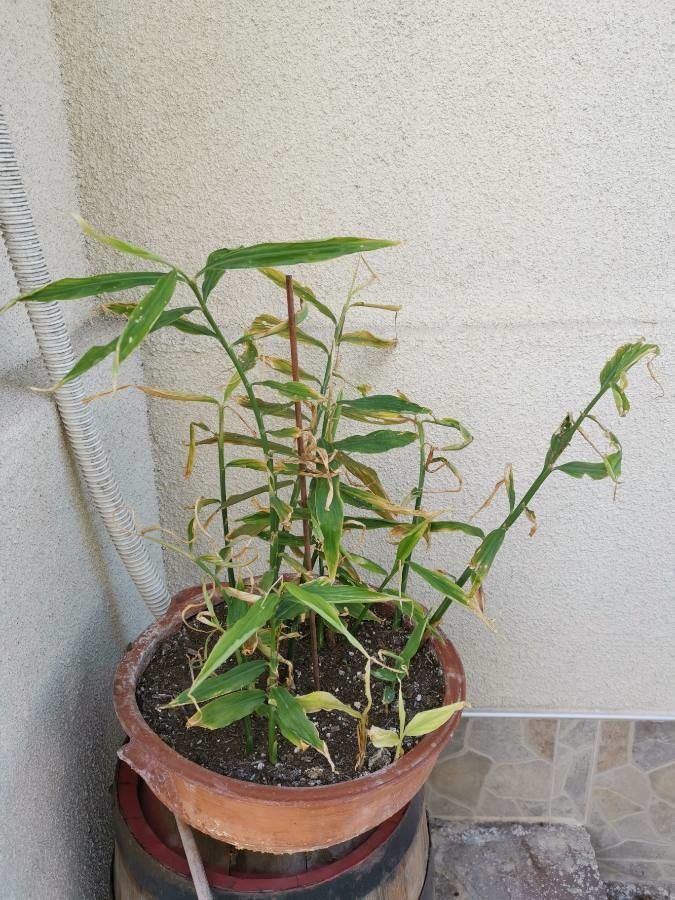


Global distribution
Taxonomic references place the presumed native range of Zingiber officinale between the eastern Himalayas and southern China, but no clearly wild population has been formally observed. Cultivation has spread it since antiquity, first through South and Southeast Asia, then toward Africa and the Caribbean along major trade routes.
- Native1
- Introduced4
- India
- Nigeria
- Indonesia
- Jamaica
- Tanzania (Zanzibar)
Hexagons: regions where the plant occurs. Green dots: native range.1
Identity
Ginger (Zingiber officinale Roscoe, 1807) is an herbaceous perennial in the genus Zingiber and family Zingiberaceae. Its fresh or dried aromatic rhizome supplies both the familiar spice and a traditional remedy. 1 6
The word ginger traces back through medieval Latin gingiber and Greek zingiberis to Sanskrit śṛṅgavera. Arab merchants called the East African coast zenj; this root also gave Zanzibar its name, a major historic trading center through which the spice traveled toward Europe. 7 6
Recognition
Leafy clumps of Zingiber officinale rise 60 cm–1.2 m (2–4 ft) from a branching underground rhizome, depending on growing conditions. Slender upright stems bear narrow, lance-shaped leaves in two ranks, retained while the plant remains in active growth. 4 5
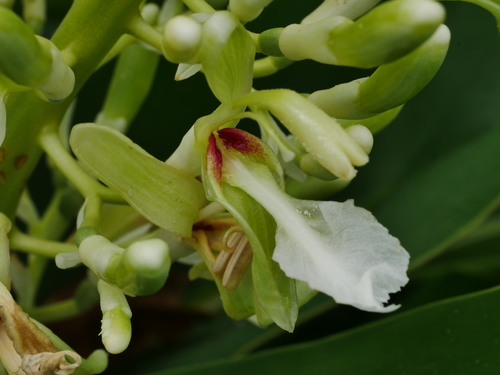
A separate leafless stalk carries an upright, cone-shaped inflorescence. Green or yellowish bracts with translucent margins protect pale yellow flowers whose lips are marked purple or red. Following flowering, short axillary spikes sometimes bear three-valved capsules containing black seeds. 7 6
The familiar "ginger root" is actually an underground stem. A light brown, slightly corky skin encloses pale yellow flesh, juicy in young rhizomes and more fibrous with age, with a characteristic pungent smell. 4 3
Useful taxonomy
Linnaeus first described ginger as Amomum zingiber in 1753. Roscoe moved it to its own genus, Zingiber, 54 years later, in 1807; POWO retains that name for the species. 1
Botanical literature still includes several homotypic or infraspecific synonyms:
- Amomum zingiber L. (botanical synonym)
- Zingiber zingiber (L.) H.Karst. (botanical synonym)
- Zingiber missionis Wall. ex Baker (botanical synonym)
- Zingiber officinale f. rubens (Makino) M.Hiroe (botanical synonym)
- Zingiber officinale var. rubrum Theilade (botanical synonym)
Within Zingiberaceae, ginger shares its family with turmeric (Curcuma longa), cardamom (Elettaria cardamomum) and galangals (Alpinia spp.). Similar rhizome shapes can cause confusion among these spices. 7 8
Habitat and range
Taxonomic references locate the presumed native range of Zingiber officinale from the eastern Himalayas to southern China, although no clearly wild population has ever been formally observed. 1 3
Despite uncertainty about its wild origin, cultivation has spread enormously. Worldwide production reached almost 4.9 million metric tons in 2023, with 45% from India alone, around 2.2 million metric tons, ahead of Nigeria, China, Nepal and Indonesia. 7
Long before modern production figures, ginger trade shaped maritime history. In 406 CE, Chinese monk Faxian reported ginger growing in pots aboard ships to prevent scurvy during long voyages. In 14th-century England, a pound of ginger cost as much as a sheep. Portuguese colonists later developed cultivation in West Africa, and the Spanish crown clandestinely introduced it to the West Indies in the 16th century. It became the first export crop of Hispaniola and Puerto Rico before sugar replaced it in the following century. 7 6
Life cycle and reproduction
Flowering is uncommon in cultivation, and a new planting often needs two years to produce its first inflorescence. Short axillary spikes may then bear three-valved capsules with black seeds, but sexual reproduction remains marginal compared with vegetative propagation. 6 4
For both gardeners and commercial growers, rhizome division is therefore the usual method. A fragment with an eye or bud is left to heal for 1–2 days, then planted just below the surface. Under warm conditions, its first shoot appears in 2–3 weeks. 5 4
Mature rhizomes are harvested 8–10 months after planting, as foliage begins to die back. Earlier harvests produce young stem ginger, juicier and less pungent, eaten raw in salads, pickled or preserved in syrup. 3 4
Uses and risks
Fresh, dried or candied rhizomes flavor savory dishes and baked goods alike. In Japan, thin pickled slices called gari cleanse the palate between sushi. Indian cooking incorporates ginger into masalas and vindaloo, while Chinese cooking often uses it to counter the smell of fish and seafood. 6
Its heat comes from gingerols, which become still hotter shogaols during drying. Powdered ginger is consequently about twice as pungent as fresh ginger. The FDA classifies it as generally recognized as safe at normal culinary doses. 3 7
Horticultural references list Zingiber officinale as non-toxic to cats, dogs and humans, with no major toxin documented. High doses still call for caution because of possible interactions with anticoagulants such as warfarin and heartburn in susceptible people. 3 7
Varieties, look-alikes and related plants
Commercial ginger grades differ mainly in geographic origin and fiber content, rather than botanical classification. Low-fiber Cochin ginger is valued for its delicate aroma; larger, milder Chinese ginger currently dominates French imports; hotter, more fibrous African ginger is chiefly used for oleoresin extraction; and Jamaican ginger, inherited from 16th-century Caribbean colonial cultivation, remains known for its aromatic quality. All four labels refer to Zingiber officinale.
Ingredients and plants most likely to cause confusion include:
- Curcuma longa, turmeric, with a much more strongly colored yellow-orange rhizome;
- Alpinia galanga, greater galangal, with firmer flesh and a more peppery flavor;
- Zingiber mioga, myoga ginger, grown mainly for its edible young inflorescences;
- Asarum canadense, North American wild ginger, botanically unrelated and containing aristolochic acid, a carcinogen discouraged by the FDA. 7
The case of Asarum canadense shows why names matter: North American wild ginger shares a common name and a similar scent with ginger, without botanical kinship or the same food safety. The scientific name separates plants that everyday language confuses.
Main sources
- Plants of the World Online / Kew, Zingiber officinale Roscoe
- International Plant Names Index, Zingiber officinale Roscoe
- Plants For A Future, Zingiber officinale
- NC State Extension Gardener Plant Toolbox, Zingiber officinale
- Missouri Botanical Garden Plant Finder, Zingiber officinale
- Wikipedia FR, Ginger (Zingiber officinale)
- Wikipedia EN, Ginger
- USDA PLANTS Database, Zingiber officinale plant profile
Frequently asked questions
Are ginger and turmeric the same plant?
No. Ginger (Zingiber officinale) and turmeric (Curcuma longa) belong to different genera in Zingiberaceae. Their rhizomes have similar shapes, but turmeric is yellow-orange inside while ginger is paler.
Is ginger toxic to cats and dogs?
No. Horticultural references classify Zingiber officinale as non-toxic to cats, dogs and humans. Very large amounts can cause digestive upset, as with many spices, rather than poisoning in the strict sense.
Does wild ginger exist?
No clearly wild population of Zingiber officinale has been confirmed. Taxonomic references place its native range between the eastern Himalayas and southern China, but it has been known only in cultivation since antiquity.
Why is ginger called a root?
It is a convenient everyday term. The harvested organ is actually a rhizome, an underground stem that stores reserves, rather than a root in the botanical sense.
Can ginger grow in a cool temperate climate?
Yes, chiefly in a large container brought indoors for winter or in a heated greenhouse. Growth stops below 13 °C (55 °F), and the rhizome cannot tolerate prolonged cold, wet conditions.
Where does the word ginger come from?
It descends through medieval Latin gingiber and Greek zingiberis from Sanskrit śṛṅgavera. The Arabic term zenj for the East African coast also gave Zanzibar its name, a historic center of the ginger trade.
How long before ginger rhizomes can be harvested?
Mature rhizomes are ready about 8–10 months after planting, when leaves start to yellow and dry. Younger rhizomes can be harvested earlier for different culinary uses.
Similar plants
If you are unsure about a plant’s toxicity, ask a botanist or veterinarian for advice.