
Billygoat weed (Ageratum conyzoides, )
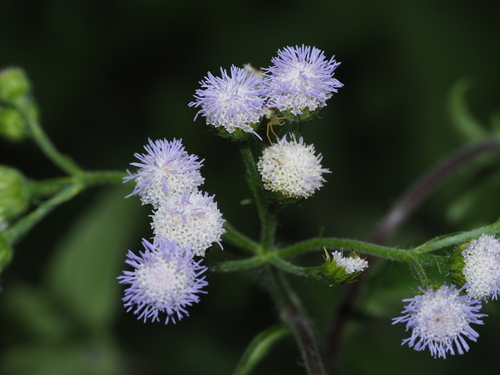
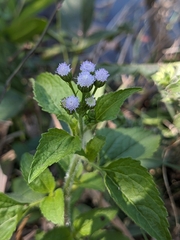
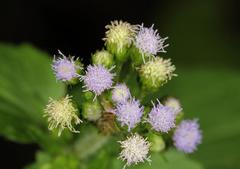
Billygoat weed (Ageratum conyzoides L., 1753) is an annual in the Asteraceae, native to tropical America and now established as a weed across tropical regions on almost every continent. Its hairy leaves release a characteristic goatlike odor when crushed. It is officially listed as a noxious weed in South Africa and as invasive in the Indian Ocean region, while remaining widely used in traditional African medicine. It is frequently confused with Ageratum houstonianum, the bedding ageratum grown in temperate gardens, but differs in the hairiness of its flower bracts.
Read moreBillygoat weed, Goatweed, Whiteweed, Tropical whiteweed, Billygoat-weed and Mentrasto
Allow a few hours of direct sun per day, preferably morning or evening.
Full sun to light partial shade
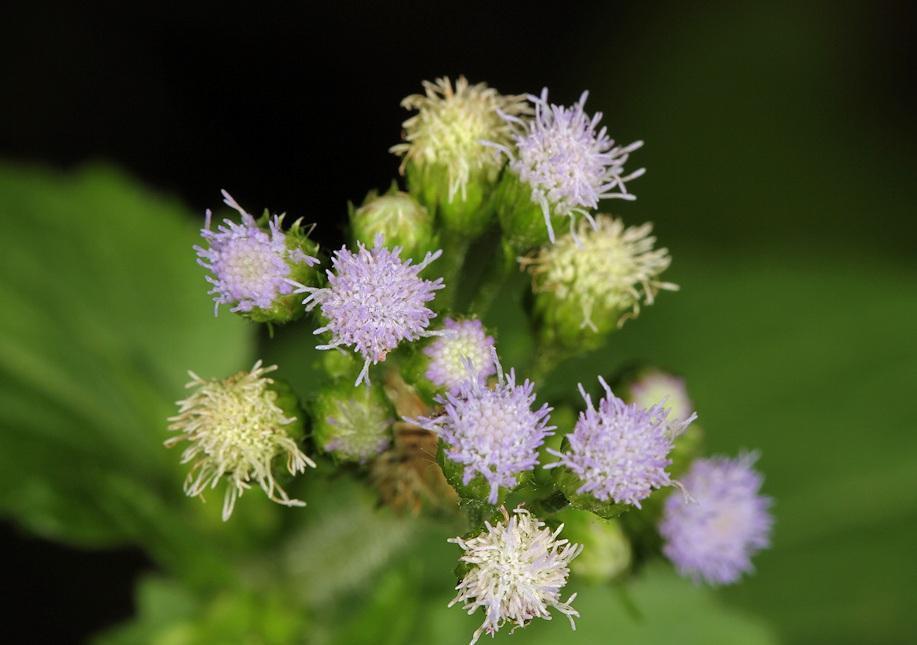
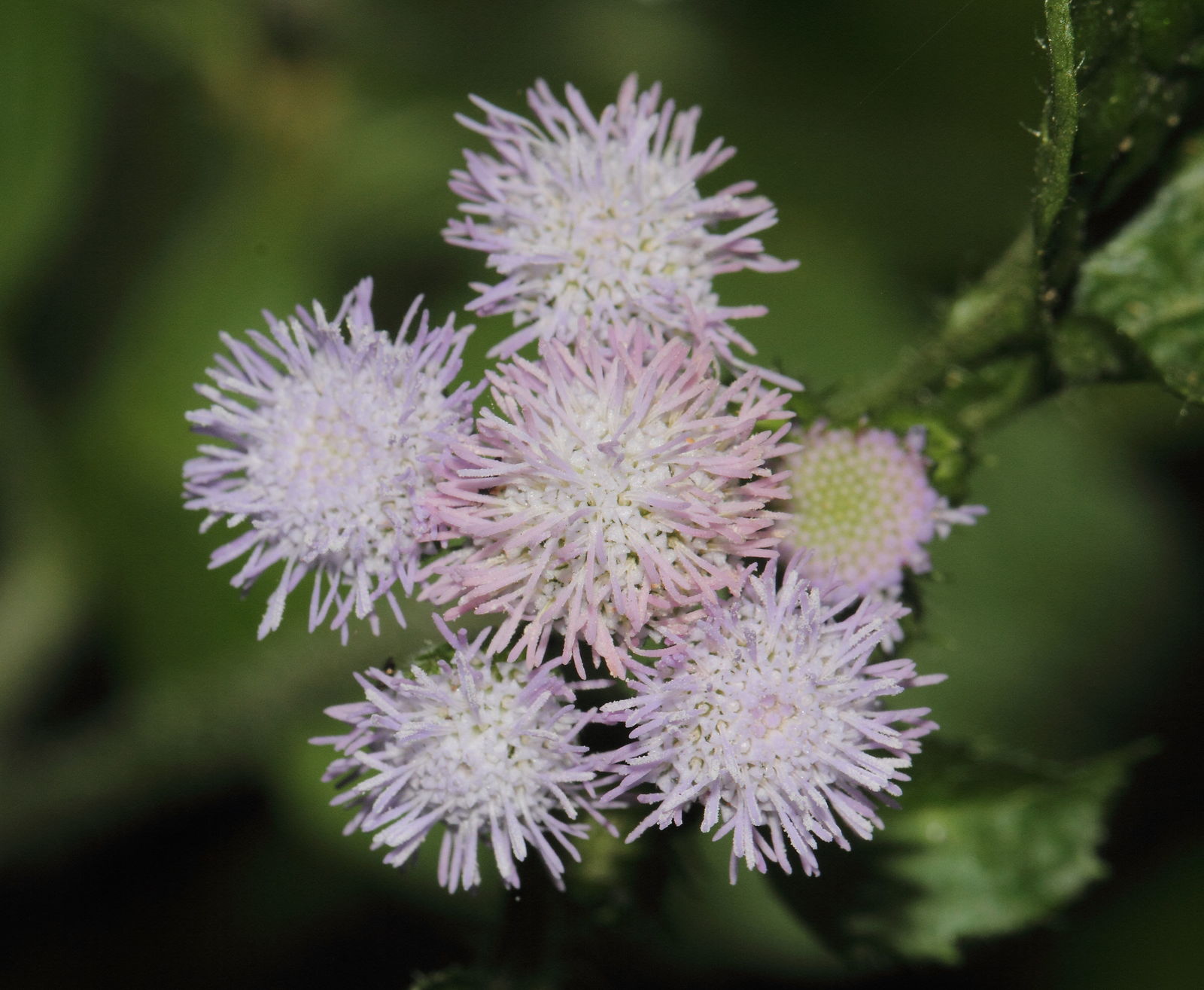
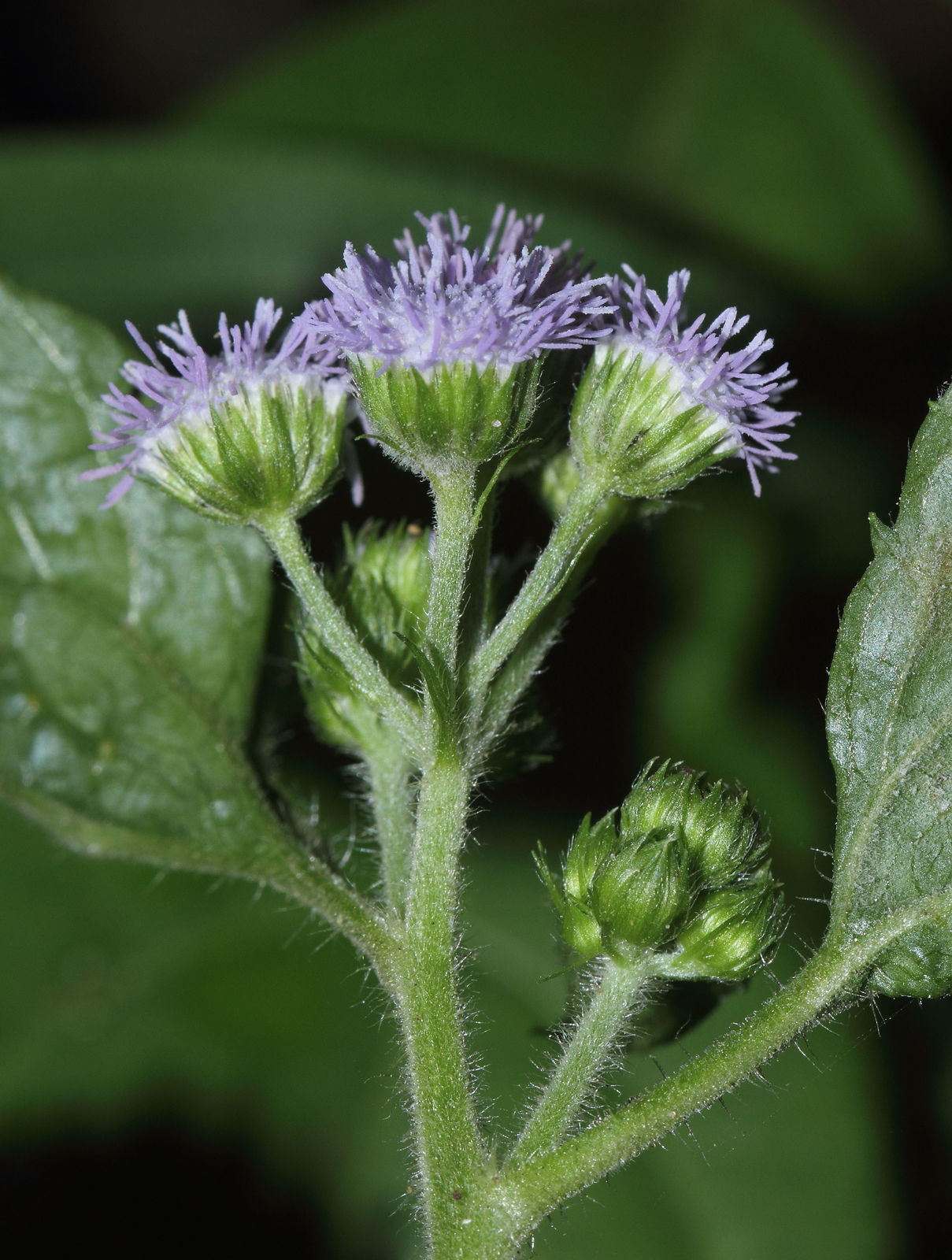
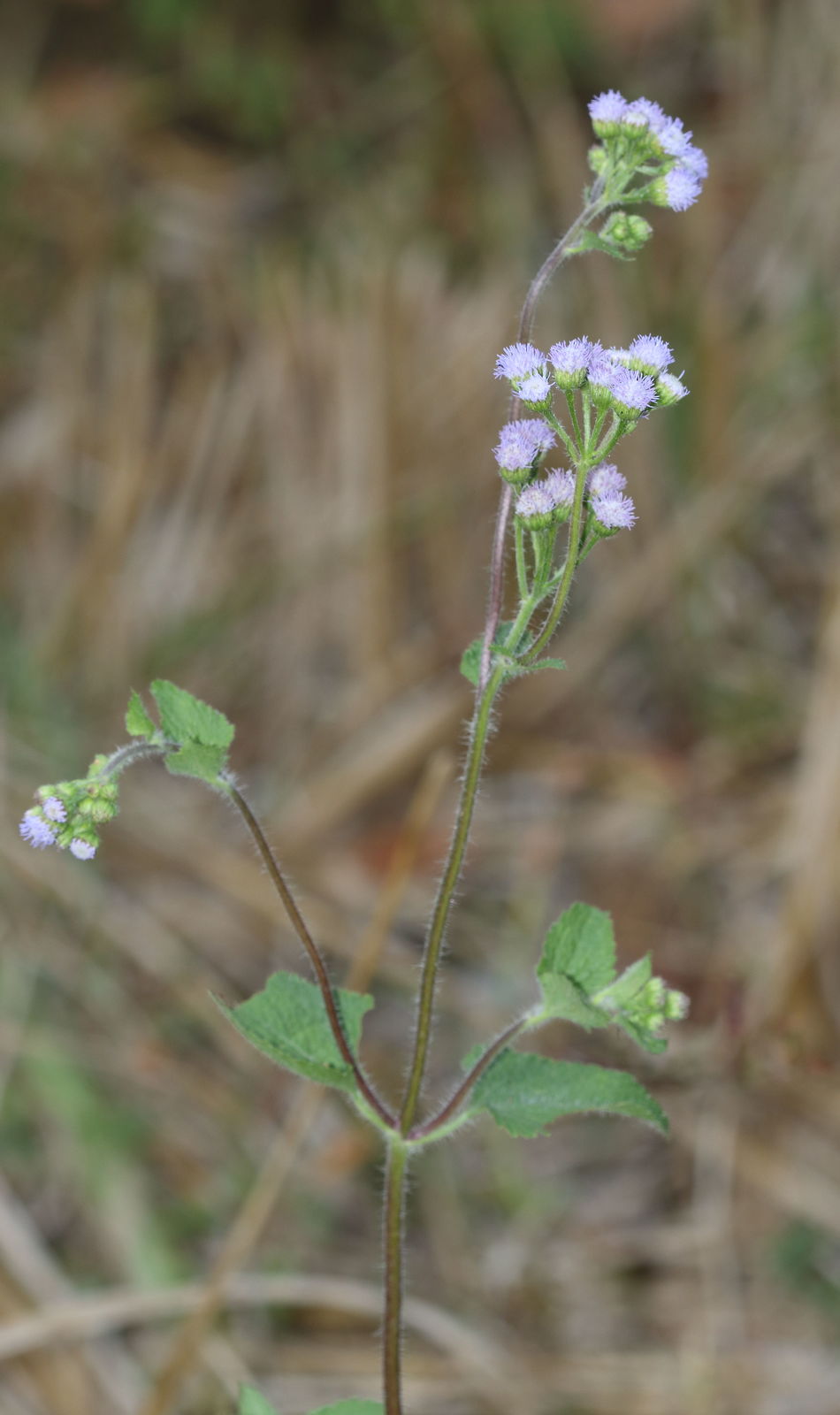
© photo
(c) 小铖/Smalltown, some rights reserved (CC BY-NC), uploaded by 小铖/Smalltown · cc-by-nc
iNaturalist User · cc-by
Wynand Uys · cc-by-nc
© copyright of the Board of Trustees of the Royal Botanic Gardens, Kew.




Global distribution
POWO centers the native range of Ageratum conyzoides around Mexico, within a broader range covering Central and South America and the Caribbean. The species has since naturalized across almost all tropical and subtropical regions worldwide and appears on several official lists of noxious weeds or invasive species.
- Native3
- Introduced2
- Invasive4
- Mexico
- Brazil
- Caribbean
- Madagascar
- United States
- South Africa
- Kenya
- India
- Réunion
Hexagons: regions where the plant occurs. Green dots: native range.1
Identity
Billygoat weed (Ageratum conyzoides L., 1753) is an accepted species in the genus Ageratum, in the Asteraceae family. Crush its hairy foliage and the common name becomes clear: it releases a pungent, goatlike odor. 4 1
Regional names include goatweed, whiteweed and tropical whiteweed in English, baume blanc and herbe à femme in French-speaking regions, and mentrasto in Brazil. These names refer to the same plant but do not reliably establish its identity. Odor and flower color vary with climate, while the scientific name remains consistent across continents. 2 9
This weed has no recognized ornamental value. Its close relative Ageratum houstonianum, bedding ageratum, is the member of the genus commonly cultivated in France. Confusing them can lead to pointless weeding: pulling bedding ageratum from a patio border will not stop Billygoat weed returning in a nearby vegetable bed. 7
Recognition
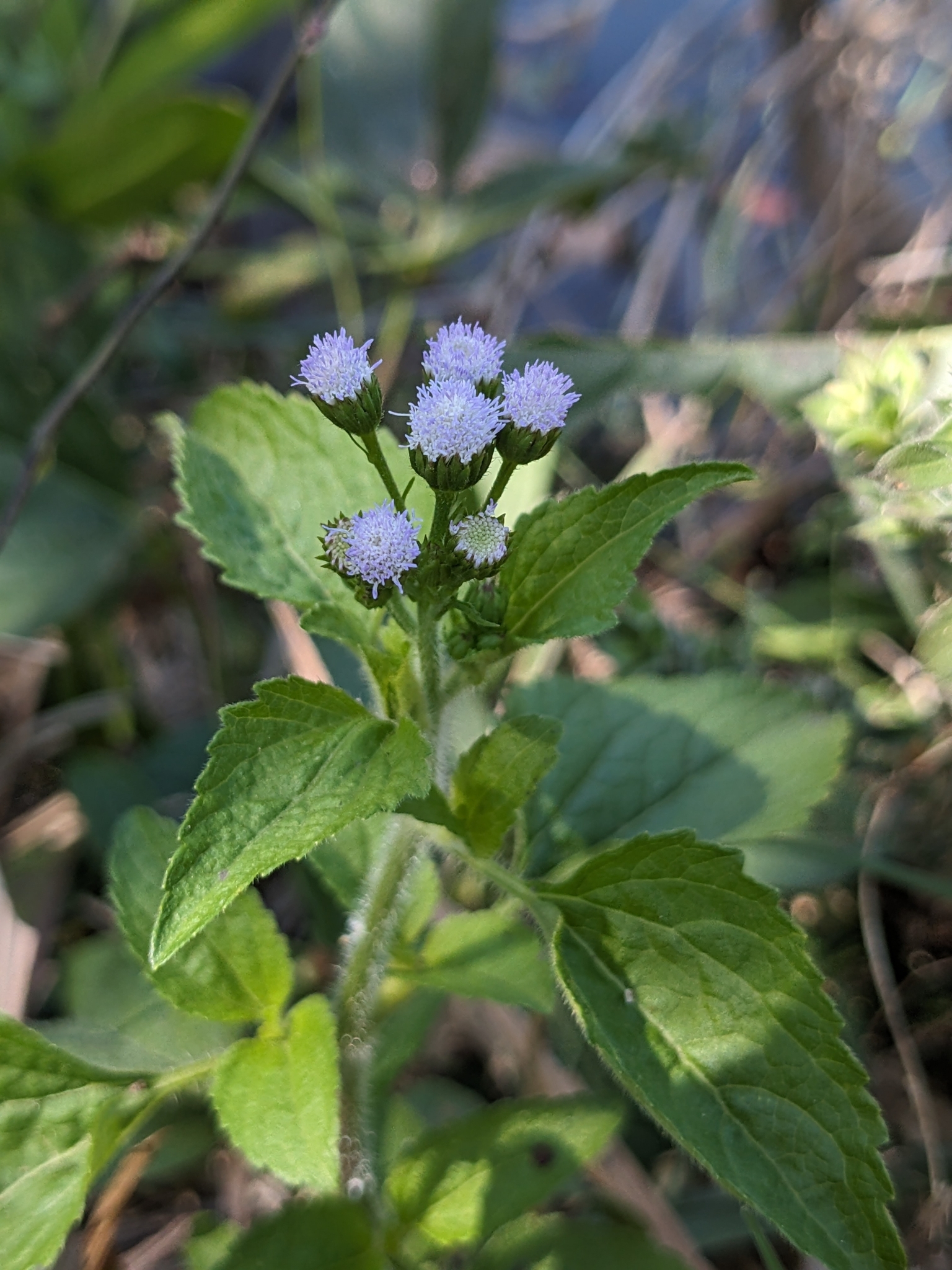
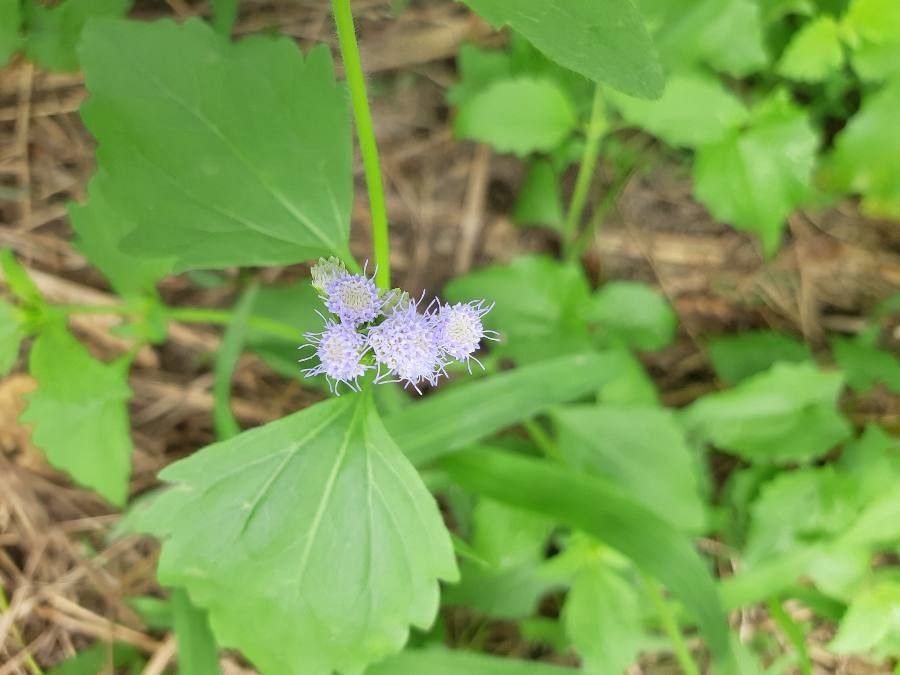
Upright, branching stems give Ageratum conyzoides its annual herbaceous habit. Usually 30 cm to 1 m (1–3.3 ft) tall, it can reach 1.2 m (4 ft) in rich soil and full sun. Fine white hairs cover the stems and leaves; the opposite, oval leaves grow up to 7.5 cm (3 in) long. The plant is slightly aromatic. 7 4
Terminal clusters hold flower heads measuring 5–8 mm (0.2–0.3 in) across, each containing 30–50 tiny mauve, bluish, pink or white florets. Each floret produces one brown achene, topped by a scaly pappus rather than conspicuous barbed bristles. 7 3
Inspecting the flower bracts provides the most reliable distinction. Those of Ageratum conyzoides bear only a few scattered hairs; its relative Ageratum houstonianum has dense glandular hairs and shorter floral styles. This visible detail separates the two without relying on flower color or common names. 7
Useful taxonomy
Botanical references accept the name Ageratum conyzoides L. POWO links it to a long list of synonyms accumulated over more than two centuries, including Ageratum album Steud., Ageratum hirsutum Poir., Ageratum ciliare L., Eupatorium conyzoides (L.) E.H.L.Krause and Carelia conyzoides (L.) Kuntze. 1
Repeated descriptions under different names reflect a variable species encountered by botanists in different parts of the world. The practical consequence is that a nursery label in Asia or Latin America may identify a different plant if it omits the accepted scientific name. POWO's accepted name provides a steadier reference than local horticultural or common names. 1
Habitat and range
Tropical America, including Central and South America and the Caribbean, forms the original range described here; POWO centers the native range around Mexico. Agriculture and the seed trade subsequently carried the species into almost every tropical and subtropical region. 1 8
Disturbed ground gives Ageratum conyzoides many opportunities to establish: around buildings, along roads, in overgrazed pastures, at forest edges and even on coastal dunes. It occurs from sea level to 2,500 m (8,200 ft) in elevation. 8 7
Several regions assign it a clear weed status. South Africa lists it as noxious; it is invasive in Kenya, Tanzania and Uganda and threatens Himalayan plant communities in India. It affects more than 40 crops and pastures and acts as an alternative host for crop pathogens and nematodes, extending its effects beyond competition for light. Across the Indian Ocean it is established on Réunion, Madagascar, Mauritius, the Comoros and the Seychelles. These regional classifications should not be read as the rules applying everywhere. 7 5 4
Horticulture itself contributed to this worldwide spread. In several regions the plant arrived as a garden introduction or as a contaminant in seed lots of other ornamentals, then escaped from beds into surrounding open habitats. 7
Life cycle and reproduction
Germination through flowering takes less than two months. The seeds germinate mainly in light, a response known as positive photoblastism, and often lose viability after twelve months. 7
Traveling achenes attach to livestock and wildlife fur, clothing and agricultural machinery. The scaly pappus of Billygoat weed grips less strongly than the barbed bristles of some other weedy Asteraceae, yet still enables long-distance dispersal. Isolated patches can appear several kilometers from the nearest population without deliberate sowing. 7
Uses and risks
Traditional medicine uses the whole plant across much of Africa for fever, rheumatism, headaches, colic, burns, uterine disorders and pneumonia. In Kenya, it is also used in remedies for asthma and to stop bleeding. These are records of traditional use rather than treatment recommendations. 7
Documented toxicity remains a concern despite those uses. Ageratum conyzoides contains liver-toxic pyrrolizidine alkaloids, including lycopsamine, found even in herbal teas sold in Brazil without clear toxicological oversight. A mass poisoning was reported in Ethiopia after consumption of grain contaminated by the plant. 10 9
PFAF records no food use for this species. No contact toxicity is reported from routine garden handling; the main concern is repeated ingestion through herbal tea or contaminated fodder. 8
Varieties, look-alikes and related plants
Horticultural cultivars are not recognized for Ageratum conyzoides. Its most frequent look-alike is Ageratum houstonianum, widely grown in French gardens for blue or violet flower heads. Bedding ageratum has densely hairy, glandular flower bracts, compared with only a few scattered hairs in A. conyzoides. Its floral styles measure 1–2 mm (0.04–0.08 in), compared with about 5 mm (0.2 in) in the wild species. 7
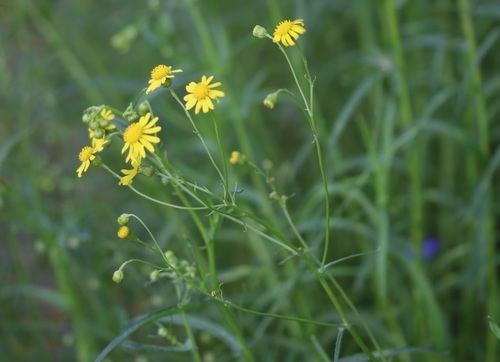
Toothed leaves and small colored flower heads may also resemble certain weedy Bidens or Erigeron. Fruit shape, specifically an achene with a scaly pappus rather than barbed bristles, and the hairiness of the bracts remain the most useful field characters. 3
Main sources
- Plants of the World Online / Kew, Ageratum conyzoides L.
- INPN, Ageratum conyzoides L., 1753
- Pl@ntUse French, Ageratum conyzoides
- Wiktrop, Ageratum conyzoides L.
- Global Invasive Species Database / IUCN, Ageratum conyzoides
- EPPO Global Database, Ageratum conyzoides (AGECO)
- EAfrinet / Lucidcentral, Ageratum conyzoides (Billygoat Weed) factsheet
- Plants For A Future, Ageratum conyzoides
- Wikipedia (EN), Ageratum conyzoides
- Revista Brasileira de Farmacognosia, pyrrolizidine alkaloids in medicinal tea of Ageratum conyzoides
Frequently asked questions
Is Billygoat weed toxic?
Yes. It contains liver-toxic pyrrolizidine alkaloids documented in traditional herbal teas and linked to chronic liver damage in livestock. A mass poisoning was also reported in Ethiopia after people ate contaminated grain.
Can you eat Billygoat weed?
No food use is documented in reference databases such as PFAF. The reported traditional uses in Africa, Asia and tropical America are medicinal rather than dietary.
How can I distinguish Billygoat weed from bedding ageratum?
The most reliable feature is the hairiness of the flower bracts. Ageratum conyzoides has only a few scattered hairs, while Ageratum houstonianum, the bedding ageratum, has dense glandular hairs and shorter floral styles.
Is Billygoat weed invasive in France?
It is classified as invasive on Réunion and more widely in the Indian Ocean region. No documented naturalization is reported in mainland France; vigilance is especially relevant in tropical overseas territories.
Where does Billygoat weed come from?
Its center of origin lies around Mexico, within a broader range covering Central and South America and the Caribbean. It has since naturalized across almost all tropical and subtropical regions worldwide.
Why does Billygoat weed smell bad?
Crushing the hairy leaves releases pungent aromatic compounds. Their odor is often compared to a male goat, which explains the English common name Billygoat weed.
Does Billygoat weed have traditional uses?
Yes. Its leaves and the whole plant appear in several traditional African pharmacopoeias for fever, rheumatism, headaches, burns and pneumonia. These uses do not offset the documented risk of liver toxicity from prolonged internal use.
Similar plants

If you are unsure about a plant’s toxicity, ask a botanist or veterinarian for advice.