
Wild sweetsop (Annona reticulata, )
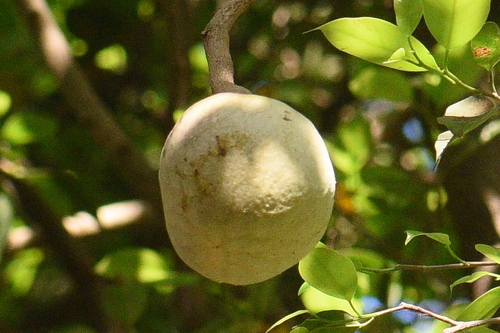
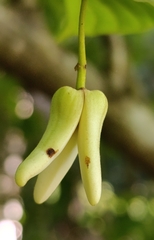

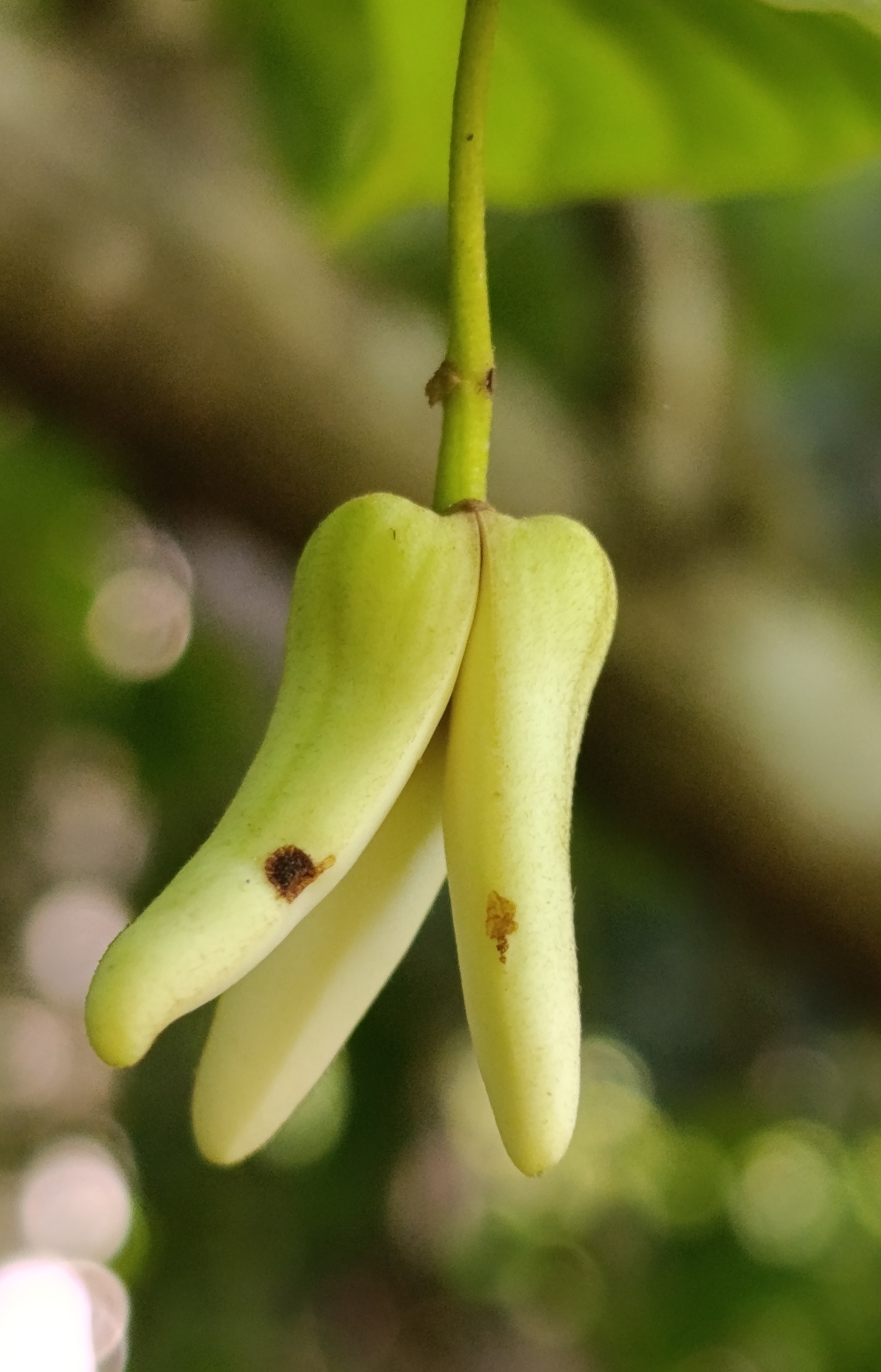
Wild sweetsop (Annona reticulata) is a small fruit tree in the Annonaceae, native to tropical America from southern Mexico to northeastern Venezuela. Cultivated since pre-Columbian times, it bears a finely net-patterned, often heart-shaped fruit with sweet, grainy, cream-colored flesh. It is now widespread across the tropics.
Read moreWild sweetsop, Custard apple, Bullock's heart and Ox heart
Allow a few hours of direct sun per day, preferably morning or evening.
Full sun to partial shade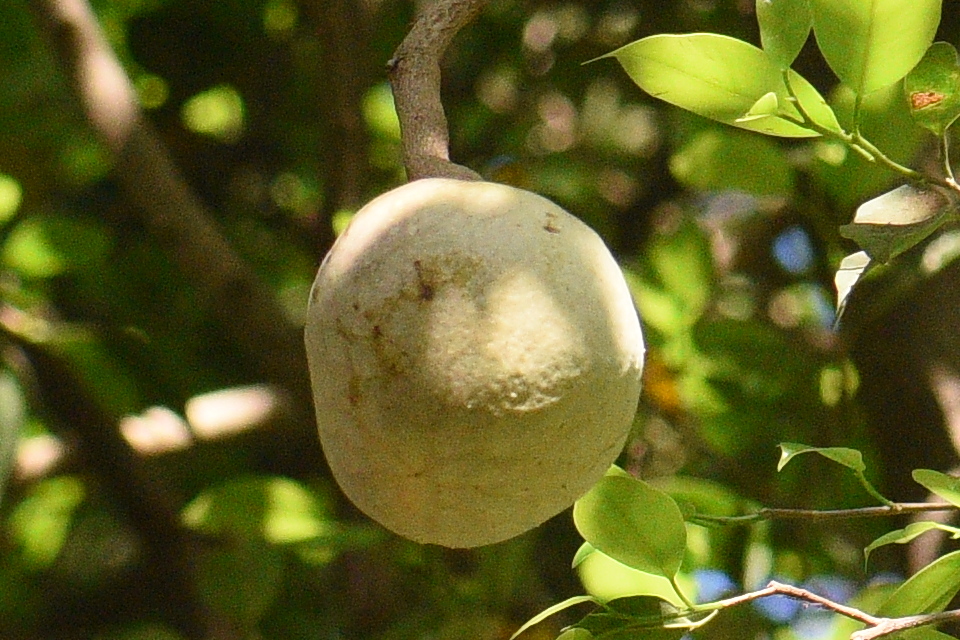


© photo
(c) Narendra Bhagwat, some rights reserved (CC BY-NC), uploaded by Narendra Bhagwat · cc-by-nc
Alberto Alcalá · cc-by-sa
Wikimedia Commons · CC BY-SA or Public Domain
Taken May 12, 2022 by Nelson Zamora Villalobos (cc-by-nc)
© copyright of the Board of Trustees of the Royal Botanic Gardens, Kew.


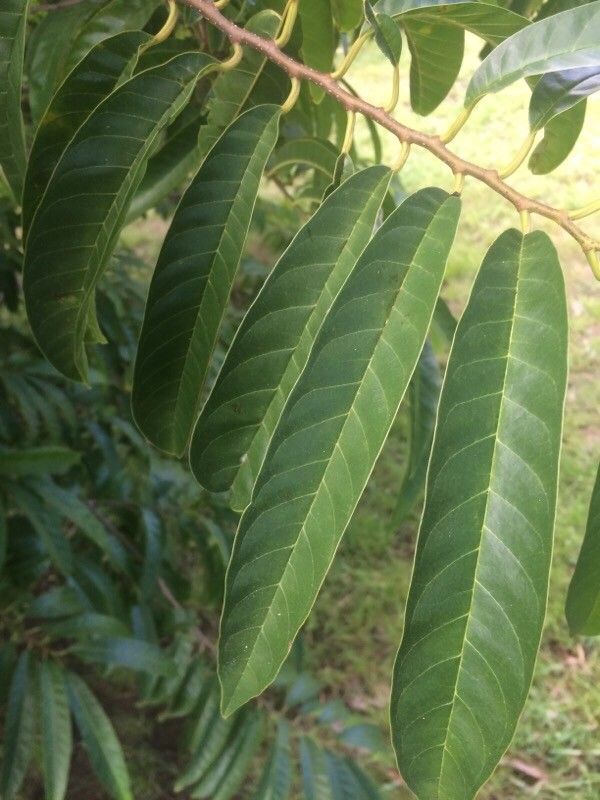


Global distribution
Plants of the World Online reconstructs a native range from southern Mexico to northeastern Venezuela. Horticultural sources sometimes suggest an older origin centered on the West Indies; distinguishing the strict native range from pre-Columbian dispersal through cultivation remains difficult.
- Native2
- Introduced5
- Mexico
- Venezuela
- Cuba
- India
- Philippines
- East Africa
- Brazil
Hexagons: regions where the plant occurs. Green dots: native range.1
Identity
Wild sweetsop (Annona reticulata L., 1753) belongs to the genus Annona in the Annonaceae. Its alternative English names bullock's heart and ox heart describe the ripe fruit, which is often heart-shaped and reddish brown. This visual association also appears in common names used in other languages. 1 2
The Latin epithet reticulata refers to the fine network of raised lines on the fruit surface. The broader name custard apple is shared with Annona cherimola and Annona squamosa. These are three distinct species in the same genus, even though fruit sellers and buyers often use overlapping common names for them in tropical markets. 2 6
Recognition
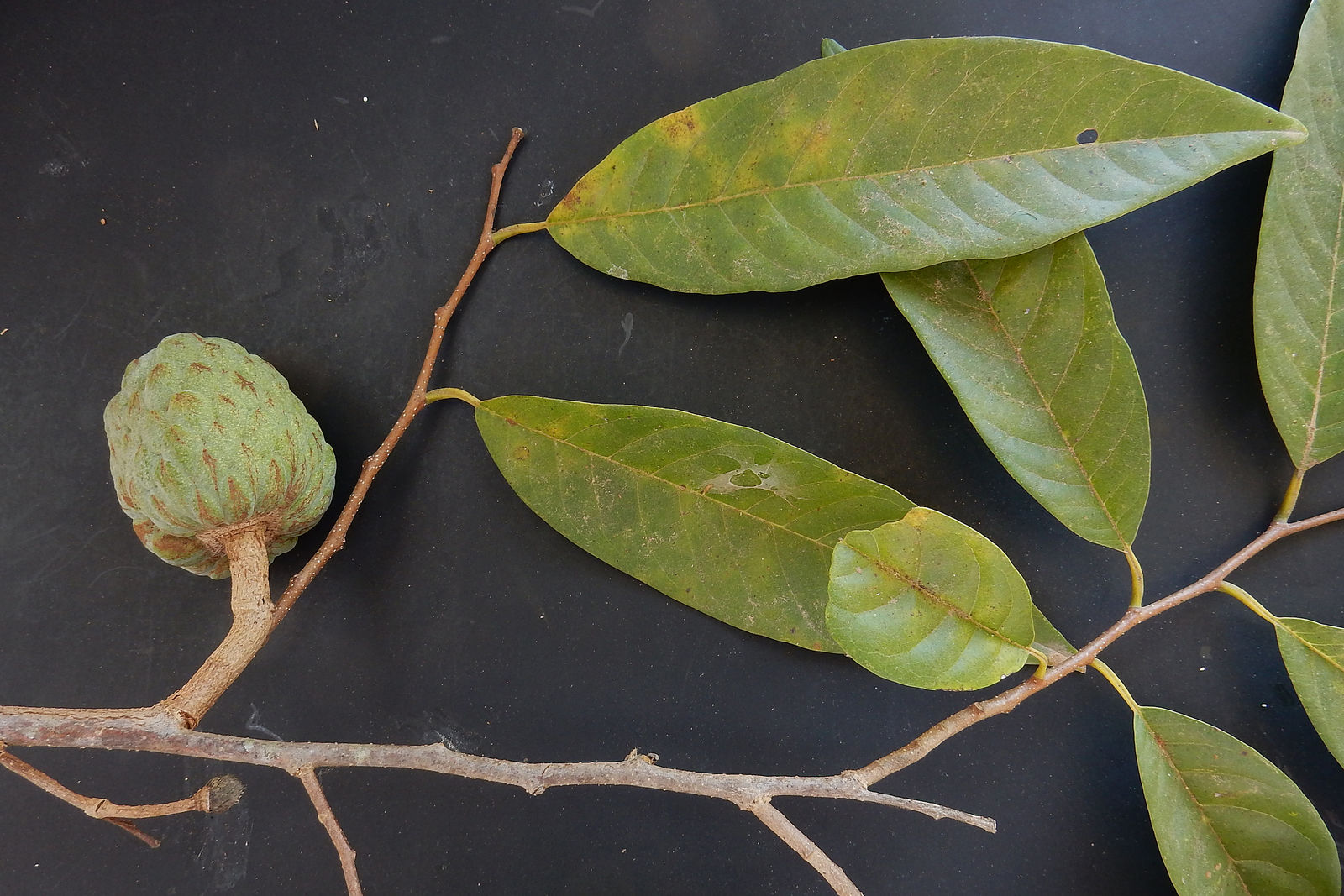
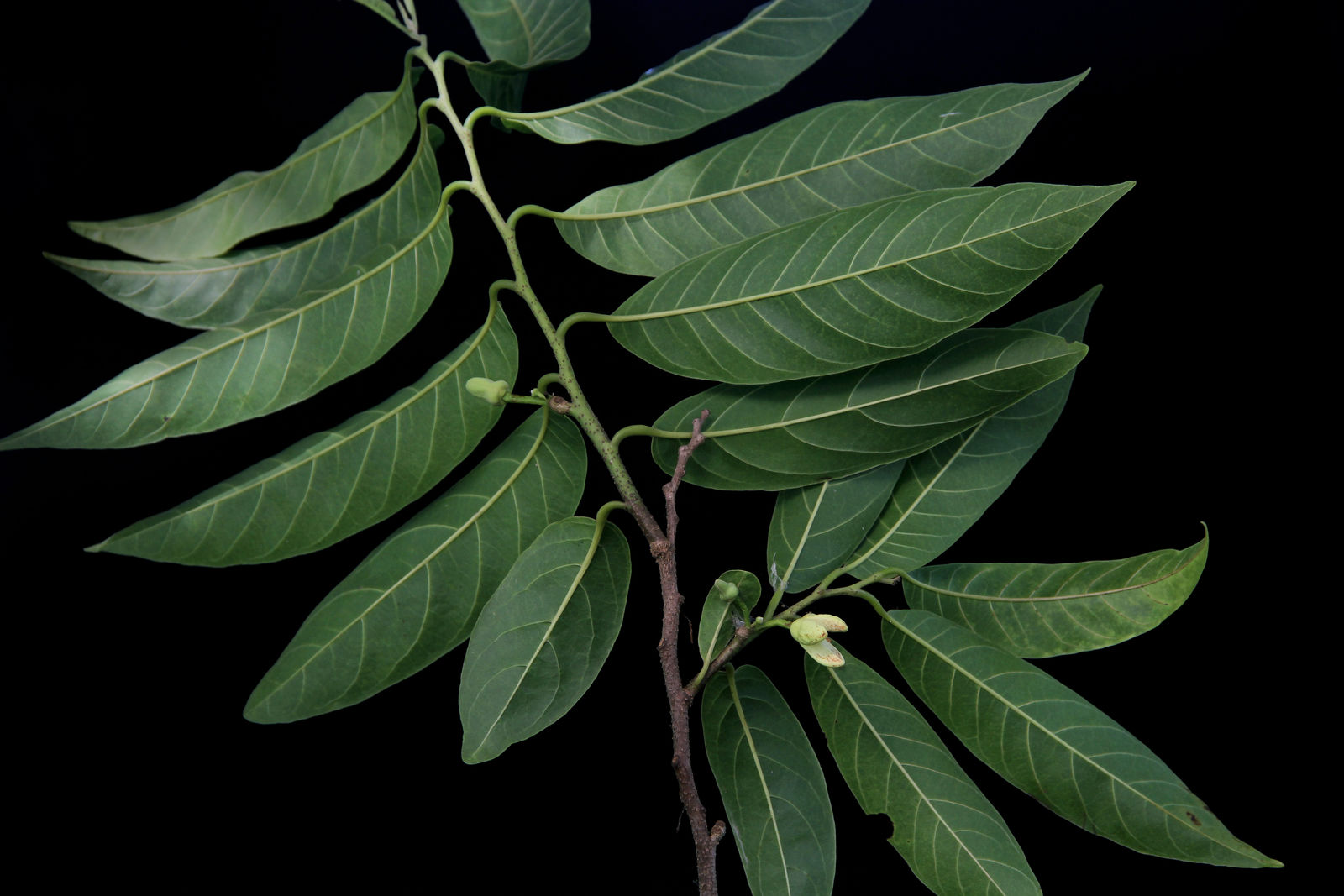
An upright trunk and sometimes irregular crown characterize this small tree, which commonly reaches 4–10 m (13–33 ft) tall with a trunk 25–35 cm (10–14 in) in diameter. Oblong to lance-shaped leaves measure 10–20 cm (4–8 in) long and release an unpleasant smell when crushed, a useful distinction from other small fruit trees growing nearby. 2 4
Hanging, fragrant flowers have three fleshy petals 2–3 cm (about 1 in) long. They are light green outside and pale yellow with a dark red patch inside. The flowers never open fully, which restricts access for pollinating insects and helps explain some of the unevenly shaped fruits found in orchards. 2 4
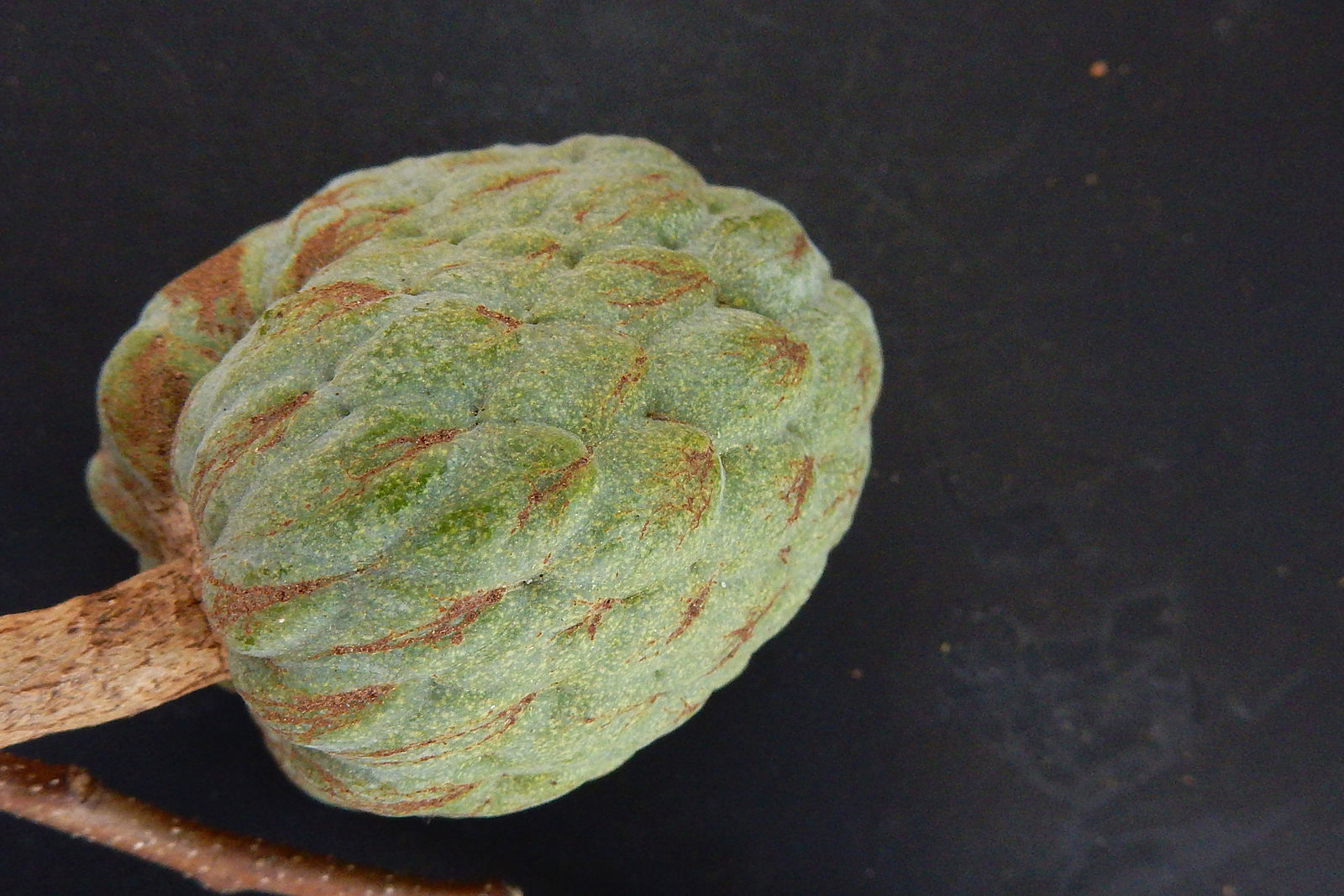
The compound fruit measures 8–16 cm (3–6 in) across and may be heart-shaped, round or irregular. Its thin but tough skin becomes yellow to brown at maturity, often flushed pink, red or reddish brown. A fine to conspicuous network marks the surface. Beneath it, sweet, grainy, cream-colored flesh surrounds numerous shiny black seeds, sometimes 55–76 per fruit. 2 4
Useful taxonomy
In 1753, Linnaeus published Annona reticulata L., the scientific name still accepted today. Plants of the World Online lists several botanical synonyms referring to this same species:
- Annona riparia Kunth, described in 1821 and later included here
- Annona laevis Kunth, a synonym recorded in botanical revision
- Annona humboldtiana Kunth, superseded by the Linnaean name
- Annona primigenia Standl. & Steyerm., first described separately and later included in this species
The name Annona reticulata Sieber ex A.DC. can mislead anyone buying a plant on its Latin name alone. It is an illegitimate homonym referring to a different species, Annona mucosa, sometimes called biriba. The accepted name with its complete authority, Annona reticulata L., provides the reliable point of reference. 1 7
Habitat and range
Southern Mexico to northeastern Venezuela forms the native range reconstructed by Plants of the World Online. Some horticultural accounts instead describe an older origin centered on the West Indies, followed by early dispersal into Central America through pre-Columbian cultivation. Separating the strictly native range from the area reached through ancient cultivation is consequently difficult in the field. 1 2
Tropical lowlands and foothills provide its habitat, with rich, deep soils that retain moisture, at elevations up to about 1,200–1,500 m (3,900–4,900 ft) depending on the region. Wild sweetsop needs a more humid atmosphere than sugar apple (Annona squamosa) and tolerates prolonged drought less well. 2 4
The IUCN Red List assesses the species as Least Concern. Its very wide horticultural distribution through tropical regions is relevant to this status, but should not be treated as a direct measure of the condition of its original wild populations. Widespread cultivation and the health of native populations are related but separate observations. 8
Life cycle and reproduction
Flowers hang from the current season's wood on productive trees, chiefly during the local spring and summer. The main harvest described in horticultural accounts falls in late winter and spring; exact timing varies with region. Fruits are picked after losing their green color but before the skin begins to split. 2 4
Once picked at that stage, fruits finish ripening off the tree within a few days and become soft enough to yield to gentle thumb pressure. A mature, well-established tree commonly produces 34–45 kg (75–100 lb) of fruit in a season. 2 3
Propagation usually starts with seeds, which germinate in a few weeks in a warm growing medium. Seedlings do not reliably preserve the characteristics of a named selection. To reproduce a particular cultivar such as Sartenaya or San Pablo faithfully, grafting onto an Annona rootstock is required. 3 2
Uses and risks
Sweet, creamy flesh provides the main food use: it is scooped fresh from the fruit or pressed for juice. Its grainy texture and flavor are generally less prized than those of Annona cherimola. The many shiny black seeds embedded in the pulp must never be chewed or swallowed. 2 3
Seed kernels are highly toxic. Bark contains about 0.12% anonaine, an alkaloid, while root bark also contains liriodenine and reticuline. Sap from cut branches is acrid and irritating and can seriously injure the eyes on direct contact. Seeds, leaves and young fruits also have long-recognized insecticidal properties that were historically put to use. 2
Varieties, look-alikes and related plants
Compared with citrus, wild sweetsop has a relatively small catalog of established commercial cultivars. Sartenaya and San Pablo, with pink, less grainy flesh, remain the selections most often recommended for orchard seed growing. Benque and Canul distinguish darker pink or purple-red pulp types from the usual cream-fleshed forms. 3
Two other Annona species are regularly confused with wild sweetsop at market. Annona squamosa has separate fleshy segments that pull distinctly apart as the fruit ripens. Annona muricata carries soft, pointed projections rather than a simple network of surface lines. Among these three, Annona reticulata has the smooth, finely net-patterned skin without strongly raised segments, a useful identifying feature even while the fruit is still green. 6 2
Main sources
- Plants of the World Online / Kew, Annona reticulata L.
- Purdue University NewCrop / Julia Morton, Custard Apple (Annona reticulata) factsheet
- Growables.org Tropical Fruit Database, Custard Apple, Annona reticulata
- Missouri Botanical Garden Plant Finder, Annona reticulata
- USDA PLANTS Database, Annona reticulata L., plant profile ANRE
- Integrated Taxonomic Information System, Annona reticulata L., TSN 18099
- GBIF, Annona reticulata L. species record
- IUCN Red List, Annona reticulata assessment 2020
Frequently asked questions
Is wild sweetsop toxic?
The seeds contain highly toxic kernels, and the bark contains alkaloids such as anonaine. Ripe flesh poses no known risk, but never chew the seeds. Sap from cut branches irritates the eyes.
How can I tell when wild sweetsop is ripe?
The fruit loses its green color and turns yellow to brown, often tinged pink or red. It yields under gentle thumb pressure and finishes ripening off the tree within a few days.
How does it differ from sugar apple and soursop?
Annona squamosa, the sugar apple, has separate fleshy segments. Annona muricata, the soursop, has soft pointed projections. Annona reticulata has a smooth, finely net-patterned surface without pronounced raised segments.
Why are some fruits misshapen?
The hanging flowers never open completely, limiting access for pollinating insects. Incomplete pollination of some carpels produces bumpy or asymmetrical fruit without affecting the taste of the flesh.
Can wild sweetsop grow outdoors in a cool climate?
In metropolitan France it requires a heated greenhouse or a large sheltered container. Active growth needs 20–30 °C (68–86 °F), and frost causes severe damage, excluding open-ground cultivation outside tropical or subtropical climates.
Does Annona reticulata Sieber ex A.DC. mean the same species?
No. It is an illegitimate homonym that actually refers to Annona mucosa, a different species sometimes called biriba. The reliable reference is the accepted name Annona reticulata L., published by Linnaeus in 1753.
Similar plants
If you are unsure about a plant’s toxicity, ask a botanist or veterinarian for advice.