
Key lime (Citrus × aurantiifolia, )


Key lime (Citrus × aurantiifolia), also called Mexican lime, is a thorny shrub in the Rutaceae family grown for its small, intensely acidic fruit. An ancient hybrid originating in tropical Southeast Asia, it is often confused in nurseries and kitchens with Persian lime, a separate hybrid with larger, seedless fruit.
Read moreKey lime, Mexican lime, West Indian lime, Egyptian lime and Lime
Place in full sun, with intense direct light all day long.


© photo
Wikimedia Commons · CC BY-SA or Public Domain
Taken Dec 23, 2021 by Aleman Gutierrez (cc-by-sa)
Taken Mar 7, 2016 by Hugo SANTACREU (cc-by-sa)


Global distribution
With no confirmed wild population, Citrus × aurantiifolia is classified as a cultigen by Plants of the World Online. Spread along ancient trade routes and later by Spanish colonization, it subsequently lost ground to Persian lime in most Western commercial markets.
- Cultivated6
- Mexico
- India
- Egypt
- United States (Florida)
- Haiti
- Metropolitan France
Hexagons: regions where the plant occurs. Green dots: native range.1
Identity
Key lime (Citrus × aurantiifolia (Christm.) Swingle, 1913), also known as Mexican lime or West Indian lime, is a thorny Rutaceae shrub in the genus Citrus. Unlike lemon, its identity does not stem from recent horticultural selection: it is an ancient natural hybrid, formed by a spontaneous cross between citron (Citrus medica) and a wild papeda, Citrus micrantha. 9 5
Its probable place of origin is tropical Southeast Asia, perhaps Malaysia or the Indonesian archipelago, where the ranges of its two parents still overlap. Arab trade carried it toward the Middle East and the Crusaders toward the Mediterranean. It reached Europe in the 13th century, before Spanish navigators introduced it to the West Indies and then Mexico. 3
Recognition
Dense, irregular branching gives Key lime the form of a shrub or small tree 2–5 m (6.5–16 ft) tall and 1.5–2.5 m (5–8 ft) wide. Its slender shoots bear short, stiff thorns, more numerous than those of lemon. Elliptical to obovate leaves are leathery, aromatic when crushed and 5–7.5 cm (2–3 in) long. 2 3
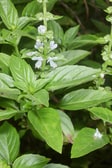
Axillary flowers are white with a purple tint outside, about 5 cm (2 in) across, with four to six petals and 20 to 25 yellow-anthered stamens. They appear mainly in March and April in the Northern Hemisphere, although flowering can recur almost year-round in favorable conditions. 3
The small, round fruit measures 2.5–5 cm (1–2 in) across. Its thin rind, 1.5–3 mm (about 1/16–1/8 in) thick, changes from bright green to pale yellow at full maturity. The intensely acidic, greenish pulp has six to 15 segments, with few or many seeds depending on pollination. 3
Useful taxonomy
Swingle's combination, published in 1913, provides the name accepted by Plants of the World Online; the basionym dates to 1777. Two names are particularly useful when tracing older records:
- Limonia × aurantiifolia Christm. is the historical basionym.
- Citrus × aurantiifolia subsp. murgetana García Lidón & al. is a recognized taxonomic synonym.
A 2018 genetic study described Mexican lime as a triploid hybrid, resulting from a cross between a doubled-diploid lime and a second papeda parent. This unusual triploid status among citrus distinguishes Mexican lime from Persian lime (Citrus × latifolia). Plants of the World Online treats the latter as a separate hybrid species, rather than a synonym of Citrus × aurantiifolia. 6 1
Habitat and range
No wild population has been confirmed, and Plants of the World Online classifies Key lime as a cultigen with a broad geographical origin associated with the eastern Himalayas. 1
Medieval trade introduced it to Egypt and the Mediterranean, reflected in the name Egyptian lime. Spanish settlers then brought it to the Americas: cultivation was already widespread in Haiti by 1520. In the United States, it became a commercial specialty of the Florida Keys during the 19th century, until a hurricane destroyed most of those orchards in 1926. 3
Mexico leads global lime production, followed by India, where Kagzi encompasses numerous regional ecotypes. French cultivation remains limited, chiefly in pots moved under cover when temperatures approach 5 °C (41 °F). That temperature advice concerns cold-prone conditions rather than a fixed calendar date. 2 3
Life cycle and reproduction
Polyembryonic seeds make Key lime unusually straightforward to propagate in warmth. They germinate in two to three weeks and usually produce a plant matching the parent type, unlike lemon seeds, which do not faithfully reproduce the fruiting variety. 7
A seedling can flower from two years of age, earlier than a grafted lemon. Flowering may recur almost throughout the year in a suitable climate, allowing buds, flowers and fruit at several stages to coexist on one tree. Individual fruit ripens in three to four months, much faster than a typical lemon. 3
Uses and risks
Intensely acidic juice flavors tropical and Caribbean cooking, from Peruvian ceviche to West Indian ti-punch, and cocktails such as mojitos and margaritas. The leaves also have culinary uses, especially in soups; dried rind is used in some confectionery and perfumery. 7 3
The ASPCA lists lime as toxic to dogs, cats and horses. Its essential oils and psoralens cause vomiting and diarrhea, and exposed skin may develop contact dermatitis. These animal risks remain distinct from the fruit's established food uses for people. 4
For people, the main risk involves skin: juice or zest left on skin before sunlight exposure can cause phytophotodermatitis, a burn followed by lasting pigmentation. Thorns on young branches can also injure hands during harvesting. 2
Varieties, look-alikes and related plants
Cultivars differ in habit and geographical origin. Kagzi includes the most widely grown Indian ecotypes, with small, very juicy fruit. Palmetto has smooth skin and compact fruit. A thornless sport, which appeared in California around 1882 and is sometimes sold as Mexican Thornless, makes hand harvesting easier by removing the risk of thorn punctures. 3
Persian lime (Citrus × latifolia) creates the most frequent confusion, since it supplies the limes sold in many supermarkets. Larger, seedless and less acidic than Mexican lime, it largely replaced it after the decline of Florida's orchards. Plants of the World Online recognizes Persian lime as a hybrid species in its own right. 1
Two related citrus plants also need separating:
- Makrut lime (Citrus hystrix) has double-lobed leaves and bumpy fruit; it is grown for zest and leaves rather than juice.
- Lemon (Citrus × limon) has larger, oval fruit, yellow even when immature, with less acidic juice than Key lime.
Seed count offers the simplest buying clue: Mexican limes have many seeds, while Persian limes have none.
Main sources
- Plants of the World Online / Kew, Citrus × aurantiifolia (Christm.) Swingle
- Royal Horticultural Society, Citrus × aurantiifolia (F)
- Morton J., 1987, Mexican Lime, in Fruits of Warm Climates, Purdue University
- ASPCA, Lime toxicity entry
- Curk et al., 2016, Phylogenetic origin of limes and lemons, Annals of Botany
- Rouiss et al., 2018, Origin of C. latifolia and C. aurantiifolia triploid limes, Annals of Botany
- Plants For A Future, Citrus aurantiifolia
- Wikipedia, Key lime (French article)
- Wikipedia, Key lime
Frequently asked questions
Is Key lime toxic to cats and dogs?
Yes. The ASPCA lists Key lime as toxic to dogs, cats and horses because of essential oils and psoralens in the leaves, bark and sap. The fruit itself is edible.
How does Key lime differ from Persian lime?
They are distinct species. Plants of the World Online treats Persian lime (Citrus × latifolia) as a separate hybrid with larger, seedless fruit that is less acidic than Key lime, Citrus × aurantiifolia.
Why is Key lime easy to grow from seed?
Its polyembryonic seeds usually produce plants matching the parent type, unlike lemon seedlings, which do not reliably reproduce the fruiting variety.
What is the lowest temperature Key lime can tolerate?
It is more cold-sensitive than lemon. Growth stops below 13 °C (55 °F), and frost below 0 °C (32 °F) is generally fatal, so plants in temperate climates need pots that can be brought under cover in fall.
Are Key lime and makrut lime the same plant?
No. Makrut lime (Citrus hystrix) is a distinct species with double-lobed leaves and bumpy fruit, grown for its zest and leaves rather than its juice.
Where does the name Key lime come from?
It refers to the Florida Keys, where the plant was grown commercially from the 19th century until a major hurricane destroyed most of the orchards in 1926.
Can Key lime grow in France?
Yes, mainly in pots. Its sensitivity to cold means it needs bright shelter when temperatures approach 5 °C (41 °F), unlike some citrus that can grow outdoors in Mediterranean areas.
Similar plants


If you are unsure about a plant’s toxicity, ask a botanist or veterinarian for advice.