
Horseradish (Armoracia rusticana, )
Horseradish (Armoracia rusticana) is an herbaceous perennial in the Brassicaceae family, native to southeastern Europe and western Asia. Its fleshy white taproot becomes pungent only when cut or grated, as an enzyme releases irritating sulfur-containing oils. Cultivated for centuries for its root and young leaves, it has naturalized on almost every continent. Root fragments provide its main means of propagation because most cultivated varieties produce few viable seeds.
Read moreHorseradish
Allow a few hours of direct sun per day, preferably morning or evening.
Full sun to light partial shade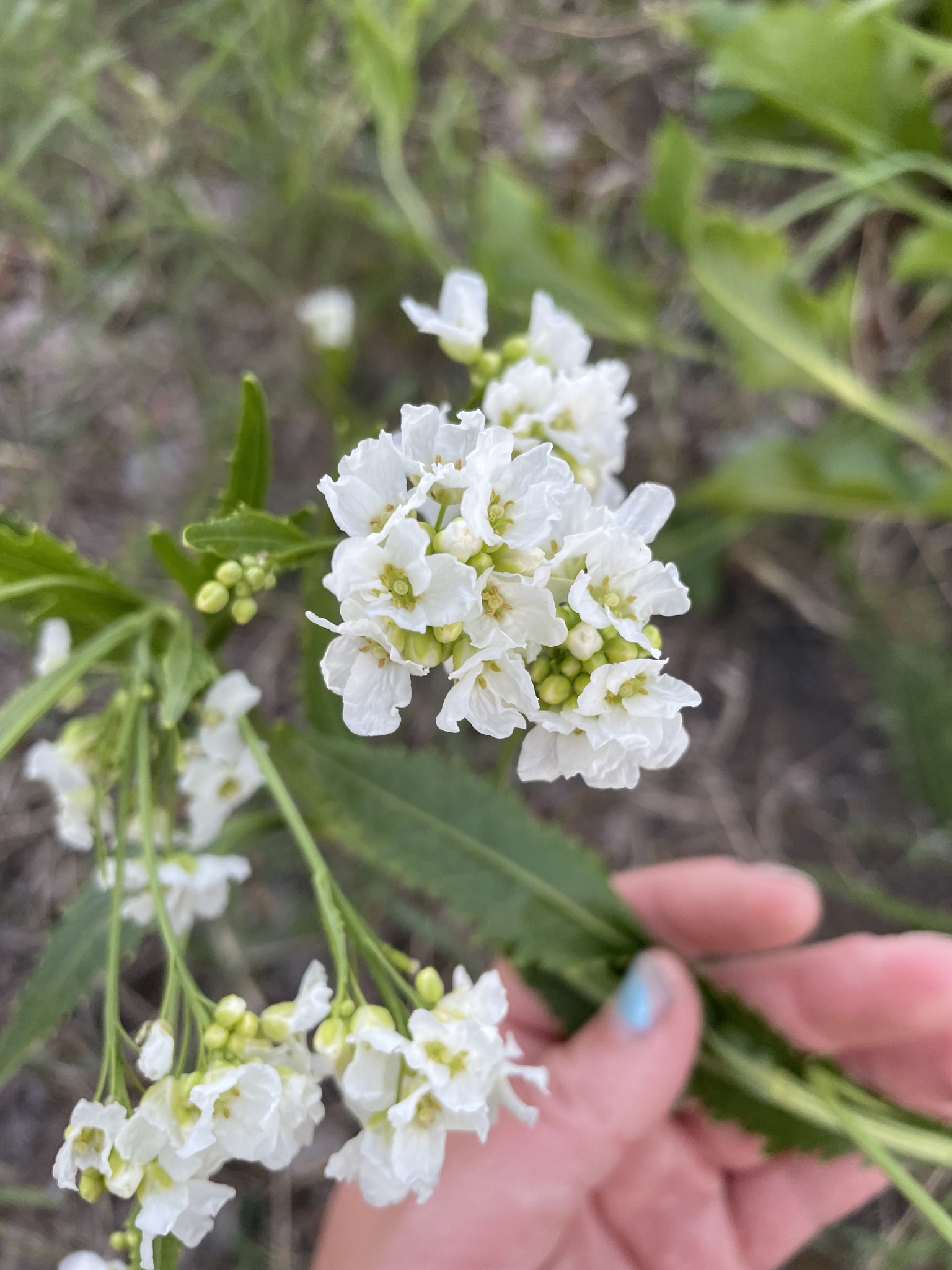



© photo
Allison McCabe · cc0
Stephen James McWilliam · cc0
iNaturalist User · cc0
Taken Jun 24, 2019 by Marino4572 (cc-by-sa)
Taken Jan 1, 1970 by Photoflora - L'Abbé COSTE (©)
Taken Jun 17, 2022 by Pekka Salokangas (cc-by-sa)
Taken Oct 18, 2022 by Martina Busse (cc-by-sa)
Taken Jan 1, 1800 by Tela Botanica − Thierry Pernot (cc-by-sa)
© copyright of the Board of Trustees of the Royal Botanic Gardens, Kew.


Global distribution
Armoracia rusticana is native to southeastern Europe and western Asia, from southern Ukraine to southern European Russia. Centuries of cultivation for its root have allowed horseradish to naturalize far beyond this range in western Europe, North America and East Asia. Its native occurrence should be distinguished from cultivated plants and garden escapes.
- Native2
- Introduced2
- Ukraine
- Russia
- United States
- Canada
Hexagons: regions where the plant occurs. Green dots: native range.1
Identity
Horseradish (Armoracia rusticana G.Gaertn., B.Mey. & Scherb., 1800) is an herbaceous perennial in the genus Armoracia and the Brassicaceae family. Its fleshy white taproot reaches 60 cm (2 ft) long and about 5 cm (2 in) in diameter. Freshly grated, it releases the pungency that is the principal reason for growing the plant. 4 1
In the English name horseradish, horse- indicates something larger or coarser than the ordinary radish, rather than a veterinary use. The French name raifort follows a related idea: it contracts Old French raiz forz, strong root, inherited from the Latin radix and fortis. Both names point toward the character of the root, although they reach it through different words. 6
Recognition
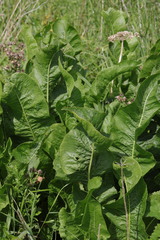
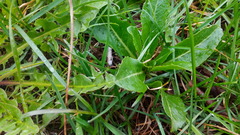
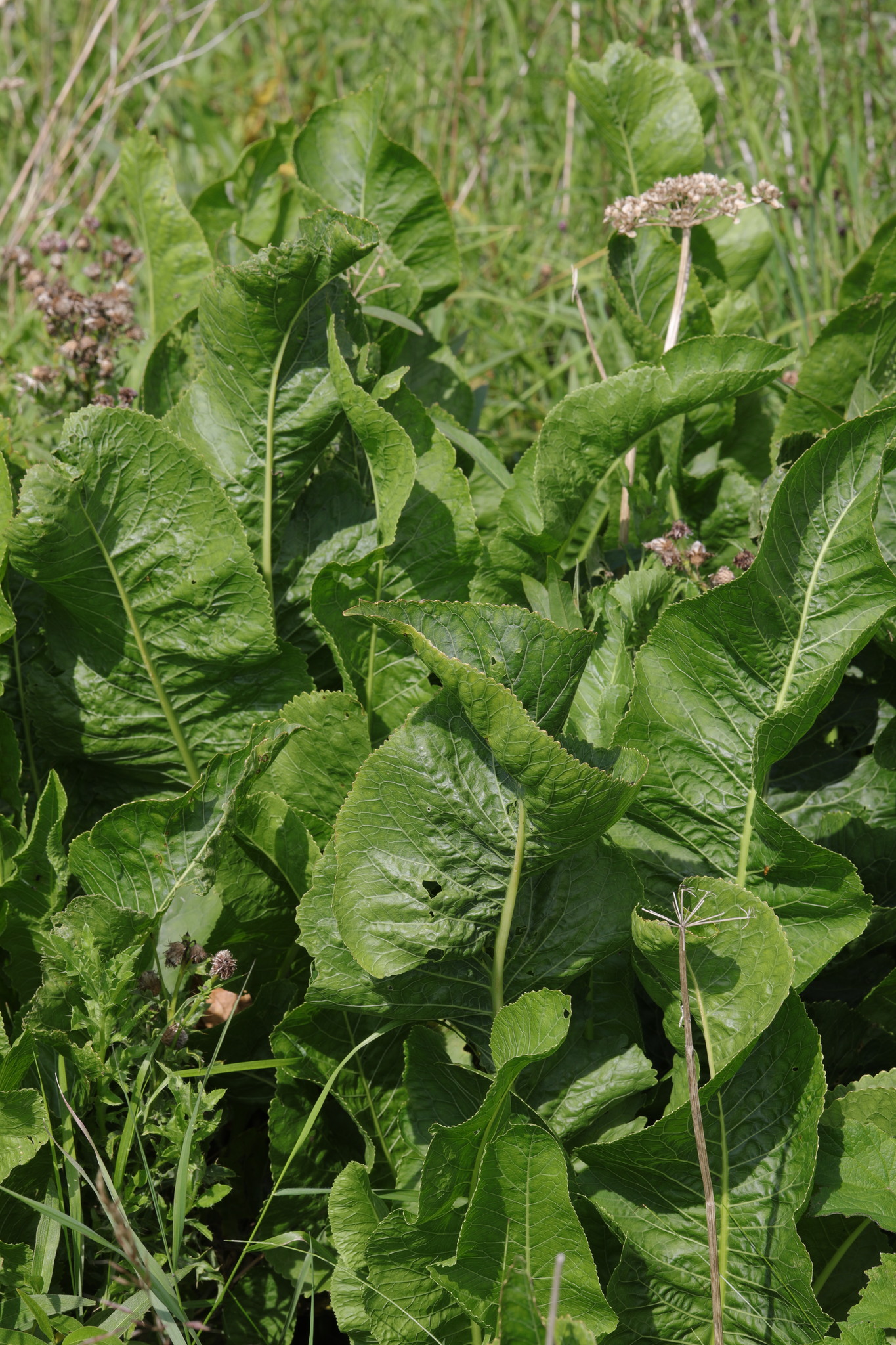
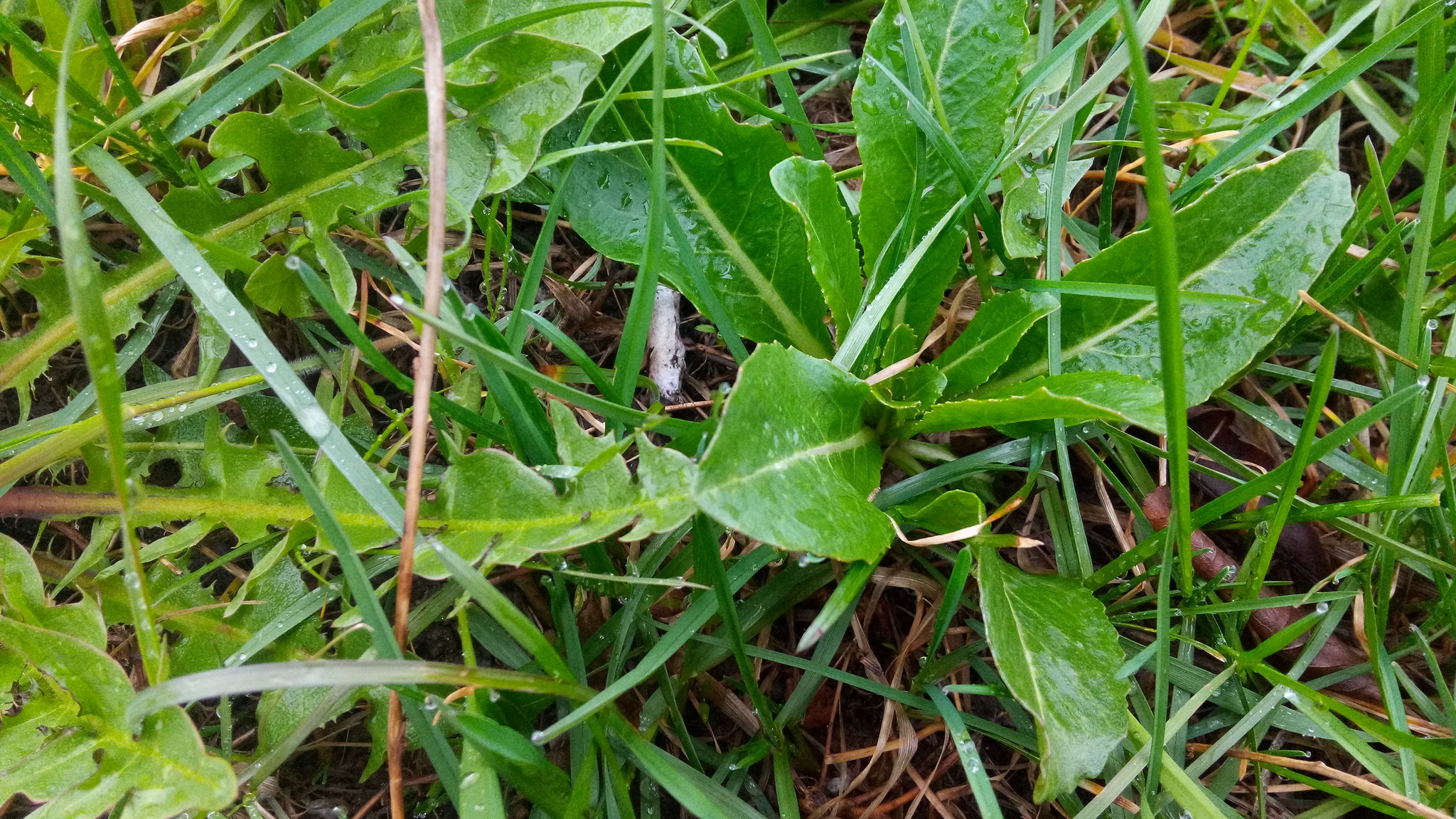
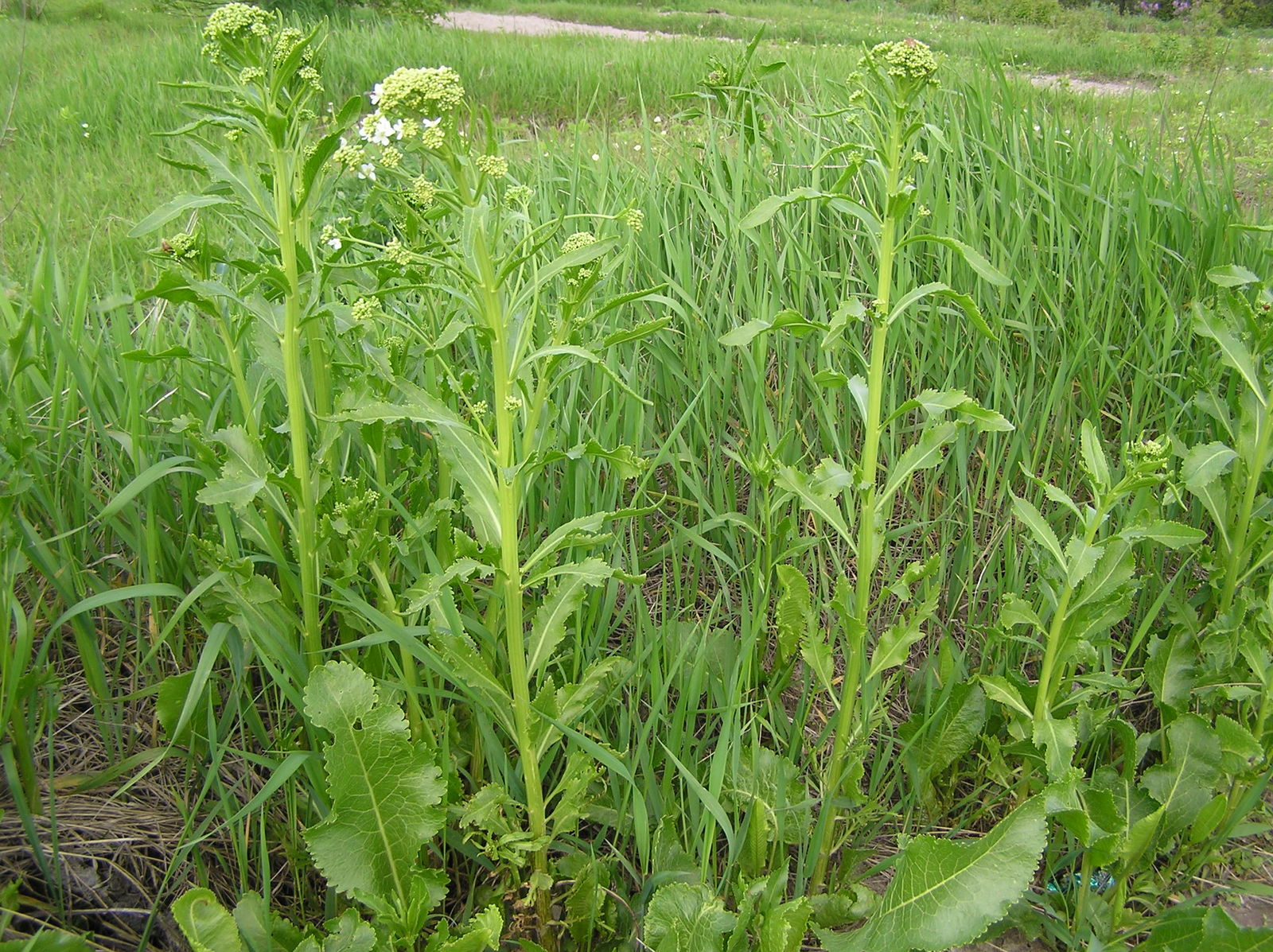
Broad, glossy leaves form a large basal rosette, with wavy, toothed margins recalling sorrel or dock. Individual leaves may exceed 50 cm (20 in) long. A mature plant commonly stands 60 cm to 1.5 m (2–5 ft) tall and spreads 60–90 cm (2–3 ft) across. Its spreading root system extends well beyond the visible foliage, so the aboveground clump gives only part of the picture. 6 5
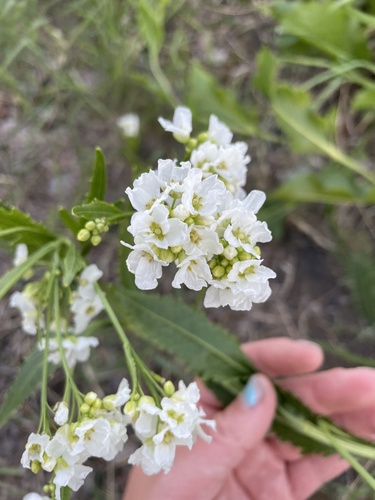
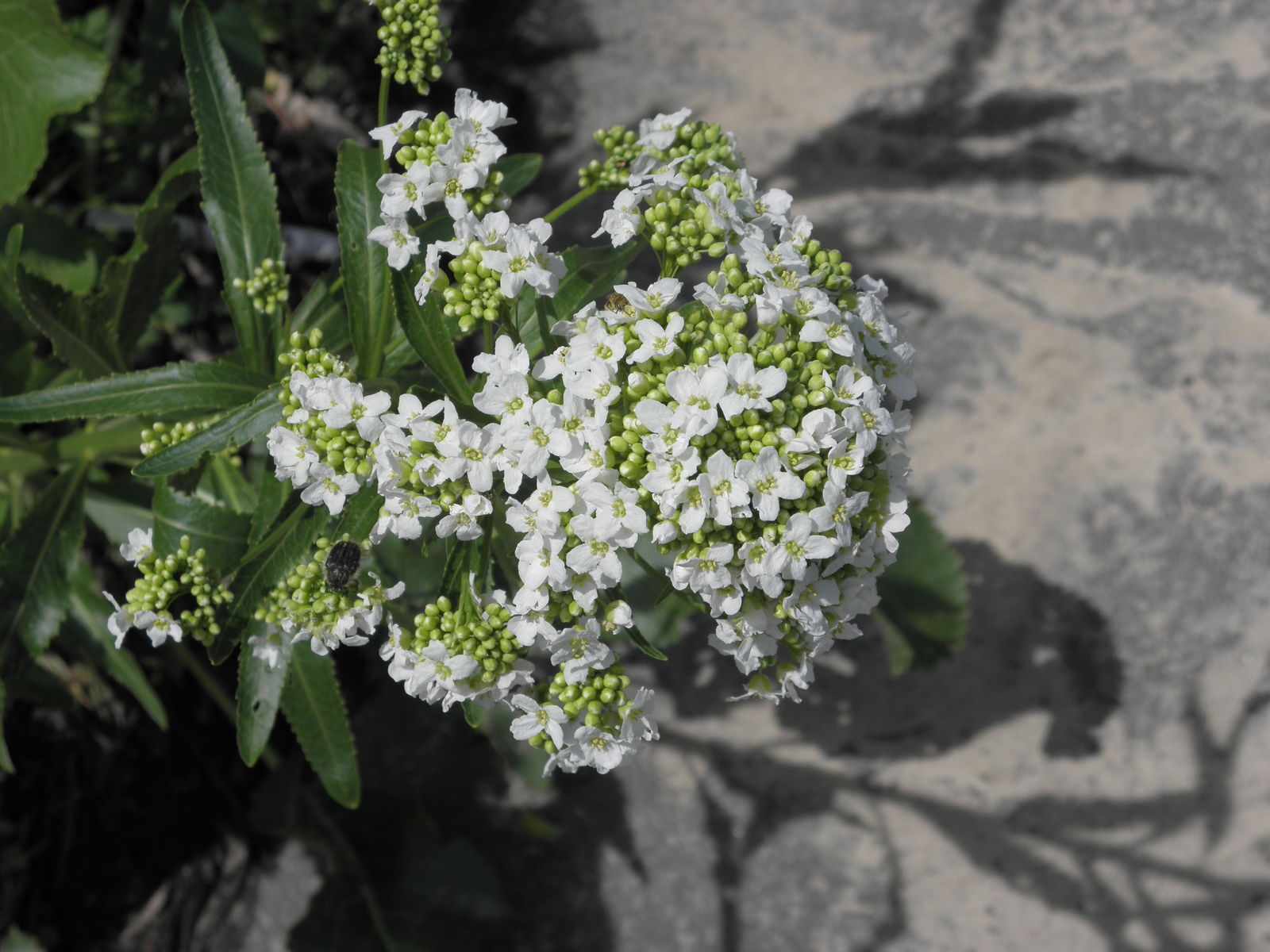
Small white flowers with four petals appear in upright clusters in late spring and summer. Their modest appearance contrasts with the vigorous leaves. Cultivated plants rarely produce viable seed because most modern varieties are sterile or have low fertility. Horseradish therefore spreads almost entirely through root fragments, an important aspect of its biology outside the flowering season. 4 5
An intact root has none of the characteristic pungency released by damaged tissue. Cutting or grating brings an enzyme into action, transforming odorless sulfur-containing compounds into irritating volatile oils. The sharp smell and taste therefore develop after the root is injured, rather than being present in the same form throughout undamaged tissue. 4
Useful taxonomy
POWO/WCVP accepts Armoracia rusticana G.Gaertn., B.Mey. & Scherb., published in 1800 from the basionym Cochlearia armoracia L., 1753. Several competing combinations circulated before the present generic placement became established. Historical synonyms include:
- Cochlearia armoracia L., the original name
- Nasturtium armoracia (L.) Fr., a historical combination
- Rorippa armoracia (L.) Hitchc., a historical combination
- Armoracia armoracia (L.) Cockerell ex Daniels, a historical combination
- Cochlearia rusticana Lam., a synonym
- Armoracia rustica Schur, a synonym
Cabbage, mustard, radish and oilseed rape also belong to the Brassicaceae. Horseradish shares their glucosinolate-based defensive chemistry: these compounds release a comparable pungency when tissues are damaged. It nevertheless remains a distinct species, with no notable commercial hybridization involving those familiar vegetable relatives. 1 8
Habitat and range
Southeastern Europe and western Asia hold the native range, from southern Ukraine to the southern part of European Russia. This original distribution is narrower than the broad area in which cultivated or escaped horseradish is now encountered, and the two should be distinguished when interpreting records. 8
Centuries of cultivation for the root have taken horseradish far beyond that native range. Naturalized populations occur in western Europe, Russia, China, Japan, New Zealand and North America. On the latter continent, its distribution stretches from Canada to the southwestern United States, reflecting its long movement alongside cultivation. 8
Commercial US growing became established in the Midwest from the middle of the 19th century. The cited production account gives an annual harvest of about 24 million pounds, approximately 11,000 metric tons, concentrated mainly in Illinois. This regional industry illustrates the importance of the crop well beyond its European and western Asian origins. 7
Life cycle and reproduction
Upright flower stalks carry small white blooms in late spring and summer. Because viable seeds are scarce, commercial growers and home gardeners chiefly propagate through root fragments. These are planted at an angle in spring, at intervals of about 12–15 cm (5–6 in) in the method described by the cited sources. Vegetative propagation preserves the crop even where seed production is poor. 7 4
Root growth peaks in late summer and early fall, when cooler conditions concentrate starch and strengthen pungency. Harvest comes in fall or winter, after the first frosts improve flavor. Roots remaining in the ground can be harvested through winter, allowing the crop to stay in place until needed rather than requiring the entire root system to be lifted at once. 3 6
Even a small root fragment left in the ground readily starts growing again. Once established, the plant is consequently difficult to eradicate completely. This persistence is useful to a grower maintaining a crop, but inconvenient in a garden where the aim is to restrict it to a particular bed. 4
Uses and risks
Freshly grated root supplies the sharp, pungent condiment commonly served with meat, smoked fish and hard-boiled eggs or mixed into dressings. Culinary use remains the main reason for cultivation. Young leaves are also edible, either raw in salads or cooked as a vegetable, providing a milder alternative to the strongly flavored root. 4
Horseradish is not classified as toxic to cats, dogs or humans. Large amounts can nevertheless irritate digestive and respiratory mucous membranes through volatile sulfur-containing oils. Pregnant or breastfeeding people, and those with thyroid, kidney or stomach disorders, have reason to limit the quantities consumed. The distinction is between ordinary food use and the effects of excessive intake. 4
Horseradish also has a symbolic place among the bitter herbs, or maror, served at the Passover meal in Jewish tradition. Its bitterness recalls the suffering of slavery in Egypt, giving the same pungent root a ritual role as well as an everyday culinary one.
Varieties, look-alikes and related plants
Two historical strains dominate horticultural accounts. Bohemian has smooth leaves and accounts for most present-day North American production. The older crinkled-leaved strain, often called Maliner Kren, is more disease-prone but remains valued for flavor. An ornamental form sold as Variegata has white-variegated foliage and is grown chiefly for its appearance. 6
Japanese wasabi, Eutrema japonicum, is the best-known culinary look-alike. It is another Brassicaceae with a similar pungent chemical profile, but it is much more demanding and costly to cultivate. Much of the green paste sold as wasabi outside Japan is therefore colored horseradish, reflecting the limited production of the true wasabi plant. 8
Before flowering, horseradish leaves can resemble those of burdock (Arctium) or sorrel and dock (Rumex). Those plants have brown, fibrous roots lacking the same sharp flavor. The white, fleshy and markedly pungent horseradish root contrasts with both; breaking it reveals the characteristic sharpness that the intact root does not release.
Main sources
- Plants of the World Online / Kew, Armoracia rusticana G.Gaertn., B.Mey. & Scherb.
- Royal Horticultural Society, Armoracia rusticana (horseradish)
- Royal Horticultural Society, How to grow horseradish
- Plants For A Future, Armoracia rusticana
- Missouri Botanical Garden Plant Finder, Armoracia rusticana
- NC State Extension Gardener Plant Toolbox, Armoracia rusticana
- University of Missouri IPM, Horseradish - America's Favorite Root
- USDA GRIN Taxonomy, Armoracia rusticana
Frequently asked questions
Are horseradish and wasabi the same plant?
No. Japanese wasabi, Eutrema japonicum, is also a Brassicaceae with similar pungent chemistry, but it is much more demanding and expensive to grow. Much of the green paste sold as wasabi outside Japan is colored horseradish because true wasabi production cannot meet demand.
Is horseradish toxic to cats and dogs?
No, horseradish is not classified as toxic to pets or humans. Large amounts can nevertheless irritate the digestive tract because of its volatile sulfur-containing oils.
Why does horseradish lose its heat when cooked?
Its pungency comes from an enzymatic reaction triggered when tissues are damaged. Heat destroys the responsible enzyme before it can act, so cooked root quickly loses its sharpness.
Can you eat horseradish leaves?
Yes. Young leaves can be eaten raw in salads or cooked as a vegetable. Their flavor is milder and less pungent than the root.
Can horseradish take over a garden?
Yes. Even small root fragments left in the ground readily regrow, making an established plant difficult to remove. A large container or a barrier around the roots limits its spread.
How do you propagate horseradish?
Plant root fragments at an angle in spring rather than sowing seeds. Cultivated plants produce few viable seeds, so vegetative propagation is much more reliable.
What does the French name raifort mean?
The French name comes from Old French raifort, a contraction of raiz forz, meaning strong root. It directly describes the pungency of the harvested root.
Similar plants
If you are unsure about a plant’s toxicity, ask a botanist or veterinarian for advice.