
Japanese mugwort (Artemisia princeps, )

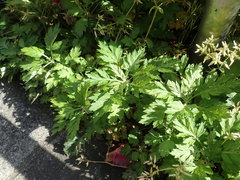

Japanese mugwort (Artemisia princeps Pamp., 1930), also called yomogi, is an aromatic herbaceous perennial in the Asteraceae family, native to China, Japan and Korea. Vigorous underground rhizomes quickly colonize disturbed ground. Its divided leaves, woolly and whitish beneath, have a long culinary and ritual history in East Asia, from yomogi mochi to the Korean founding legend of Gojoseon.
Read moreJapanese mugwort, Yomogi, Ssouk, Korean mugwort and Korean wormwood
Allow a few hours of direct sun per day, preferably morning or evening.
Full sun; tolerates light partial shade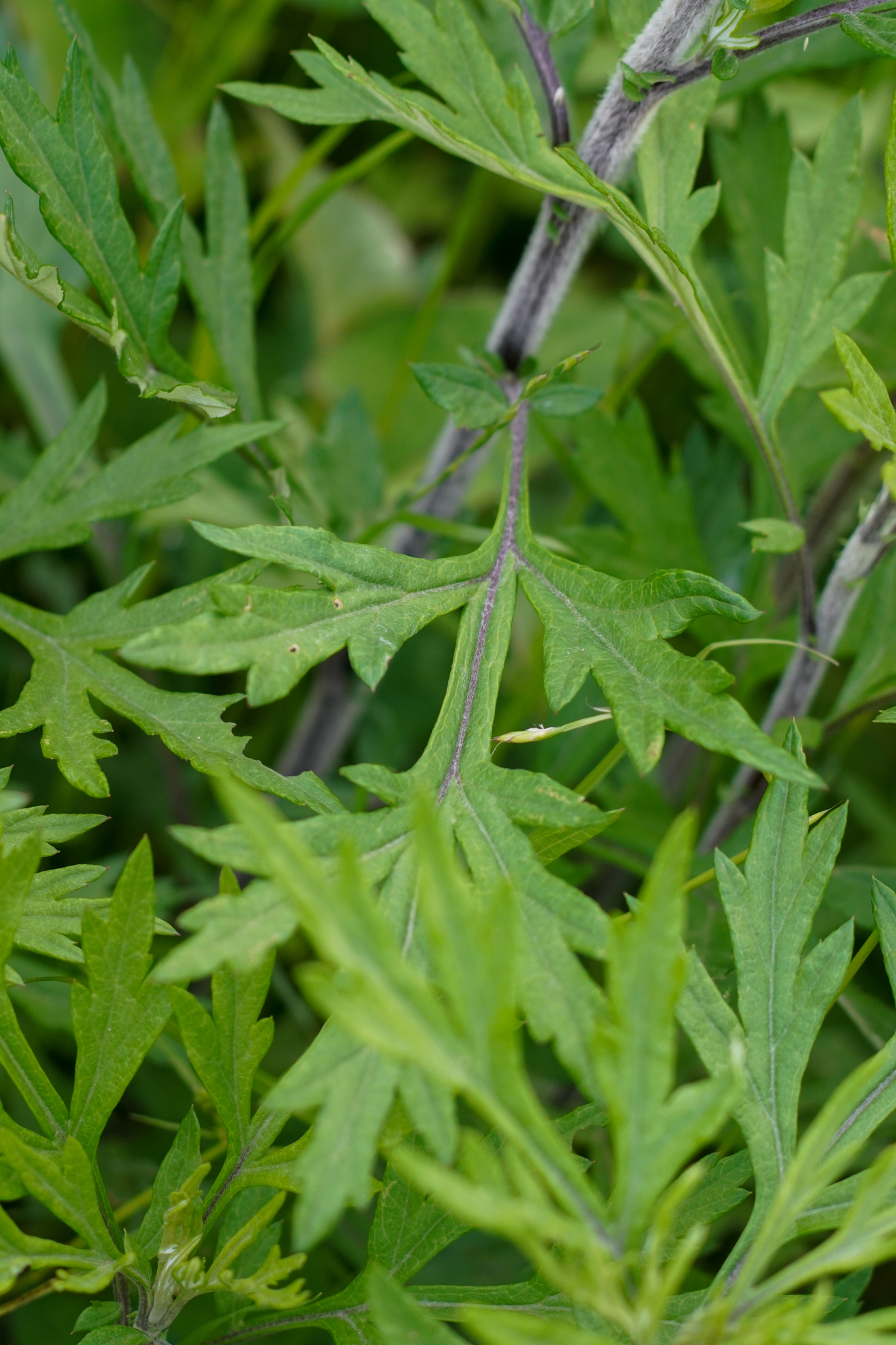

© photo
(c) WATANABE Hitoshi 渡辺仁, some rights reserved (CC BY), uploaded by WATANABE Hitoshi 渡辺仁 · cc-by
Yoshihiro Tokue · cc-by
Wikimedia Commons · CC BY-SA or Public Domain


Global distribution
POWO summarizes the native range as temperate China to temperate East Asia. Flora of China details occurrences in around twenty Chinese provinces, plus Japan and Korea. Outside Asia the species is mainly grown for practical or ornamental use; its spreading rhizomes require caution comparable to that needed with Artemisia vulgaris.
Identity
Japanese mugwort (Artemisia princeps Pamp., 1930) is an aromatic herbaceous perennial in the Asteraceae family and the genus Artemisia. POWO places its native range from temperate China to temperate East Asia. 1
English names include Japanese mugwort, Korean mugwort and Korean wormwood. The plant also circulates under its names of origin: yomogi in Japan and ssouk in Korea. These names refer here to the same species. 5
The epithet princeps means “first” or “principal” in Latin, distinguishing this East Asian mugwort within a genus of several hundred species across the Northern Hemisphere.
Recognition
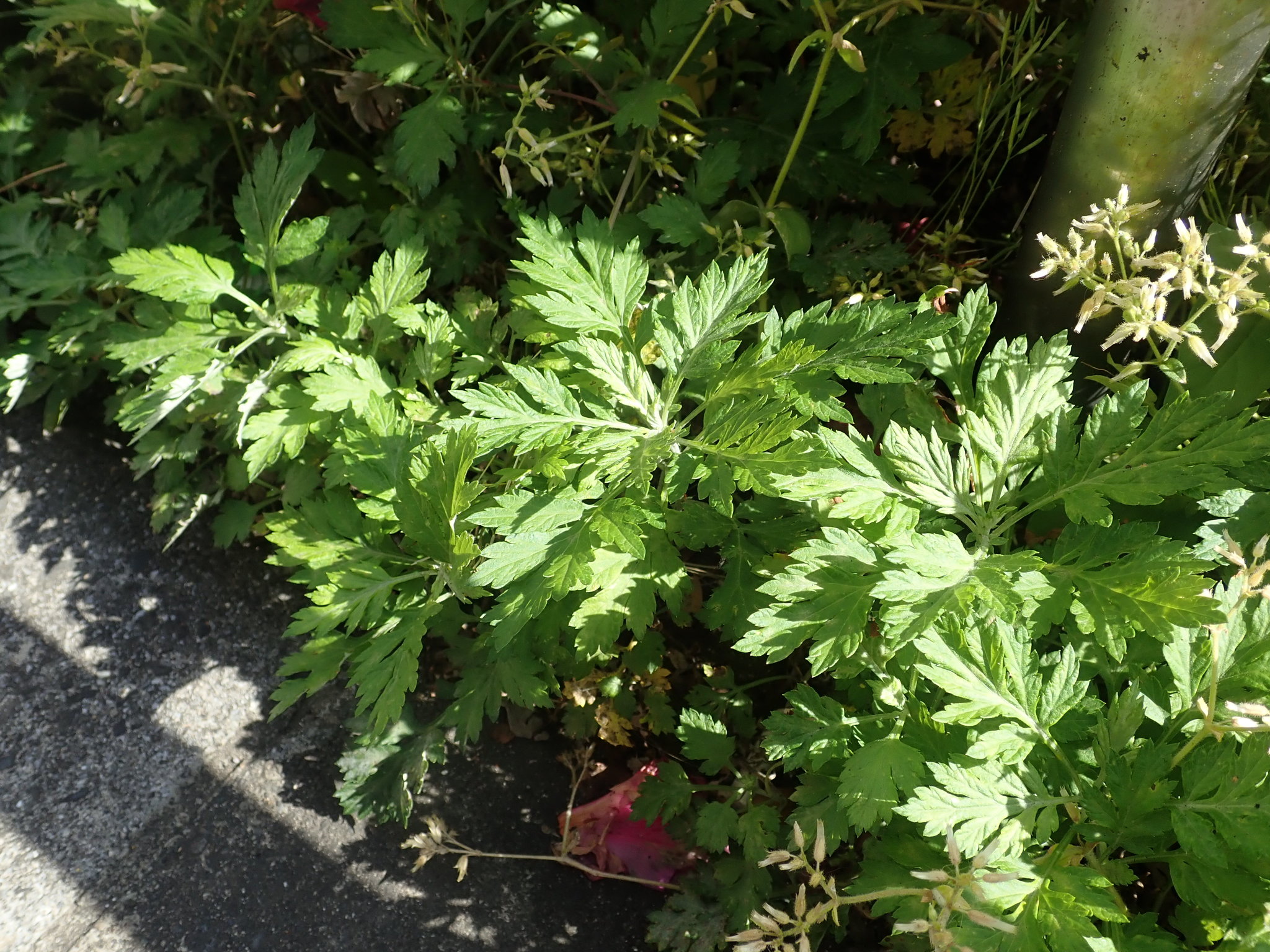
Flora of China describes an upright clump 60 cm to 1.5 m (2–5 ft) tall, with stems sparsely to densely covered in cobweb-like hairs. Branching is concentrated in the upper third. 4
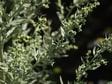
Once- or twice-divided leaves are light green and nearly hairless above, but densely woolly and whitish beneath. This cottony underside, paler than that of common mugwort, traditionally supplies the material for moxa. Mid-stem leaves commonly measure 6–12 cm (2.4–4.7 in) long. The clear contrast between the light green upper surface and whitish underside helps identify the species outside flowering season. 4
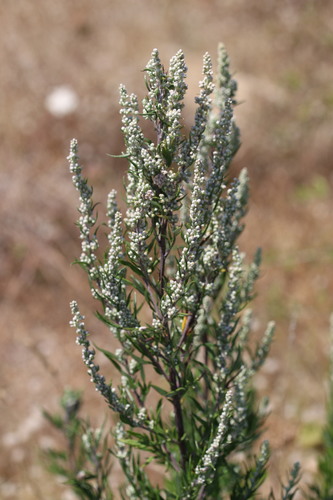
From July to November in its Northern Hemisphere range, tiny flower heads just 1.5–2.5 mm (0.06–0.1 in) wide form broad, oblong panicles. Each carries 5–7 marginal female florets and 4–9 central bisexual florets. These inconspicuous flowers explain why identification relies more on foliage than on the blooms. 4
Useful taxonomy
Kew accepts Artemisia princeps Pamp. as a species distinct from Artemisia vulgaris and Artemisia indica, despite considerable overlap in their synonymy. Important historical names include: 1
- Artemisia vulgaris var. maximowiczii Nakai, a historical combination
- Artemisia lavandulifolia var. maximowiczii (Nakai) Pamp., another historical combination
- Artemisia indica var. maximowiczii (Nakai) H.Hara, a further historical combination
- Artemisia parvula Pamp., a synonym
- Artemisia montana (Nakai) Pamp., another synonym
A nomenclatural trap concerns orientalis. Despite its name, Artemisia princeps var. orientalis H.Hara is now assigned by POWO to Artemisia indica var. indica, rather than Artemisia princeps. Without the full scientific name and author, the epithets maximowiczii or orientalis alone cannot resolve the identity: they circulate among three neighboring species under different botanical interpretations. 1 3
Habitat and range
In temperate China, Flora of China records the species in around twenty provinces, as well as in Japan and Korea. It grows along roadsides, slopes, scrub, woodland edges, valleys and riverbanks, from sea level to about 1,400 m (4,590 ft). 4
Spreading rhizomes let a clump expand rapidly in disturbed soil. Even a buried fragment can regenerate a new colony, a behavior shared with common mugwort. 6 Along a bed edge or in a shared container, those rhizomes can quickly crowd out neighboring spring bulbs unless a physical root barrier separates them.
Outside East Asia, Artemisia princeps remains mainly a cultivated plant valued for culinary or traditional uses, rather than a widely documented weed. Container cultivation is a sensible precaution wherever a gardener wants to limit its spread. 5
Life cycle and reproduction
Perennial rootstocks and rhizomes send up fresh upright stems each spring, followed by flowering from July to November in the Northern Hemisphere. PFAF confirms rapid growth, favored by poor, dry, well-drained soil rather than rich growing media. 6 Without cutting back after flowering, the heads set seed and self-sown plants can quickly spread into an adjacent bed.
Surface sowing from late winter to early summer, clump division, and basal cuttings in spring or autumn all provide means of propagation. Young shoots 10–15 cm (4–6 in) long are harvested in late spring for food, before the stems harden. 6
Poor soil also supports longevity and aroma. PFAF states that plants grown in dry, relatively infertile ground survive longer than those in rich soil, despite the species' vigorous vegetative growth. 6
Traditional and cultural uses
Young leaves and shoots are eaten raw or cooked in East Asia. They are often pounded into Japanese kusa mochi, glutinous rice cakes, after cooking has reduced their bitterness. 6
Woolly hairs from the leaf undersides traditionally supply moxa, the plant material burned in moxibustion. The word derives from Japanese mogusa, a contraction of yomogi. This controlled burning practice, associated with acupuncture, has been passed down in East Asia for centuries. 5
Korean tradition calls the plant ssouk and gives it a central role in the founding story of Gojoseon. A bear and a tiger are told to eat only mugwort and garlic for one hundred days, away from sunlight, to become human. Only the bear completes the trial, becoming the woman Ungnyeo and later giving birth to Dangun, the kingdom's legendary founder. 8
Toxicity and look-alikes
Neither PFAF nor the usual toxicological databases classifies Artemisia princeps among plants toxic to domestic animals through ingestion. The risk documented by PFAF concerns skin contact: handling crushed foliage with bare hands can cause contact dermatitis or an allergic reaction in sensitive people. 6
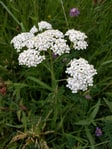
Confusion involves three neighboring mugworts with woolly foliage: Artemisia vulgaris, more widespread in Europe; Artemisia indica, which absorbs part of the princeps synonymy under some botanical interpretations; and Artemisia montana, sometimes treated simply as a synonym. The full scientific name with its author remains the most reliable guide through this overlap. 1 7
Main sources
- Plants of the World Online / Kew, Artemisia princeps Pamp.
- International Plant Names Index, Artemisia princeps Pamp.
- GBIF Backbone Taxonomy, Artemisia princeps Pamp.
- Flora of China, Artemisia princeps Pampanini
- Royal Horticultural Society, Artemisia princeps
- Plants For A Future, Artemisia princeps
- NCBI Taxonomy, Artemisia princeps
- Encyclopaedia Britannica, Tangun (Dangun) legend of Gojoseon
Frequently asked questions
Is Japanese mugwort the same as common mugwort?
No. POWO treats Artemisia princeps and Artemisia vulgaris as distinct species, although their synonymy overlaps considerably around the epithet maximowiczii. Japanese mugwort has paler upper leaf surfaces and more densely woolly undersides.
What does yomogi have to do with moxa?
Moxa comes from the Japanese word mogusa, derived from yomogi, the name for Japanese mugwort. Its dried, crushed leaves traditionally supply the plant material burned in moxibustion.
Is Japanese mugwort toxic?
Neither PFAF nor the usual toxicological databases classifies it among plants toxic to domestic animals. PFAF chiefly records contact dermatitis in people sensitive to the foliage, rather than ingestion toxicity.
Can you eat Japanese mugwort?
Young leaves and shoots are traditionally eaten raw or cooked in East Asia, notably pounded into Japanese kusa mochi rice cakes after cooking to reduce bitterness.
Is Japanese mugwort invasive?
Within its native East Asian range, it quickly colonizes disturbed soils through spreading rhizomes. Elsewhere it remains mainly cultivated. Growing it in a container is a cautious way to prevent uncontrolled spread.
How does Japanese mugwort feature in the Gojoseon legend?
In the Korean founding myth, a bear becomes a woman after eating mugwort and garlic for one hundred days, then gives birth to Dangun, the legendary founder of Gojoseon. Mugwort has remained associated with spring in Korea.
Similar plants
If you are unsure about a plant’s toxicity, ask a botanist or veterinarian for advice.