
Common mugwort (Artemisia vulgaris, )
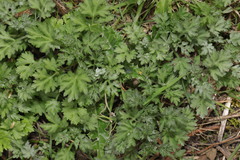
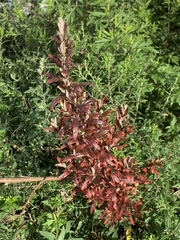
Common mugwort (Artemisia vulgaris L.) is an aromatic herbaceous perennial in the Asteraceae, native across temperate Eurasia and North Africa. Its divided leaves are dark green above and woolly white beneath. Called the mother of herbs in medieval Europe, it has a long history of traditional use, with particular cautions during pregnancy and a risk of confusion with wormwood.
Read moreCommon mugwort, Mugwort and Felon herb

© photo
(c) Valentin Hamon, some rights reserved (CC BY-NC), uploaded by Valentin Hamon · cc-by-nc
Stephen James McWilliam · cc0
Sandy Wolkenberg · cc-by
(c) Sandy Wolkenberg, some rights reserved (CC BY) · cc-by
no rights reserved · cc0
Global distribution
POWO gives a broad native range from temperate Europe to Indochina, including North Africa and metropolitan France. Outside Eurasia, behavior differs: NC State Extension describes it as highly invasive in North America, where spreading rhizomes colonize disturbed soil.
- Native5
- Introduced1
- Invasive1
- Metropolitan France
- Continental Europe
- North Africa
- Temperate Asia to Indochina
- United Kingdom
- New Zealand
- North America
Hexagons: regions where the plant occurs. Green dots: native range.1
Identity
Common mugwort (Artemisia vulgaris L., 1753) is an aromatic herbaceous perennial in the Asteraceae and the genus Artemisia. POWO accepts the name published by Linnaeus in 1753. Its native range extends across temperate Europe and Asia to Indochina, including North Africa. 1
The familiar English names mugwort and felon herb refer to this species. In France, INPN records the names armoise commune and herbe de feu; older regional traditions also use herbe de la Saint-Jean. These names describe the same plant rather than separate botanical species. 6
Artemis, the Greek goddess, gives the genus its name. During the Middle Ages, mugwort was known as mater herbarum, the mother of herbs, reflecting its central place in traditional medicine. 8
Recognition
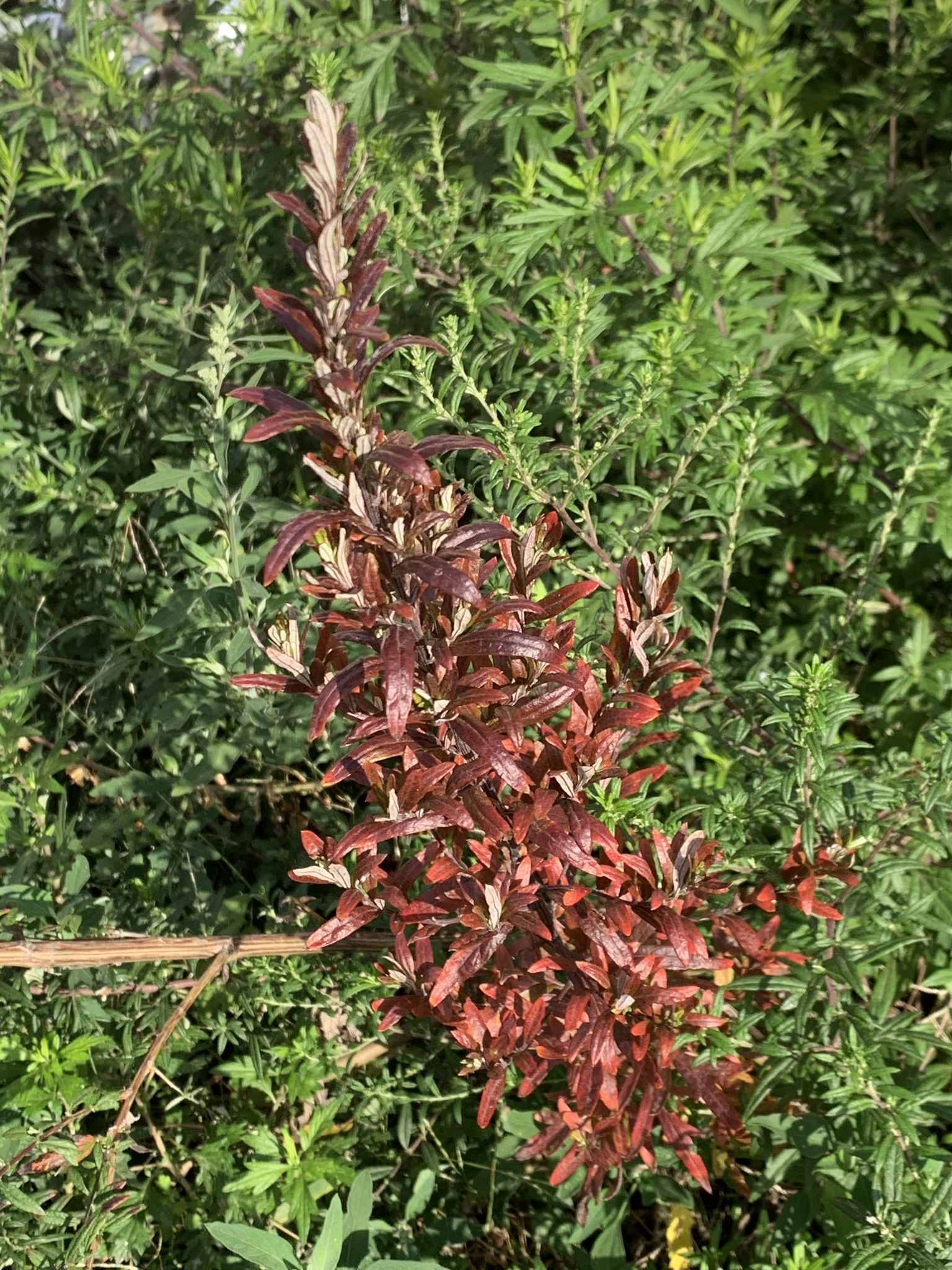
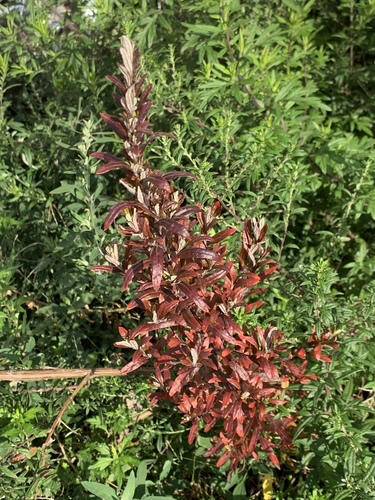
An upright mugwort clump reaches 50 cm to 2 m, exceptionally 2.5 m according to RHS. Its ridged stems are often reddish and hairy, providing a useful first clue when the plant is growing among other tall herbs. 2 6
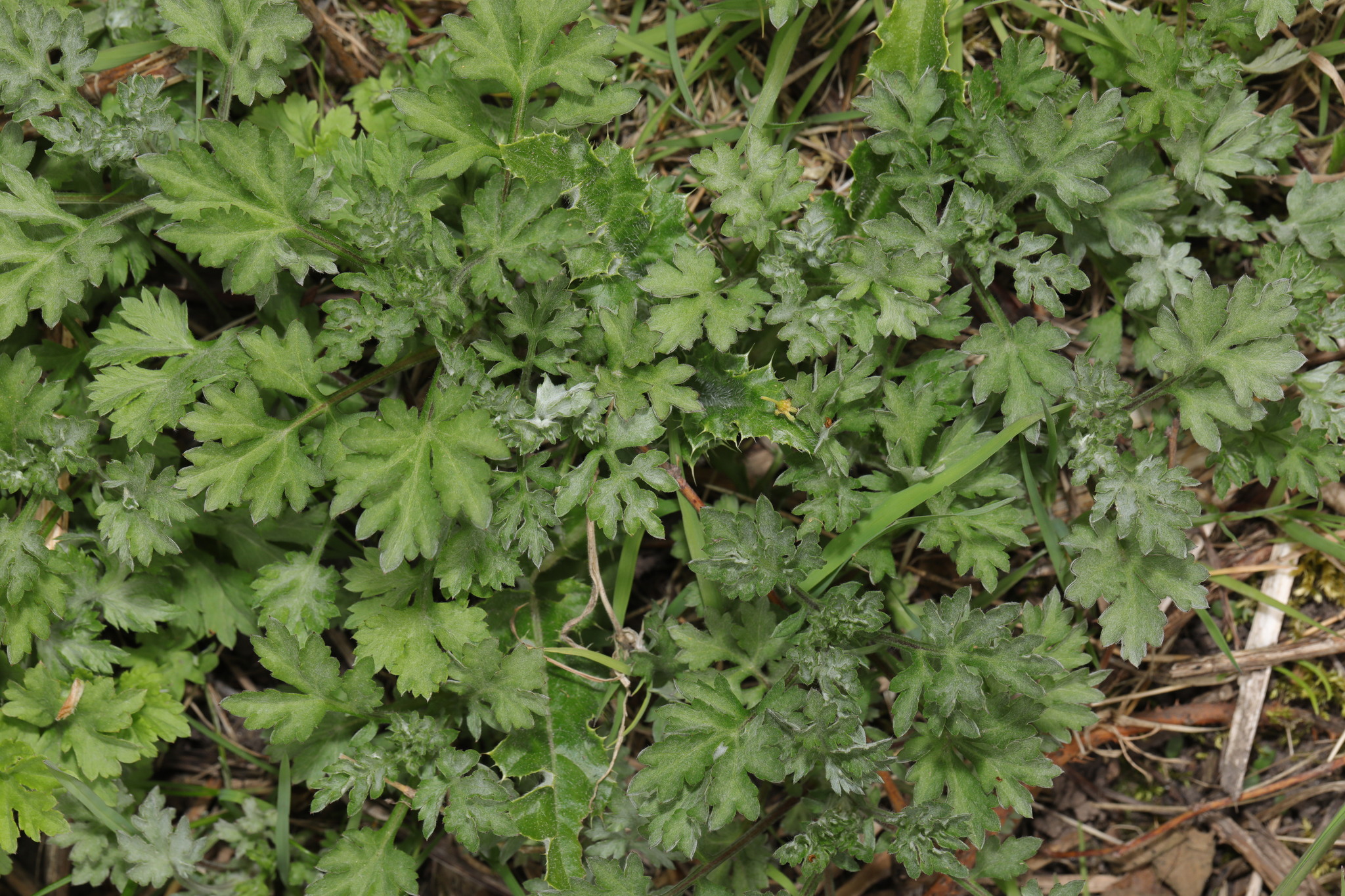
Dark upper surfaces contrast with distinctly woolly white undersides on the alternate, deeply divided leaves. This two-sided contrast is the most reliable field feature, more useful than leaf shape alone when distinguishing a nonflowering plant from other Asteraceae. 6 7
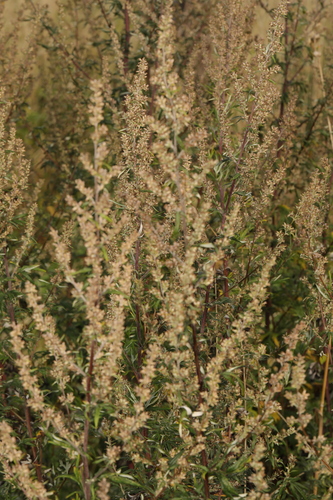
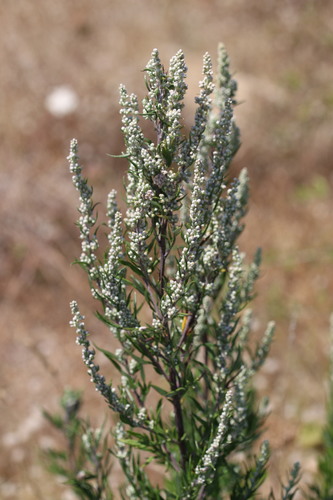
In the French seasonal frame, July to October brings small yellowish to reddish flower heads in dense, leafy spikes. Each head is only 2 to 4 mm wide and lacks showy petals. Their inconspicuous appearance can make the plant easy to overlook among other waste-ground Asteraceae; INPN also records reddish shades in some populations. 2 6
Useful taxonomy
Within the Asteraceae, POWO accepts Artemisia vulgaris L. as a species of the tribe Anthemideae. This full scientific name provides a stable reference when common names vary between languages and regions. 1
Sharing the genus Artemisia does not make common wormwood, Artemisia absinthium, or Artemisia pontica the same plant as common mugwort. Foliage is the practical distinction: wormwood is silvery gray on both surfaces, whereas common mugwort is dark green above and woolly only beneath. 2
Habitat and range
Temperate Europe through Indochina, together with North Africa, forms the native range given by POWO. Metropolitan France lies within that range, so its presence there has a different ecological meaning from its occurrence as an introduced plant elsewhere. 1
Across France, INPN describes common mugwort as very common on waste ground, roadsides, hedges and disturbed land. Tela Botanica confirms this broad distribution on varied soils, often where the ground has been disturbed. 6 7
North American conditions reveal a different side of the species. NC State Extension describes it as highly invasive, with creeping rhizomes that rapidly colonize disturbed soil. Even a small root fragment can regenerate a new clump, making accidental spread a practical concern. 4 5
Life cycle and reproduction
Persistent rootstocks and rhizomes allow common mugwort to regrow each spring, quickly produce upright stems and flower in summer. Disturbed, well-drained soil encourages this rapid growth; PFAF describes a plant capable of establishing a full clump within one season. 3
Seeds, clump division and basal cuttings provide propagation routes in spring or fall. PFAF describes the species as very easy to propagate, a useful horticultural trait that also helps explain its ability to spread. 3
Regrowth from fragments makes this ease of propagation troublesome outside the native range. NC State Extension notes that any rhizome piece left in the soil may produce a complete plant, so a single attempt at hand removal can leave substantial regrowth behind. 4
History and traditional uses
Classical medical writers, including Dioscorides, Pliny the Elder and Galen, described mugwort's uses long before it gained its medieval reputation as mater herbarum. Its enduring place in traditional medicine explains the many historical names attached to it. 8
Asian traditions also use dried mugwort leaves in moxibustion, burning the material in a controlled way at acupuncture points. This practice has a history spanning centuries, distinct from the plant's European uses. 8
Historical use does not establish a current prescription. Common mugwort contains sesquiterpene lactones and an essential oil containing thujone. Traditional gynecological uses call for particular caution during pregnancy, while its pollen is also recognized as allergenic. 3 8
Toxicity and look-alikes
Skin contact and ingestion of large amounts are the main concerns. PFAF records potential toxicity at high doses and contact dermatitis in sensitive people exposed to the foliage. NC State Extension likewise identifies skin irritation among the cautions associated with growing it. 3 4
For household animals, none of the selected sources provides a direct species-specific ASPCA classification. Caution therefore remains appropriate for cats and dogs, with particular uncertainty for horses. An animal that eats a large quantity of foliage needs veterinary advice rather than a home remedy. 3
The chief botanical look-alike is Artemisia absinthium, with grayer foliage and a more bitter taste. Variegated horticultural selections such as Oriental Limelight and Variegata also occur, but their leaf colors do not change the underlying biology or the precautions appropriate to the species. 2
Main sources
- Plants of the World Online / Kew, Artemisia vulgaris L.
- Royal Horticultural Society, Artemisia vulgaris - mugwort
- Plants For A Future, Artemisia vulgaris
- NC State Extension Gardener Plant Toolbox, Artemisia vulgaris
- NC State Extension Publications, Mugwort or Chrysanthemum Weed (Artemisia vulgaris)
- INPN / MNHN, Artemisia vulgaris L., 1753 - common mugwort
- Tela Botanica eFlore, Artemisia vulgaris L.
- PMC, Significance of Artemisia vulgaris L. in the history of medicine
Frequently asked questions
How do common mugwort and wormwood differ?
Common mugwort has dark green upper leaf surfaces and woolly white undersides, while Artemisia absinthium is silvery gray on both sides and much more bitter. Both belong to Artemisia, which can cause confusion.
Is common mugwort invasive?
It is native in France and is not treated there as an invasive alien species. Outside its native range, particularly in North America, NC State Extension describes it as highly invasive through spreading rhizomes.
Why was mugwort called the mother of herbs?
The medieval Latin name mater herbarum reflects its central place in traditional medicine, with uses described by classical authors including Dioscorides, Pliny the Elder and Galen.
Is common mugwort safe to use?
Self-medication is not recommended. It contains thujone and bitter lactones, and its historical gynecological uses call for particular caution during pregnancy and breastfeeding.
Is common mugwort toxic to animals?
The assessment varies with animal species and available sources. Contact and ingestion precautions remain appropriate for cats and dogs; the status for horses is unresolved.
Where does common mugwort grow in France?
INPN and Tela Botanica describe it as very common throughout France on waste ground, roadsides, hedges and disturbed land, on varied soils.
Similar plants
If you are unsure about a plant’s toxicity, ask a botanist or veterinarian for advice.