
Devil's beggarticks (Bidens frondosa, )
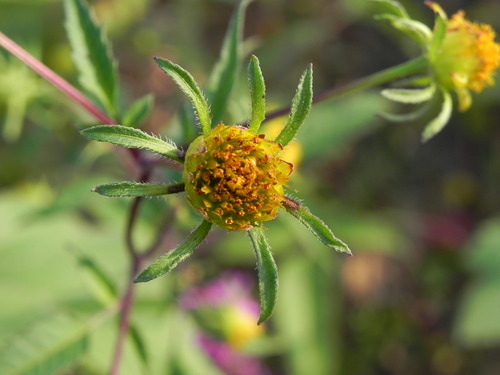
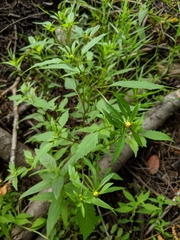
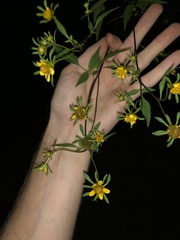
Devil's beggarticks (Bidens frondosa L.) is an annual in the Asteraceae native to North America. Now established across much of Europe, it colonizes riverbanks, ditches and disturbed wetlands. Its flat fruits have two barbed awns that cling to fur and clothing, explaining many of its English names. Minor food uses are recorded, but its spread and competition with native trifid bur-marigold are the main concerns in Europe.
Read moreDevil's beggarticks, Devil's-pitchfork, Devil's bootjack, Leafy beggarticks, Sticktights and Bur marigold
Allow a few hours of direct sun per day, preferably morning or evening.
Full sun to light partial shade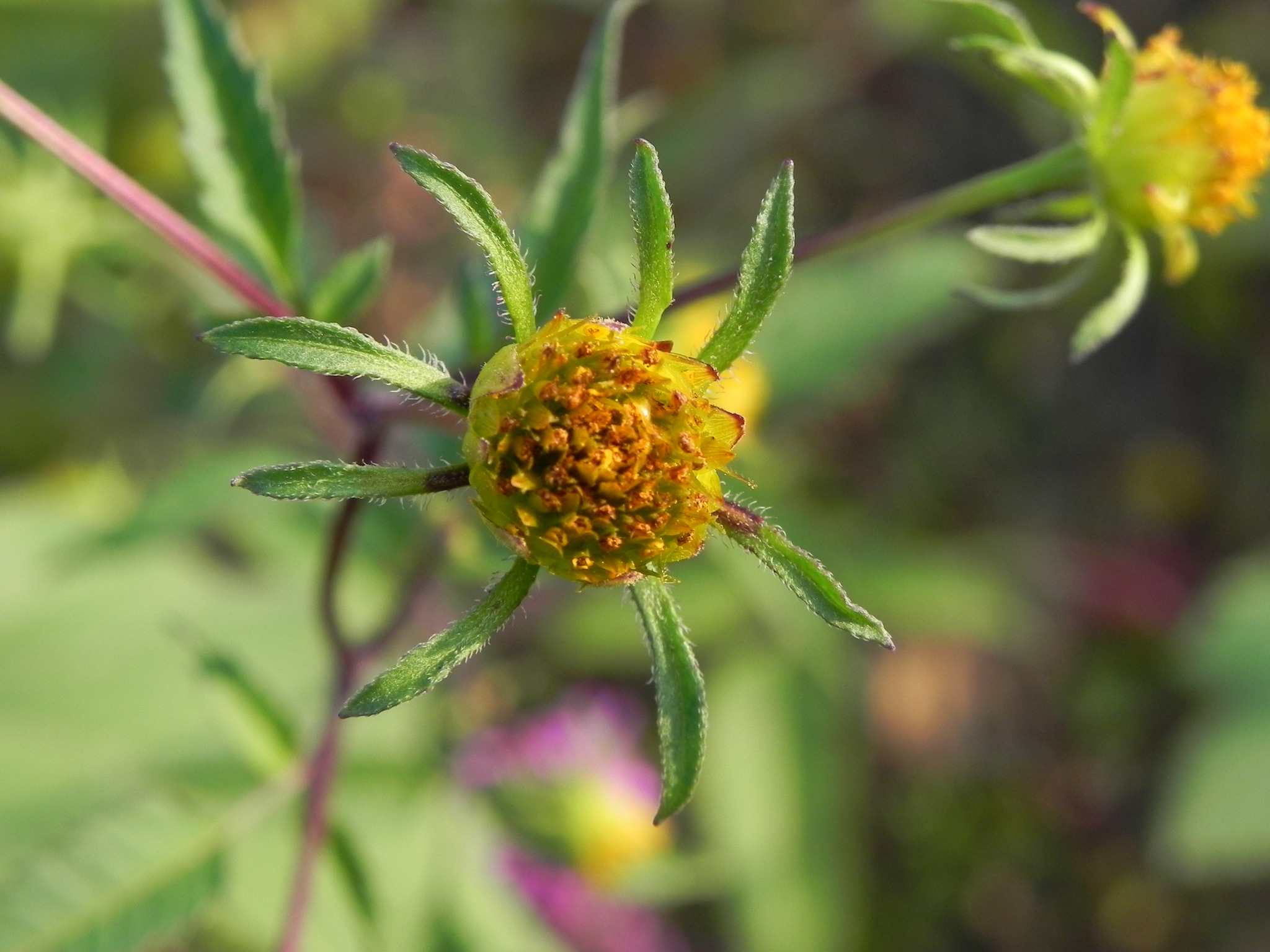
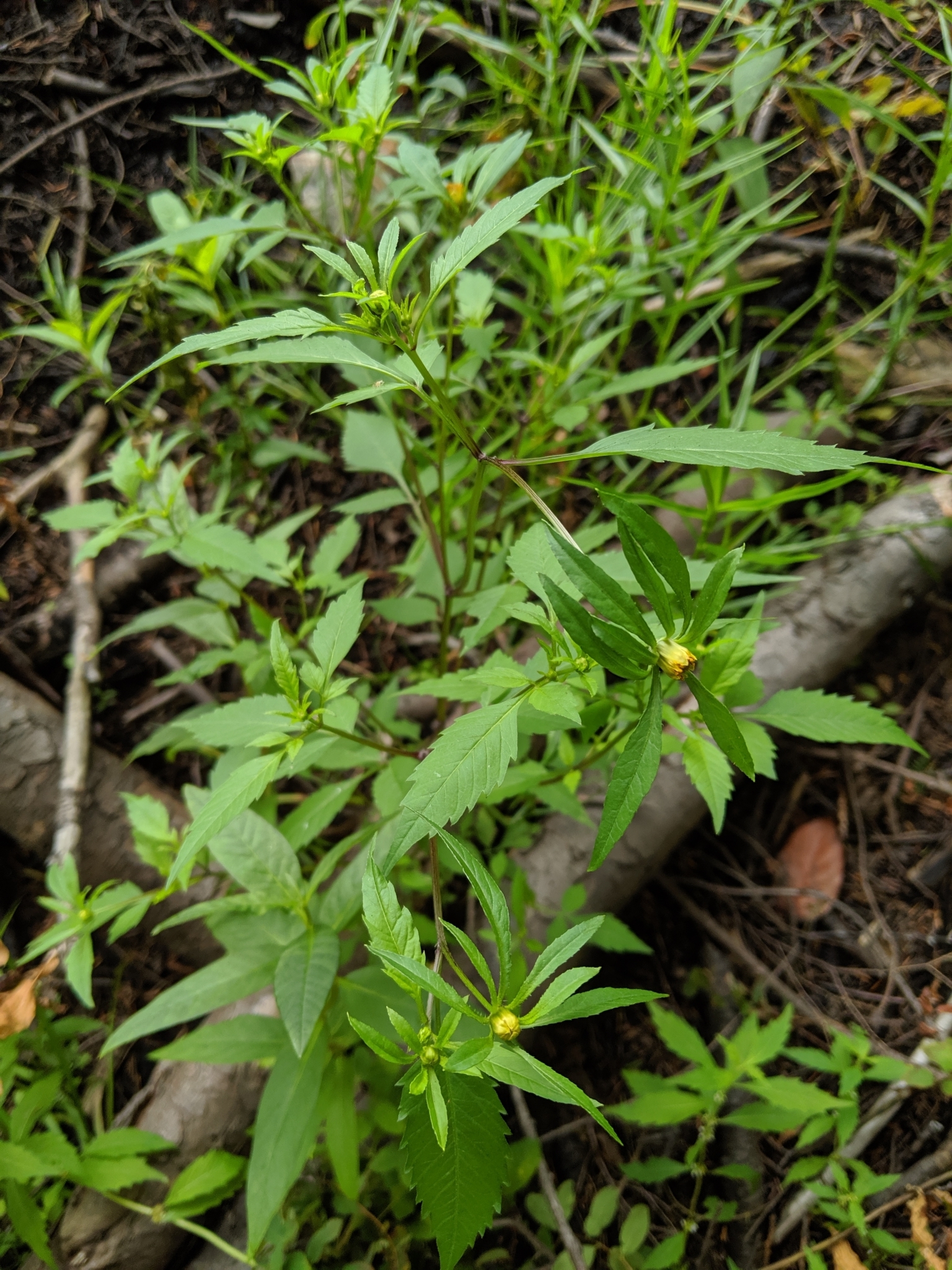
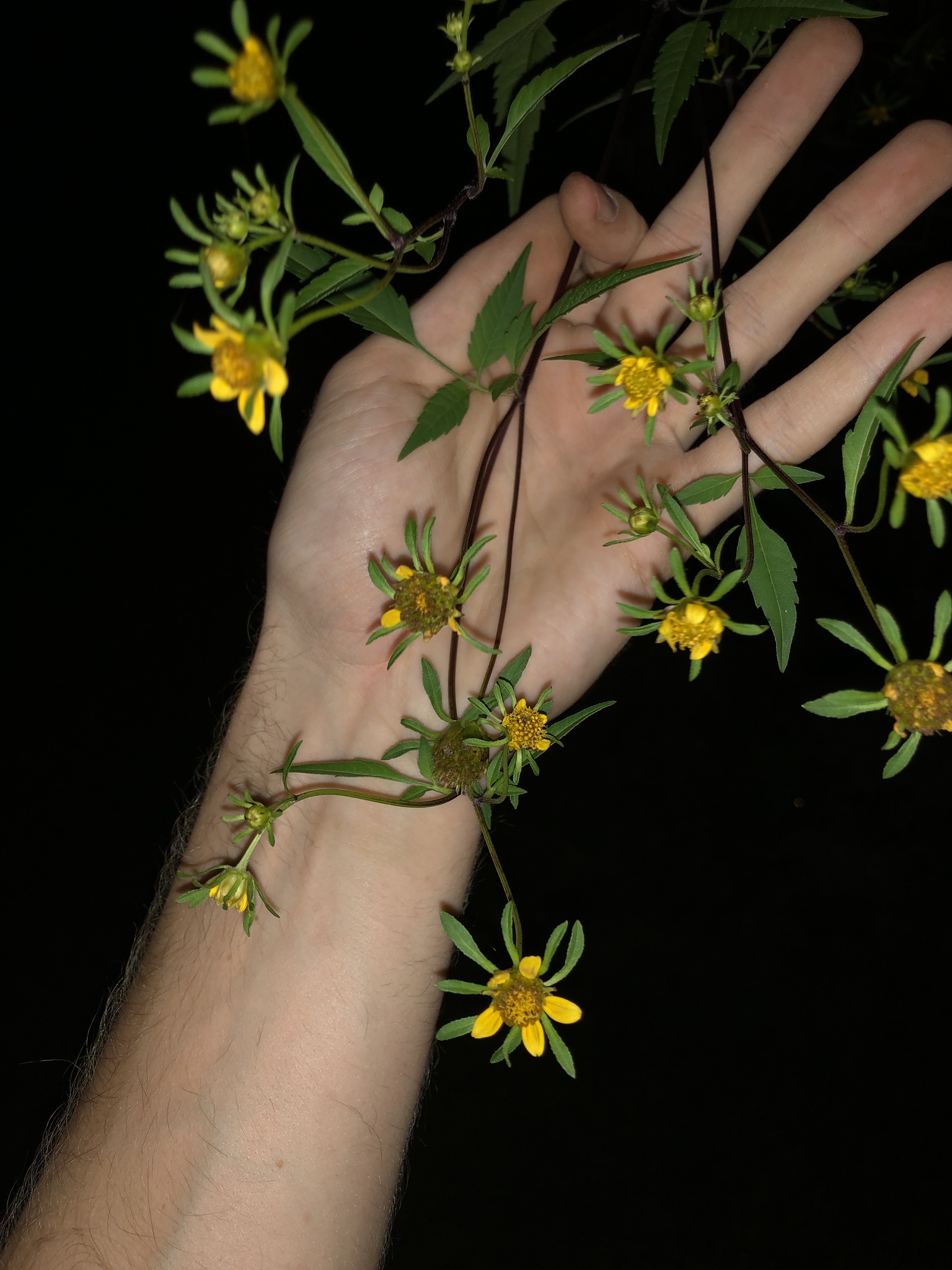


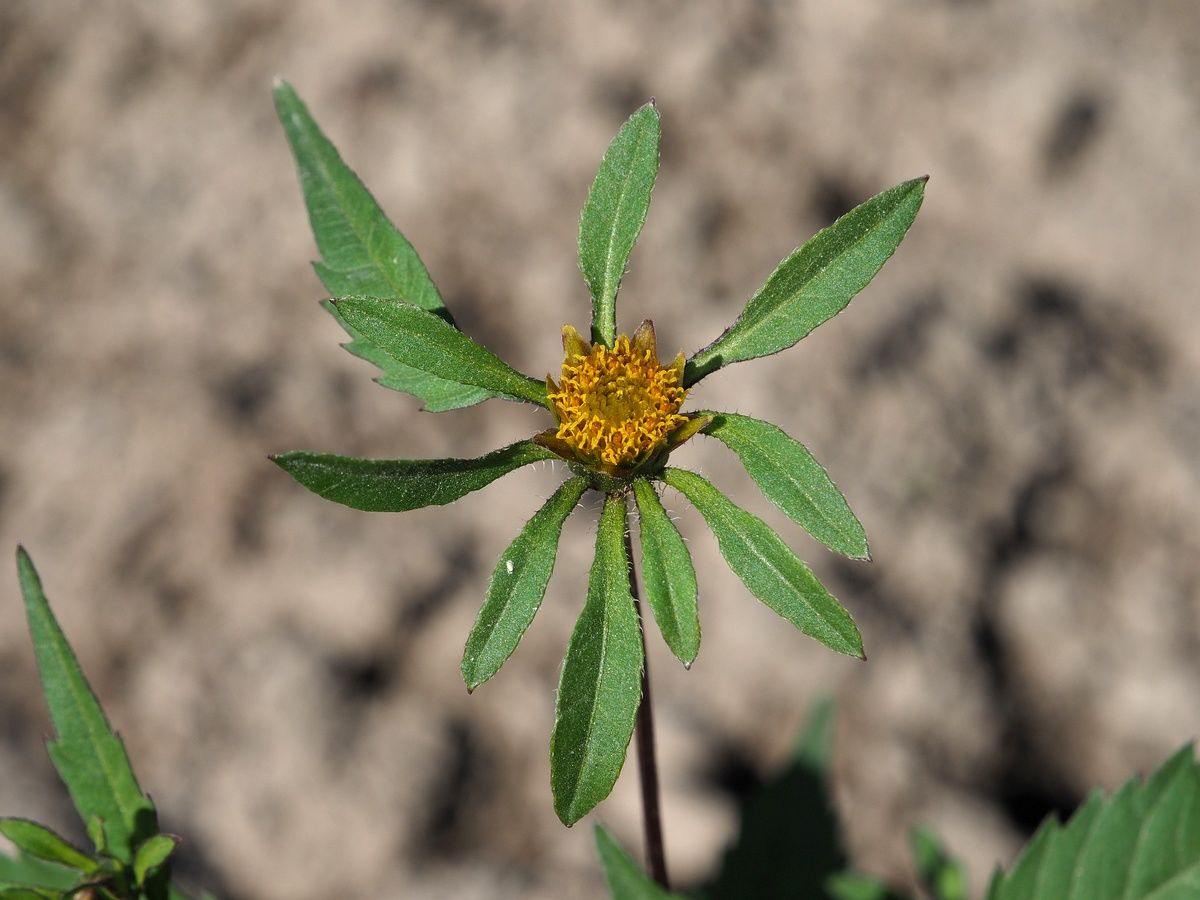
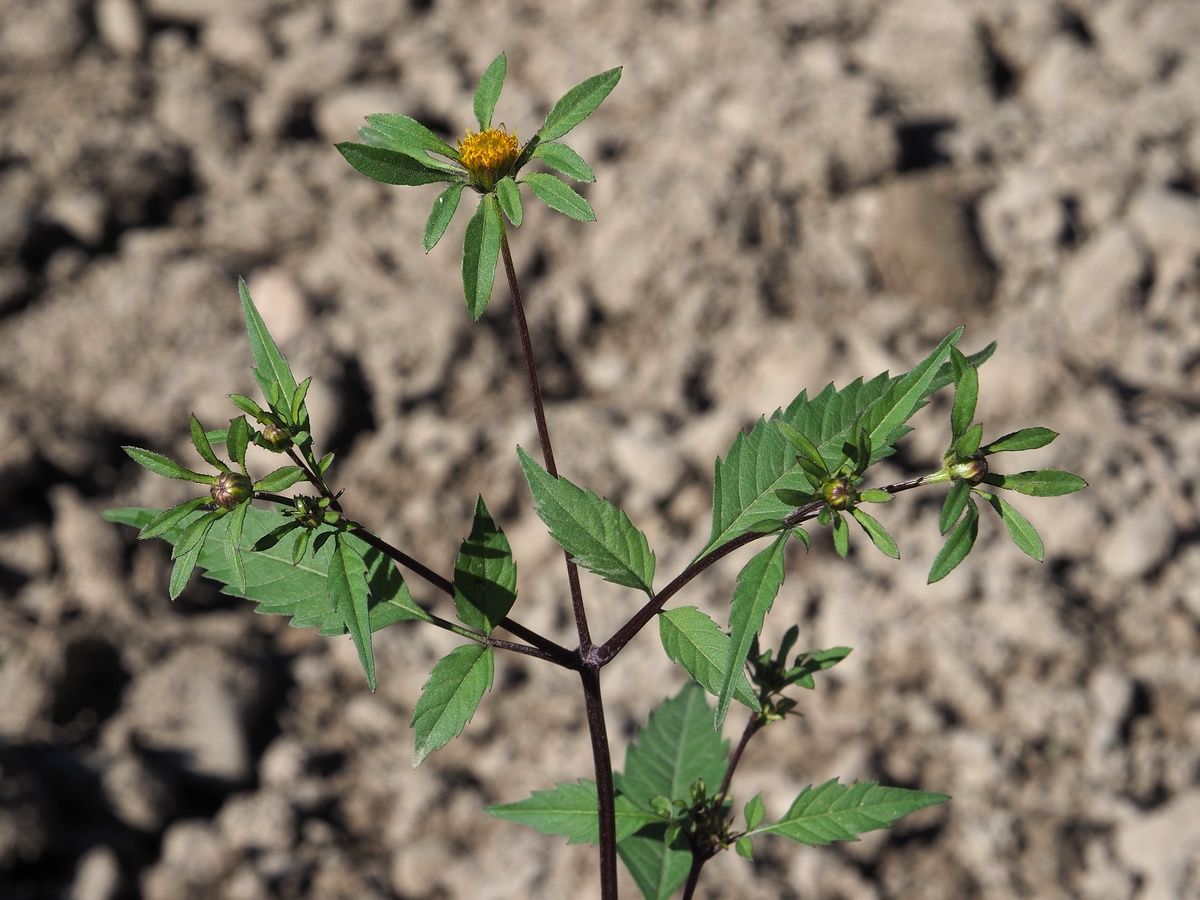
© photo
(c) matteo_76, some rights reserved (CC BY-NC) · cc-by-nc
Ben Keen · cc0
Andrew Conboy · cc-by
Taken Sep 9, 2012 by Tela Botanica − Sylvain PIRY (cc-by-sa)
Taken Jul 5, 2020 by viader (cc-by-sa)
Taken Sep 27, 2008 by Tela Botanica − Joseph RÉZEAU (cc-by-sa)
Taken Sep 14, 2011 by Tela Botanica − Bertrand BUI (cc-by-sa)
Taken Sep 9, 2017 by Yoan MARTIN (cc-by-sa)
© copyright of the Board of Trustees of the Royal Botanic Gardens, Kew.




Global distribution
POWO/WCVP place the native range of Bidens frondosa in Canada and the contiguous United States. Introduced to Europe around the start of the 20th century, it later reached Asia and New Zealand. In France, its invasive impact varies considerably by region.
- Native2
- Introduced3
- Invasive3
- Canada
- United States
- China
- Japan
- New Zealand
- Mainland France
- Belgium
- Central Europe
Hexagons: regions where the plant occurs. Green dots: native range.1
Identité
Devil's beggarticks (Bidens frondosa L., 1753) is an accepted species of Bidens in the Asteraceae. POWO and IPNI attribute the name to Linnaeus in 1753 and place its native range in Canada and the contiguous United States. English aliases include devil's-pitchfork, devil's bootjack, leafy beggarticks, sticktights and bur marigold. 1 2
Two barbed awns at the tip of each fruit explain the genus name Bidens, from Latin bi- (two) and dens (tooth). The epithet frondosa means leafy or bushy, describing the dense foliage of mature plants. 5
European populations became established around the start of the 20th century, and France now regards Bidens frondosa as an invasive alien species. Its spread and competition with native trifid bur-marigold (Bidens tripartita) matter more than any horticultural use. 3 9
Recognition
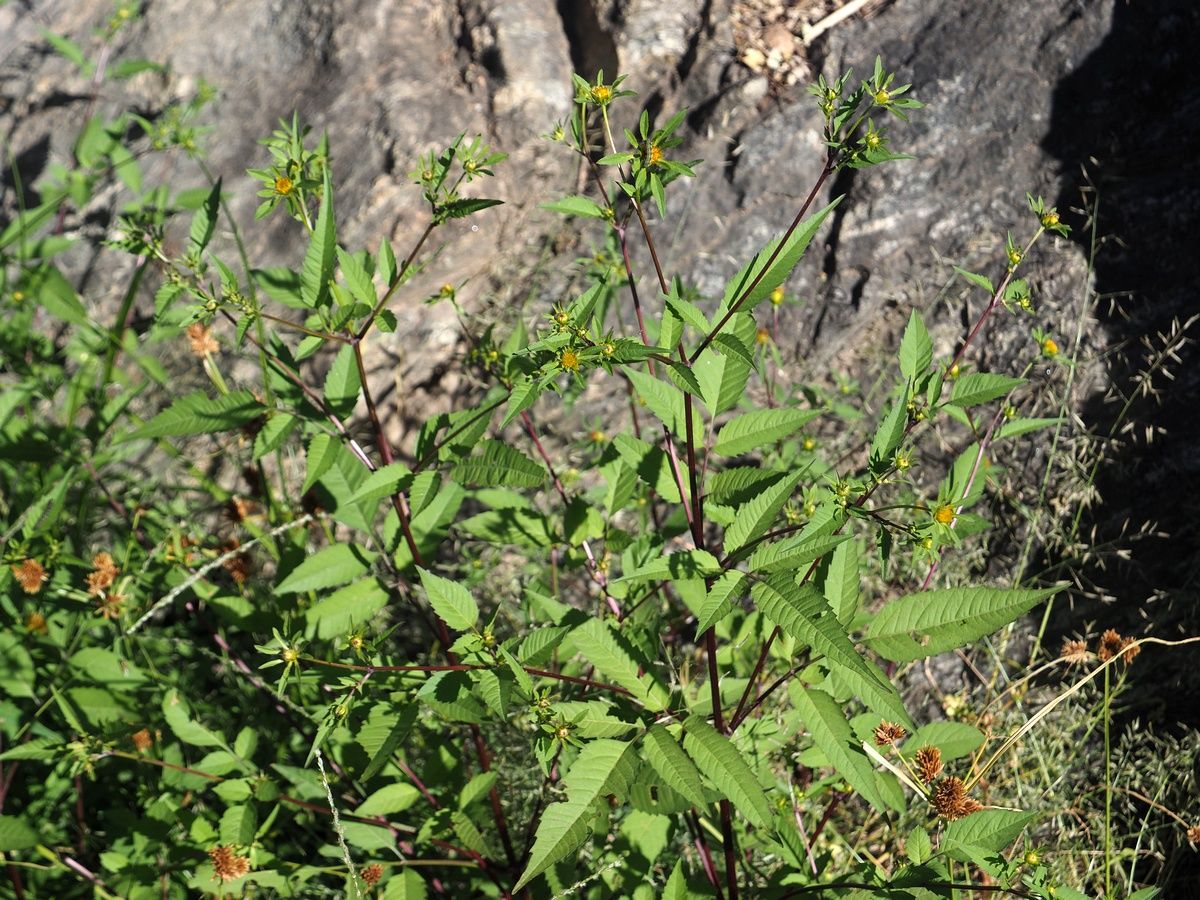
An upright, angular, often reddish stem carries this annual to 30 cm–1.5 m (1–5 ft), depending on soil moisture. On sunny riverbanks, the plant quickly develops a bushy outline. 6
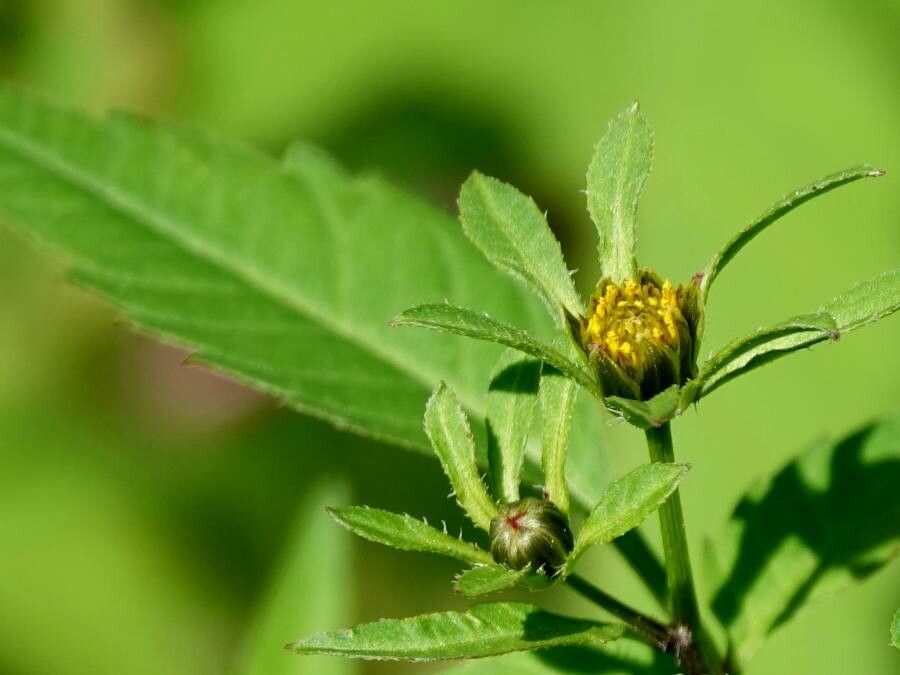
Opposite compound leaves comprise three to five sharply toothed, lance-shaped leaflets. Each distinct leaflet has its own scarcely winged stalklet. These nearly bare stalklets distinguish Bidens frondosa from Bidens tripartita, whose lobed leaves have clearly winged stalks rather than separate leaflets. 7
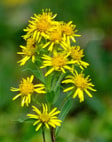
Discoid flower heads measure 1–2 cm (0.4–0.8 in) across. Most plants lack well-developed yellow-orange ray florets, so the flowers can be easy to overlook even on a 1.5 m (5 ft) stem. In France, flowering runs from August to October, corresponding to late summer and fall. 6
Useful taxonomy
Botanical names listed under Bidens frondosa L. by POWO include Bidens frondosa var. puberula Wiegand, var. major Hook., var. minor Hook., var. anomala Porter ex Fernald, var. caudata Sherff, var. pallida (Wiegand) Wiegand and var. stenodonta Fernald & H.St.John. These names belong to the same accepted taxon. 1
Those botanical varieties are minor taxonomic ranks, useful for synonymy rather than garden selection. They do not represent horticultural breeding, and no ornamental cultivar is recorded for the species. 1
Regional common names can differ sharply: French sources use bident feuillu, whereas Devil's beggarticks is an English name. The scientific name provides a consistent reference across languages and regional populations. 3
Habitat and range
Canada and the contiguous United States form the native temperate range recorded by POWO and WCVP. Waterlogged ground supports the species along rivers, ditches, floodplains, ponds and lakes. 1 5
After its introduction to Europe in the early 20th century, the plant naturalized across much of the continent and subsequently in Asia and New Zealand. Invmed describes its French impact as major in the southwest and Massif Central, moderate in the Pyrenees and along the Mediterranean coast, with prevention the priority in Alpine areas. These are regional French assessments. 9
Dense stands compete directly with Bidens tripartita for wetland habitat. A single plant can produce up to 10,000 seeds, helping it colonize rapidly after flooding or disturbance of a riverbank. 9
Life cycle and reproduction
Seed is the only means of reproduction for this strictly annual species. Germination takes place on bare, moist ground in spring; flowering follows in late summer and fall, before frost kills the plant. The French flowering record is August through October. 9 6
Flattened, dark brown to black fruits end in two barbed awns. Their barbs point forward in Bidens frondosa but backward in Bidens tripartita, a technical yet reliable distinction when leaves do not settle identification. 7
Hooked onto fur, feathers or clothing, the fruits disperse by epizoochory, transport on an animal's outer surface. Fruits that fall beside a watercourse can also float downstream, establishing new patches farther along the river. 5
Uses and risks
Cooked young shoots and leaves account for the main recorded food use. Their culinary value is considered minor, and a sweet aftertaste is sometimes reported. 8 5
Traditional use for urinary irritation has also been recorded. Laboratory extracts show antibacterial and antioxidant properties, but these remain traditional practices or experimental findings, rather than established medical indications. 8
Human food toxicity is not documented, and common veterinary toxicity references provide no species profile. Missing animal data do not establish safety. The documented concerns are chiefly ecological competition with native vegetation and the mechanical nuisance of hooked fruits on fur, clothing and field equipment. 8 9
Varieties, look-alikes and related plants
Garden varieties are absent: the botanical ranks listed by POWO serve scientific synonymy rather than plant selection. Identifying this wetland annual is more relevant than planting it. 1
Trifid bur-marigold, Bidens tripartita, is the main look-alike in the same wet habitats. Its deeply lobed leaves have clearly winged stalks, unlike the separate leaflets on scarcely winged stalklets in Bidens frondosa. Fruit characters confirm identification when the leaves remain ambiguous. 7
Other Bidens species and young weeds on damp disturbed ground can look similar before flowering. Using Bidens frondosa as the reference name avoids confusion between French bident feuillu and American Devil's beggarticks, which name the same plant. 3
Main sources
- Plants of the World Online / Kew, Bidens frondosa L.
- International Plant Names Index, Bidens frondosa L.
- INPN / MNHN–OFB, Bidens frondosa L., CD_NOM 85957 — original notice, Internet Archive 2022-12-11
- USDA PLANTS Database, Bidens frondosa, devil's beggarticks (BIFR)
- Tela Botanica, Jacques Jacqva, Le Bident feuillu (20 October 2022), original article archived 7 October 2024
- FloreAlpes, Bidens frondosa - leafy beggarticks
- FloreAlpes, comparison of Bidens frondosa and Bidens tripartita
- Plants For A Future, Bidens frondosa — Internet Archive, 2026-06-06
- Invmed / invasive alien species observatory, Bidens frondosa profile
Frequently asked questions
Is Devil's beggarticks poisonous?
No human food toxicity is documented, and the plant is absent from common veterinary toxicity databases. Young shoots are eaten cooked as a minor food.
Can you eat Devil's beggarticks?
Young leaves and shoots are eaten cooked, although their culinary value is considered low and a sweet aftertaste is sometimes reported. This is not a commercial vegetable.
Why do the fruits stick to clothes?
Each fruit has two barbed awns that work like hooks. This dispersal mechanism, called epizoochory, carries seeds on fur, feathers or clothing before they fall elsewhere.
How can you distinguish Bidens frondosa from Bidens tripartita?
Leaves and fruits provide the most reliable distinction. Bidens frondosa has separate leaflets on scarcely winged stalklets; Bidens tripartita has lobed leaves on winged stalks. The fruit barbs also point forward in frondosa and backward in tripartita.
Where does Devil's beggarticks come from, and is it invasive in France?
Its native range covers Canada and the contiguous United States. Introduced to Europe around the start of the 20th century, it is now considered invasive in France, with moderate to major impacts depending on the region.
Should you remove Devil's beggarticks from a garden?
On sensitive wetland sites, cutting or pulling plants before fruits form in late summer limits spread. Elsewhere, identification and cleaning equipment after entering infested ground remain priorities.
Similar plants
If you are unsure about a plant’s toxicity, ask a botanist or veterinarian for advice.