
Borage (Borago officinalis, )
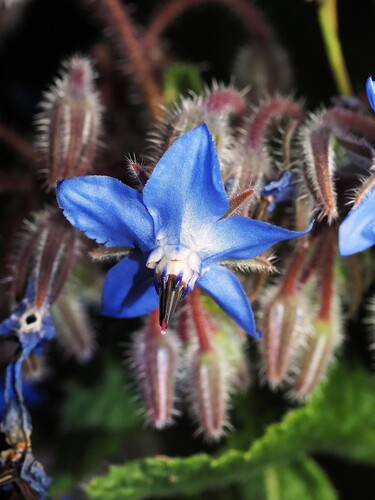
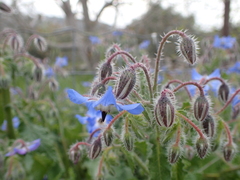
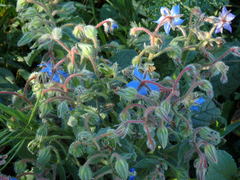
Borage (Borago officinalis) is an annual herb in the Boraginaceae, native to the western and central Mediterranean. Covered in stiff hairs, it bears blue star-shaped flowers much visited by bees and cucumber-scented leaves, eaten in moderation.
Read moreBorage, Starflower and Common borage



© photo
(c) Sergio Ibarra, some rights reserved (CC BY-NC), uploaded by Sergio Ibarra · cc-by-nc
Juraj Ahel · cc-by
Duarte Frade · cc-by
Taken Jun 13, 2021 by Jacques Zuber (cc-by-sa)
Taken Mar 30, 2021 by Maryse M (cc-by-sa)
Taken Apr 2, 2022 by Fabrice Rubio (cc-by-sa)
Taken Jan 1, 2022 by huy HO (cc-by-sa)
© copyright of the Board of Trustees of the Royal Botanic Gardens, Kew.


Global distribution
Borago officinalis originates in the western and central Mediterranean. Widely cultivated as an herb and bee plant, it has naturalized across temperate Europe and other continents; these introduced areas remain distinct from its native range.
- Native3
- Introduced5
- Spain
- Italy
- Morocco
- France
- United Kingdom
- Germany
- United States
- Australia
Hexagons: regions where the plant occurs. Green dots: native range.1
Identity
Borage (Borago officinalis L., 1753) is an annual herb in the Boraginaceae, the family that also includes forget-me-nots and comfrey. The epithet officinalis recalls its former apothecary use: it was grown as an herb and a reputed soothing remedy. 1 4
Known as starflower or common borage, it now finds a place in flower-filled vegetable gardens. Its blue star-shaped flowers and young cucumber-flavored leaves provide edible decoration in moderation, while the blooms attract many bees. Stiff hairs cover the plant and make it rough to touch. 2 6
Recognition
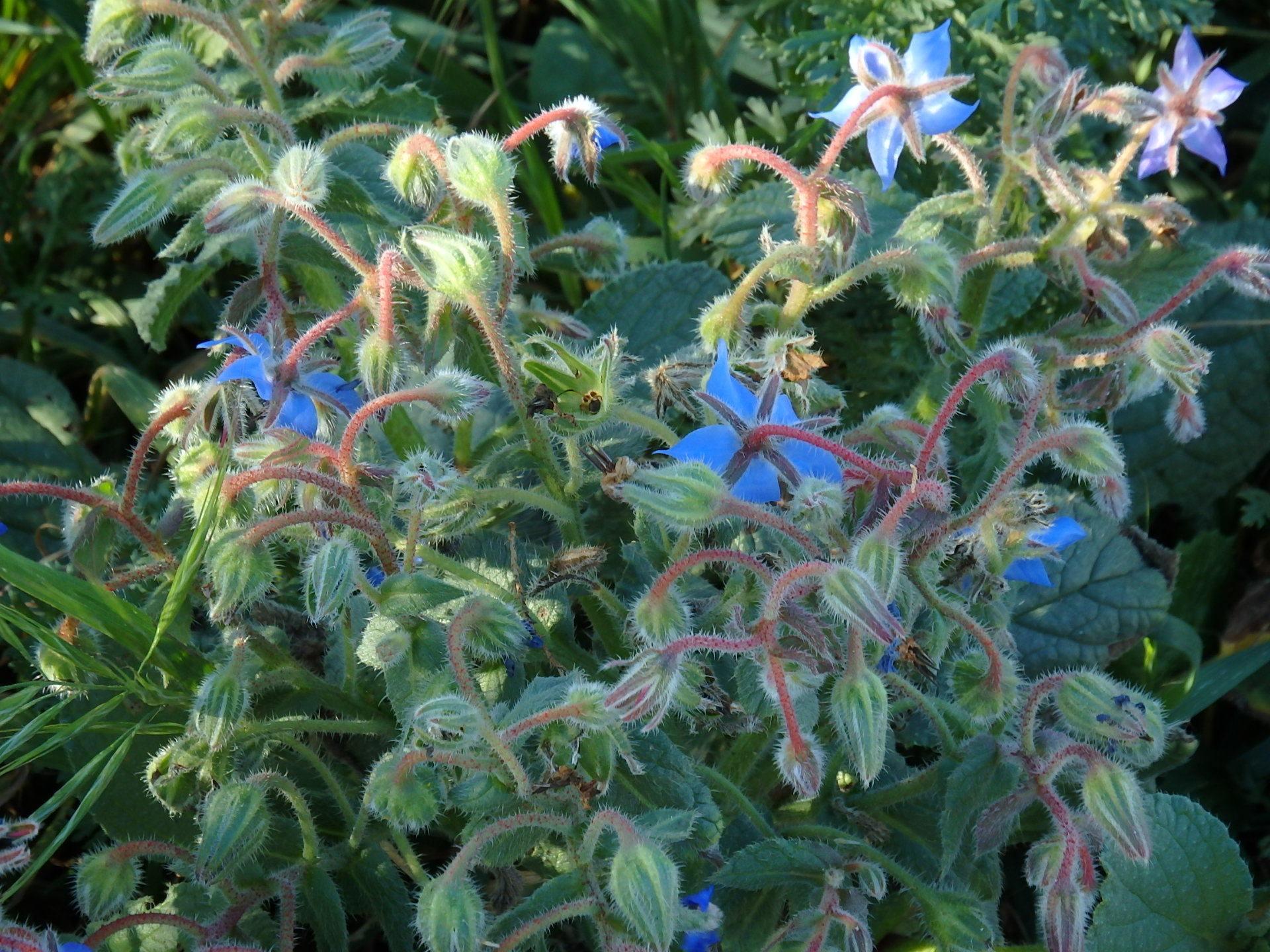
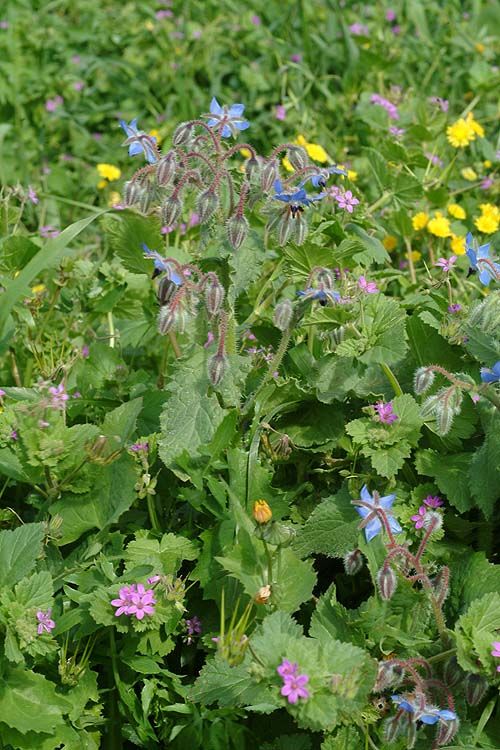
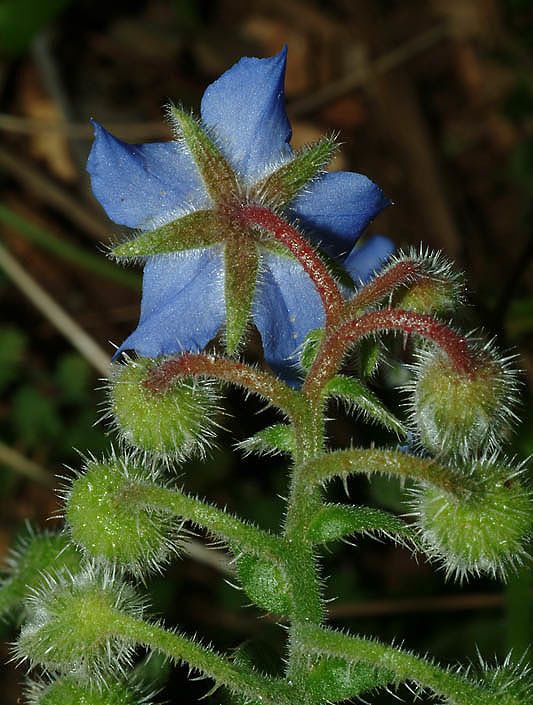
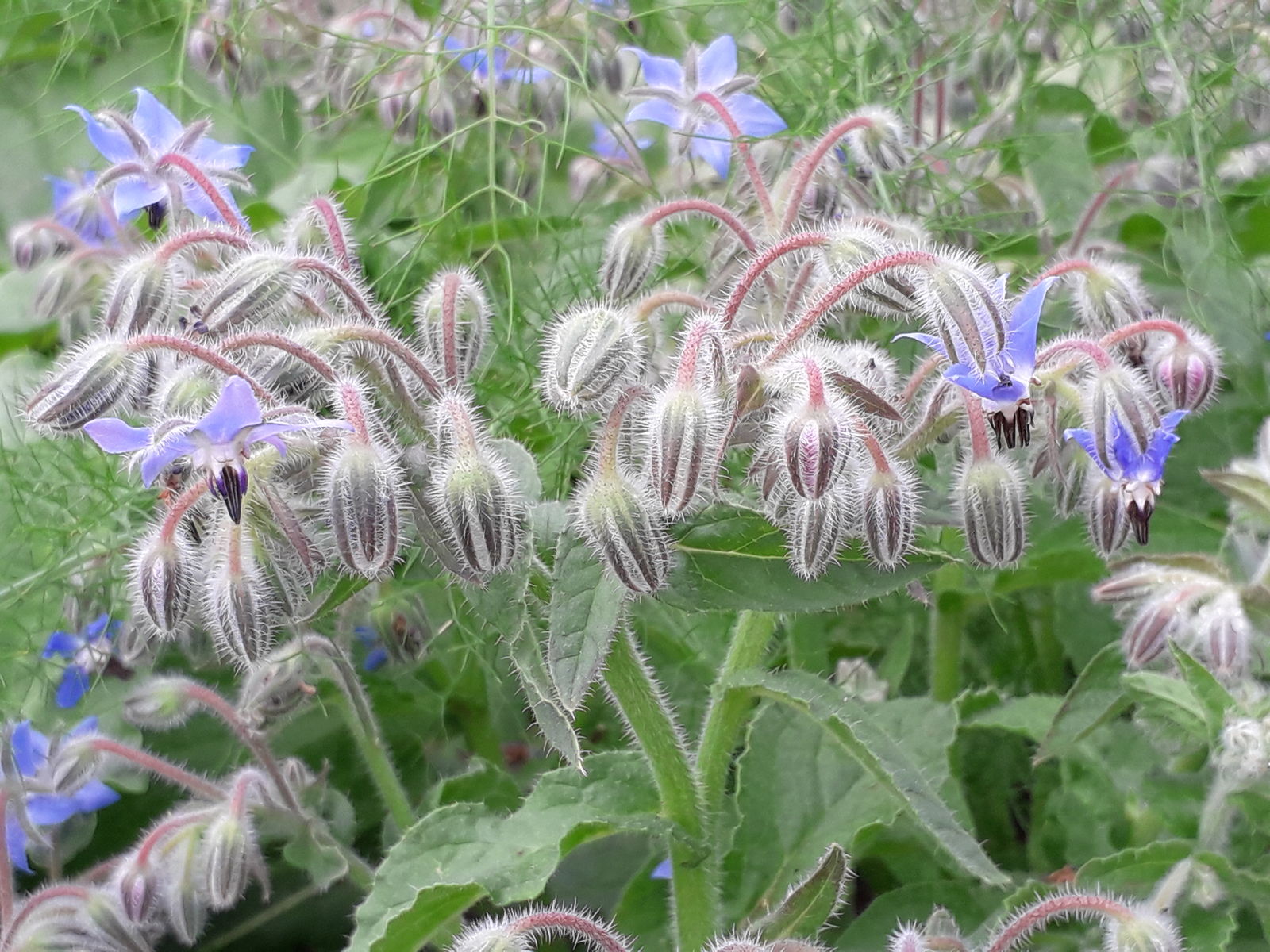
A rosette of oval to lance-shaped, crinkled leaves bristling with whitish hairs appears first. Hollow, branching stems then reach 30–90 cm (12–35 in) tall and 23–45 cm (9–18 in) wide, sometimes more in well-fed plants. Crushed leaves give off a distinct cucumber scent. 3 6
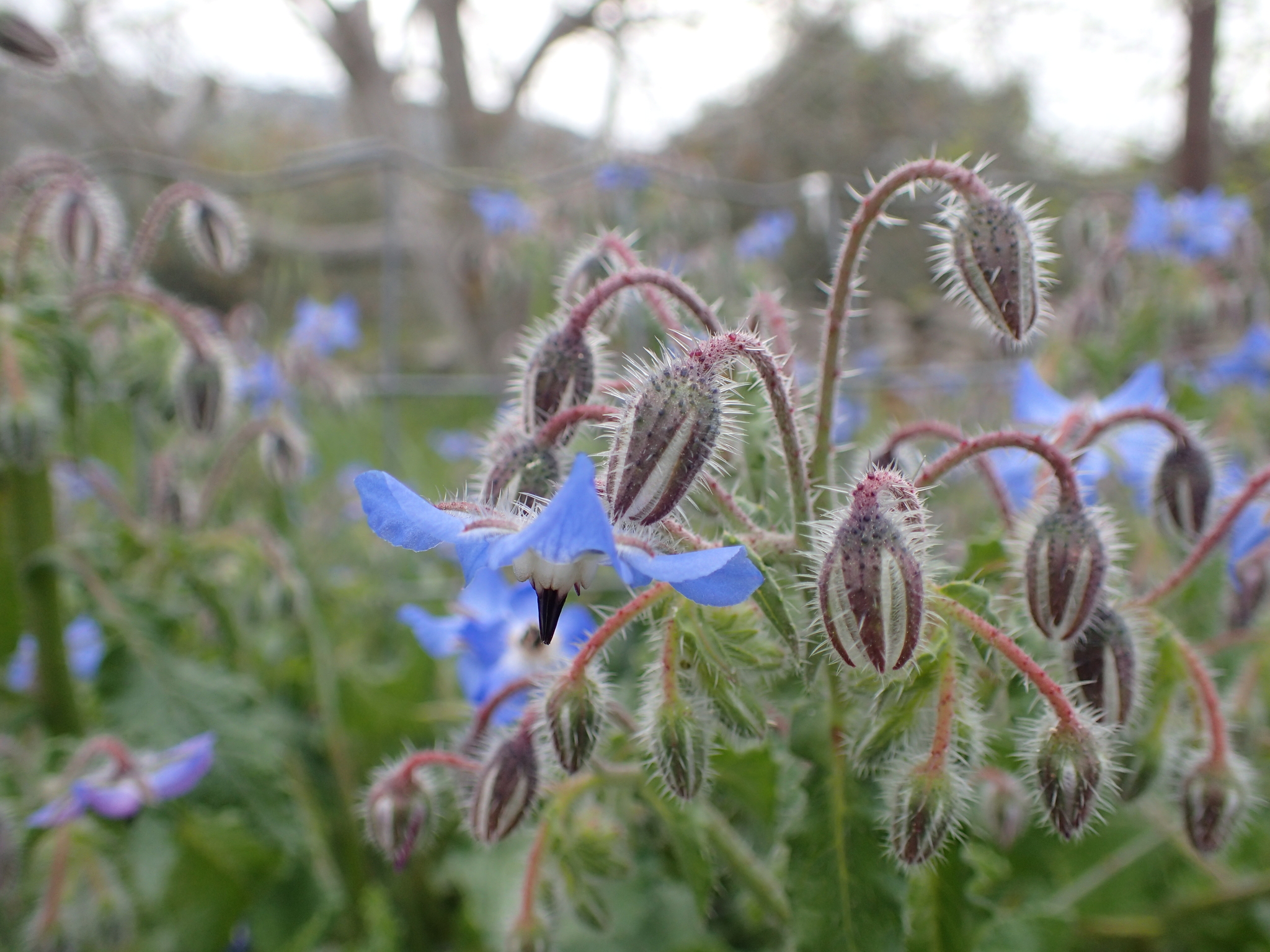
Blue flowers offer the clearest identification feature: five-pointed stars 2–3 cm (0.8–1.2 in) across, with projecting black stamens forming a small central cone that points downward. Buds and flowers grow in scorpioid cymes, curled clusters that unroll as flowering progresses. Petals often change from pink to blue as they open because their acidity changes. 2 4
In temperate Northern Hemisphere gardens, flowering commonly extends from June to August. Small brown dry fruits, or achenes, follow and allow self-seeding from one year to the next. 3 2
Useful taxonomy
Carl Linnaeus described the species in 1753 as Borago officinalis, the name still accepted today. Borago is a small genus, long regarded as containing a single species; several older infraspecific names now survive only as synonyms. Examples are:
- Borago officinalis var. alba Gray, an old varietal name;
- Borago officinalis var. coerulea Alef., an old varietal name;
- Borago officinalis var. variegata Alef., an old varietal name;
- Borago officinalis var. saxicola Rouy, an old varietal name;
- Borago officinalis var. stenopetala Ducell. & Maire, an old varietal name.
The accepted scientific name, Borago officinalis, is therefore the clearest reference. Garden names such as Alba, with white flowers, and Bill Archer, with variegated leaves, describe horticultural selections rather than separate species. 1 7
Habitat and range
Western and central Mediterranean habitats form borage’s native range. It grows on waste ground, field edges and well-drained sandy soils in full sun or light partial shade. As a temperate annual, its growth follows the warm season. 1 3
Cultivation as an herb and bee plant has carried it far beyond that range. It has naturalized across much of temperate Europe, North America and elsewhere. References list a broad USDA 2–11 range, but young plants remain vulnerable to severe frost. 3 2
Abundant self-seeding can sustain borage in gardens for years: a single sowing often leads to plants returning without further sowing. In France, this persistence does not lead to its classification as invasive; status elsewhere should be considered locally. 2 6
Life cycle and reproduction
Within a single growing season, this annual germinates in spring, forms a rosette, quickly sends up flowering stems, fruits and dies in autumn in temperate Northern Hemisphere conditions. Its taproot resents transplanting, making direct sowing useful. 2 3
Seeds provide its sole means of reproduction. Bees are the principal pollinators of the nectar-rich flowers, which quickly replenish nectar after visits and maintain a steady stream of insects. Ripe achenes fall to the ground and germinate the following year, producing self-sown seedlings. 6 4
Removing spent flowers before seed ripens limits unwanted seedlings. Conversely, allowing a few stems to set seed encourages its return and feeds pollinators until the end of the season. 2
Uses and risks
Borage serves two main purposes: supporting bees in gardens and culinary use in small amounts. Blue flowers decorate salads, cold drinks and desserts. Young cucumber-flavored leaves are eaten raw or cooked as a leafy vegetable in several Mediterranean cuisines. 3 4
Food use should remain moderate. The plant contains pyrrolizidine alkaloids, compounds that can affect the liver at high doses or with repeated consumption. Leaves and flowers are therefore eaten occasionally and in small amounts; seed oil should be certified free of these alkaloids. 6 5
The ASPCA lists borage as toxic to cats, dogs and horses because of those same alkaloids. Risk depends on the amount ingested: contact or an occasional bite is rarely serious, but substantial consumption should be prevented. 8 6
Varieties, look-alikes and related plants
Garden selections belong to the same species. Alba has white flowers; Bill Archer and Variegata have cream-variegated foliage and are grown for ornament. Before purchase, check the scientific name, expected flower color and annual habit. 2 1
Other hairy members of the Boraginaceae can cause confusion:
- Symphytum officinale, common comfrey, grows taller and has bell-shaped flowers;
- Echium vulgare, viper’s bugloss, has upright blue flower spikes and a stiffer habit;
- Pentaglottis sempervirens, green alkanet, is a perennial with small blue flowers.
A five-pointed star-shaped flower, with black stamens forming a cone, carried on curled cymes, is the decisive combination. Among common garden Boraginaceae, these features identify Borago officinalis. 7 4
Main sources
- Plants of the World Online / Kew, Borago officinalis L.
- Royal Horticultural Society, Borago officinalis - borage
- Missouri Botanical Garden, Borago officinalis
- Encyclopaedia Britannica, borage
- Plants For A Future, Borago officinalis
- North Carolina State Extension, Borago officinalis
- Tela Botanica, Borago officinalis L.
- ASPCA, borage (Borago officinalis) toxicity entry
Frequently asked questions
Is borage edible?
Yes. Its blue flowers and young cucumber-flavored leaves are eaten raw or cooked, but in moderation. The plant contains pyrrolizidine alkaloids, which should not be consumed in large quantities or repeatedly.
Is borage poisonous to animals?
The ASPCA lists borage as toxic to cats, dogs and horses. Its pyrrolizidine alkaloids can affect the liver, so animals should not eat substantial amounts.
Why does borage attract so many bees?
Its flowers produce abundant nectar and replenish it quickly after visits, making it highly attractive to honeybees and wild bees.
Does borage come back every year?
It is an annual that dies after fruiting, but it self-seeds freely and often reappears in the same place the following year.
Which plants look like borage?
Other hairy Boraginaceae, especially comfrey (Symphytum) and viper’s bugloss (Echium), can cause confusion. Blue star-shaped flowers with black stamens are the most reliable guide.
Does borage need fertilizer?
No. Ordinary garden soil is sufficient. Excess nitrogen produces plentiful foliage but fewer flowers, reducing its value to bees.
Similar plants
If you are unsure about a plant’s toxicity, ask a botanist or veterinarian for advice.