
Rosemary (Salvia rosmarinus, )
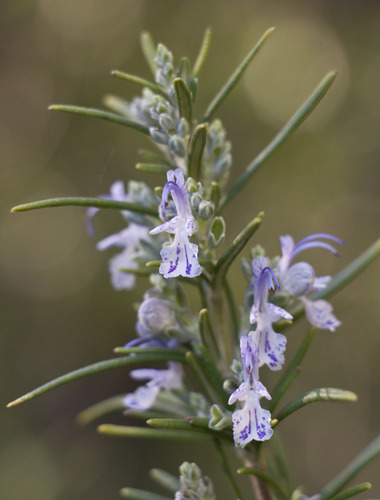
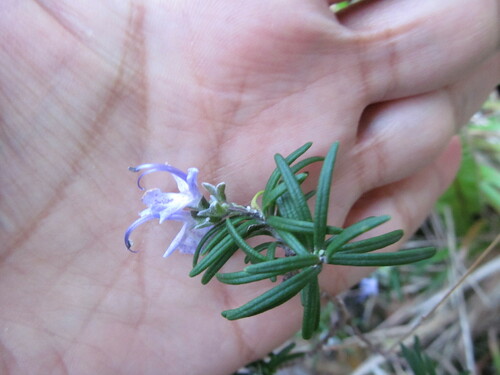
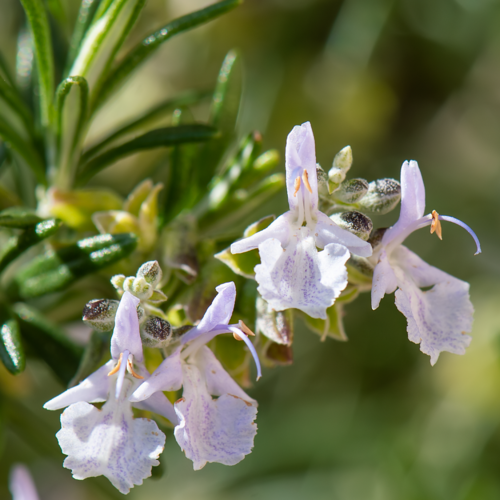
Rosemary (Salvia rosmarinus), formerly Rosmarinus officinalis, is an evergreen subshrub in the mint family, Lamiaceae, native to the Mediterranean Basin. Its narrow, leathery and strongly aromatic leaves, carried on square stems that turn woody with age, account for its double role as a dry-garden shrub and a kitchen herb.
Read moreCommon rosemary
Place in full sun, with intense direct light all day long.
Global distribution
POWO places the native range of Salvia rosmarinus in the Mediterranean Basin. Where it grows wild on Mediterranean coasts it is locally native; elsewhere it is mainly a cultivated plant, not a uniformly naturalized one.
- Native6
- Introduced3
- Mediterranean France
- Spain
- Italy
- Greece
- Morocco
- Tunisia
- United Kingdom
- Germany
- United States
Hexagons: sourced regions. Green dots: native range. Statuses according to POWO (Kew).
Identity
Rosemary is Salvia rosmarinus Spenn., an accepted species in the genus Salvia, family Lamiaceae. The name Rosmarinus officinalis is still everywhere in cookbooks, nursery catalogs and older botanical references, but POWO treats it as a homotypic synonym of the accepted name. 1 2
The plant is an evergreen, aromatic shrub or subshrub of Mediterranean climates. In English, rosemary is the everyday name and common rosemary the fuller one; the Latin binomial is the clearest reminder that the plant now sits in the genus Salvia, alongside the sages. 2 3
Both names deserve to stay visible: Salvia rosmarinus for current taxonomy, Rosmarinus officinalis for historical, culinary and horticultural searches. They refer to one plant, not two. 1 4
Recognition
Growth habit varies a lot between selections: upright, arching, rounded or prostrate, always evergreen. RHS gives a very wide horticultural range, from low forms of about 15 cm (6 in) to shrubs close to 2 m (6.5 ft), with a mature spread that can reach 1.5–2.5 m (5–8 ft). 5
Young stems are square, a common trait in the Lamiaceae, and later turn woody. The leaves are opposite, simple, linear, narrow and leathery, strongly aromatic, dark green above and whitish and felted beneath; their rolled-under margins give them the look of small needles. 6 5
Small two-lipped flowers, usually pale blue to violet, occasionally white or pink depending on the cultivar, appear mostly from spring into summer, with a possible light repeat in fall under good conditions. The dry fruit splits into small brown nutlets, but it is of little use for everyday identification. 5 6
Useful taxonomy
POWO lists Salvia rosmarinus as the accepted name, published by Spenner in 1835, and cites the work of Drew et al. among the references behind this treatment. Their 2017 paper recommends folding several small embedded genera, Rosmarinus among them, into a broadly defined Salvia. 1 7
The main names to recognize in references, catalogs or on plant labels are:
- Rosmarinus officinalis L.
- Rosmarinus angustifolius Mill.
- Rosmarinus officinalis var. angustifolius (Mill.) DC.
- Rosmarinus laxiflorus de Noé
- Rosmarinus prostratus H.J.Veitch
- Salvia fasciculata Fernald
The real trap is verbal: Salvia rosmarinus is not Salvia officinalis. The first is rosemary; the second is common sage. Both are aromatic Lamiaceae, but their profiles, uses and precautions are not interchangeable. 1 2
Habitat and range
Around the Mediterranean, POWO records the species as native in France, Spain, Italy, Greece, North Africa, Turkey and the Mediterranean islands, among other areas. NC State reads the range the same way and separates out areas of introduction such as Great Britain and the United States. 1 6
Native status does not mean the plant grows wild everywhere in those countries. Rosemary belongs to garrigue, dry slopes, rocks, seashores and well-drained ground; outside those settings it is mainly cultivated, in pots, low hedges, rock gardens or sunny containers. 3 5
Its care follows from that habitat: full sun, poor to moderately fertile soil, sharp drainage and good air circulation. Rosemary handles drought and salt better than cold, waterlogged ground. With hardiness usually given as USDA zones 8 to 10, it can stay outdoors year-round where winters are mild, while in colder regions a soggy pot in winter is often more dangerous than a brief frost in dry soil. 5 6
None of the sources consulted gives rosemary an invasive status. It is native around the Mediterranean and cultivated elsewhere without being treated as an invasive alien species. 1 6
Life cycle and cultivation
A woody, evergreen perennial, rosemary grows at a moderate pace: RHS gives 5–10 years to reach full size, while NC State describes a generally upright, rounded shrub of around 1.2–1.5 m (4–5 ft) tall in cultivation. 5 6
Flowering often starts in spring and carries on into summer. Bees, butterflies and other visitors work the flowers, which is why rosemary earns a place in dry and pollinator gardens as well as in the kitchen. 5 6
Seed is possible, but it germinates slowly and does not always come true to a cultivar. For a specific type, horticultural sources favor semi-ripe stem cuttings, layering or dividing forms that have already rooted. 5 6
The diseases best supported by the sources are moisture-related: powdery mildew, botrytis, and crown or root rot. Indoors, watch for aphids, scale insects, whiteflies and spider mites; outdoors, RHS notably lists rosemary beetle, sage leafhopper and scale insects. 5 6
Uses and risks
Cooking is the best-established use: the leaves flavor meat, vegetables, breads, vinegars, herbal teas and herb blends. NC State also lists the flowers as edible, but the leaf remains the main culinary part. 6
Rosemary is also an ornamental for dry gardens, borders, containers, low hedges, rock gardens and coastal plantings. Its sprigs go into dried arrangements, potpourri and scented sachets; cosmetic and essential-oil uses exist too, but they involve a very different concentration from the kitchen leaf. 5 6 3
For pets, the most direct source is the ASPCA: its Rosemary entry, still filed under Rosmarinus officinalis, lists the plant as non-toxic to dogs, cats and horses. That is no reason to let an animal eat large amounts of it; any chewed plant can cause digestive discomfort. 8
Essential oils call for separate treatment. The Merck Veterinary Manual notes that they are concentrated volatile extracts, absorbed through the gut, skin or airways, and that cats are especially sensitive to some exposures. Applying or diffusing rosemary essential oil around animals without veterinary advice is therefore not recommended. 9
Finally, RHS flags a potential skin allergen and recommends wearing protection when handling the plant. This caution does not contradict ordinary culinary use; it simply sets limits around pruning, heavy harvesting and concentrated products. 5
Varieties, look-alikes and related plants
Cultivars differ mainly in habit, relative cold hardiness and flower color. NC State lists, for example, 'Arp', 'Prostratus', 'Tuscan Blue', 'Albus', 'Irene', 'Majorca Pink', 'Salem' and 'Severn Sea'. These are horticultural names; they do not replace the binomial Salvia rosmarinus. 6
Useful comparisons include:
- Salvia officinalis, common sage, another culinary species
- Lavandula angustifolia, which shares the dry garden but not the leaf
- Thymus vulgaris, lower and with much smaller leaves
- Santolina chamaecyparissus, with gray aromatic foliage but different flowers and scent
- prostrate forms of rosemary, which remain S. rosmarinus despite their different habit
For a confident identification, combine the woody evergreen habit, the opposite linear leaves with whitish undersides, the resinous scent, the two-lipped flowers and the botanical name on the label. 5 6
Main sources
- Plants of the World Online / Kew, Salvia rosmarinus Spenn.
- International Plant Names Index, Salvia rosmarinus
- GBIF Backbone Taxonomy, Salvia rosmarinus Spenn.
- Drew et al. 2017, Salvia united: The greatest good for the greatest number
- Royal Horticultural Society, Salvia rosmarinus, rosemary
- NC State Extension Gardener Plant Toolbox, Salvia rosmarinus
- ASPCA, Rosemary non-toxic plant entry
- Merck Veterinary Manual, essential oil toxicoses in animals
- French National Museum of Natural History (MNHN), Romarin
Frequently asked questions
Why did Rosmarinus officinalis become Salvia rosmarinus?
Current taxonomic sources treat Salvia rosmarinus as the accepted name. Rosmarinus officinalis remains a very useful synonym for cookbooks, plant labels and searches.
Is rosemary edible?
Yes, the leaves and sometimes the flowers are used as a culinary herb. That use does not turn rosemary essential oil into a food or veterinary product.
Is rosemary toxic to cats and dogs?
The ASPCA lists rosemary as non-toxic to dogs, cats and horses. Eating an unusual amount can still cause some digestive discomfort.
Can I diffuse rosemary essential oil around pets?
Caution is warranted: essential oils are concentrated, can be absorbed through inhalation, skin or ingestion, and cats are especially sensitive, according to Merck.
Why does my rosemary die in winter?
The most common cause is cold, wet soil or potting mix. Rosemary copes better with moderate cold in well-drained ground than with a waterlogged pot.
Is rosemary invasive?
The sources consulted treat it as a Mediterranean native that is widely cultivated elsewhere, and none of them list it as an invasive species.
Similar plants
Botanical data compiled from reference sources (RHS, Kew Gardens, POWO). This profile is for guidance only and is not a substitute for advice from a botanist or veterinarian if you have concerns about toxicity.