
Common hazel (Corylus avellana, )
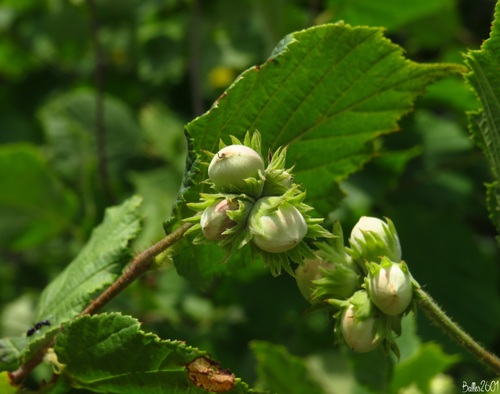
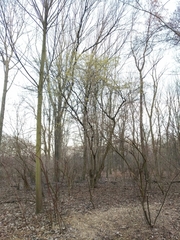
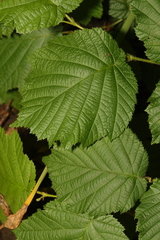
Common hazel (Corylus avellana) is a deciduous shrub in the Betulaceae family, widespread in European woods and hedges, including France. Its rounded, softly hairy leaves, long yellow male catkins in late winter and edible nuts in leafy husks distinguish it. The species is monoecious, with male and female flowers on the same plant.
Read moreCommon hazel, European hazel and Cobnut

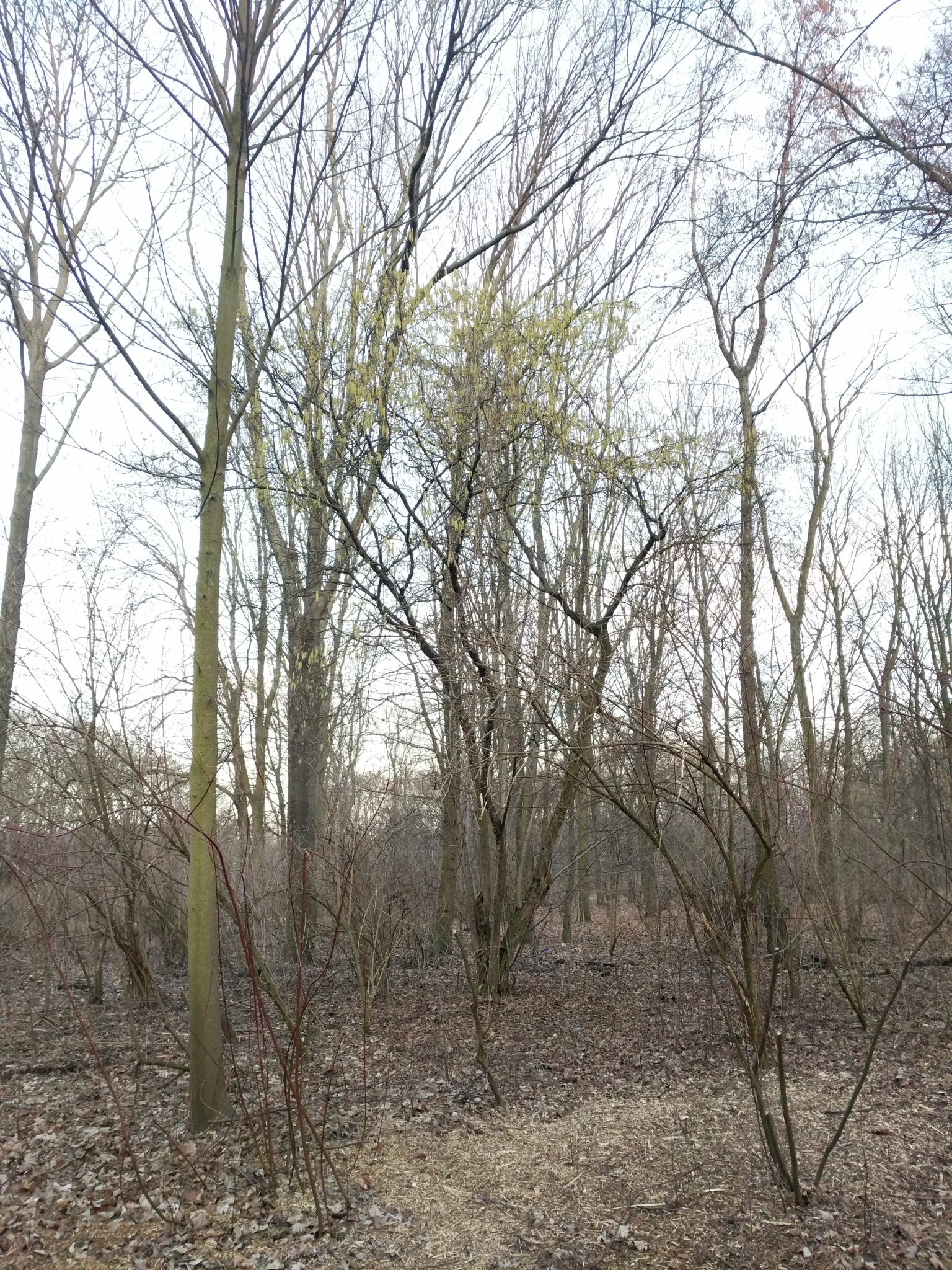
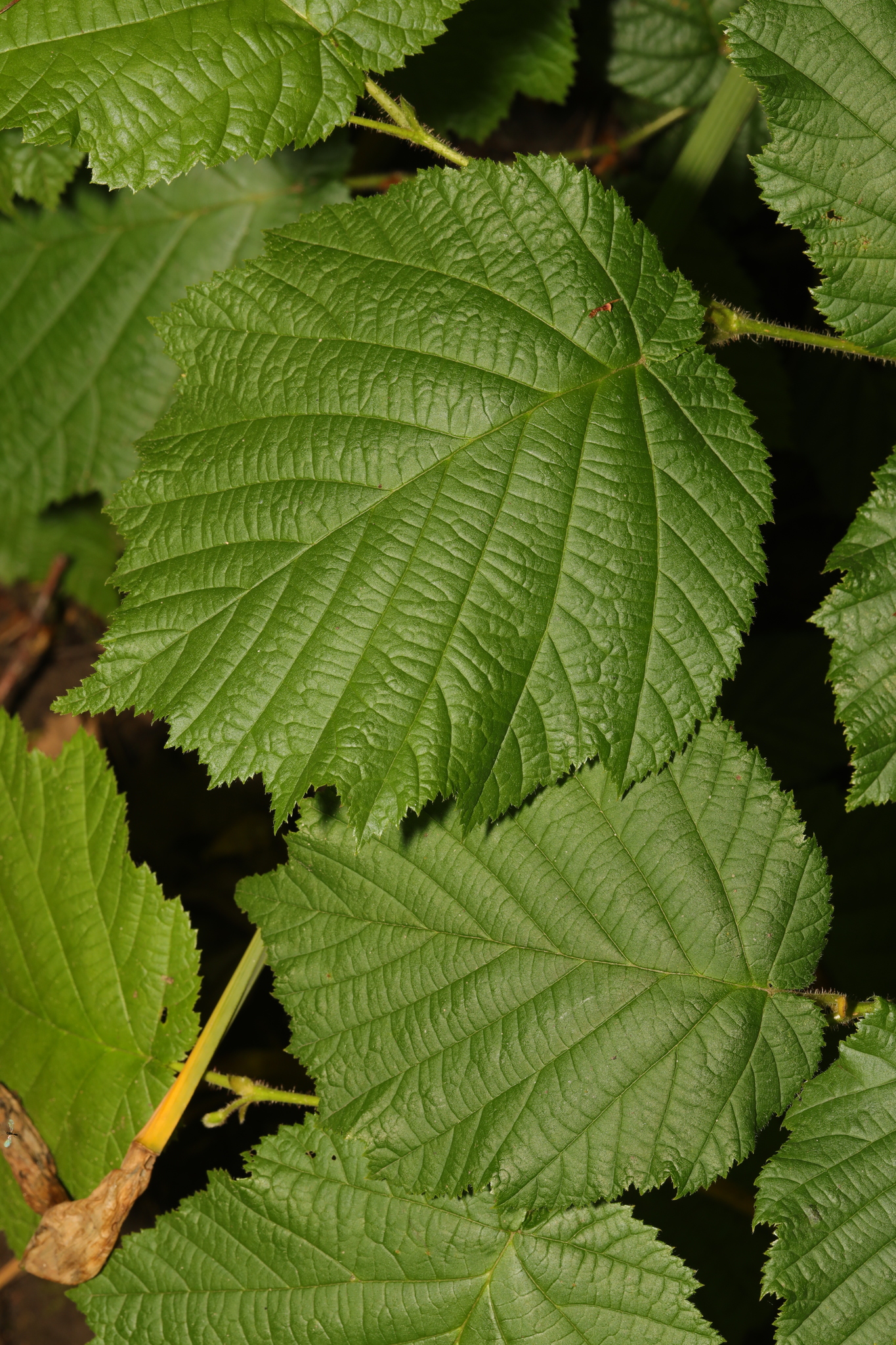
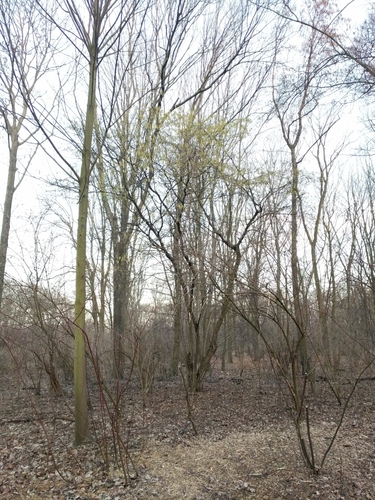
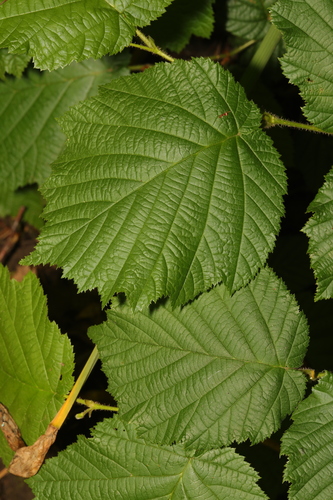
© photo
(c) David Ballesteros, some rights reserved (CC BY-NC), uploaded by David Ballesteros · cc-by-nc
d1618d96 · cc0
Stephen James McWilliam · cc0
no rights reserved · cc0
Global distribution
The native range of Corylus avellana covers most of Europe, from northern Iberia to Scandinavia, extending to the Caucasus and Asia Minor. In France it grows wild and is common in moist woods, edges and hedges, from lowlands to middle mountain elevations. It is also widely planted for nuts and ornament.
- Native7
- Metropolitan France
- United Kingdom
- Spain
- Germany
- Italy
- Sweden
- Turkey
Hexagons: regions where the plant occurs. Green dots: native range.1
Identity
Common hazel (Corylus avellana L., 1753), also called European hazel or Cobnut, is a deciduous shrub in the genus Corylus, family Betulaceae. One of Europe's most widespread hazels, it produces the hazelnuts most commonly gathered wild or grown as a crop on the continent. 1 5
Across France, hazel is familiar in moist woodland, along woodland edges and in rural hedgerows. It is grown both for edible nuts and for ornament, including twisted and purple-leaved forms. The epithet avellana refers to ancient Abella in Campania, a town already known for its hazels. 7 8
Recognition
Rounded to almost heart-shaped leaves provide the first clue to common hazel: they are alternate, doubly toothed, medium green and soft, with a downy underside. The shrub usually forms a multi-stemmed stool, its several stems arising as shoots from the base, rather than developing a single trunk. 4 2
Its most striking feature appears in late winter, when long, hanging yellow male catkins lengthen and shed abundant pollen, often before leaves unfold. On the same plant, tiny female flowers show only a tuft of red stigmas emerging from a bud. Common hazel is monoecious, but largely self-incompatible: pollen from another hazel greatly improves fertilization. 3 4
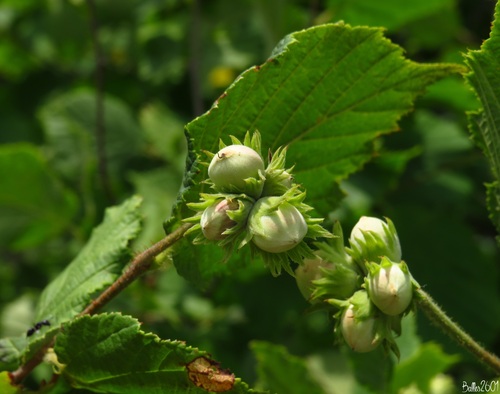
The nuts are achenes with hard brown shells, grouped in clusters of one to four and held in a cut-edged leafy husk. They ripen in fall. The shrub usually reaches 3–8 m (10–26 ft) tall and 3–5 m (10–16 ft) wide, with smooth grayish-brown bark marked by pale lenticels. 2 3
Useful taxonomy
Linnaeus described this species as Corylus avellana L. in 1753. Hazel has accumulated many infraspecific and horticultural names, several now treated as synonyms. Names encountered in botanical references include:
- Corylus avellana var. avellana
- Corylus avellana var. grandis Aiton (botanical name)
- Corylus avellana var. urticifolia (Nois.) A.DC. (botanical name)
- Corylus avellana f. glomerata (Aiton) W.T.Aiton (botanical name)
Use the accepted scientific name, Corylus avellana, as the stable reference. Cultivar names such as Contorta and Purpurea identify horticultural selections, not separate species or botanical varieties. Common hazel must also be distinguished from Turkish hazel, Corylus colurna, which develops a single trunk. 1 7
Habitat and range
Europe is the heart of common hazel's native range, from northern Iberia to Scandinavia, extending east to the Caucasus and Asia Minor. In France it grows wild and is common beneath oak and beech woodland, forming a shrubby understory, as well as at woodland edges, in hedges and beside watercourses. 8 7
Partial shade and moist soil suit this species. It thrives from lowlands to middle mountain elevations on deep soil that is neutral to slightly calcareous. Its strong ability to regrow from the base allows it to occupy woodland edges and cut areas, and to persist in mixed hedges with hawthorn, hornbeam and elder. 4 5
Cultivation for nuts and ornament has taken common hazel far beyond its wild range, including North America and temperate Asia. These planted populations should be distinguished from the native European and Caucasian range rather than treated as evidence that the shrub originated in every place where it grows. 3 5
Life cycle and reproduction
Very early flowering, in late winter, sets hazel apart from most trees. Wind carries pollen released by male catkins to the receptive red stigmas of female flowers. Because the species is largely self-incompatible, several neighboring hazels are the key to a good crop rather than a single isolated shrub. 3 4
Fruit develops through summer, with nuts ripening from late summer into fall in its Northern Hemisphere range. Late spring frosts are the main risk: they destroy open female flowers and jeopardize that year's crop. The shrub itself is long-lived and very hardy, tolerating frost around −25 °C (−13 °F). 2 5
Growers propagate common hazel by seed, layering or cuttings. Nuts given cold stratification in fall germinate the following spring, but seedlings vary. Layering basal shoots and taking cuttings preserve a cultivar's character. These are the methods to choose when reproducing a twisted or purple-leaved form, or a selected nut-bearing variety. 6 2
Uses and risks
Nut production is common hazel's main use. Its oil-rich nuts are eaten raw, roasted or processed, and numerous selected varieties are grown in orchards. The shrub also joins mixed rural hedges and provides ornamental twisted or purple-leaved forms. Managed as coppice and cut back, it supplies straight rods long used for woven fencing and basketry. 6 5
Common hazel is not toxic: the plant contains no notable dangerous substance, and its nuts are edible. The reservation concerns people with tree nut allergies, for whom hazelnuts are allergens to avoid. Apart from that allergy concern, the plant is described as safe around children and domestic animals in the garden. 4 6
Varieties, look-alikes and related plants
Ornamental hazel selections belong to the same species. Contorta is the familiar corkscrew form with spiraling branches; Purpurea and Fuscorubra have purple or brownish-red leaves. Aurea bears golden young foliage, while Pendula has a weeping silhouette. Alongside these decorative forms, many fruiting varieties have been selected for the size and flavor of their nuts. 2
Check these related plants when identifying a hazel:
- Corylus colurna, Turkish hazel, forms a true single-trunked tree;
- Corylus maxima, the filbert, has an elongated husk that completely encloses the nut;
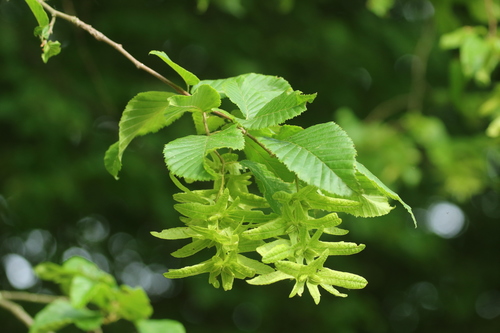
- Carpinus betulus, European hornbeam, has similar but more regularly toothed leaves and does not produce hazelnuts.
Early yellow catkins, the red stigmas of female flowers and nuts held in leafy husks remain the most reliable combination for confirming Corylus avellana. These reproductive features distinguish it more clearly than the general shape of a leaf considered on its own. 4 1
Main sources
- Plants of the World Online / Kew, Corylus avellana L.
- Royal Horticultural Society, Corylus avellana - common hazel
- Missouri Botanical Garden, Corylus avellana
- NC State Extension, Corylus avellana (European Hazelnut)
- Encyclopaedia Britannica, European filbert (hazelnut)
- Plants For A Future, Corylus avellana
- Tela Botanica, Corylus avellana L.
- INPN / MNHN, Corylus avellana L., 1753 (cd_nom 92606)
Frequently asked questions
Is common hazel toxic?
No. Common hazel is not toxic, and its edible nuts have been eaten for thousands of years. People with tree nut allergies should avoid hazelnuts.
Why is my common hazel not producing nuts?
Usually the shrub is still young, late-winter frosts have destroyed the female flowers, or pollination has failed. Common hazel is largely self-incompatible, so planting several nearby plants greatly improves cross-pollination.
Is common hazel monoecious or dioecious?
It is monoecious. Yellow male catkins and tiny female flowers with red stigmas grow on the same plant, but most successful pollination comes from another hazel.
When should I harvest hazelnuts?
Hazelnuts ripen in fall, generally from late summer into mid-fall depending on climate. Harvest when shells turn brown and nuts detach easily from their leafy husks, or after they fall.
How do I prune common hazel?
Prune in winter during frost-free weather. Maintain several stems as a coppiced stool, cutting the oldest to ground level every few years. Remove dead wood and excess basal shoots.
How big does common hazel grow?
Common hazel is a shrub 3–8 m (10–26 ft) tall, usually with several stems rather than a single trunk. Its spread is about 3–5 m (10–16 ft).
Which plants look like common hazel?
The main look-alikes are Turkish hazel (Corylus colurna), a single-trunked tree, and European hornbeam (Carpinus betulus), with more regularly toothed leaves. Early catkins and hazelnuts settle the identification.
Similar plants
If you are unsure about a plant’s toxicity, ask a botanist or veterinarian for advice.