
Japanese spindle tree (Euonymus japonicus, )
Japanese spindle tree (Euonymus japonicus) is an evergreen shrub or small tree in the Celastraceae family, native to Korea, Japan and the Nansei Islands. Introduced to Europe around 1800, it became a widely planted clipped hedge in temperate gardens, valued for its glossy foliage, tolerance of urban pollution and ability to recover from hard pruning.
Read moreJapanese spindle tree, Japanese spindle, Evergreen spindle, Japanese spindletree, Evergreen euonymus and Masaki
Allow a few hours of direct sun per day, preferably morning or evening.
Full sun to partial shade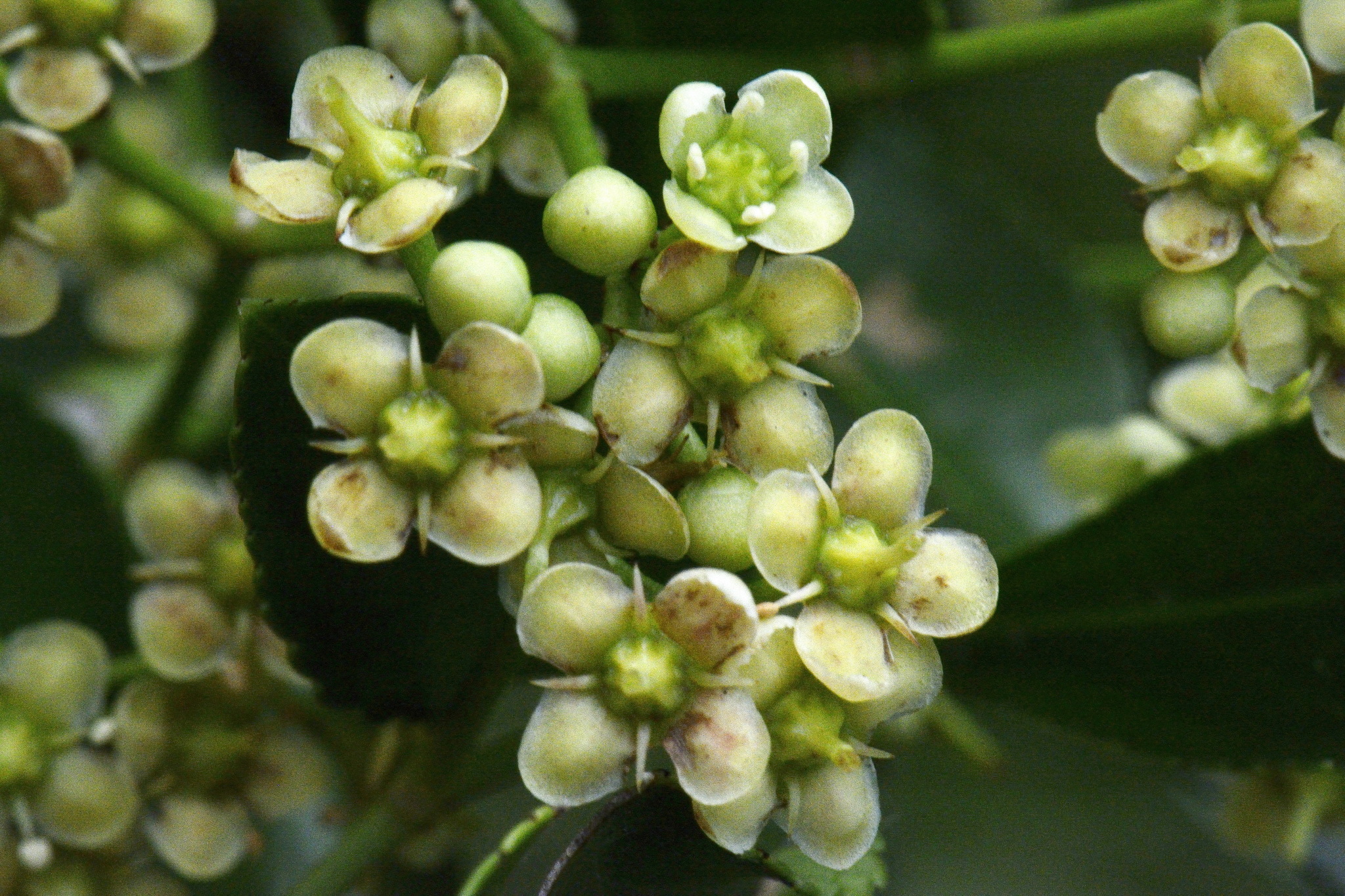


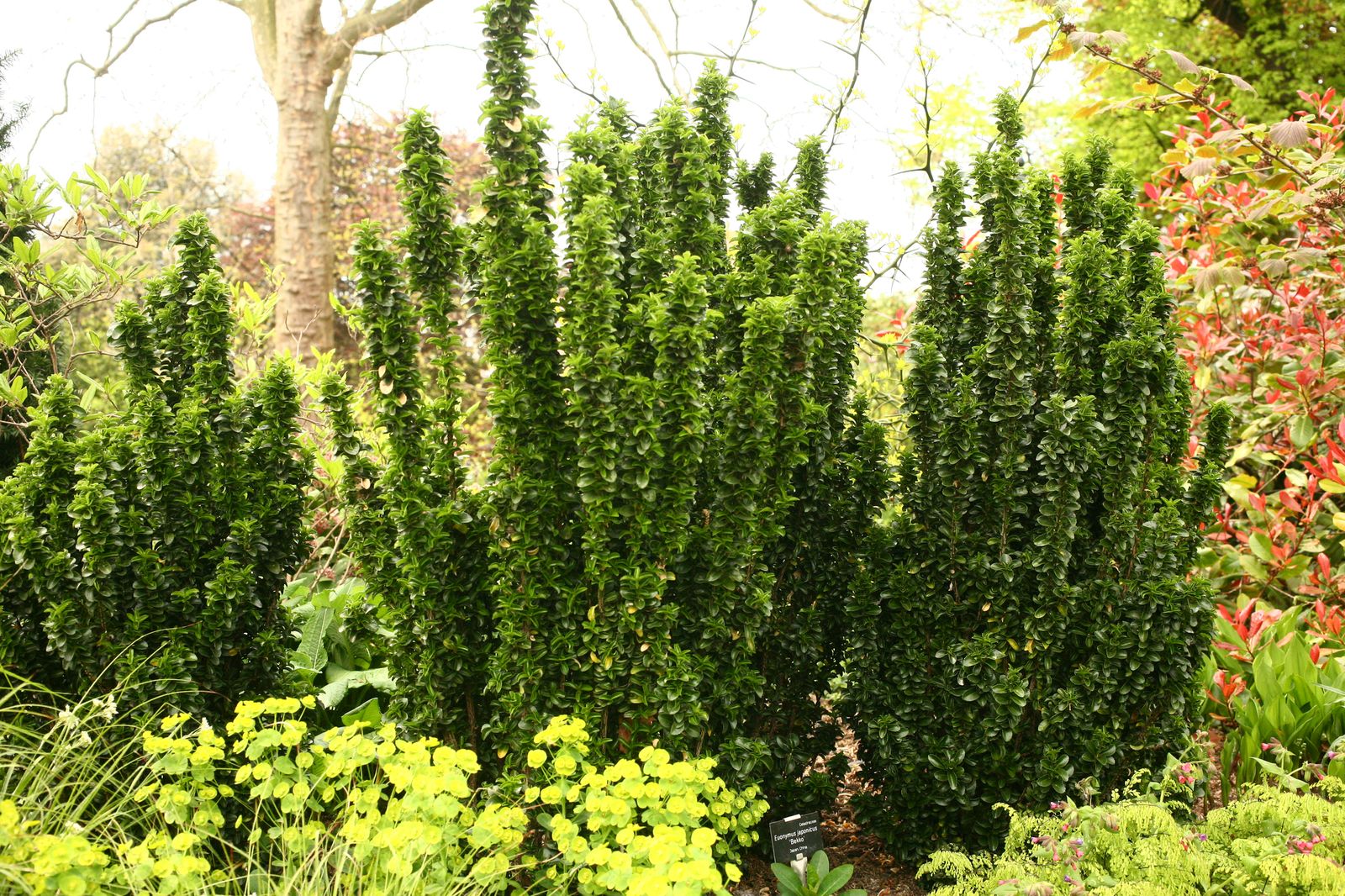
© photo
(c) Pat Enright, some rights reserved (CC BY-NC), uploaded by Pat Enright · cc-by-nc
Robert H. Wardell · cc0
Sandy Wolkenberg · cc-by
Taken Sep 2, 2020 by Nina Kuijer (cc-by-sa)
Taken Apr 12, 2020 by Albert (cc-by-sa)
Taken Oct 29, 2020 by Reyes Ivan (cc-by-sa)
Taken Apr 14, 2020 by lsusr lsusr (cc-by-sa)
© copyright of the Board of Trustees of the Royal Botanic Gardens, Kew.




Global distribution
Euonymus japonicus is native to South Korea, Japan and the Nansei (Ryukyu) Islands. Introduced to Europe around 1800, it is now grown as a hedge shrub across much of the temperate world. It has naturalized and become locally invasive in some oceanic regions; this differs from its ordinary ornamental cultivation elsewhere.
- Native2
- Invasive2
- Japan
- South Korea
- New Zealand
- Australia
Hexagons: regions where the plant occurs. Green dots: native range.1
Identity
Japanese spindle tree (Euonymus japonicus Thunb., 1780), also called Japanese spindle, evergreen spindle, Japanese spindletree, evergreen euonymus or Masaki, is an evergreen shrub or small tree in the genus Euonymus, family Celastraceae. Clipped once or twice a year, it stays around 1–2.5 m (3–8 ft) as a hedge; an unpruned specimen can reach 8 m (26 ft). Swedish botanist Carl Peter Thunberg described it following his stay in Japan in 1775–1776. It is now among the most widely planted hedge shrubs in temperate gardens. 1 8
The Greek roots of Euonymus are eu, meaning good, and onomazo, meaning to name: literally “well named.” Used by Pliny the Elder in antiquity, the name may have been ironic, contrasting attractive foliage with toxic fruits. The French name fusain refers to the genus's wood, traditionally charred to make drawing charcoal. That historical use is associated with Euonymus europaeus rather than this Japanese species. 8
Recognition
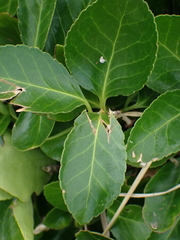
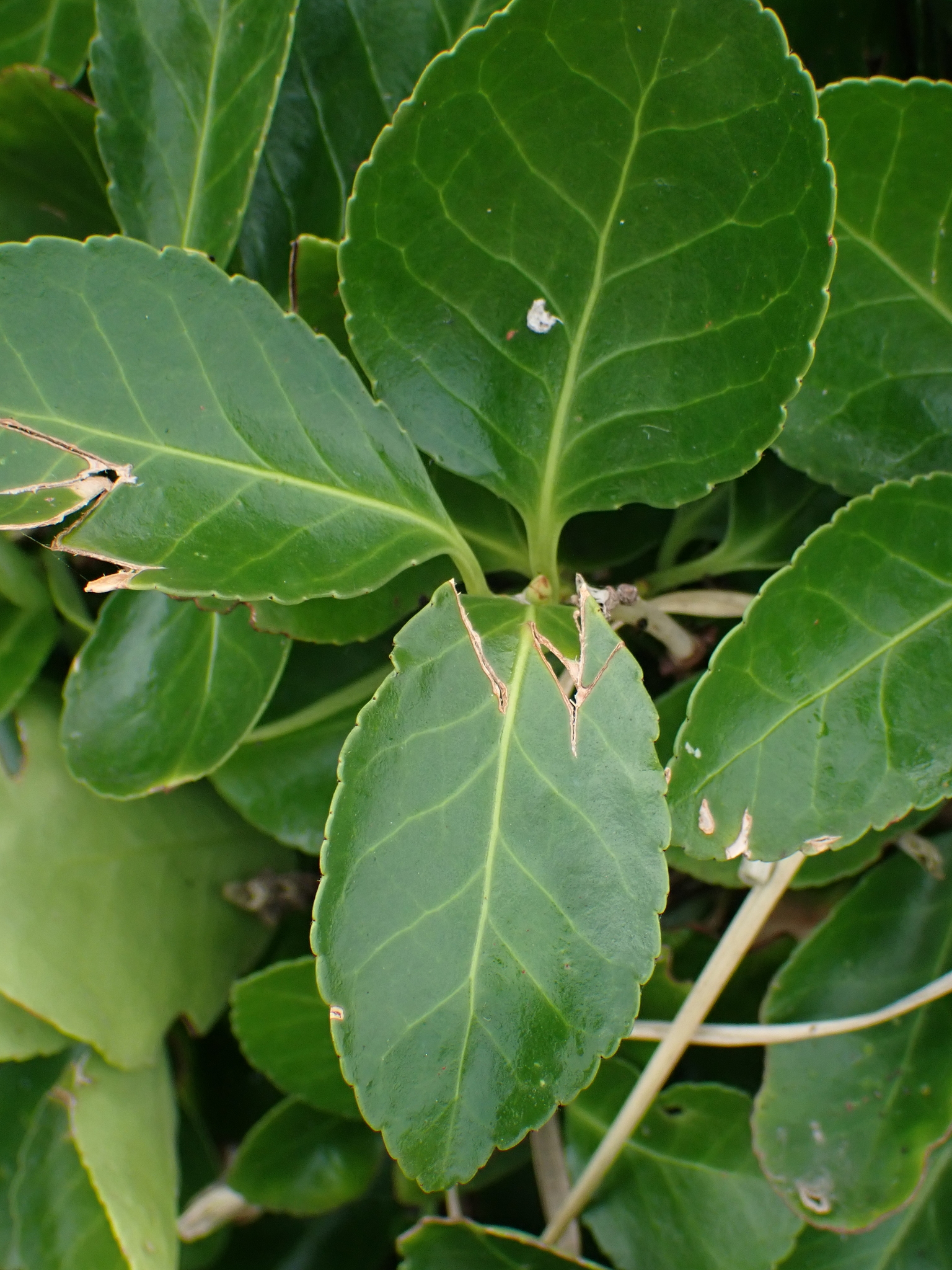
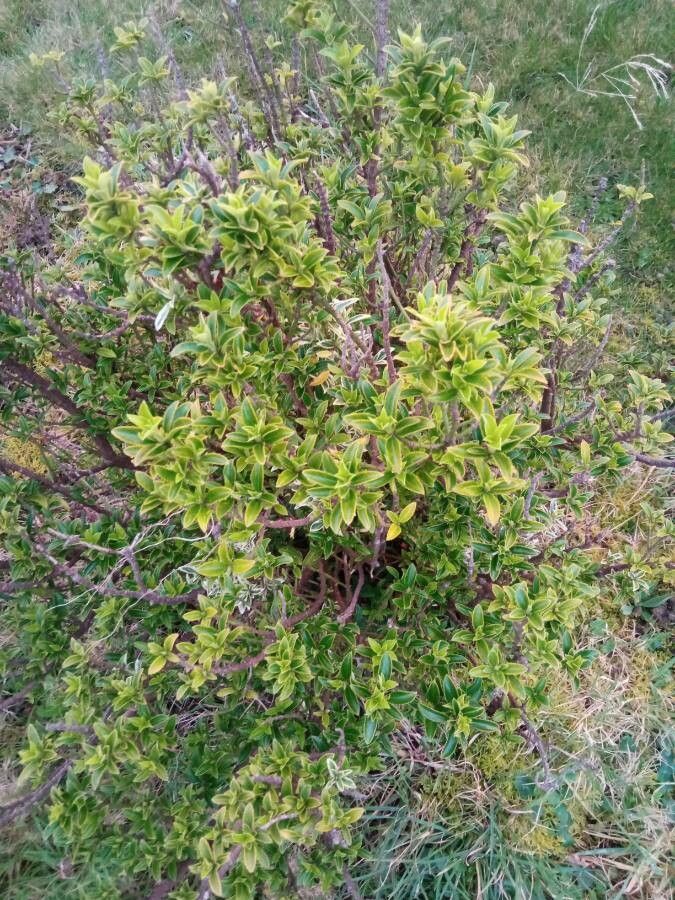
Dense, upright or spreading branches give Euonymus japonicus its characteristic shrub outline. Young shoots are green, hairless and cylindrical. The opposite, evergreen leaves are leathery and glossy, usually 5–10 cm (2–4 in) long, elliptical to obovate, with finely toothed margins except near the base. 2 4
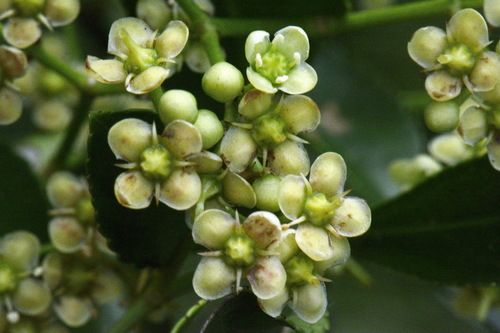
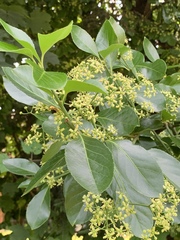
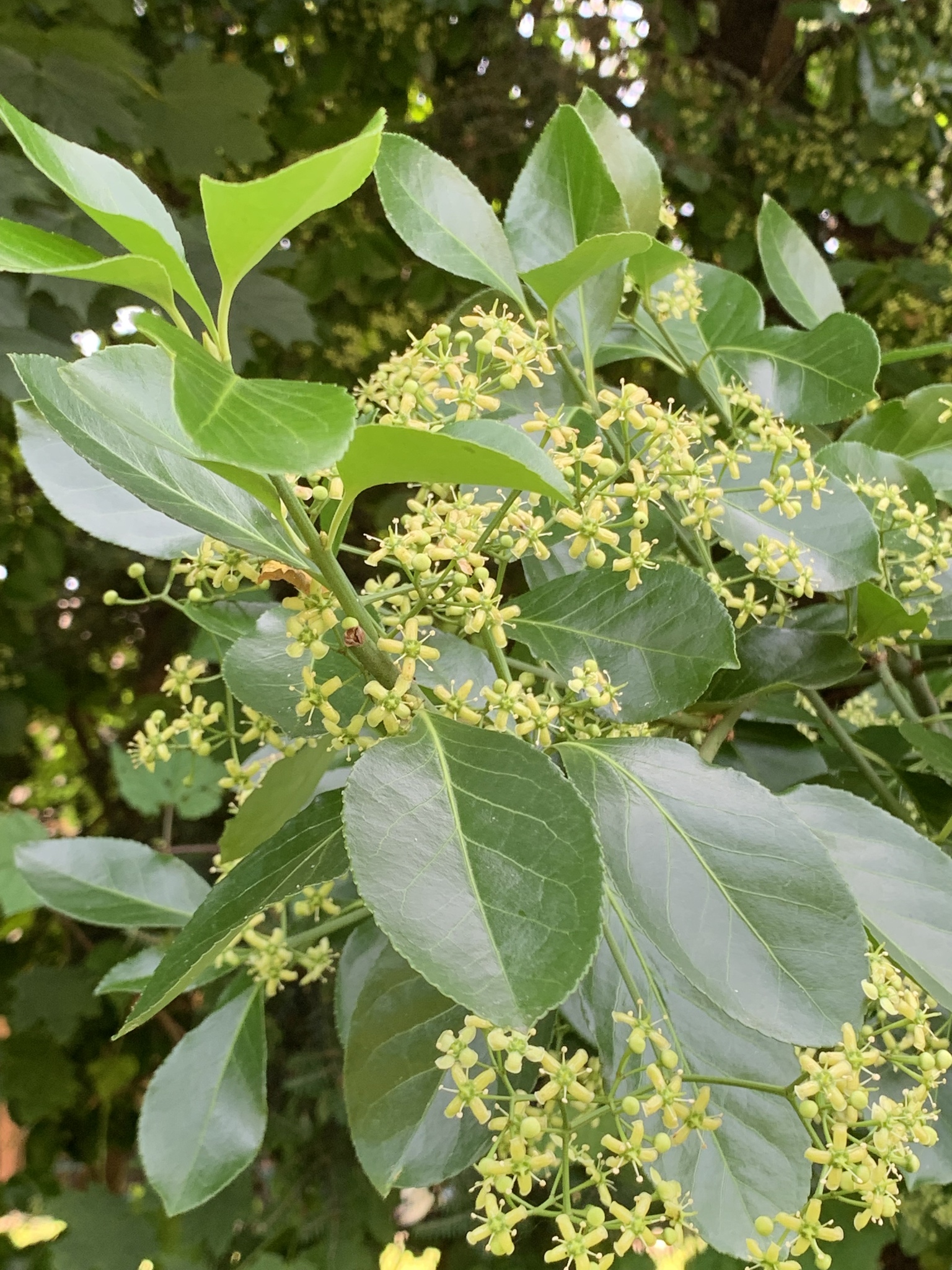
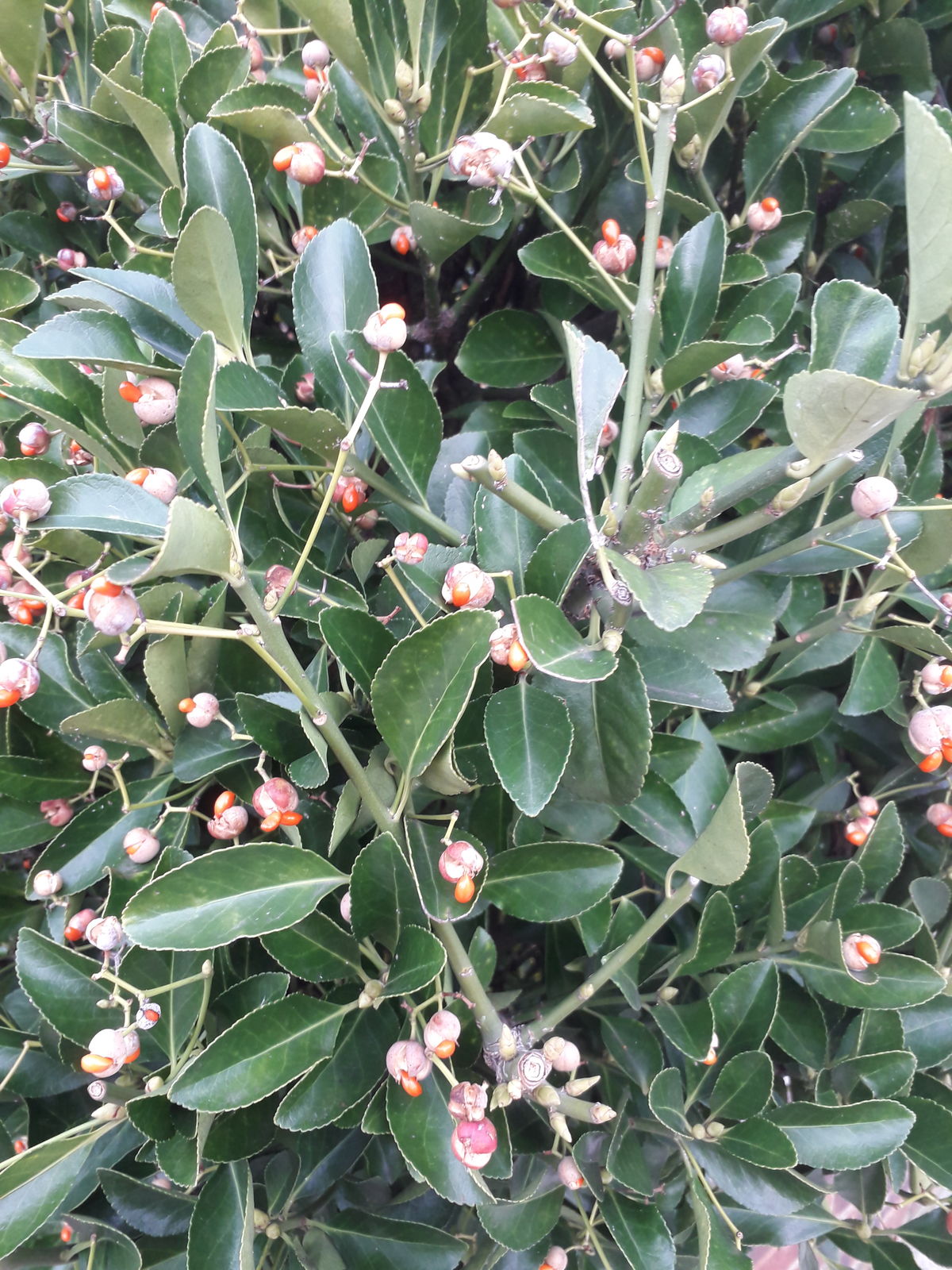
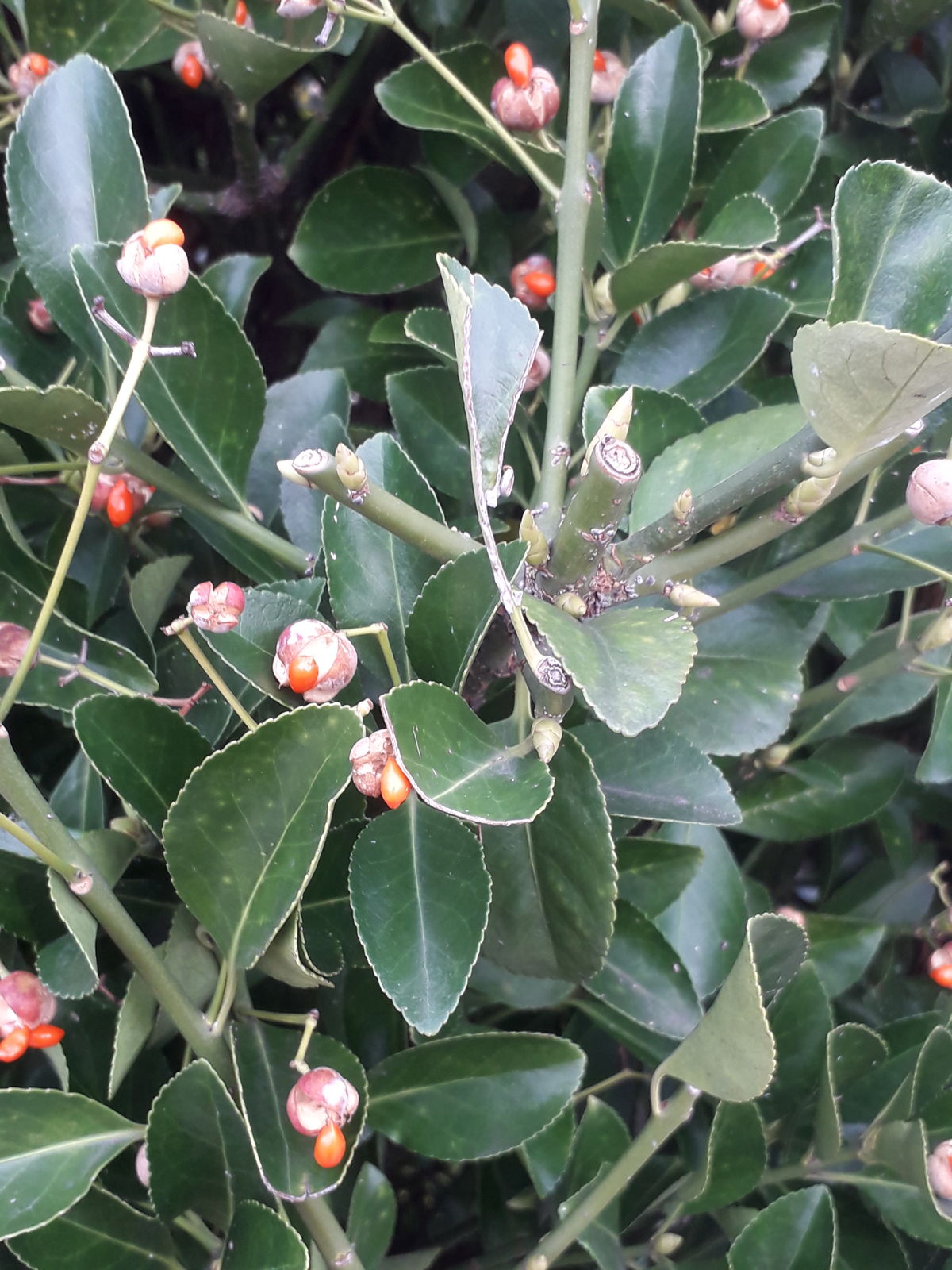
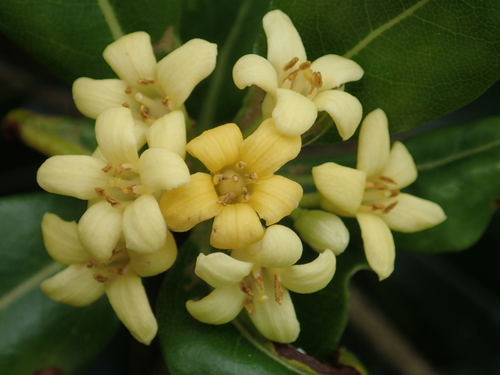
Small, inconspicuous flowers appear from late spring into summer in clusters at the leaf axils. Each has four greenish, yellowish or cream petals and measures about 5–6 mm (0.2–0.24 in) across. The rounded fruit capsule is pink to yellowish brown, 6–10 mm (0.24–0.4 in) wide, and opens into four sections. It exposes seeds wrapped in orange to bright red arils, a conspicuous fall contrast. 7 4
Growth habit separates it reliably from Euonymus fortunei. Japanese spindle tree forms an upright shrub, whereas its close relative, more widespread in East Asia, is climbing or creeping and grips supports with adventitious roots. Similar leaves alone are therefore insufficient for identification. 5
Useful taxonomy
For this species, POWO/WCVP accepts the name Euonymus japonicus Thunb. Numerous synonyms and historical names have circulated, including variegated horticultural forms described as early as the 19th century:
Historical names for Japanese spindle tree:
- Elaeodendron javanicum Turcz.
- Euonymus carrierei Dippel
- Euonymus pulchellus Dippel
- Euonymus repens Carrière
- Masakia japonica (Thunb.) Nakai
- Euonymus japonicus f. aureomarginatus (Rehder) Rehder
Linnaeus established the genus Euonymus in 1753. It belongs to the Celastraceae family and the order Celastrales. Horticultural labels sometimes blur the distinction, but Euonymus fortunei is not merely a variety of Euonymus japonicus. They remain separate species despite their strongly similar foliage. 1
Habitat and range
South Korea, Japan and the Nansei (Ryukyu) Islands make up the native range of Euonymus japonicus. There it occupies coastal thickets and forest edges, extending onto wooded slopes near the sea. 1 4
European cultivation began around 1800, followed by widespread planting across temperate regions worldwide. Parks and gardens have made particular use of the shrub in single-species ornamental hedges. A planted hedge outside the native range does not by itself establish that a population is naturalized. 2
Some introduced populations do become locally invasive. Naturalized in New Zealand since 1980, the species is listed there as an environmental weed: dense stands hinder the establishment of native seedlings. South Australia also considers it a weed of disturbed habitats. These documented situations in New Zealand and southern Australia should be distinguished from ordinary ornamental cultivation elsewhere. 7
Life cycle and reproduction
Late spring and summer bring the flowering season, with the main flush in early to midsummer in temperate Europe. The small, nectar-producing flowers mainly attract small insect pollinators; the foliage remains much more noticeable than the blooms. 2
Fall ripening exposes the seeds when the pink to yellowish-brown capsules split into four sections. Birds seek out the brightly colored arils and provide most seed dispersal. For these arillate seeds, transport by birds is more effective than wind dispersal and helps explain scattered naturalized populations beyond the original range. 7
Nurseries mainly propagate the shrub from semi-ripe shoot cuttings taken in summer. These root within a few weeks under a frame, whereas cold-stratified seeds may take several months. Seed propagation is possible, but germination is less predictable than rooting cuttings. 5
Uses and risks
Clipped evergreen hedges are a major use of Japanese spindle tree. It also grows in containers on balconies or patios, while cultivars such as 'Compactus' make low edging. Tolerance of calcareous soil and salt spray explains its popularity by the sea; resistance to pollution also makes it familiar in urban hedges. 2 4
Eating the plant can cause poisoning, especially its fruits and seeds, which concentrate cardenolides and sesquiterpene alkaloids. Human ingestion causes digestive irritation, vomiting and diarrhea, sometimes bloody. The cited toxicology account estimates a purgative effect from three or four fruits in adults, or a single fruit in children. In cats and dogs, the same compounds cause vomiting and diarrhea and, at high doses, abnormal heart rhythms. 6 4
Cold sets another limit on cultivation. Below −18 °C (0 °F), young plants and strongly variegated cultivars may partially defoliate, while summer peaks up to 35 °C (95 °F) are tolerated without damage. Mulching around the base helps limit injury to recent plantings during cold spells below that threshold. 4
Varieties, look-alikes and related plants
Variegated cultivars account for many nursery offerings. 'Albomarginatus' has creamy-white leaf margins; 'Aureomarginatus' has golden margins documented since the 19th century; 'Aureopictus' has irregular yellow patches in the leaf centers. 'Benkomasaki' is a narrow, upright Japanese selection reaching 1–1.5 m (3–5 ft). The small-leaved 'Microphyllus' is now often used to replace box hedges damaged by box tree moth. 2
Several other hedge plants can look similar:
- Euonymus fortunei is closely related but climbs or creeps rather than growing upright;
- Euonymus europaeus, European spindle, is deciduous, with bright pink, distinctly four-lobed fruits;
- Buxus sempervirens, common box, has opposite leaves with smooth, entire margins;
- Ligustrum species, the privets, have a characteristic smell when crushed and lack the colorful capsule.
Toothed leaf margins and pink capsules exposing seeds with colored arils provide the strongest confirmation of Euonymus japonicus among these superficially similar hedge plants.
Main sources
- Plants of the World Online / Kew, Euonymus japonicus Thunb.
- Royal Horticultural Society, Euonymus japonicus
- Missouri Botanical Garden Plant Finder, Euonymus japonicus
- NC State Extension Plant Toolbox, Euonymus japonicus
- Plants For A Future, Euonymus japonicus
- Toxiplante, Euonymus japonicus (Japanese spindle tree) monograph
- New Zealand Plant Conservation Network, Euonymus japonicus weed profile
- INPN/MNHN, Euonymus japonicus Thunb. 1780
Frequently asked questions
Is Japanese spindle tree toxic to cats and dogs?
Yes. Its fruits and seeds contain cardenolides and alkaloids that cause vomiting and diarrhea, and at high doses heart problems, in cats, dogs and humans.
How can I tell Euonymus japonicus from Euonymus fortunei?
Growth habit is the most reliable clue. Euonymus japonicus forms an upright or spreading shrub, while the closely related Euonymus fortunei climbs or creeps, attaching itself to supports with adventitious roots.
Can Japanese spindle tree replace box hedges?
Partly. The small-leaved cultivar 'Microphyllus' is widely used for garden edging to replace box damaged by box tree moth, with similar pruning requirements.
When should I prune Japanese spindle tree?
Prune in spring and again in late summer to keep a compact hedge. The shrub tolerates hard pruning and readily regrows from old wood.
Where does Japanese spindle tree come from?
It is native to South Korea, Japan and the Nansei Islands. Introduced to Europe around 1800, it has since become widely grown as a hedge shrub in temperate regions worldwide.
Is Japanese spindle tree invasive?
It is listed as an environmental weed in New Zealand, where it has been naturalized since 1980, and is considered locally invasive in South Australia. In France, it remains primarily a cultivated hedge plant.
Why is my Japanese spindle tree losing leaves in winter?
Euonymus japonicus normally keeps its leaves all year. Leaf loss is more likely to indicate water stress, scale insects or excessively wet roots than natural dormancy.
Similar plants
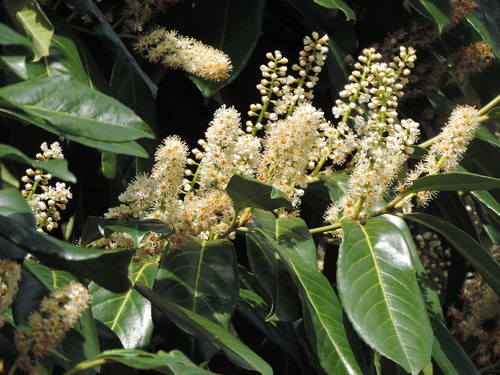
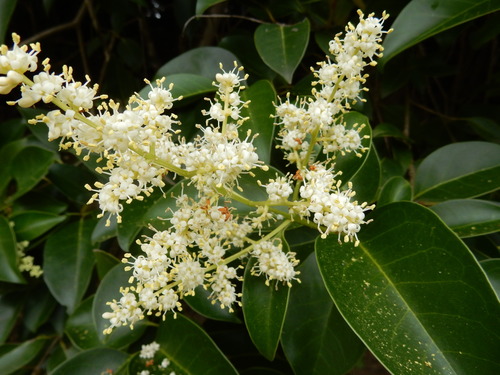
If you are unsure about a plant’s toxicity, ask a botanist or veterinarian for advice.