
African milk tree (Euphorbia trigona, )


African milk tree (Euphorbia trigona Mill., 1768) is a shrubby succulent in the Euphorbiaceae, associated with Central Africa but known almost entirely in cultivation. Upright, three- or four-angled stems have pale green chevrons and tiny seasonal leaves between pairs of spines. Despite its cactus-like outline, it belongs to a different family and almost never flowers, an observation linked to a possible hybrid origin.
Read moreAfrican milk tree, Cathedral cactus, Friendship cactus and Abyssinian euphorbia
Allow a few hours of direct sun per day, preferably morning or evening.
Full sun to light partial shade


© photo
no rights reserved · cc0
Wikimedia Commons · CC BY-SA or Public Domain
Wikipedia · CC BY-SA
Taken Oct 6, 2022 by poto margallo (cc-by-sa)
Taken May 27, 2020 by penny vaudour (cc-by-sa)
Taken Dec 25, 2020 by g p (cc-by-sa)
Taken Jan 15, 2021 by Alves Chiari Darci (cc-by-sa)
Taken Jul 23, 2020 by lopez estefania (cc-by-sa)
© copyright of the Board of Trustees of the Royal Botanic Gardens, Kew.




Global distribution
Plants of the World Online assigns Euphorbia trigona a range from Gabon to Malawi; horticultural extension accounts also name Angola and the Democratic Republic of the Congo. Yet the plant is known almost exclusively in cultivation, with no confirmed wild population, supporting a possible hybrid origin. It has spread widely as an ornamental and living hedge, becoming locally invasive in some tropical regions.
- Native4
- Invasive2
- Gabon
- Angola
- Democratic Republic of the Congo
- Malawi
- Cuba
- India
Hexagons: regions where the plant occurs. Green dots: native range.1
Identity
African milk tree (Euphorbia trigona Mill., 1768), also called cathedral cactus, friendship cactus or Abyssinian euphorbia, belongs to the genus Euphorbia in the Euphorbiaceae. Scottish botanist Philip Miller published the name in 1768 in the eighth edition of his Gardener's Dictionary. Plants of the World Online still accepts that combination. 1 2
Its spiny, columnar outline suggests a cactus, but African milk tree belongs to a different family. Its milky latex is a characteristic feature of this euphorbia. The epithet trigona, meaning “three-angled,” describes the main stem ribs, although four-sided stems commonly occur on the same plant. 3 7
Flowering is unusually elusive in this cultivated euphorbia. Euphorbia trigona almost never flowers, despite more than two centuries in cultivation, an observation that has encouraged the hypothesis of a hybrid origin. 7
Recognition
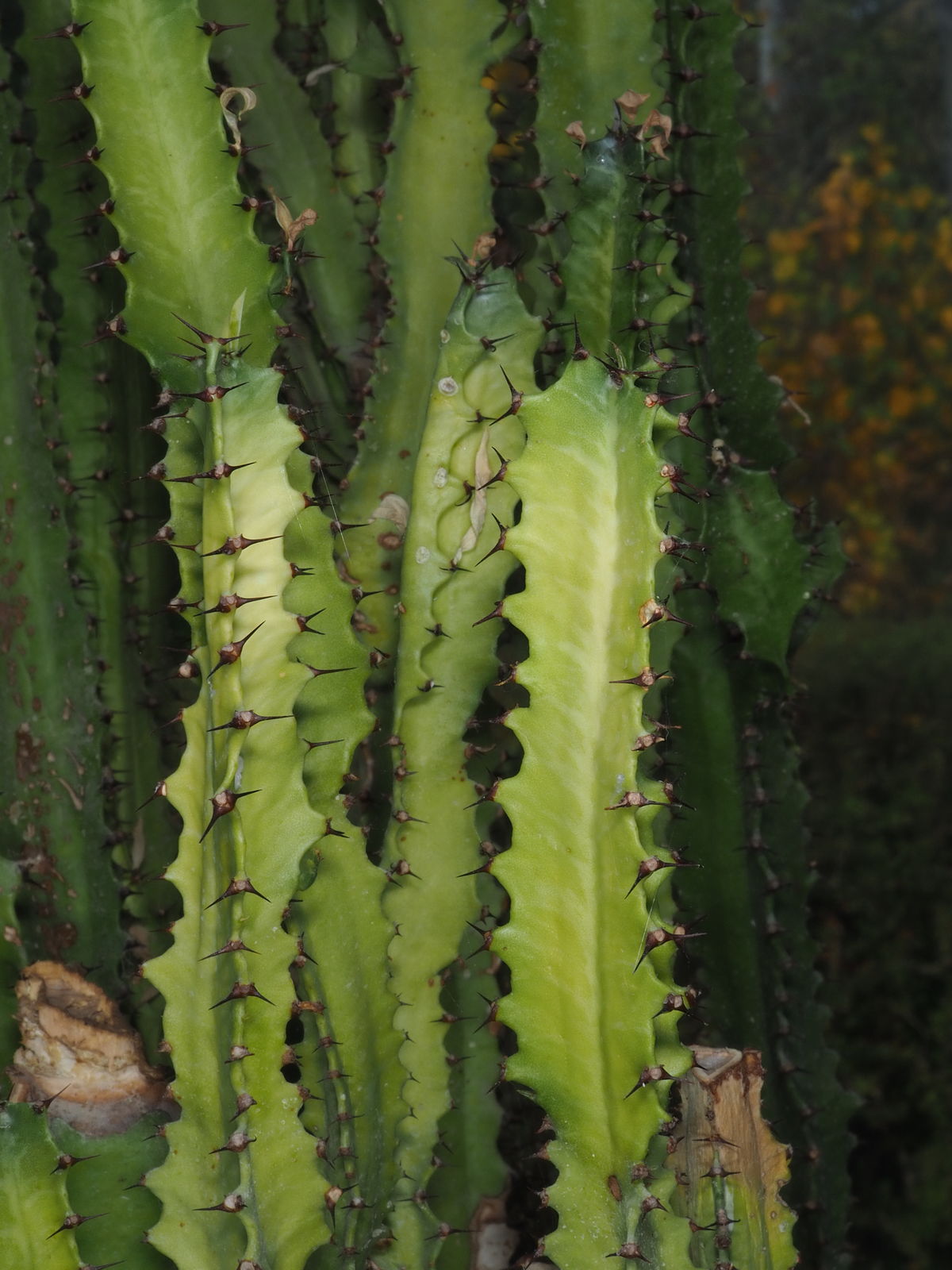
Upright, fleshy stems give Euphorbia trigona the form of a succulent shrub or small tree. They grow in tight clusters, staying close and parallel to the main trunk. Each stem measures 4–6 cm (1.6–2.4 in) across, with pale green V-shaped chevrons against a dark green background. 7 5
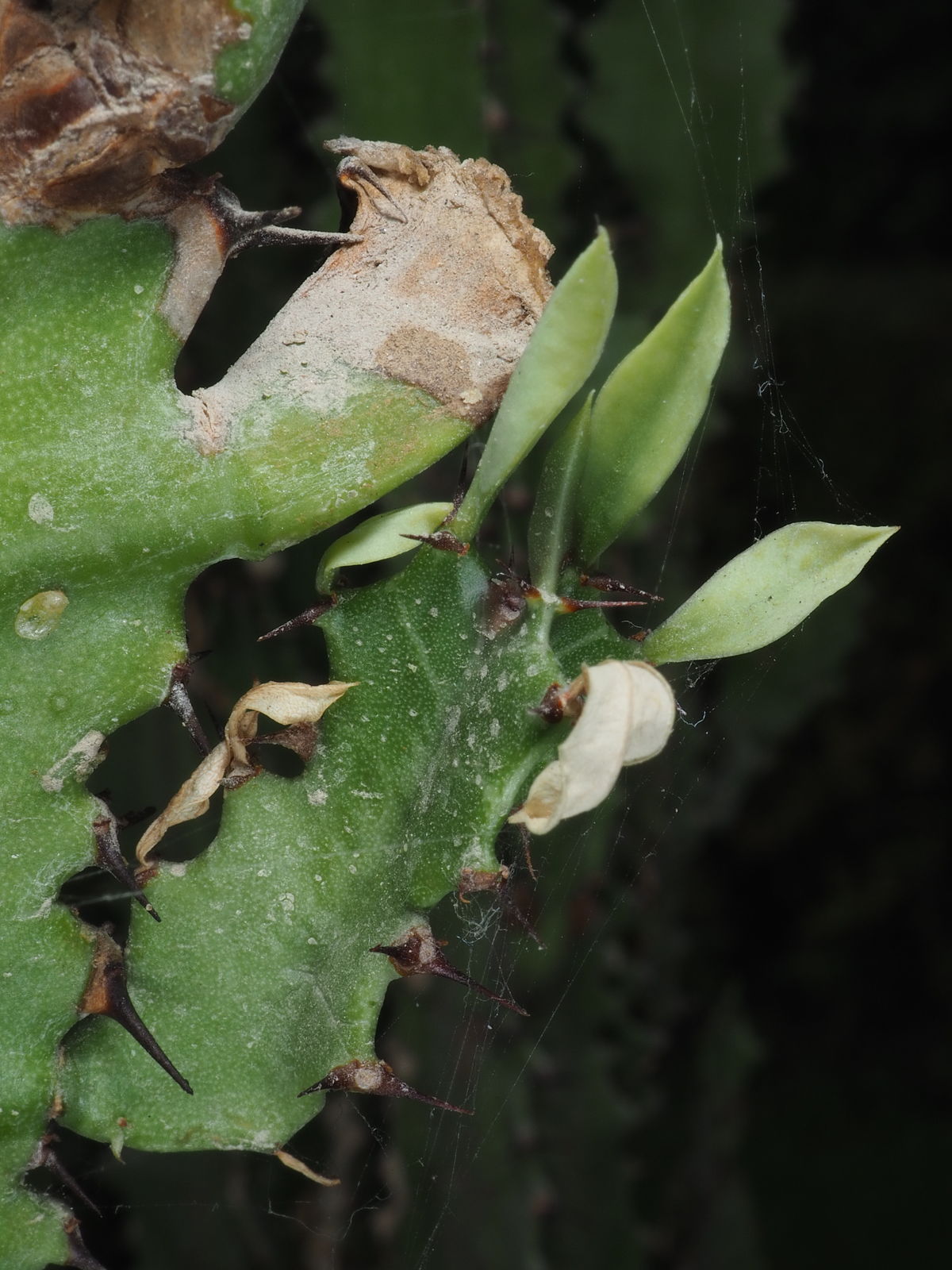
Pairs of short spines, about 5 mm (0.2 in) long, line the ribs. They begin reddish brown and turn gray with age. Tiny, teardrop-shaped leaves grow between the paired spines, then fall seasonally; their brief life does not make leaf loss a sign of disease. 3 5
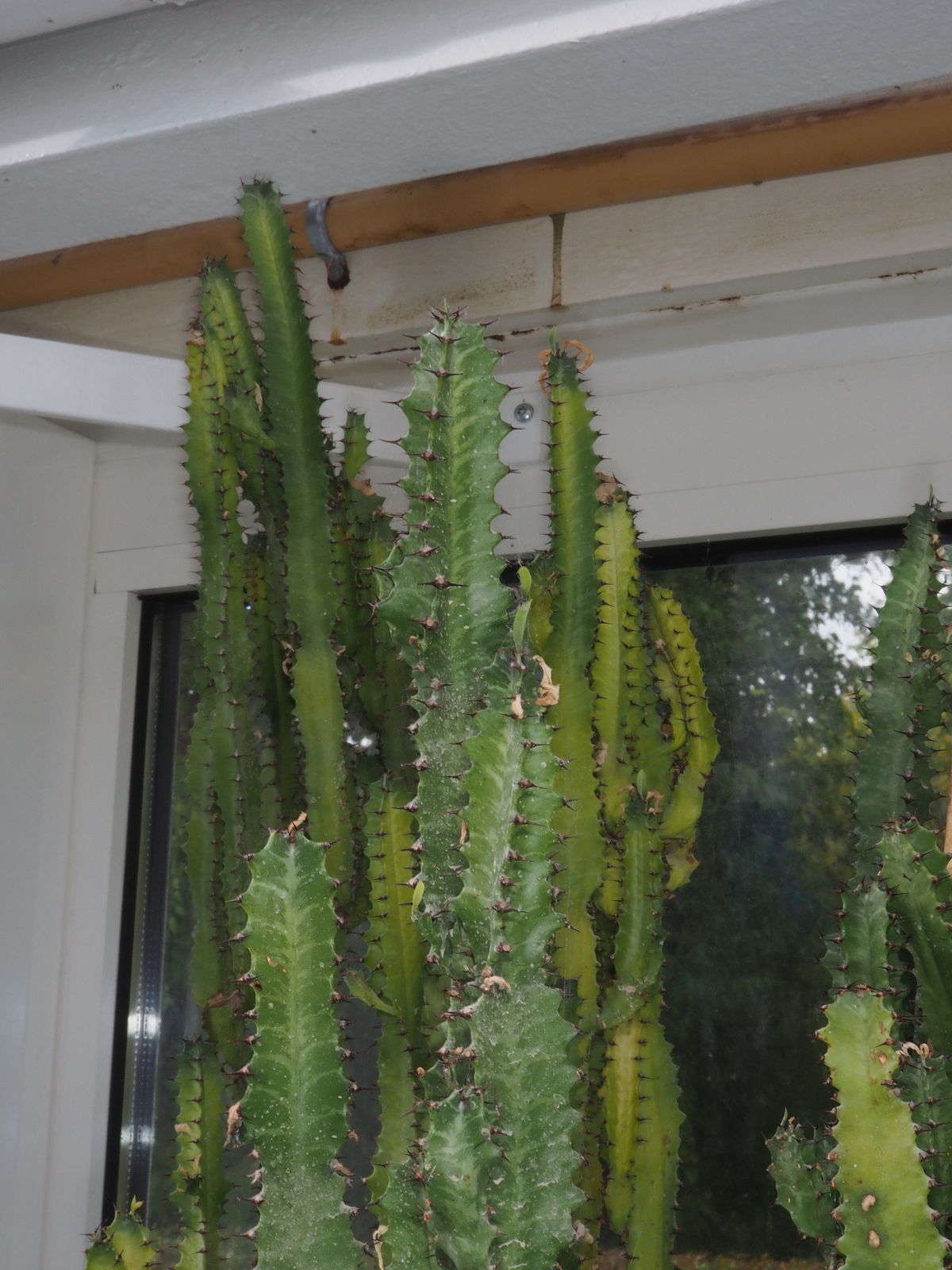
Container-grown plants rarely exceed 1–2 m (3–7 ft), while plants in warm ground can reach 4 m (13 ft) tall and spread 1–3 m (3–10 ft). The bark at the base becomes gray with age. Shallow, poorly developed roots leave a tall, heavy specimen liable to tip over, especially in a lightweight pot. 4 5
Useful taxonomy
One synonym recognized by Plants of the World Online remains familiar in older horticultural writing: Euphorbia hermentiana Lem., published in 1858. 1 7
An identical species name with a different author can mislead online searches. Euphorbia trigona Roxb., published later, is an illegitimate name for an unrelated Asian species now associated with Euphorbia lacei. The reliable reference is the full name with its author: Euphorbia trigona Mill. 1
Succulent specialists continue to question its wild status. Although cultivated for more than two centuries, the plant has never been reliably documented in flower, an observation consistent with the hypothesis of a hybrid rather than a conventional wild species. 7 6
Habitat and range
Kew's Plants of the World Online assigns Euphorbia trigona a Central African range from Gabon to Malawi. Horticultural extension accounts also frequently name Angola and the Democratic Republic of the Congo. 1 3
That attributed range comes with considerable uncertainty. No wild population has been formally documented, and the plant is described as known almost exclusively in cultivation. The most frequently cited hypothesis places its probable origin in Angola, rather than India, an older attribution now rejected. 7
Living hedges and ritual plantings in Gabon are among its traditional uses. Euphorbia trigona has spread widely through the tropics; in places including Cuba and India, it has naturalized into dense stands and is classified as invasive. 3
Life cycle and reproduction
Temperatures below 15 °C (59 °F) markedly slow growth. Growth nearly stops during a cool winter and resumes as warmth and light return in spring. A plant generally needs 10–20 years to develop its full tree-like silhouette. 4
On the exceptional occasions when flowering occurs, tiny greenish to yellow cyathia appear in summer on older plants. This bears little resemblance to the regular flowering of many other cultivated euphorbias. 5
With no dependable seed supply, propagation relies almost entirely on stem cuttings. A cut section is left to dry for 3–7 days so that a callus forms and latex stops flowing, then set in a barely moist, freely draining medium. Air layering offers an alternative for large specimens. 3
Uses and risks
Ornamental planting and protective hedges account for its main uses. In warm climates, Euphorbia trigona forms an impenetrable living hedge or an architectural feature in a dry rock garden. Indoors, its branching, candelabra-like stems make it a popular container plant. 3
The main hazard is its milky white latex, rich in irritating diterpene esters. Skin and eye contact can cause severe irritation and burns; splashes in the eyes can cause temporary blindness. Swallowing latex causes gastroenteritis and vomiting, with convulsions in severe cases. 3
Wear gloves and protective eyewear when pruning, taking cuttings or repotting. The toxic latex poses a risk to children as well as cats and dogs that chew the stems. 3
Varieties, look-alikes and related plants
'Rubra', the form most widely sold in garden centers, develops purple to red stems and young leaves, with stronger color in full sun. 'Royal Red' takes the coloration toward a deeper burgundy red sought by succulent collectors. 7
Compare the branching when distinguishing it from Euphorbia lactea. Both have angular stems, but E. lactea branches spread away from the trunk to form a more open, tree-like plant. Those of E. trigona remain close, compact and parallel. 7
Rib counts also help distinguish Euphorbia trigona from Euphorbia acrurensis: the main stems usually have three ribs in trigona and four in acrurensis. Intermediate stems can occur in both species as plants age. 7
Main sources
- Plants of the World Online / Kew, Euphorbia trigona Mill.
- International Plant Names Index, Euphorbia trigona Mill.
- NC State Extension, Euphorbia trigona (African Milk Tree)
- Royal Horticultural Society, Euphorbia trigona
- Missouri Botanical Garden Plant Finder, Euphorbia trigona
- Integrated Taxonomic Information System, Euphorbia trigona Mill.
- LLIFLE Encyclopedia of Succulents, Euphorbia trigona
Frequently asked questions
Is African milk tree a true cactus?
No. Despite its succulent, spiny stems, it belongs to the Euphorbiaceae rather than the cactus family. Its outline causes the confusion; milky latex is a characteristic feature of this euphorbia.
Why does my African milk tree never flower?
This is normal for the species. Flowers have almost never been observed, even on old specimens after more than two centuries of cultivation. A possible hybrid origin is one explanation; lack of care is not the cause.
Is African milk tree toxic?
Yes. Its latex contains diterpene esters that strongly irritate skin and eyes on contact. Swallowing it can cause gastroenteritis in a child or pet.
How do you propagate African milk tree?
Use stem cuttings. Cut a section, allow the wound to dry for 3–7 days until a callus forms and latex stops flowing, then plant it in a barely moist, freely draining medium.
How can I distinguish Euphorbia trigona from Euphorbia lactea?
Euphorbia trigona branches remain close and parallel to the main stem. Euphorbia lactea branches spread outward, producing a more open, tree-like form.
Why is my African milk tree losing its tiny leaves?
This is normal. Small, short-lived leaves grow between the spines and fall seasonally without harming the plant. The green stems carry out most photosynthesis.
What is the lowest temperature African milk tree can tolerate?
It can briefly survive -3 °C (27 °F), but already suffers below 7 °C (45 °F). Bring it indoors before cold weather in regions with cool winters, outside USDA zones 9–11.
Similar plants
If you are unsure about a plant’s toxicity, ask a botanist or veterinarian for advice.