
Houseleek (Sempervivum tectorum, )
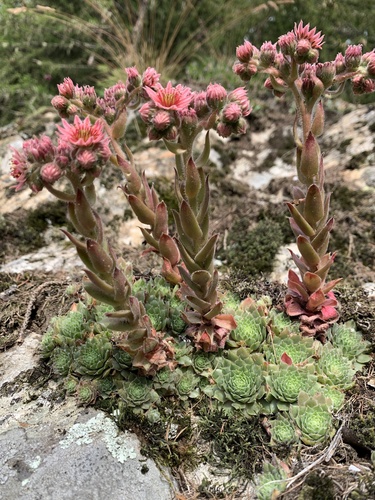
Houseleek (Sempervivum tectorum L., 1753) is a perennial succulent in the Crassulaceae family, native to the mountains of southern Europe from the Pyrenees to the southwestern Balkans. Grown on roofs and walls since antiquity for its resilience and its reputation for protection against lightning, it forms compact, fleshy rosettes. Each rosette flowers just once, then dies as its offsets take over.
Read moreHouseleek, Common houseleek, Hens and chicks and Jove’s beard
Allow a few hours of direct sun per day, preferably morning or evening.
Full sun; tolerates light partial shade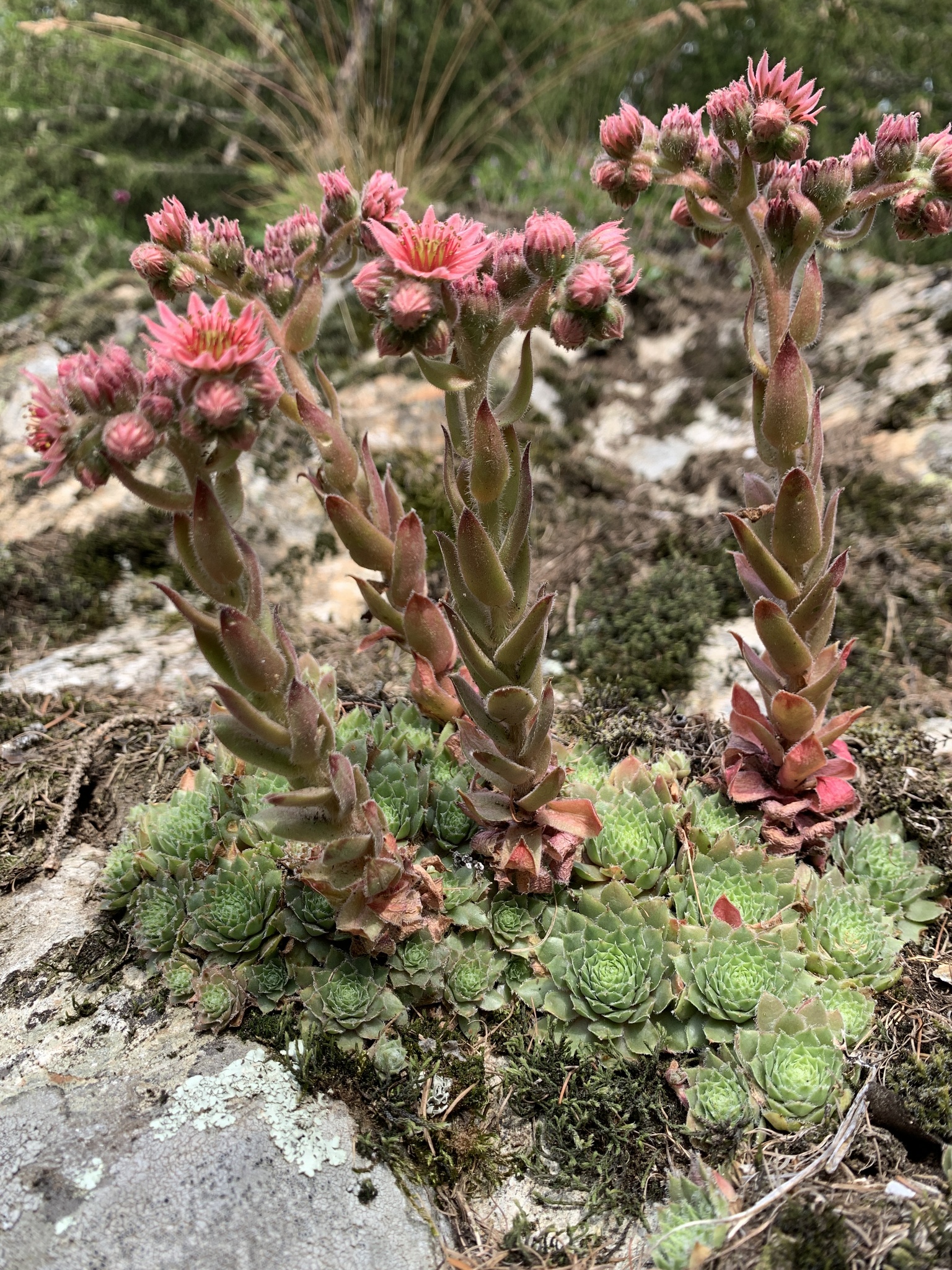



© photo
(c) snowlizard, some rights reserved (CC BY-NC) · cc-by-nc
Felicia Seichter · cc0
Nico · cc0
Taken Nov 29, 2018 by Hannah mountford (cc-by-sa)
Taken Jun 23, 2018 by Steven Vanhalst (cc-by-sa)
Taken Nov 20, 2020 by luque isa (cc-by-sa)
Taken Jul 19, 2020 by anjana shah (cc-by-sa)
Taken Aug 14, 2019 by Michel Cosme (cc-by-sa)
© copyright of the Board of Trustees of the Royal Botanic Gardens, Kew.


Global distribution
The strict native range of Sempervivum tectorum lies in the mountains of southern Europe, from the Pyrenees to the southwestern Balkans. Cultivated on roofs and walls since antiquity, it has naturalized well beyond that range, especially in Great Britain and central Europe.
- Native3
- Introduced1
- Pyrenees (France, Spain)
- Alps (France, Italy, Switzerland)
- Western Balkans
- United Kingdom
Hexagons: regions where the plant occurs. Green dots: native range.1
Identity
Houseleek (Sempervivum tectorum L., 1753), also called common houseleek, hens and chicks or Jove’s beard, is a perennial succulent in the genus Sempervivum, family Crassulaceae. The genus name comes from the Latin semper vivum, meaning “always living.” It describes a plant that remains fleshy and green throughout the year, even in winter, rather than disappearing completely below ground at the end of the growing season. 1 2
Roof planting explains the epithet tectorum, the plural genitive of tectum, meaning roof. People deliberately established the plant on thatched roofs and walls, valuing roots that helped hold roofing material in place as well as a reputation for protection against lightning. Its French name joubarbe derives from Jovis barba, Jupiter's beard, referring to the Roman god of thunder. This is the same association expressed by the English name Jove's beard. 5
Recognition
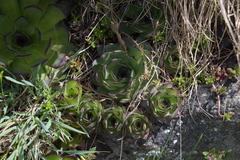
Compact rosettes measure 4–10 cm (1.6–4 in) across and contain 50–60 thick, stalkless, gray-green leaves. Their tips are often suffused with purple-red, and a fine fringe of hairs lines the edges. Rosettes sit close to the ground in a tight cushion. An established clump can spread 20–50 cm (8–20 in) wide, occupying far more space than a single newly planted rosette. 5 4
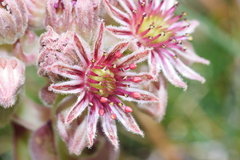
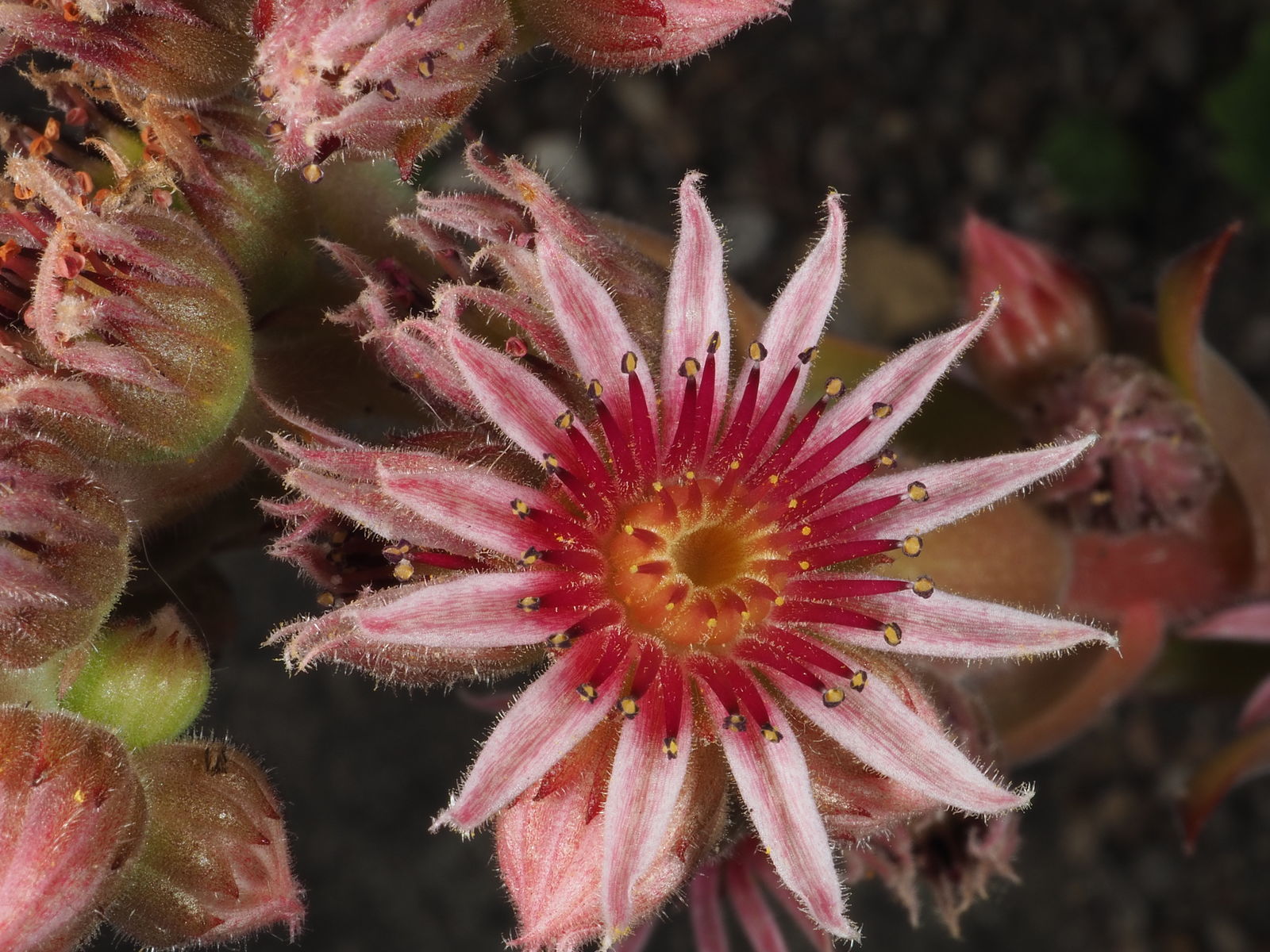
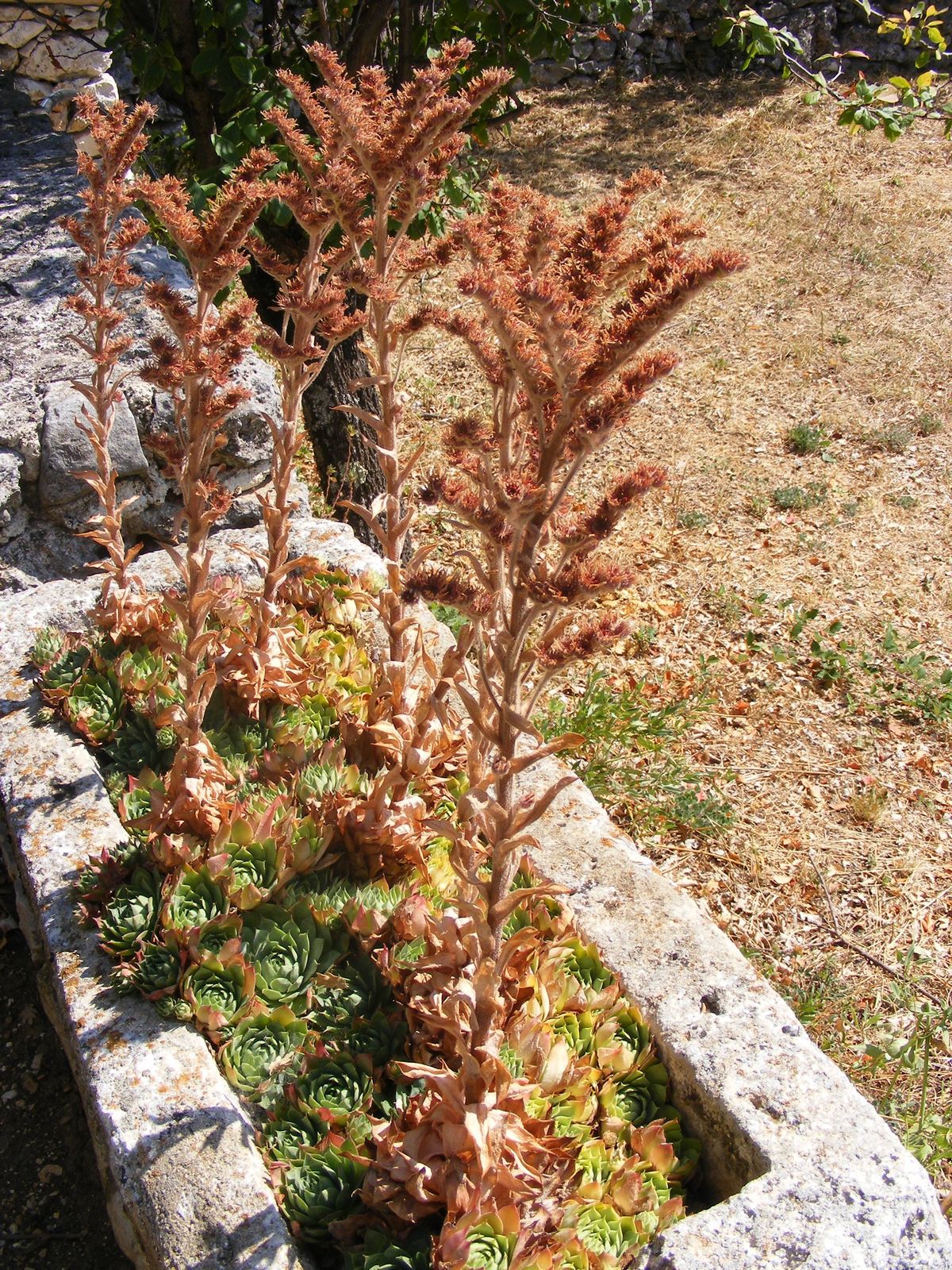
Flowering marks the final stage of an individual mature rosette: it is monocarpic, meaning it flowers once and then dies. An upright, hairy stalk about 20 cm (8 in) tall carries a flat-topped cluster of 8–16 star-shaped, purple-red flowers with pointed petals. The summer flowers attract pollinating insects. A flowering stalk therefore signals a particular rosette's maturity rather than the start of a repeating annual display from that same rosette. 4 5
Death after flowering is a normal part of houseleek biology, not evidence by itself of disease. The clump survives because offsets have already rooted around the parent before it flowers. Those established replacements are essential: without them, the dying parent would leave an empty space instead of renewing the colony. Looking at the surrounding offsets helps distinguish a healthy continuing clump from the loss of its only rosette. 5
Useful taxonomy
Kew's Plants of the World Online accepts Sempervivum tectorum L., published in Species Plantarum in 1753. The species is highly variable, and several historical names have been treated as varieties, subspecies or synonyms by different authors:
Historical names associated with houseleek:
- Sempervivum calcareum Jord.
- Sempervivum atlanticum Ball ex Hook.f.
- Sempervivum montanum (L.) Bonnier & Layens
For identification, keep Sempervivum tectorum as the stable binomial reference rather than assuming every historical label has the same modern treatment. 1 3
Natural variation has supported hundreds of horticultural cultivars, selected for rosette color and shape over more than 200 years. A nursery label does not always make the exact botanical identity clear. Checking the scientific name is the useful first step when assessing the actual hardiness of a plant sold under a fanciful cultivar or trade name. Color alone is not a substitute for that identification. 3
Habitat and range
Mountains in southern Europe form the strict native range, from the Pyrenees to the southwestern Balkans. Houseleek grows on rocks, limestone scree and old walls in lean, mineral, sharply drained ground. Standing water is a serious limitation: even a few days of saturation can cause root rot. A rocky position is useful because of its drainage, not merely because its appearance suits a succulent. 1
Centuries of planting on buildings have carried houseleek well outside its native mountain range. Cultivated since antiquity for roof protection, it has naturalized especially in Great Britain and central Europe. Old seed-grown colonies can still persist on walls and thatched roofs far from any recent planting. These long-established populations reflect a history of introduction rather than an expansion of the species' strict native range. 6
Life cycle and reproduction
Offsets dominate propagation in gardens because a separated rosette establishes in 2–4 weeks, while seed takes several months to produce a mature rosette. Each parent produces lateral offsets in spring; they root by themselves when they contact a mineral growing medium. Division in spring or early summer generally yields 4–10 new plants per parent. The clump thus expands through a succession of rosettes rather than the indefinite life of one central plant. 5
Seeds remain another option, germinating in 2–6 weeks at around 10 °C (50 °F). Without offsets, seed provides a way to introduce new genetic material to a collection. For reproducing the parent's exact characteristics, offsets are faster and more predictable: establishment in a few weeks contrasts with several months of seedling growth. The choice depends on whether the aim is to preserve a particular plant or raise a more variable new generation. 6
Uses and risks
Rock gardens, low walls, shallow green roofs, edging and sharply drained pots are the main ornamental settings for houseleek. It is often combined with other rock-garden succulents. The Royal Horticultural Society has given the species its Award of Garden Merit, recognizing reliable garden performance. Its low growth allows it to form a living surface without the height of a larger succulent shrub. 4
Young leaves may be eaten raw in salads. The plant's juice also has a long history of external use to soothe burns, stings and minor skin wounds, a practice reported since antiquity. These records describe traditional use as well as food use; they do not change its primary role in present-day gardens as a hardy ornamental succulent. 6
The ASPCA lists the Sempervivum group, under “hens and chickens,” as non-toxic to cats, dogs and horses. That classification is reassuring when a curious dog chews a rosette. It does not turn houseleek into routine animal food: the plant is still primarily grown for ornament, and the identification should remain attached to the safety statement. 7
Varieties, look-alikes and related plants
Rosette-forming succulents from several other genera share the same rock-garden setting. Echeveria also goes by hens and chicks, but most are damaged by the first hard freezes. Sempervivum tectorum, rated H7 by the Royal Horticultural Society, withstands winters below −20 °C (−4 °F) without protection. 4 Sedum and Jovibarba are also commonly grown beside houseleeks. Flower shape and the way offsets detach help separate them: Jovibarba offsets come loose at a light touch, whereas a Sempervivum offset stays firmly attached to its parent rosette. 5
When choosing a plant, check its exact scientific name, healthy offsets around the parent and firm rosettes. Soft or waterlogged rosettes commonly point to excessive winter moisture rather than a severe disease. The presence of sound young offsets is especially useful because those are the rosettes that will continue the clump after the parent eventually flowers. 4
Main sources
- Plants of the World Online / Kew, Sempervivum tectorum L.
- International Plant Names Index, Sempervivum tectorum L.
- GBIF Backbone Taxonomy, Sempervivum tectorum
- Royal Horticultural Society, Sempervivum tectorum
- Missouri Botanical Garden Plant Finder, Sempervivum tectorum
- Plants For A Future, Sempervivum tectorum
- ASPCA, Hens and Chickens, Sempervivum tectorum
Frequently asked questions
Why does a houseleek rosette die after flowering?
This is normal. Sempervivum tectorum is monocarpic: each rosette flowers only once in its lifetime, then dies. The clump survives through offsets already established around the parent rosette.
Is houseleek toxic to cats and dogs?
No. The ASPCA lists the Sempervivum group, which includes Sempervivum tectorum, as non-toxic to cats, dogs and horses.
How cold hardy is Sempervivum tectorum?
Very hardy. The Royal Horticultural Society rates it H7, able to survive the coldest continental European winters, below −20 °C (−4 °F), provided drainage remains good.
Why is Sempervivum tectorum associated with roofs?
The epithet tectorum means 'of roofs.' Houseleek was traditionally planted on roofs for its stabilizing roots and its reputation for protection from lightning. Another name, Jove’s beard, refers to Jupiter, the Roman god of thunder.
How do I propagate houseleek?
The easiest method is to divide offsets in spring or early summer. Seed also works, germinating in 2–6 weeks at around 10 °C (50 °F), but it is slower.
Can Sempervivum tectorum be mistaken for Echeveria?
Yes. Both have rosettes and share the name hens and chicks. Sempervivum tectorum is much hardier and tolerates severe freezing, unlike most Echeveria.
Similar plants
If you are unsure about a plant’s toxicity, ask a botanist or veterinarian for advice.