
Mother of thousands (Kalanchoe daigremontiana, )
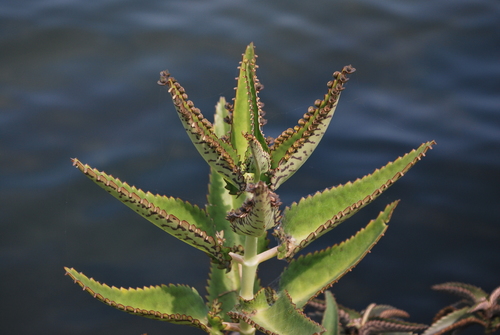


Mother of thousands (Kalanchoe daigremontiana) is a perennial succulent in the Crassulaceae, native to arid southwestern Madagascar. Each toothed leaf edge produces dozens of already-rooted plantlets that can colonize bare ground within weeks. Every part of the plant is toxic.
Read moreMother of thousands, Alligator plant, Devil’s backbone and Mexican hat plant
Allow a few hours of direct sun per day, preferably morning or evening.
Full sun to bright partial shade




© photo
(c) Pedro G Coscarelli, some rights reserved (CC BY-NC), uploaded by Pedro G Coscarelli · cc-by-nc
Tony Rebelo · cc-by-nc
Jay Pruett · cc-by-nc
Taken Feb 18, 2021 by Picardo Osvaldo (cc-by-sa)
Taken Feb 6, 2020 by Hans-WernerOtt (cc-by-sa)
Taken Jan 9, 2016 by Tela Botanica − Liliane ROUBAUDI (cc-by-sa)
Taken May 8, 2022 by Leonardo Jacinto (cc-by-sa)
Taken Oct 18, 2020 by Teodorak Igor (cc-by-sa)
© copyright of the Board of Trustees of the Royal Botanic Gardens, Kew.




Global distribution
Kalanchoe daigremontiana is native only to rocky, arid southwestern Madagascar. Distributed early as an ornamental for its striking plantlets, it has naturalized in many warm regions worldwide and is classified as invasive in several, despite its narrow original range.
- Native1
- Introduced3
- Invasive5
- Madagascar
- Florida
- New Caledonia
- Réunion
- South Africa
- Hawaii
- Cuba
- Venezuela
- Australia
Hexagons: regions where the plant occurs. Green dots: native range.1
Identity
Mother of thousands (Kalanchoe daigremontiana Raym.-Hamet & H.Perrier, 1914) is a perennial succulent in the genus Kalanchoe, family Crassulaceae. Unlike most cultivated kalanchoes, it produces already-rooted plantlets along the entire leaf edge, explaining its invasive spread outside Madagascar. The epithet daigremontiana honors the collectors who supplied the specimens used to describe the species. 1 3
For many years this succulent circulated as Bryophyllum daigremontianum, a synonym still found in horticultural literature. The Royal Horticultural Society entry uses that name rather than the currently accepted binomial. 2 6
The name Mother of thousands describes its unusually prolific vegetative reproduction through marginal plantlets. Alligator plant and Devil’s backbone refer instead to the appearance of the foliage, with brownish-purple mottling on its underside. Mexican hat plant is another common name for the same succulent. 4
Recognition
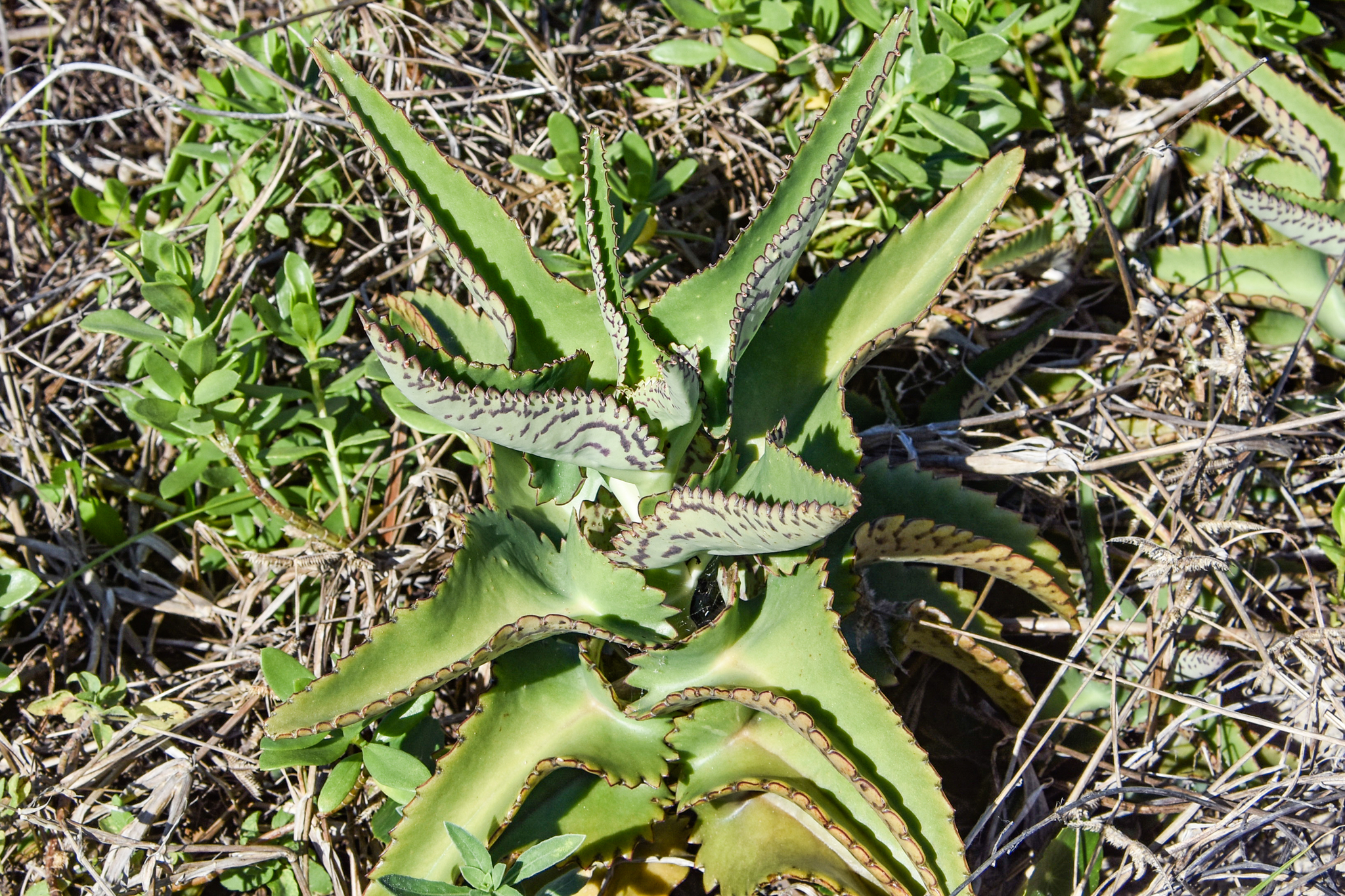
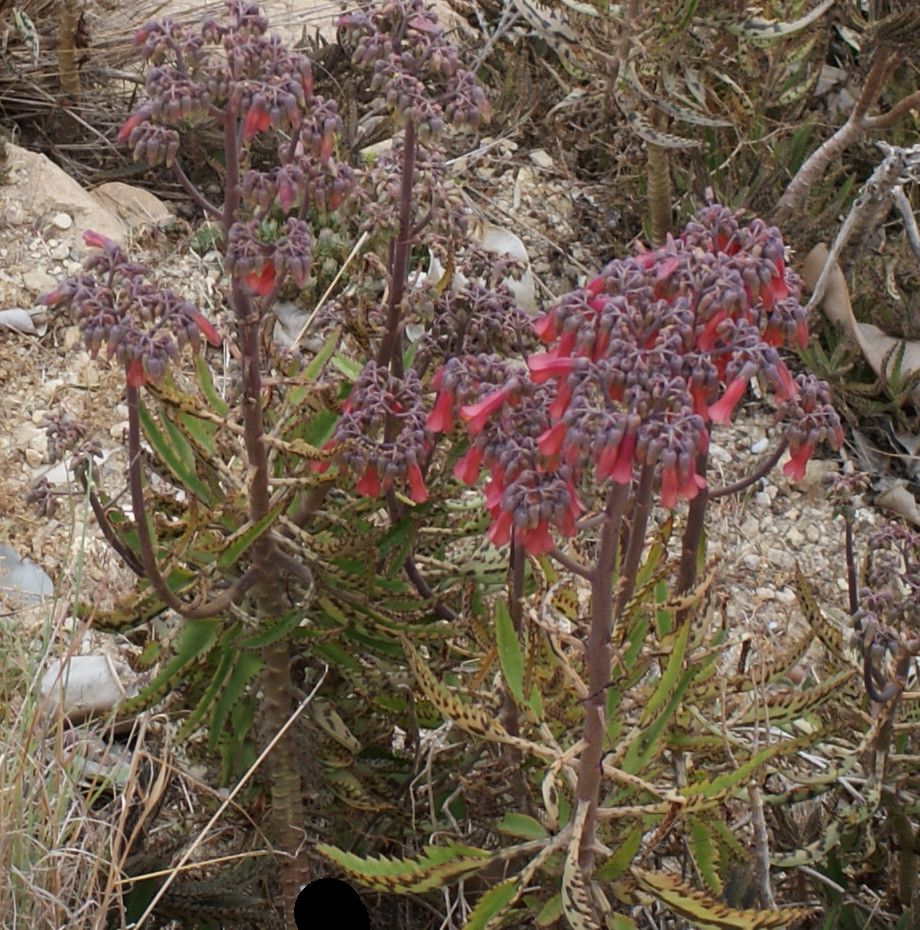
Upright Kalanchoe daigremontiana has a single, sparsely branching stem, usually 30 cm–1 m (12–39 in) tall and sometimes reaching 1.5 m (5 ft) in favorable climates. Opposite, fleshy, brittle leaves are triangular to lance-shaped, gray-green above and blotched brownish-purple underneath. 4 6
Leaf edges provide the clearest distinction from other fleshy-leaved kalanchoes: each tooth bears a miniature plantlet, already rooted before it detaches. A leaf without plantlets does not rule out this species when the plant is young or growing in low light. 4
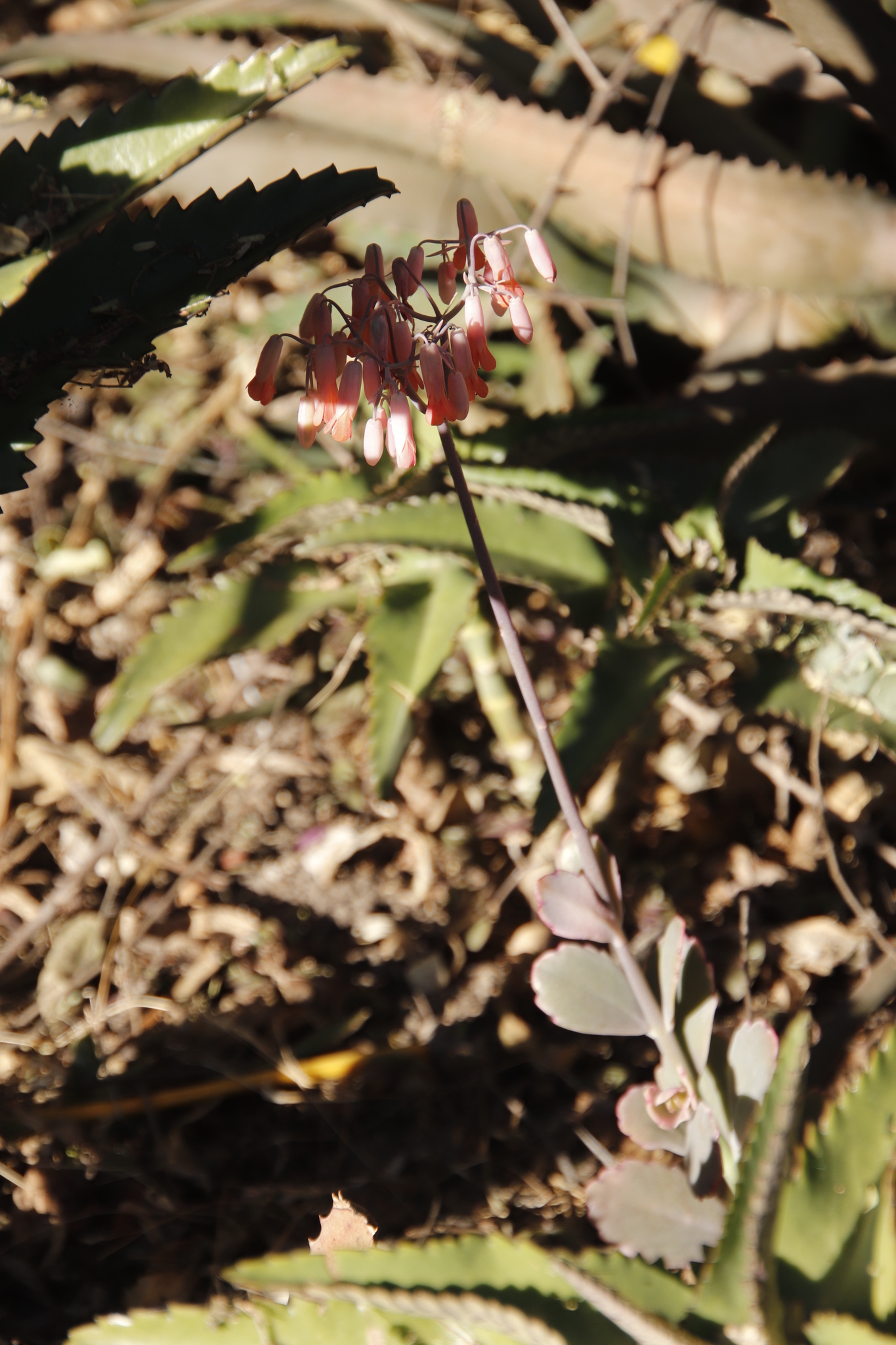
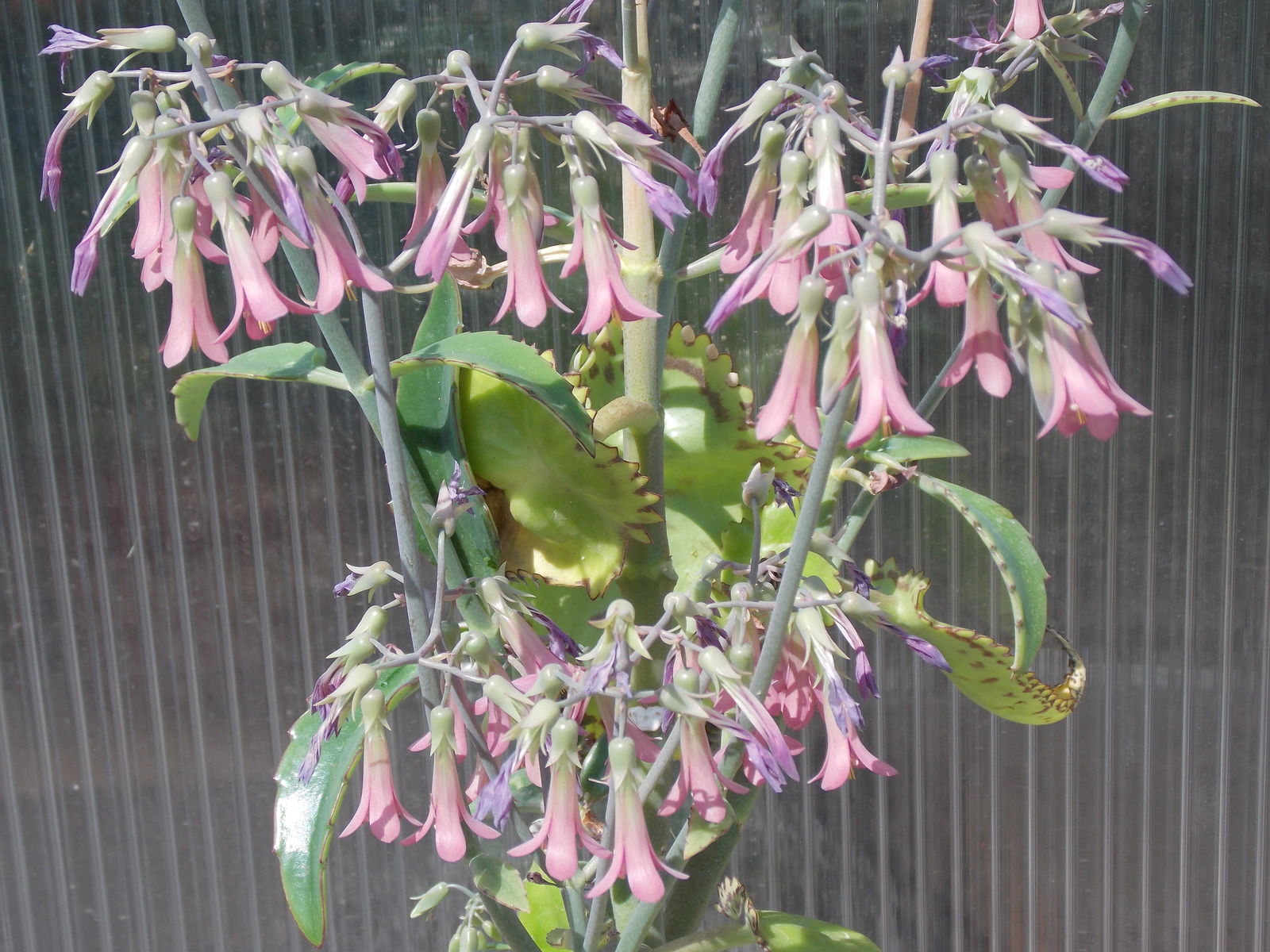
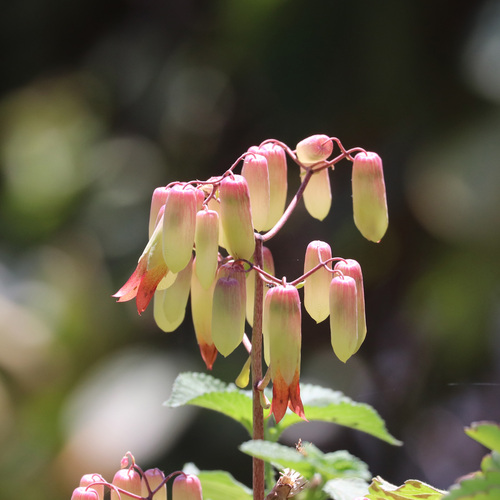
The terminal inflorescence forms an umbrella-like cluster of tubular grayish-pink or orange flowers about 2 cm (0.8 in) long. They hang before opening and then become upright. Flowering is uncommon indoors and occurs mainly in late winter and early spring. 6 4
Useful taxonomy
Botanically, the accepted name is Kalanchoe daigremontiana Raym.-Hamet & H.Perrier. Its principal synonym, Bryophyllum daigremontianum (Raym.-Hamet & H.Perrier) A.Berger, remains widely used, especially in English-language horticultural catalogs. 1 2
These parallel names reflect a longstanding taxonomic debate. Some botanists retain Bryophyllum as a separate genus; broader treatments followed by Plants of the World Online include these plants within Kalanchoe, in the Crassulaceae subfamily Kalanchooideae. 1
Misidentification extends beyond the names: plants in the field and in nurseries are often confused with Kalanchoe × houghtonii, a hybrid with Kalanchoe delagoensis frequently sold as the pure species. 8
Habitat and range
Southwestern Madagascar contains the narrow native range of Kalanchoe daigremontiana: rocky, arid sites within low-elevation dry scrub. 1 3
Early distribution as a horticultural curiosity, prized for its striking plantlets, led to widespread naturalization outside Madagascar. It is classified as invasive in at least five regions, from South Africa to Australia, including Cuba and Venezuela. In Florida, where it is introduced, field records often confuse it with Kalanchoe × houghtonii. 4 8
In metropolitan France, Mother of thousands is mainly grown in pots or frost-free conservatories. Its succulent tissues cannot withstand temperatures persistently below 10 °C (50 °F). 6
Life cycle and reproduction
Vegetative reproduction greatly outweighs sexual reproduction in Mother of thousands. Each adult leaf produces dozens of rooted plantlets along its toothed margin; they detach at the slightest touch and can colonize bare soil within weeks. Only 0.5–1 cm (0.2–0.4 in) long when they fall, they root within days on contact with soil, without passing through a seed stage. 4
Another unusual trait among cultivated Crassulaceae is its monocarpic behavior. A flowering rosette becomes exhausted and dies within the following year or two, although lateral shoots sometimes keep the clump alive. 4
To propagate it in cultivation, lay a detached plantlet or whole leaf flat on moist, well-drained growing medium. Roots develop within days without rooting hormone or preliminary cutting. 4
Uses and risks
Ornamental cultivation is its main use, in indoor pots or frost-free conservatories. Outside regions where it has naturalized, it is rarely planted directly in the ground. 6
Every part contains bufadienolides, cardiac glycosides including daigremontianin, which acts powerfully and directly on heart muscle. A study isolated eight new bufadienolides from the roots alone, demonstrating the species’ unusual chemical diversity. 9
The ASPCA lists the genus Kalanchoe as toxic to cats and dogs. Reported signs range from salivation and vomiting to abnormal heart rhythms and, in severe cases, seizures. 7 4
Despite that documented toxicity, water extracts have shown antioxidant activity and cytotoxic effects against some cancer cell lines in laboratory studies. These findings have not yielded an approved medicine. 10
Varieties, look-alikes and related plants
Commercially named stable cultivars are scarce. Houghtonii, widely sold in garden centers, actually denotes a hybrid with Kalanchoe delagoensis, rather than Kalanchoe daigremontiana in the strict sense. A cream-variegated Variegata form remains rare and unstable. 8
Besides the hybrid Kalanchoe × houghtonii, two other Crassulaceae with marginal plantlets regularly cause confusion:
- Kalanchoe delagoensis has narrow cylindrical leaves, with plantlets grouped at the tips rather than in a continuous row;
- Kalanchoe pinnata has much broader, fleshier leaves with scalloped rather than finely toothed edges.
Against these two relatives, inspect the leaf margin carefully: only Kalanchoe daigremontiana lines up its plantlets along the full length of a flattened triangular leaf.
Main sources
- Plants of the World Online / Kew, Kalanchoe daigremontiana Raym.-Hamet & H.Perrier
- GBIF, Kalanchoe daigremontiana Raym.-Hamet & H.Perrier
- Tela Botanica / BDTFX, Kalanchoe daigremontiana
- NC State Extension Plant Toolbox, Kalanchoe daigremontiana
- NC State Extension Plant Toolbox, Kalanchoe delagoensis
- Royal Horticultural Society, Kalanchoe daigremontiana (Bryophyllum daigremontianum)
- ASPCA, Kalanchoe toxicity entry
- Atlas of Florida Plants, Kalanchoe daigremontiana
- Wu et al., 2019, new bufadienolides from the roots of Kalanchoe daigremontiana
- In vitro anticancer, antioxidant and phytochemical study on water extract of Kalanchoe daigremontiana
Frequently asked questions
Is Mother of thousands toxic to cats and dogs?
Yes. The ASPCA lists Kalanchoe as toxic to cats and dogs. Bufadienolides throughout the plant can cause vomiting, diarrhea and abnormal heart rhythms.
Why does the plant die after flowering?
Kalanchoe daigremontiana is largely monocarpic. The flowering rosette becomes exhausted within one or two years, a documented trait of this species, although side shoots sometimes prolong the parent plant.
How can I keep its plantlets from spreading?
Remove leaves carrying plantlets before they fall, or keep the plant in an isolated pot on a saucer, away from bare ground where plantlets take root on contact.
How does it differ from Mother of millions, Kalanchoe delagoensis?
Kalanchoe delagoensis has narrow cylindrical leaves with plantlets clustered at their tips. Kalanchoe daigremontiana has flat triangular leaves with plantlets along the whole toothed edge.
Does Mother of thousands need much water?
No. It tolerates drought and is more vulnerable to excess water than to limited light. Let the growing medium dry almost completely between waterings.
Where does the name Mother of thousands come from?
Each mature leaf carries dozens of small, already-rooted plantlets along its edges. A single fallen leaf can produce dozens of new plants within a few weeks.
Peut-on la cultiver en extérieur en "Metropolitan France" ?
Growing it in the ground is difficult. It cannot tolerate frost and needs to come indoors as temperatures approach 10 °C. It is mainly grown in pots or a frost-free conservatory.
Similar plants
If you are unsure about a plant’s toxicity, ask a botanist or veterinarian for advice.