
Barbary fig (Opuntia ficus-indica, )
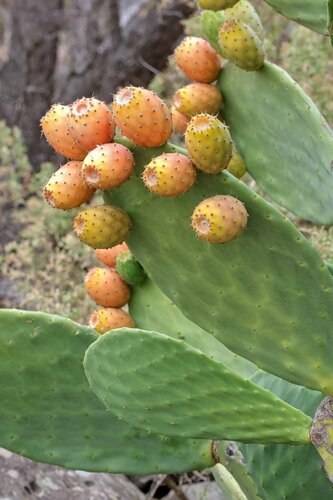
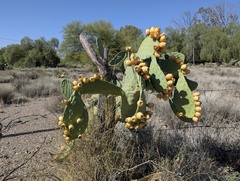

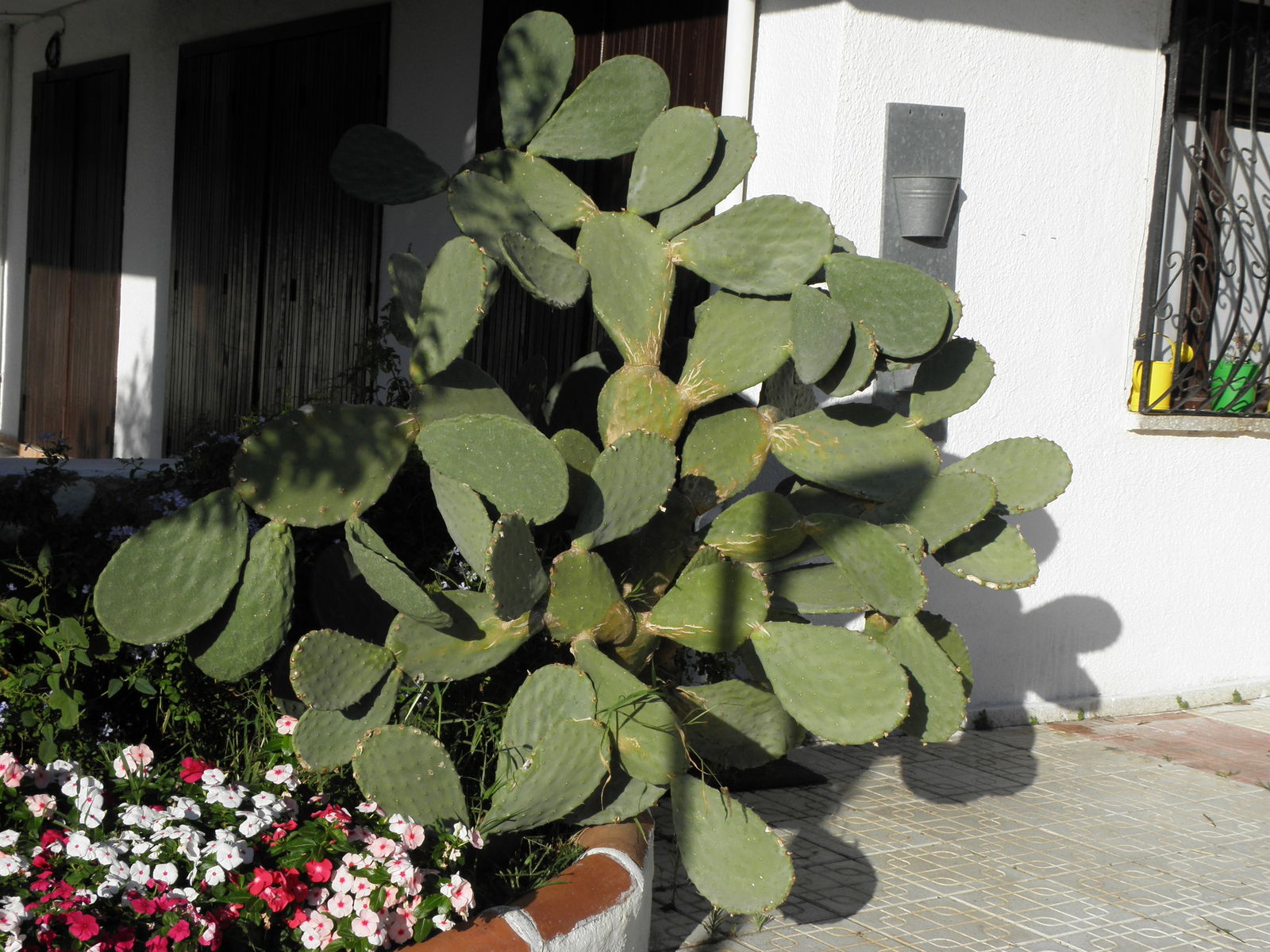
Barbary fig (Opuntia ficus-indica (L.) Mill., 1768) is a tree-like succulent in the Cactaceae family, domesticated from wild forms in central Mexico. Its flattened stem pads, called cladodes, take over the role of short-lived leaves and bear spines and glochids on the characteristic areoles of cacti.
Read moreBarbary fig, Indian fig opuntia, Prickly pear, Cactus pear and Nopal



© photo
(c) Richard Boon, some rights reserved (CC BY-NC), uploaded by Richard Boon · cc-by-nc
Zoltán Stekkelpak · cc0
Francesco Cecere · cc0
Taken Oct 27, 2021 by Le Thuaut Alexandre (cc-by-sa)
Taken Feb 3, 2022 by Annemarie Ahrens-Stehle (cc-by-sa)
Taken May 22, 2020 by tallel kouadria (cc-by-sa)
Taken Jan 25, 2020 by Pokotilo Olga (cc-by-sa)
© copyright of the Board of Trustees of the Royal Botanic Gardens, Kew.




Global distribution
Opuntia ficus-indica is native to central Mexico, where genetic analysis places its closest wild relatives. Domestication spread it through much of the Americas before European contact. From 1492 onward it reached the Mediterranean Basin, southern Africa and other warm regions, becoming widely naturalized.
- Native1
- Introduced6
- Invasive1
- Mexico
- Spain
- Italy
- South Africa
- Namibia
- Algeria and Tunisia
- Southern United States
- Australia
Hexagons: regions where the plant occurs. Green dots: native range.1
Identity
Barbary fig (Opuntia ficus-indica (L.) Mill., 1768) is a tree-like succulent in the Cactaceae family, domesticated from wild forms in central Mexico, where its closest genetic relatives occur. 1 3
The name Barbary fig recalls the Barbary Coast of North Africa, a connection also reflected in the French name and its association with French colonial contact in Algeria. The older name Indian fig opuntia refers to the broad historical use of “Indies” for the New World. In Mexico, nopal, a Nahuatl name, denotes the plant rather than its fruit, which is called tuna. 4
Recognition
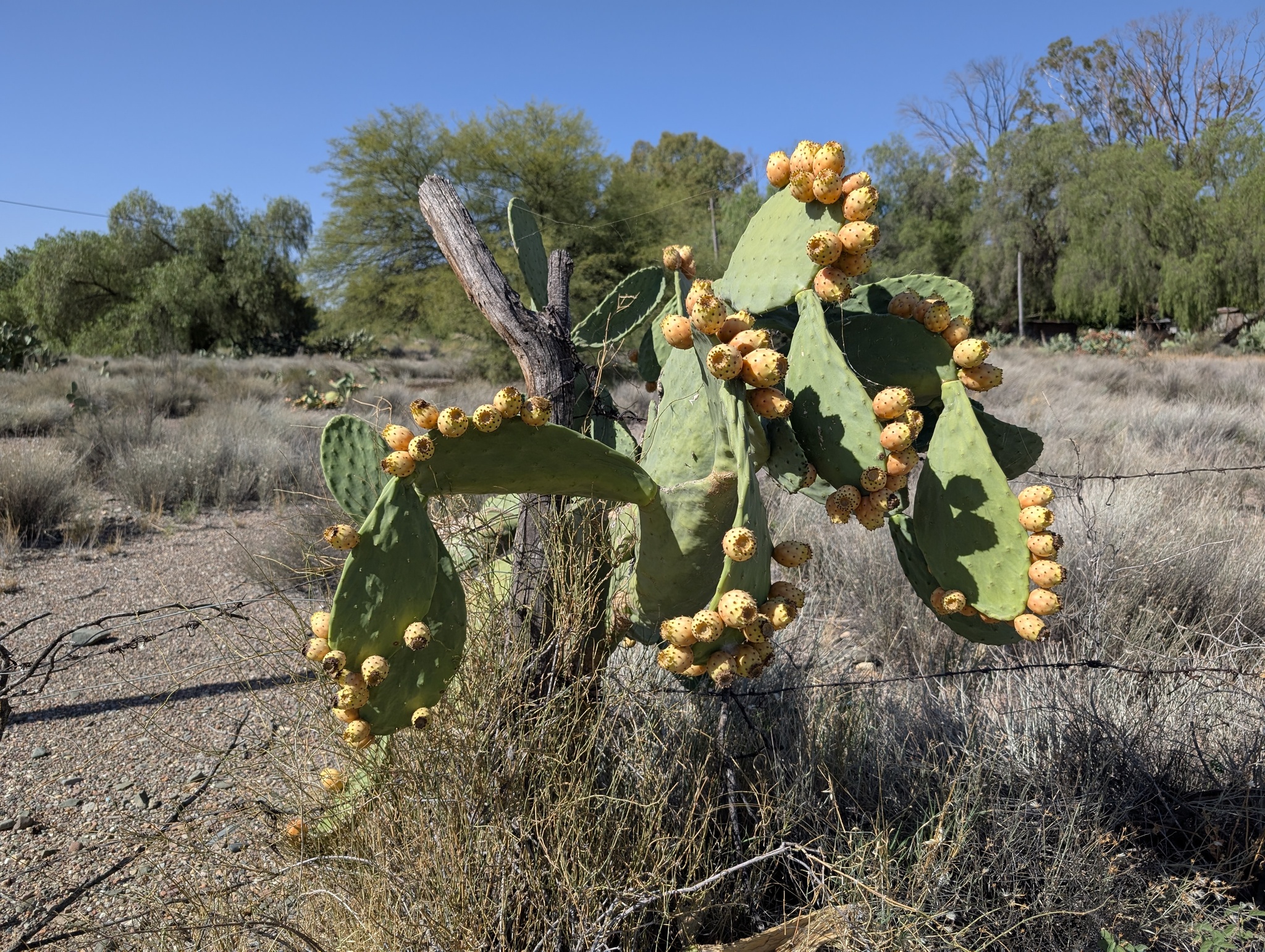
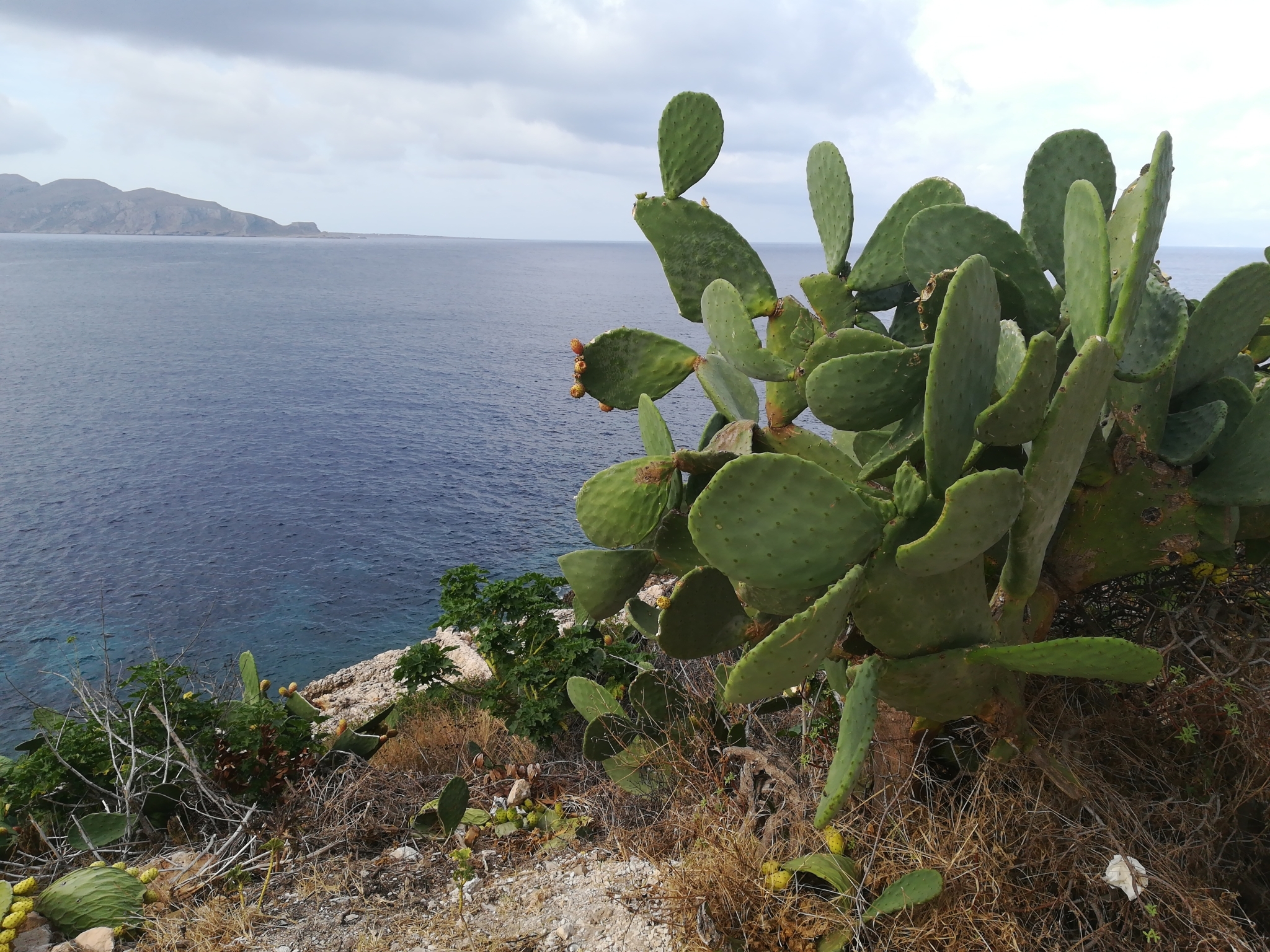
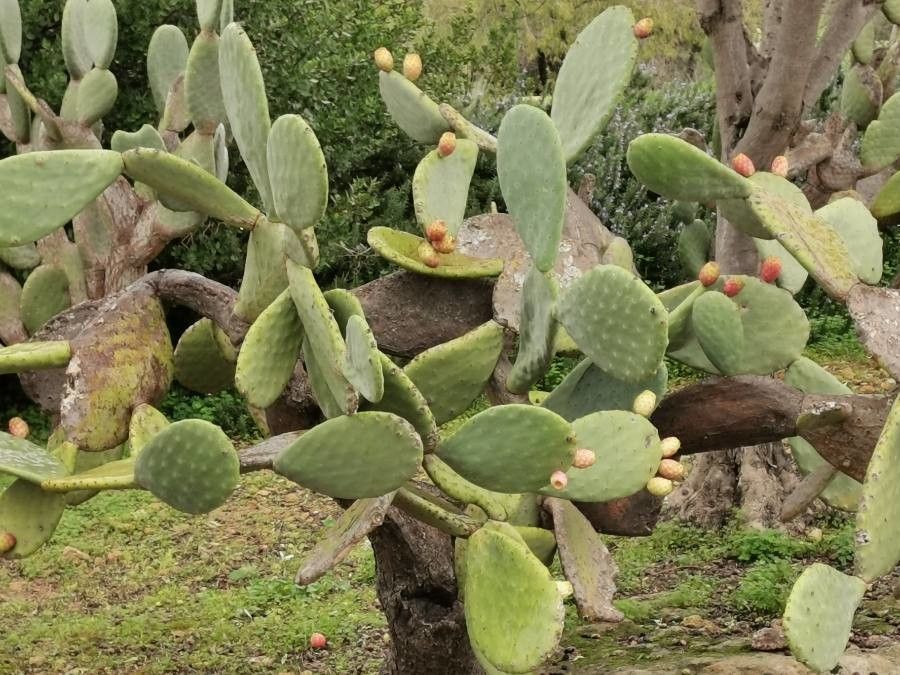
Stacked, flattened stems build a shrub or small tree 3–5 m (10–16 ft) tall. These stems, known as cladodes or pads, photosynthesize in place of the tiny, short-lived leaves. Basal pads become woody, forming a true trunk after the fourth year of growth. 4 3
A single pad measures 30–40 cm (12–16 in) long and carries around 150 areoles. These modified buds, characteristic of cacti, produce spines, glochids, flowers or roots. The whitish spines measure 1–2 cm (0.4–0.8 in); glochids are fine, barbed bristles a few millimeters long that detach readily but lodge firmly in skin. They occur even on so-called spineless varieties. 4
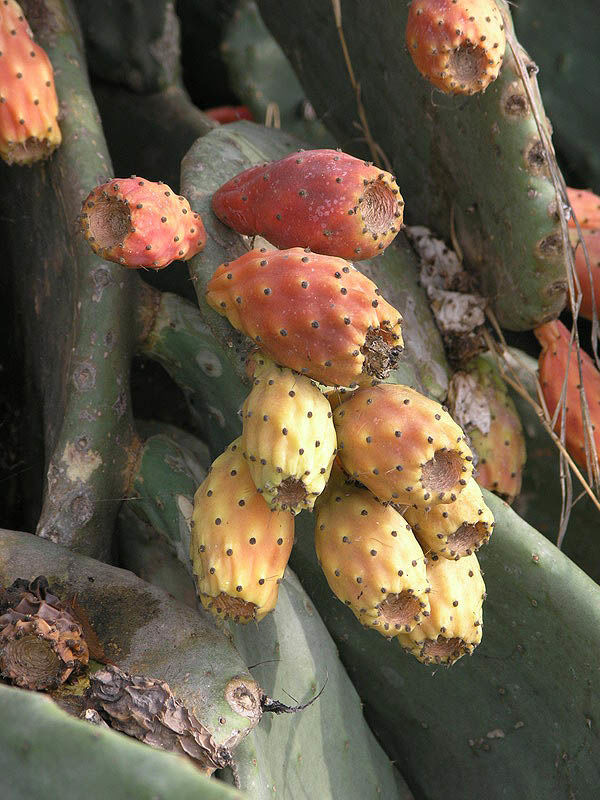
Each prickly pear fruit weighs 150–400 g (5–14 oz) and contains around 300 seeds per 160 g (5.6 oz) of flesh. Depending on the variety, its color ranges from yellow to red. 4
Useful taxonomy
For POWO, the accepted name is Opuntia ficus-indica (L.) Mill., a combination Philip Miller published in 1768 using an earlier name by Linnaeus. The species belongs to the subfamily Opuntioideae within Cactaceae. 1 2
- Platyopuntia ficus-indica (L.) F.Ritter, a homotypic synonym based on the same type
- Opuntia ficus-indica var. amyclaea (Ten.) A.Berger, a southern variety
- Opuntia ficus-indica f. reticulata Backeb., a form with conspicuous net-like markings
Published in the same year, Opuntia maxima Mill. denotes a distinct species accepted separately by POWO. Horticultural trade nevertheless regularly confuses the two names, making a complete scientific name more reliable than a sales label alone. 1
Habitat and range
Central Mexico is the native home of Barbary fig. Following domestication, people spread it through much of the Americas before European contact. From 1492 onward, it reached the Mediterranean Basin, southern Africa and other warm regions worldwide. 3 4
Cultivation requires at least 200 mm (8 in) of annual rainfall on deep sandy soil, with an optimum of 200–400 mm (8–16 in). The plant thrives at relative humidity above 60% and struggles when humidity remains below 40%. Growth stops between −10 and −12 °C (14 and 10 °F), although it tolerates brief heat above 50 °C (122 °F). 3
Root systems spread widely near the surface, remaining concentrated in the upper 30 cm (12 in) of soil. This shallow architecture captures rare rainfall as soon as it falls and helps the cactus establish on poor sandy ground where few other species persist. 4
Australia received Opuntia as cochineal hosts from the eighteenth century onward. They invaded nearly 40,000 km² (15,400 square miles) of farmland, spreading at a million acres a year in 1919, before control by the moth Cactoblastis cactorum, introduced in 1925. The outcome remains a historical landmark in biological control. 8
Life cycle and reproduction
Yellow-orange flowers emerge from areoles on pads at least a year old, near the tops of pads exposed to sun. A fertile pad can carry around thirty flowers. Flowers attract pollinators and birds; birds later disperse the seeds as they eat the fruit. 4 7
Harvesters pick the fruit by hand. Small spines and glochids are removed by rubbing the fruit on an abrasive surface or through grass before peeling. Pads are cut off with a knife at a joint. 3
Growers nearly always propagate Barbary fig from pad cuttings. The wound must callus for several days before planting in dry substrate. Once planted, a cutting roots in 2–4 weeks if the substrate dries between waterings. Seeds are another option, but take much longer to produce a mature plant. 7
Uses and risks
Raw or cooked, the fruit is among the fruits richest in vitamin C. Its flesh is about 85% water and is also used in jams and drinks, including the fermented Mexican drink colonche. Cooked young pads are eaten as a vegetable called nopalitos. 3
Barbary fig supplies livestock fodder in dry regions, particularly Namibia and the southwestern United States, replacing forage crops that require more water. The same cactus forms erosion-reducing hedges in the Mediterranean Basin and North Africa. It also hosts cochineal insects, used to produce red dye since pre-Columbian times. 3
The ASPCA lists the genus Opuntia as non-toxic to cats, dogs and horses, with no documented systemic toxin. The practical hazard is physical injury from spines, especially glochids, which lodge in skin and are difficult to remove without breaking. 5
Varieties, look-alikes and related plants
Mediterranean production centers on three horticultural cultivars: Sulfarina, with yellow fruit and almost spineless pads; Muscaredda, with white fruit; and Sanguigna, with red fruit and spiny pads. 3
Similar-looking plants include:
- Opuntia stricta, another flat-padded species, widely naturalized and invasive in Australia;
- Opuntia maxima, a distinct species often confused with O. ficus-indica in horticulture;
- other Opuntia with similar pads, distinguished chiefly by pad size and fruit color.
Once celebrated for biological control in Australia, the moth Cactoblastis cactorum is now considered a threat to nopal crops in Mexico and the Caribbean. Its caterpillars do not distinguish between wild and cultivated Opuntia, attacking plants grown for fodder, dye and fruit alike. 9
Main sources
- Plants of the World Online / Kew, Opuntia ficus-indica (L.) Mill.
- International Plant Names Index, Opuntia ficus-indica (L.) Mill.
- Wikipedia EN, Opuntia ficus-indica
- Wikipedia FR, Barbary fig
- ASPCA, Tree Cactus (Opuntia species) toxicity entry
- NC State Extension, Opuntia - Prickly Pear Cactus
- Plants For A Future, Opuntia ficus-indica
- Wikipedia EN, Prickly pears in Australia
- Wikipedia EN, Cactoblastis cactorum
Frequently asked questions
Is Barbary fig toxic to animals?
No. The ASPCA lists Opuntia as non-toxic to cats, dogs and horses. The real hazard is physical injury from spines, especially glochids that lodge easily in skin.
Why is my Barbary fig not flowering?
Flowers develop on the areoles of pads at least a year old, in full sun. Insufficient light or a plant that is still too young explains most failures to flower.
Can you eat the whole plant?
Ripe fruit and young pads (nopalitos) are edible after removing spines and glochids. Older woody parts are not eaten.
Is Barbary fig invasive?
It became spectacularly invasive in Australia in the early twentieth century before control by a moth introduced in 1925. It remains considered invasive in North Africa and naturalizes locally in mild Mediterranean climates.
How is Barbary fig propagated?
Mostly from pad cuttings, a fast and reliable method in cultivation. Seeds also work, but growth is slower and the outcome less predictable.
What is the difference between nopal and prickly pear fruit?
Nopal refers to the plant and its edible pads, particularly in Mexico. Prickly pear refers to the fruit, which is unrelated botanically to true figs despite another common name, Barbary fig.
Similar plants
If you are unsure about a plant’s toxicity, ask a botanist or veterinarian for advice.