
Calabash (Lagenaria siceraria, )
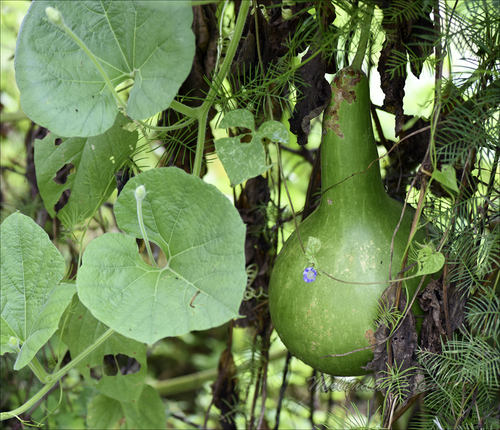


Calabash (Lagenaria siceraria) is an annual herbaceous vine in the Cucurbitaceae, probably native to tropical Africa. Domesticated in Africa and Asia in prehistoric times, it bears white flowers that open only at night. The dried fruit has a hard, waterproof rind, long used for drinking vessels, containers and musical instruments throughout almost all tropical regions.
Read moreCalabash and Bottle gourd
Place in full sun, with intense direct light all day long.
Full sun; tolerates light afternoon shade



© photo
(c) Melinda Hoehn, some rights reserved (CC BY-NC-SA), uploaded by Melinda Hoehn · cc-by-nc-sa
Wikimedia Commons · CC BY-SA or Public Domain
Taken Jul 19, 2020 by Auka Sisa (cc-by-sa)
Taken Sep 15, 2008 by Photoflora - Jean-Luc TASSET (©)
Taken Sep 15, 2001 by Photoflora - Jean-Luc TASSET (©)
© copyright of the Board of Trustees of the Royal Botanic Gardens, Kew.


Global distribution
The precise native range of Lagenaria siceraria remains uncertain because its dried fruit floats and may have drifted long distances at sea before cultivation began. POWO places the native range from western tropical Africa to Ethiopia and Tanzania. It is now cultivated through almost all tropical and warm-temperate regions, often with a history of cultivation spanning thousands of years.
- Native4
- Senegal
- Ethiopia
- Tanzania
- Zimbabwe
Hexagons: regions where the plant occurs. Green dots: native range.1
Identity
Calabash (Lagenaria siceraria (Molina) Standl., 1930), also called bottle gourd, has a dried fruit used as a watertight container. This annual herbaceous vine belongs to the Cucurbitaceae. Erickson and colleagues report bottle gourd remains from China and Japan dating to 8,000–9,000 years before the present. These occurrences do not establish the initial domestication date: the authors consider earlier Asian beginnings, potentially predating the first food crops such as corn and wheat. After 2–4 months of drying, its shell becomes hard and waterproof, protecting its contents for months, long before pottery was invented in several parts of the world. 7 2
The epithet siceraria comes from the Latin sicer, itself borrowed from Hebrew for a fermented drink resembling cider. It recalls the fruit's old use as a drinking vessel, rather than an association with drunkenness. Molina described the species as Cucurbita siceraria in 1782; Standley transferred it to Lagenaria in 1930. 6 1
Recognition
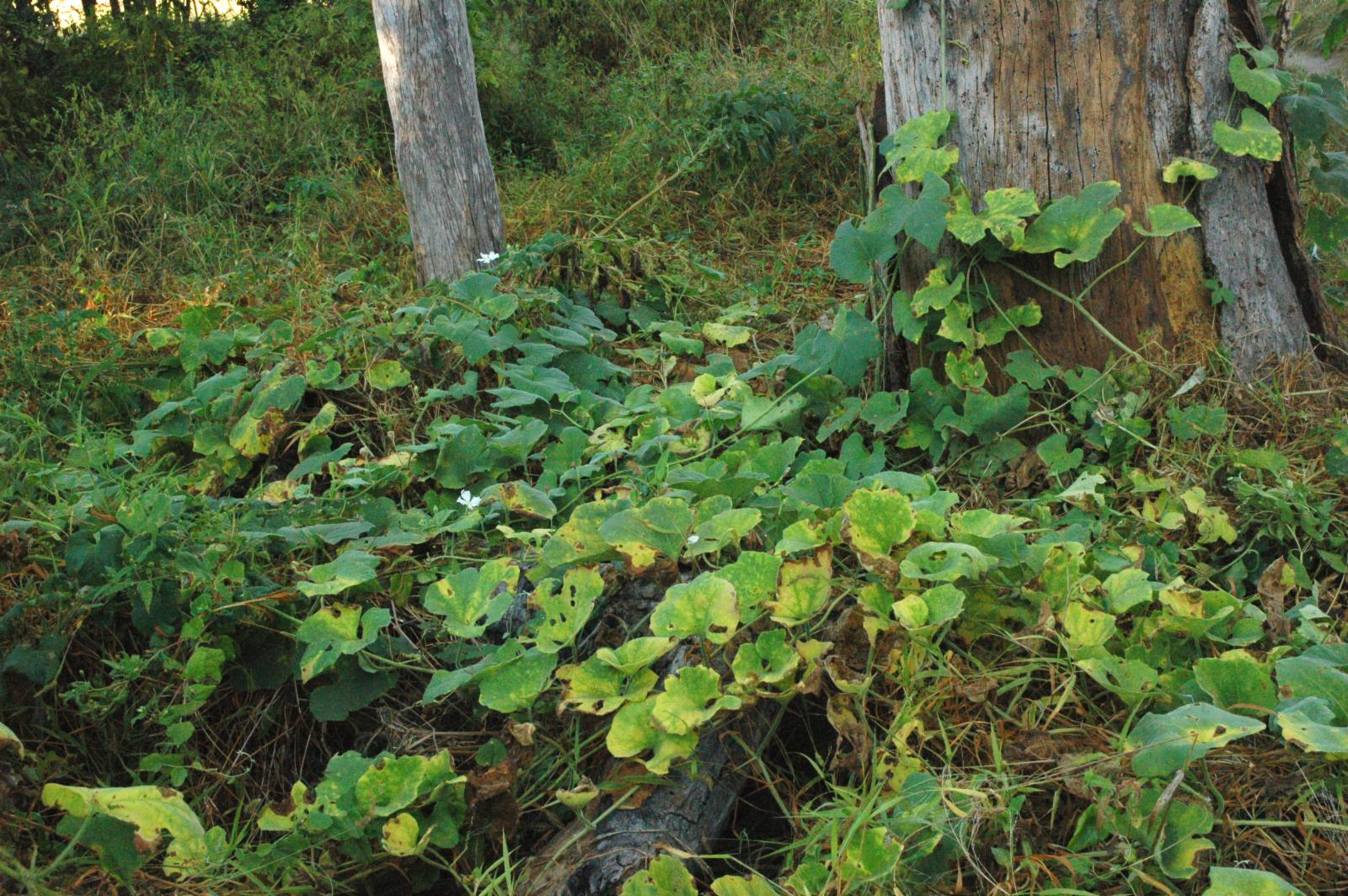
Branched tendrils carry the vine up its supports along an angular, hairy stem that can reach 9 m (30 ft) in one warm season. Heart-shaped to kidney-shaped leaves have 3–7 shallow lobes and can measure 30 cm (12 in) across. 4 5
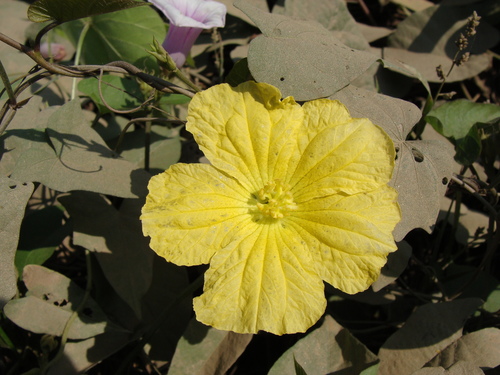
Unlike Cucurbita squashes, whose large yellow flowers open by day, bottle gourd has white, trumpet-shaped flowers that open only at night and close in the morning. This nocturnal flowering depends on moths: they are the only pollinators active after sunset, when daytime bees have returned to their hives. 2 3
Depending on the variety, the fruit is bottle-shaped, club-shaped or snake-like, and 10–90 cm (4–35 in) long. Its smooth, pale green skin resembles a zucchini when young. At full maturity, the rind yellows and hardens, becoming completely waterproof after thorough drying. It is then unsuitable as food but ideal as a container. 5 2
Useful taxonomy
POWO/WCVP accepts Lagenaria siceraria (Molina) Standl. It is the only widely cultivated species in a genus whose other African relatives remain wild. Several synonyms and varieties have been described according to fruit shape:
- Lagenaria siceraria var. clavata (Ser.) H.Hara, a historical botanical name
- Lagenaria siceraria var. gourda (Ser.) H.Hara, a historical botanical name
- Lagenaria siceraria var. turbinata (Ser.) H.Hara, a historical botanical name
- Lagenaria siceraria subsp. asiatica (Kobjakova) Heiser, a historical botanical name
- Lagenaria vulgaris Ser., a historical botanical name
The long, slender fruits of Lagenaria siceraria var. longissima, known as snake gourds or long gourds, are grown as vegetables rather than containers. These five synonyms and varieties identify horticultural groups, not separate species. Confusing sales names can lead to ordering errors; the accepted scientific name provides a firmer starting point when looking for particular seed. 1
Habitat and range
Its exact native range is uncertain because the dried fruit floats and can drift long distances at sea, obscuring its geographical origins. POWO places the native range in western tropical Africa, extending to Ethiopia and Tanzania. There it occupies riverside thickets, wooded savannas and dry-forest edges at 245–1,265 m (804–4,150 ft) above sea level. 1 5
In their synthesis, Erickson and colleagues distinguish these Asian remains from an early report of a bottle gourd in a tomb at Thebes, Egypt, dated to about 4,000 years before the present. They infer independent African domestication more than 4,000 years after Asian domestication; that interval is their interpretation of the evidence then available, rather than a direct date for the two events. The genetic study published in 2014 links pre-Columbian American bottle gourds to African lineages. Its simulations indicate that wild fruits could have drifted across the ocean before their domestication in the Americas, where human use is documented by 10,000 years before the present. 7 8
Now widely cultivated in the tropics and in temperate gardens during the warm season, bottle gourd does not persistently naturalize outside cultivation in France. Below 5 °C (41 °F), frost destroys the stem and prevents regrowth, making it necessary to harvest the dried fruits before the first frosts. 2
Life cycle and reproduction
Male and female flowers grow separately on the same plant: bottle gourd is monoecious. Male flowers have a long stalk; females can be recognized by the swollen ovary beneath the flower. The first flowers open about 45 days after sowing. Without pollinating moths in the garden, female flowers abort without setting fruit; hand pollination at dusk resolves the problem in almost all cases. 2
Once pollinated, the fruits grow quickly. A well-fed plant can produce one fruit per day for several weeks. Complete maturation, including drying of the shell and internal flesh, takes 2–4 months. Soaking seed in warm water for 12 hours, with a soil temperature close to 25 °C (77 °F), greatly improves germination. 4 2
Uses and risks
Young fruit is prepared like zucchini, boiled, steamed or fried. Young leaves and shoots are eaten as greens in several southern African countries. Once the rind hardens, mature fruit is no longer eaten; hollowed and dried, it becomes a water bottle, bowl or spoon. 6 5
The main risk comes from fruit that has become bitter. Like other Cucurbitaceae, bottle gourd can accumulate cucurbitacins, compounds that are cytotoxic at high doses and make the fruit's juice unpleasant from the first sip. Juice from abnormally bitter fruit can cause severe, sometimes fatal digestive illness. A published Indian case series includes several such cases, notably in patients with diabetes. The rule is straightforward: never consume distinctly bitter fruit or juice. 9
Dried, hollow fruits also provide resonators for traditional instruments such as the kora and balafon. Ritual and decorative uses vary between regions. 6
Varieties, look-alikes and related plants
Forms sold for cultivation differ mainly in the outline of the mature fruit. The narrow-necked bottle form is the traditional water vessel; the round, slim-necked birdhouse form becomes a bird shelter when dried. The long, snake-like longissima is harvested young as a vegetable. 2
Other climbing cucurbits with elongated fruits are the most likely sources of confusion:
- Luffa aegyptiaca dries to a fibrous sponge, never a hard shell;
- Cucurbita pepo has yellow daytime flowers and an angular fruit stalk with five ridges;
- Momordica charantia has a bumpy, naturally bitter fruit, a different situation from cucurbitacin poisoning in bottle gourd.
After 45 days of cultivation, white nighttime flowers greatly reduce confusion with the yellow daytime flowers of Cucurbita. The hard, waterproof mature shell distinguishes it from luffa, which remains fibrous as it dries. Together, nocturnal flowering and a hard shell are the most reliable features for recognizing Lagenaria siceraria among climbing cucurbits. 3 5
Main sources
- Plants of the World Online / Kew, Lagenaria siceraria (Molina) Standl.
- North Carolina State Extension, Lagenaria siceraria (bottle gourd)
- Missouri Botanical Garden Plant Finder, Lagenaria siceraria
- Plants For A Future, Lagenaria siceraria
- South African National Biodiversity Institute (PlantZAfrica), Lagenaria siceraria
- PlantUse Français / PROTA, Lagenaria siceraria
- Erickson et al., 2005, An Asian origin for a 10,000-year-old domesticated plant in the Americas, PNAS
- Kistler et al., 2014, Transoceanic drift and the domestication of African bottle gourds in the Americas, PNAS
- Puri et al., 2011, Gastrointestinal toxicity due to bitter bottle gourd, Indian Journal of Gastroenterology
Frequently asked questions
Is bottle gourd toxic?
The young fruit is edible and generally non-toxic to cats and dogs according to the available veterinary databases. The real risk comes from bitter fruits, which can accumulate cucurbitacins dangerous even to humans.
Can you eat a mature bottle gourd?
Not in normal use. Mature fruit is used almost exclusively as a dried container; only the young, still green and tender fruit is cooked like zucchini.
Why are my bottle gourds flowering without setting fruit?
Lagenaria siceraria flowers open only at night and depend on nocturnal pollinating moths. In their absence, hand pollination at dusk generally resolves the problem.
How does bottle gourd differ from squash?
Bottle gourd belongs to Lagenaria, with white nighttime flowers, whereas Cucurbita squashes have yellow daytime flowers. Mature bottle gourd also hardens into a watertight shell, a utilitarian use uncommon in ordinary squashes.
Where does bottle gourd come from?
Its exact geographical origin is debated because the dry fruit floats and disperses by sea. Current evidence points to early domestication in tropical Africa and a separate domestication in Asia, several millennia before Christopher Columbus reached the Americas.
How can you recognize a dangerous fruit?
An intensely bitter taste in the first bite or in juice extracted from the fruit signals toxic cucurbitacins. Never consume distinctly bitter fruit or juice.
Is bottle gourd the same as a plastic water bottle?
No. Here, gourd means the dried plant fruit of Lagenaria siceraria, used as a container since prehistoric times, long before modern plastic or metal vessels.
Similar plants
If you are unsure about a plant’s toxicity, ask a botanist or veterinarian for advice.