
Crape-myrtle (Lagerstroemia indica, )
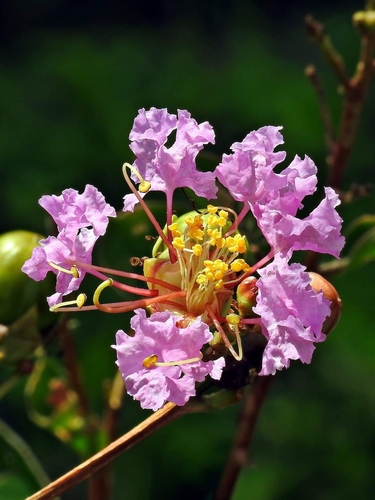

Crape-myrtle (Lagerstroemia indica L.) is a deciduous shrub or small tree in the Lythraceae. Native to southern China, the Himalayas and Indochina, it is grown worldwide for its long, colorful summer flowering and smooth bark that peels in patches.
Read moreCrape-myrtle, Crape myrtle and Crepe myrtle



© photo
(c) Rich_Yang, some rights reserved (CC BY-NC), uploaded by Rich_Yang · cc-by-nc
Nonbinary-Naturalist · cc0
Wikimedia Commons · CC BY-SA or Public Domain
Taken Aug 13, 2015 by Tela Botanica − Yannick HILLERET (cc-by-sa)
Taken Aug 5, 2020 by Giode Tonpino (cc-by-sa)
Taken Aug 18, 2021 by Dieter Wagner (cc-by-sa)
Taken Jul 25, 2021 by StealthIntel (cc-by-sa)
Taken Jan 9, 2018 by Beverly Patrick (cc-by-sa)
© copyright of the Board of Trustees of the Royal Botanic Gardens, Kew.




Global distribution
The native range of Lagerstroemia indica extends from the central Himalayas to southern China, Indochina, the Philippines and Japan. Long cultivation in East Asia, followed by worldwide horticultural introduction from the eighteenth century, has greatly expanded its cultivated range.
- Native5
- Introduced1
- Invasive1
- Central Himalayas
- Southern China
- Indochina (Vietnam, Laos, Cambodia, Thailand)
- Philippines
- Japan and Korea
- Mediterranean basin
- Southeastern United States
Hexagons: regions where the plant occurs. Green dots: native range.1
Identity
Crape-myrtle (Lagerstroemia indica L., 1759), also called crape myrtle, is a deciduous shrub or small tree in the genus Lagerstroemia, family Lythraceae. POWO accepts this binomial, published by Linnaeus in 1759. 1
Despite the French name meaning Indian lilac, this plant has no botanical relationship to true lilacs (Syringa); the dense, colorful flower panicles explain the resemblance. The genus honors Magnus von Lagerström, an administrator of the Swedish East India Company who sent the plant to Linnaeus in the eighteenth century. The epithet indica preserves an early belief in an Indian origin, although its native range centers on southern China and the Himalayas. 2
Recognition
NC State describes an often multistemmed deciduous shrub or small tree commonly reaching 1.8–9 m (6–30 ft), depending on the variety. RHS gives mature heights of 4–8 m (13–26 ft) in temperate climates; Missouri Botanical Garden places most cultivars between 1.8 and 7.6 m (6–25 ft). Longer, hotter summers encourage denser branching and greater eventual size. 2 3 4
Outside the flowering season, the bark is the clearest clue: smooth, pale brown to gray or cinnamon, it peels in patches on established plants. NC State and Missouri Botanical Garden both describe this winter ornamental feature. Young plants instead retain smooth green bark for 3–5 years, before the first patches peel away. Opposite, leathery leaves are bright green in summer and turn yellow, orange or red in fall. 2 4
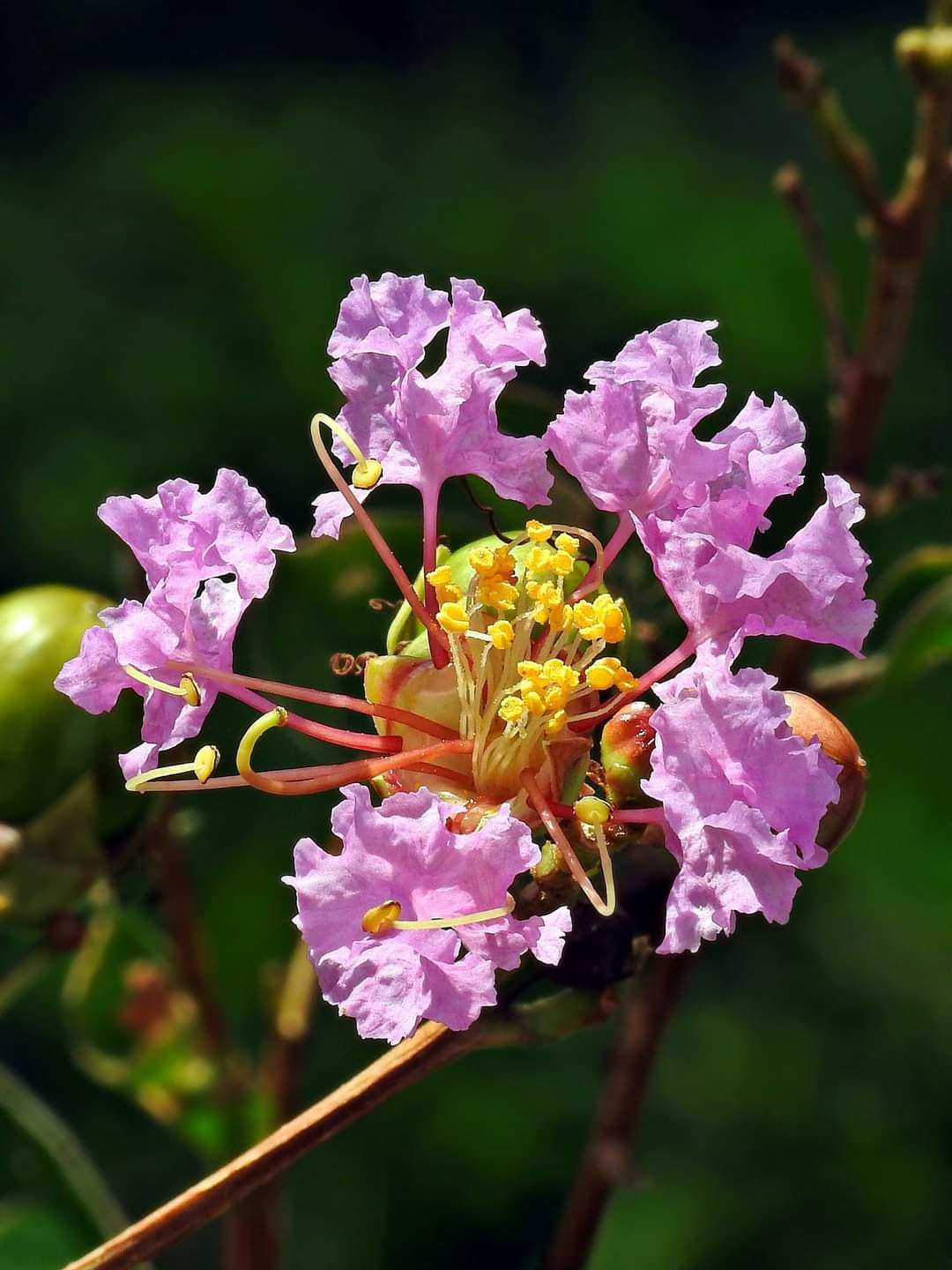
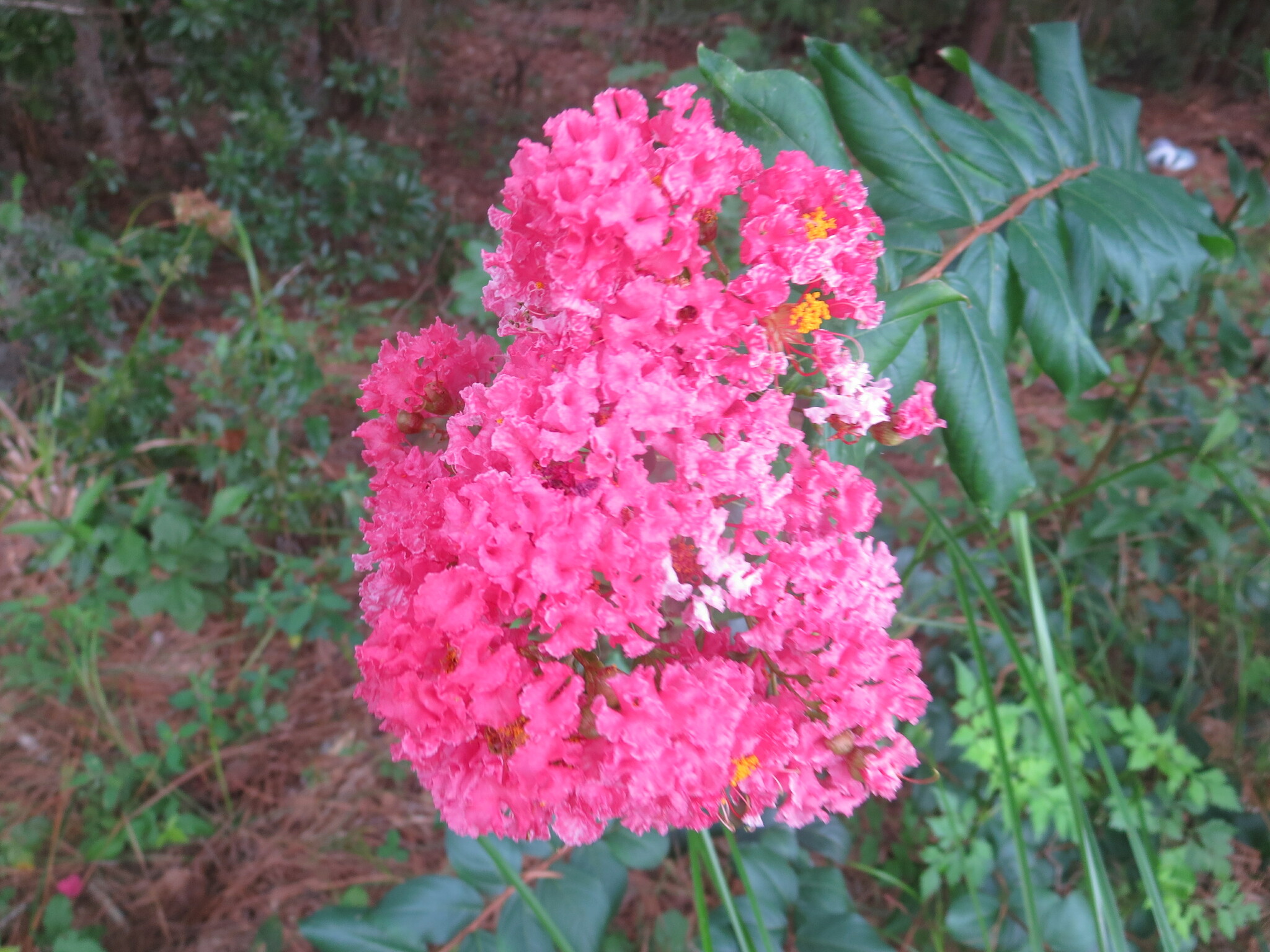
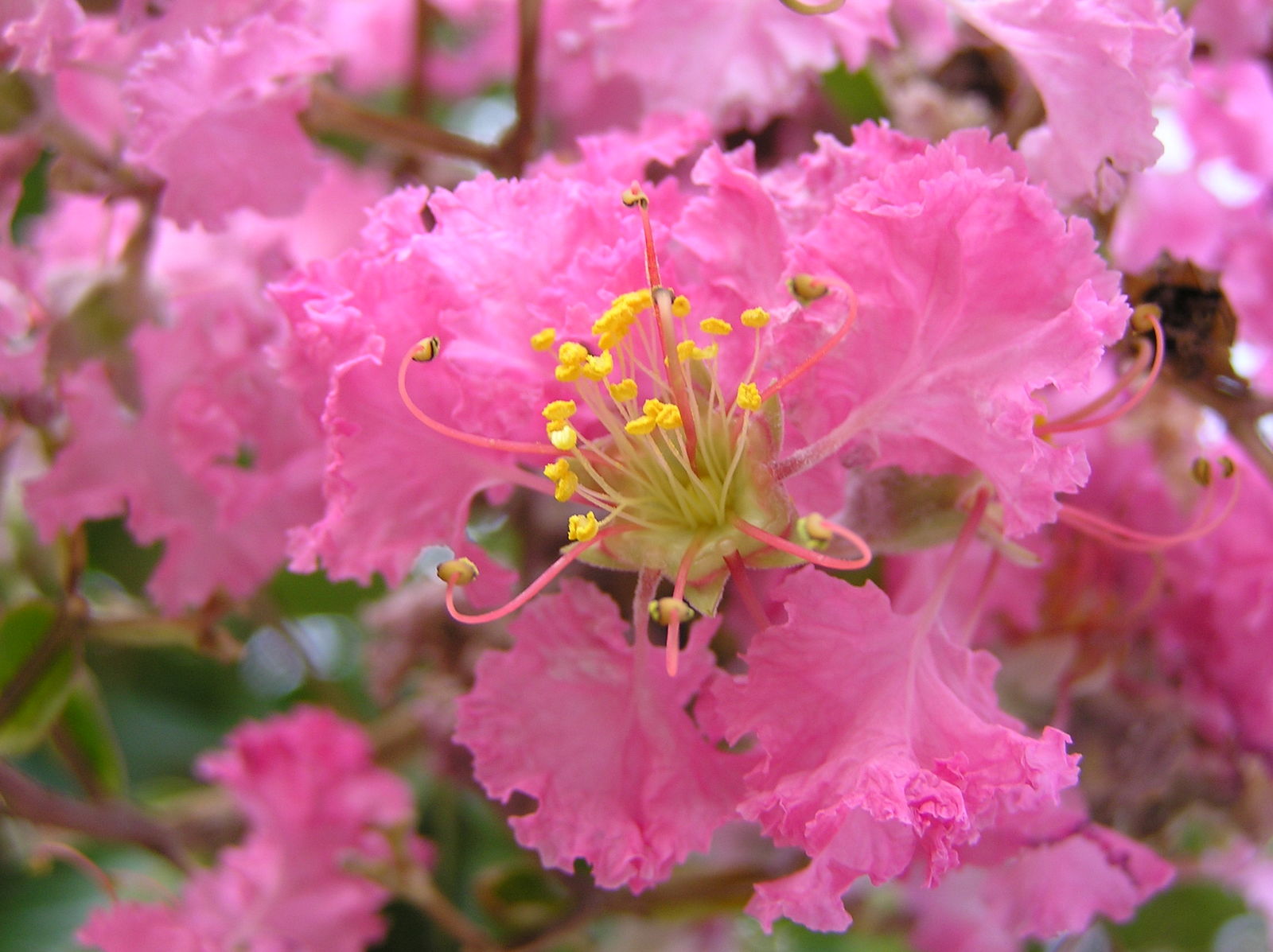
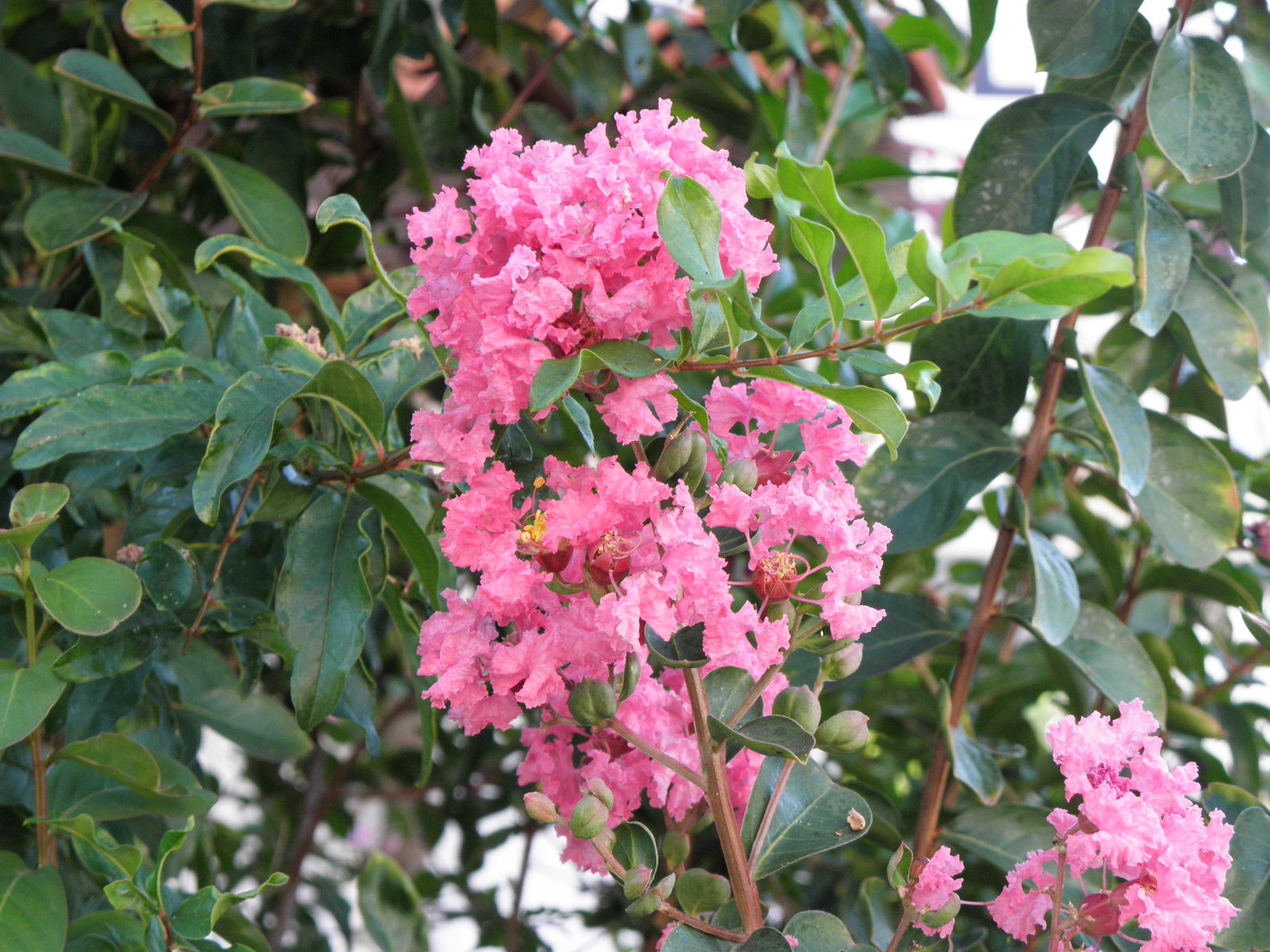
Broad terminal panicles 15–45 cm (6–18 in) long carry flowers with petals crinkled like crepe paper, giving crape-myrtle its English name. In Northern Hemisphere temperate gardens, flowering runs from July to September, with white, pink, red or purple flowers depending on the cultivar. 3 2
Useful taxonomy
Several dozen species from Asia and Oceania belong to Lagerstroemia. Of these, Lagerstroemia indica is the most widely grown in temperate ornamental horticulture. Since 1962, the U.S. National Arboretum in Washington has crossed it with Lagerstroemia fauriei, a Japanese species with strongly contrasting bark, to combine powdery mildew resistance with abundant flowers. 8
Historical forms and names still occur in botanical literature and horticultural trade:
- Lagerstroemia indica f. alba (G.Nicholson) Rehder, a historical botanical name
- Lagerstroemia indica var. grafii S.Yadav, a historical botanical name
- Lagerstroemia elegans Wall. ex C.Presl, a historical botanical name
- Lagerstroemia chinensis Lam., a historical botanical name
These are historical botanical names and forms, distinct from named garden hybrids.
A sales name such as Natchez or Tuscarora therefore identifies an indica x fauriei hybrid rather than pure Lagerstroemia indica. Check the full botanical name and cultivar on the label: the sales name alone cannot guarantee powdery mildew resistance. 1 8
Habitat and range
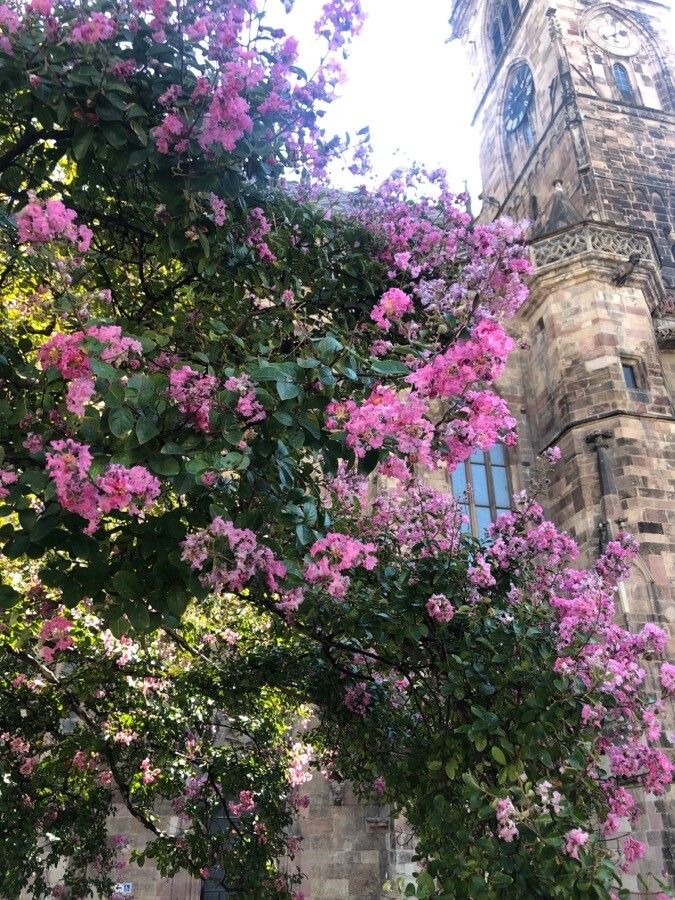
From the central Himalayas, its native range reaches southern China, Indochina, the Philippines and Japan. It grows in open grassy places, on low-elevation cliffs and along forest edges. 5 2
Early horticultural introductions through the Swedish East India Company were followed by widespread planting in regions with hot summers, from the Mediterranean basin to North America. The plant thrives in full sun and well-drained ground, tolerating clay, loam, sand and limestone soils. 2
Warm, humid conditions in the southeastern United States, similar to those of its native range, have allowed it to naturalize beside roads and at woodland edges. It appears in the regional Invasive Plant Atlas. In mainland France, cooler summers limit this risk; no comparable invasive status is documented, and it remains an ornamental garden plant. These regional observations do not establish its status elsewhere. 9
Life cycle and flowering
Summer flowers develop on the current season’s shoots. This matters when pruning: cutting wood in late winter does not remove future flowers as it would on a shrub that blooms on older wood. Clemson HGIC emphasizes this distinction when explaining a widespread but damaging pruning practice. 7
Severe topping of the trunk, sometimes called crape murder, does not increase flowering. Clemson HGIC shows that an unpruned plant flowers as well as one topped every year. Topping produces dense, weak regrowth and permanently distorts the plant’s structure. 7
Where summer warmth persists, flowering can last from July into early fall in the Northern Hemisphere, almost 100 consecutive days. This explains the Chinese nickname meaning a hundred days of red. Small brown capsules follow the flowers and often remain through winter. Commercial propagation favors semi-ripe cuttings 8–15 cm (3–6 in) long, taken in summer. Seeds can also be used, but do not faithfully reproduce a named cultivar. 2 5
Uses and risks
Gardeners grow crape-myrtle chiefly as an ornamental: a specimen for winter bark, an informal hedge, a street tree or, for compact forms, a large patio container. Bees and butterflies visit throughout its long summer bloom, a duration matched by few deciduous woody shrubs. 3 2
For cats, dogs and horses, the ASPCA lists Lagerstroemia indica as non-toxic, with no adverse effects reported from accidental ingestion. 6
On modern cultivars, NC State mainly records growing problems rather than serious diseases: aphids, scale insects, humidity-related leaf spots and iron chlorosis in overly alkaline soil. Powdery mildew remains the main limitation, chiefly on forms that have not been hybridized with Lagerstroemia fauriei. 2
Varieties, look-alikes and related plants
National Arboretum hybrids named after Native American peoples now dominate sales in temperate climates. Natchez combines strongly contrasting cinnamon bark and good powdery mildew resistance, making it a common specimen choice. Tuscarora offers coral-pink flowers on a similarly resistant framework, while pale mauve Muskogee expands the color range for hot climates. White-flowered Alba corresponds to Lagerstroemia indica f. alba in botanical synonymy and is closer to the species than to these hybrids. 8 1
Before choosing a plant, establish whether it is the species or an indica x fauriei hybrid. Their flowers look similar, but the hybrid tolerates foliage humidity better and retains healthier leaves late in summer. 2
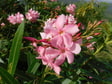
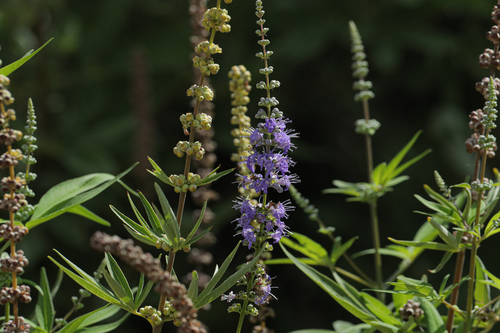
Other summer-flowering shrubs with large colorful panicles can cause confusion: oleander (Nerium oleander) has leathery evergreen leaves and is toxic to pets, while butterfly bush (Buddleja davidii) is classed as invasive in several regions. Crape-myrtle’s peeling bark and crinkled petals distinguish it, with the bark remaining useful when the plant is out of flower. 3
Main sources
- Plants of the World Online / Kew, Lagerstroemia indica L.
- NC State Extension Gardener Plant Toolbox, Lagerstroemia indica
- Royal Horticultural Society, Lagerstroemia indica (crape myrtle)
- Missouri Botanical Garden Plant Finder, Lagerstroemia indica
- Plants For A Future, Lagerstroemia indica
- ASPCA, Crape Myrtle (Lagerstroemia indica) toxicity entry
- Clemson HGIC, Crape Myrtle Pruning
- Missouri Botanical Garden Plant Finder, Lagerstroemia 'Natchez'
- Invasive Plant Atlas of the United States, Lagerstroemia indica
Frequently asked questions
Is crape-myrtle toxic to cats or dogs?
No. The ASPCA lists Lagerstroemia indica as non-toxic to cats, dogs and horses, with no adverse effect reported from ingestion.
Why does crape-myrtle bark peel?
Peeling in patches is normal on established plants and is especially marked in some hybrids such as Natchez. A young plant with smooth bark simply has not reached that stage.
Does crape-myrtle need hard pruning to flower?
No. Clemson HGIC shows that it flowers abundantly without hard pruning. Topping the trunk, sometimes called crape murder, weakens the structure and delays flowering rather than improving it.
How does Lagerstroemia indica differ from hybrids such as Natchez?
These hybrids cross Lagerstroemia indica with Lagerstroemia fauriei to add powdery mildew resistance and more contrasting bark while retaining summer flowering comparable to the species.
Is crape-myrtle invasive?
In the southeastern United States, the species has naturalized and appears in the regional Invasive Plant Atlas. No invasive status is documented in mainland France, where it remains an ornamental garden plant. Status elsewhere depends on the region.
How long does crape-myrtle bloom?
In temperate Northern Hemisphere gardens, flowering runs from July to September and can continue if summer warmth lasts. Its long season explains the Chinese nickname meaning a hundred days of red.
How can I identify crape-myrtle in winter without leaves?
Smooth, peeling bark, pale brown to cinnamon, remains the most reliable off-season feature, together with the brown capsules that often persist on the branches.
Similar plants
If you are unsure about a plant’s toxicity, ask a botanist or veterinarian for advice.