
Pomegranate (Punica granatum, )
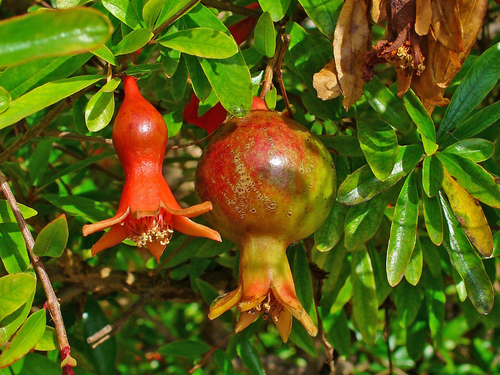
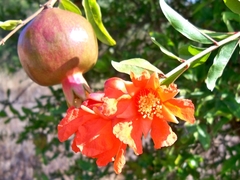
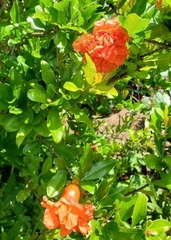
Pomegranate (Punica granatum L.) is a deciduous shrub or small tree in the genus Punica, now placed in the Lythraceae family. Native to Iran and Central Asia, it has been cultivated since antiquity for its fruit filled with juicy arils and its scarlet, funnel-shaped flowers.
Read morePomegranate, Granado and Melograno





© photo
(c) H. Zell, some rights reserved (CC BY-SA) · cc-by-sa
Daniel Capilla · cc0
Lisa Ferrel · cc0
Taken Nov 29, 2013 by Tela Botanica − Pierre Bonnet (cc-by-sa)
Taken Aug 14, 2016 by philippe lutz (cc-by-sa)
Taken Nov 11, 2021 by Alexandre Biosse Duplan (cc-by-sa)
Taken Dec 11, 2021 by Lavinia Chu (cc-by-sa)
Taken Nov 1, 2019 by John Cole (cc-by-sa)
© copyright of the Board of Trustees of the Royal Botanic Gardens, Kew.




Global distribution
The native range of Punica granatum extends from Iran and the Caucasus to the western Himalayas, from northeastern Turkey to northern Pakistan and Afghanistan. Ancient cultivation spread it throughout the Mediterranean basin and India, and later to the Americas.
- Native4
- Introduced4
- Iran and the Caucasus
- Anatolia (Turkey)
- Afghanistan and northwestern Pakistan
- Western Himalayas (northern India)
- Mediterranean basin
- Egypt
- California
- Southeast Asia
Hexagons: regions where the plant occurs. Green dots: native range.1
Identity
Pomegranate (Punica granatum L., 1753) belongs to the Lythraceae, although this deciduous shrub or small tree was long placed in its own family, Punicaceae. It is a member of the genus Punica. POWO accepts the name Punica granatum, published by Linnaeus in 1753. 1 2
The fruit gives the species its scientific epithet: granatum refers to the many seeds packed inside a pomegranate, rather than to a feature of the tree itself. Domesticated in the Near East in antiquity, it spread to Egypt and the Mediterranean basin, then reached India around the first century and the Americas much later. 5
Identification
Climate strongly affects the size of this woody, often multistemmed plant. NC State describes typical heights of 3–3.6 m (10–12 ft) with a similar spread in favorable conditions. RHS gives smaller British garden dimensions of 1.5–2.5 m (5–8 ft), while Morton records warm-climate specimens reaching 6–10 m (20–33 ft). Long, hot summers favor branching, as all three sources indicate for favorable climates. 3 2 5
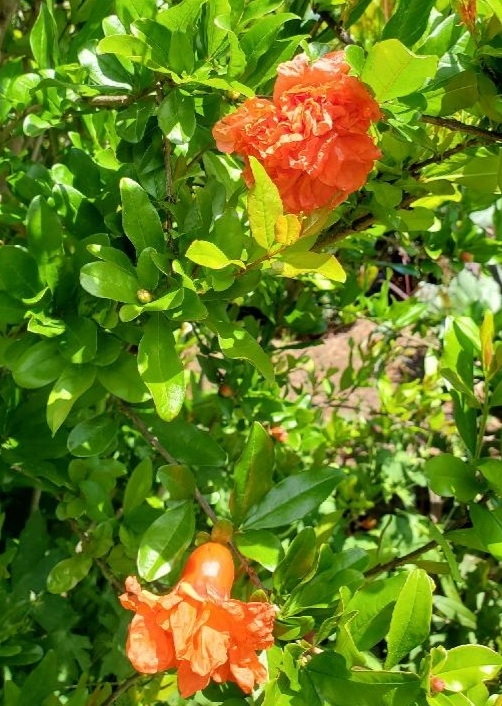
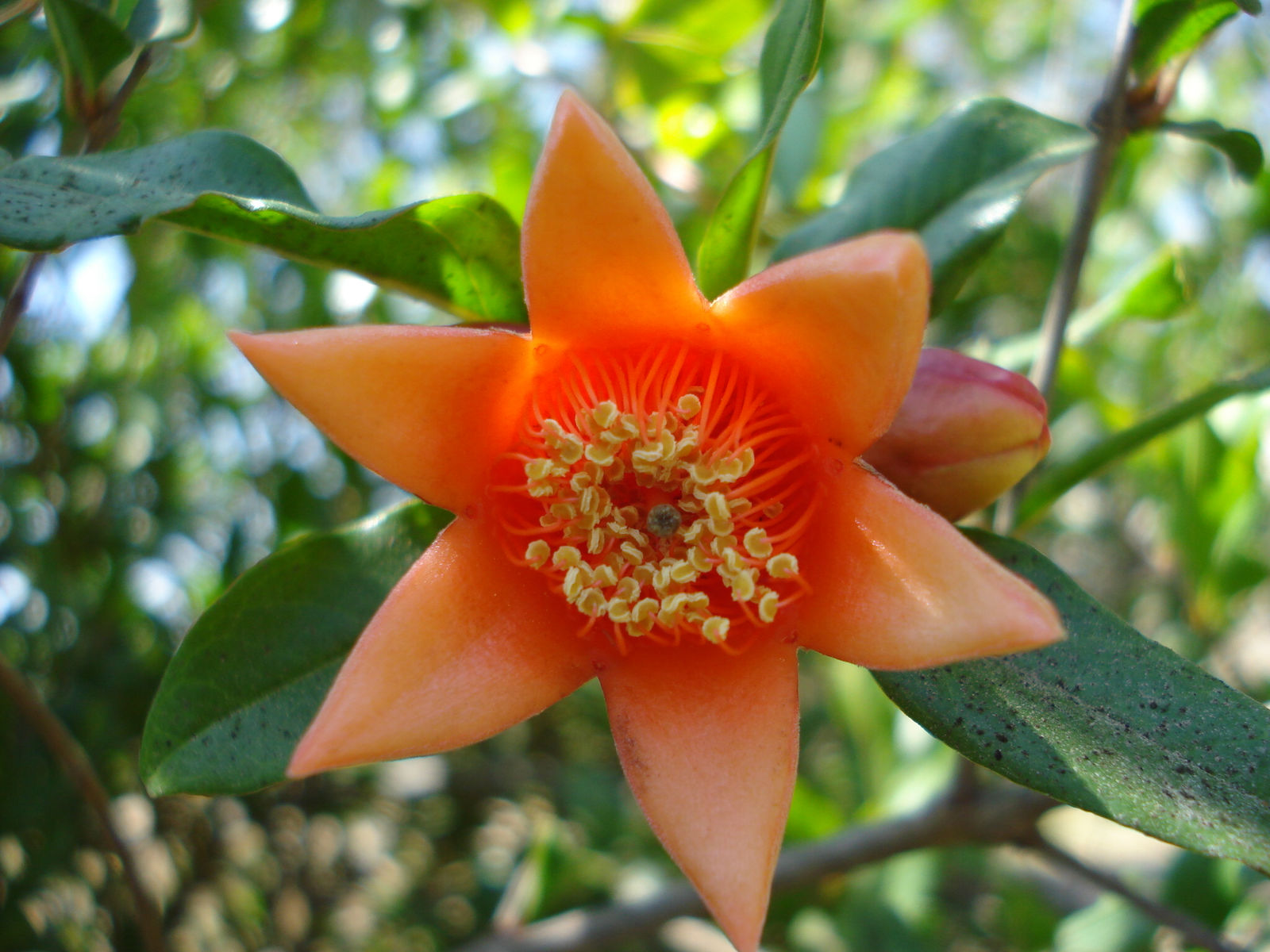
Opposite or whorled leaves are narrow and glossy, often bronze when opening before turning bright green. They become distinctly yellow in autumn before falling. Flowers cluster at shoot tips and have funnel-shaped bases and petals crumpled like crepe paper. RHS describes vivid scarlet blooms 3–4 cm (1–1.5 in) across; NC State also lists orange, pink, yellow and white, depending on the cultivar. 2 3
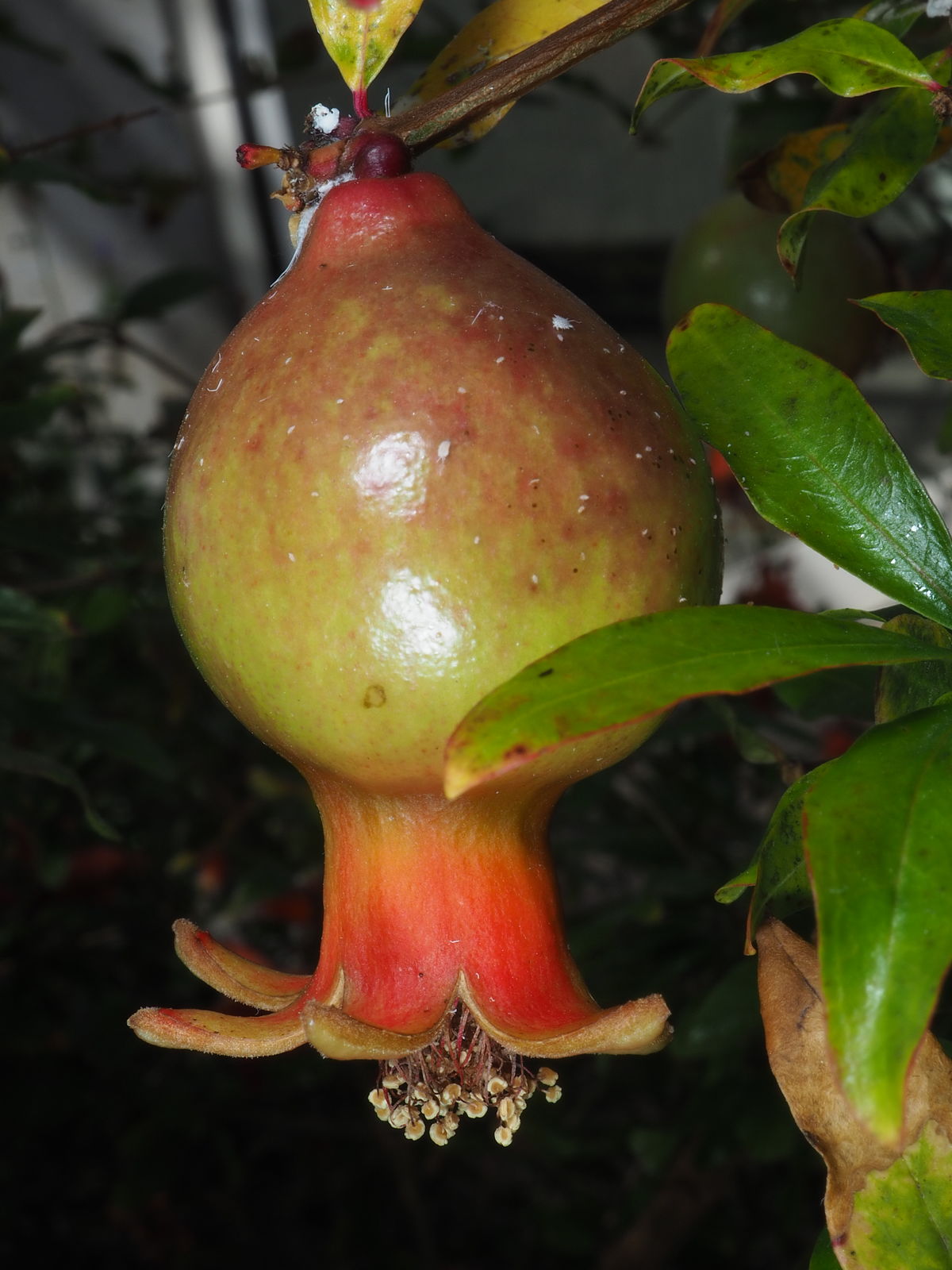
A round berry with a leathery yellow to deep-red skin, the fruit retains a star-shaped calyx at its tip. Inside, membranous partitions divide chambers filled with juicy arils, ranging from translucent to bright red. Each aril surrounds a seed whose hardness varies with the cultivar. 5 3
Useful taxonomy
Only two recognized species belong to Punica: the widely cultivated Punica granatum and Punica protopunica, endemic to Socotra. The latter has smaller flowers and has never been domesticated on a large scale. Both once formed the Punicaceae family before recent phylogenetic classifications placed them in Lythraceae. 1
Historical names still encountered in botanical and horticultural literature include the following synonyms:
- Punica nana L. (historical synonym)
- Punica spinosa Lam. (historical synonym)
- Punica grandiflora Steud. (historical synonym)
- Punica florida Salisb. (historical synonym)
- Punica multiflora Voss (historical synonym)
- Punica legrellei J.N.Haage & E.Schmidt (historical synonym)
Nana illustrates a frequent naming difficulty. The name occurs in botanical synonymy but is also used commercially for dwarf container forms. In practice, the binomial Punica granatum followed by a cultivar name is the clearest way to identify a particular cultivated plant. 1 2
Habitat and distribution
Iran, the Caucasus and the western Himalayas mark the broad native range. More detailed records extend from northeastern Turkey to northern Pakistan and Afghanistan. RHS describes the range more broadly as the eastern Mediterranean to the Himalayas. 3 2
Domestication began several thousand years ago in this region, followed by an early spread to Egypt, the Levant and the Mediterranean basin. Morton traces later introductions to India around the first century and Indonesia around 1416, followed by California with Spanish settlers in 1769. 5
Garden conditions that suit pomegranate combine full sun, well-drained soil, including chalky soil, a hot, dry summer and a winter cool enough to initiate flowering. Clemson notes moderate salt tolerance, allowing it to be planted in coastal gardens. 6 4
Life cycle and fruiting
Flowering begins in spring and continues through summer, sometimes into autumn in mild climates. Flowers occur on current-season wood, which explains why severe pruning in late winter can reduce the following harvest. 6 2
Fruit ripening requires several months of warmth. RHS notes that autumn temperatures of 13–16 °C (55–61 °F) are needed for the fruit to mature, limiting reliable cropping to places with long, hot summers. Clemson adds that irregular irrigation, especially drought followed by heavy watering, causes the skin to split before harvest, particularly when fruit is already nearly ripe. 2 6
Commercial propagation favors hardwood cuttings 25–50 cm (10–20 in) long, treated with rooting hormone, because seedlings do not reliably preserve a named cultivar. PFAF also describes removing basal suckers as a straightforward method for home growers. 5 4
Uses and risks
Fresh arils and juice are familiar foods, while the fruit also goes into grenadine, jelly, syrup and, in some cuisines, a dried powder called anardana. PFAF records historical medicinal uses: root bark rich in pelletierine alkaloids was used to expel intestinal worms, and tannin-rich fruit peel served externally as an astringent. 5 4
Ripe fruit and edible arils are not reported as toxic to cats or dogs in the available information. Caution chiefly concerns bark, roots and large amounts of foliage rather than ordinary consumption of the edible portion. 4
Cultivation problems receive more attention than severe disease in Clemson and NC State accounts. Scale insects, aphids and moisture-related leaf spots can occur. Poor fruiting is especially associated with too little sunshine, inadequate pollination or excessive pruning. 6 3
Cultivars, similar plants and identification
Fruit-producing cultivars and ornamental forms serve different purposes. Wonderful dominates commercial California production. Nana is a dwarf grown in containers or as bonsai, with fruit of little eating value. Russian-series cultivars, including Afganski and Salavatski, bring cold resistance down to USDA zone 6, compared with zone 8 for the typical species. 5 6
Double, striped flowers distinguish ornamental selections such as Legrelleae, which has little value as a fruit crop. Before choosing a cultivar, establish whether its purpose is fruit production, a dwarf container habit or decorative flowers alone. 2
Confusion chiefly concerns horticultural names. Socotra's isolation has long kept the sister species, Punica protopunica, out of the European horticultural mainstream. In English, pomegranate names both tree and fruit. The dependable identification remains Punica granatum, with a cultivar name added when selecting a plant for a particular purpose. 1 5
Main sources
- Plants of the World Online / Kew, Punica granatum L.
- Royal Horticultural Society, Punica granatum - pomegranate
- NC State Extension Gardener Plant Toolbox, Punica granatum
- Plants For A Future, Punica granatum
- Julia Morton, Fruits of Warm Climates, Pomegranate
- Clemson HGIC, Pomegranate - Punica granatum growing guide
Frequently asked questions
Is pomegranate toxic to cats or dogs?
The fruit and its edible arils are not reported as toxic to cats or dogs. Bark and roots contain alkaloids formerly used as deworming agents and should be kept out of reach rather than used as home remedies.
Why does my pomegranate produce no fruit?
Common causes include insufficient full sun, winters too mild to induce flowering, poor pollination or severe pruning that removes flowering wood.
Can pomegranate grow in a pot or indoors?
Yes, especially dwarf forms such as Nana, but it still needs full sun and benefits from a cool winter outdoors or in an unheated greenhouse rather than a heated living room year-round.
How do dwarf forms differ from ordinary pomegranate?
Dwarf forms such as Nana belong to the same species, Punica granatum. Their compact habit and poorly developed fruits make them chiefly ornamental container plants rather than fruit crops.
Is pomegranate invasive in France?
No invasive status is assigned in metropolitan France, where it has long been cultivated as an ornamental and fruit shrub without documented problematic naturalization.
How can I recognize a ripe pomegranate?
Taut skin ranging from yellow to deep red, a well-formed star-shaped calyx and a weight that feels heavy for its size often indicate maturity. A fruit beginning to split should be harvested promptly.
What were pomegranate peel and root bark used for?
Tannin-rich fruit peel was traditionally used externally as an astringent. Root bark contained pelletierine alkaloids formerly used against intestinal worms; this historical practice does not replace current medical advice.
Similar plants

If you are unsure about a plant’s toxicity, ask a botanist or veterinarian for advice.