
Osage-orange (Maclura pomifera, )
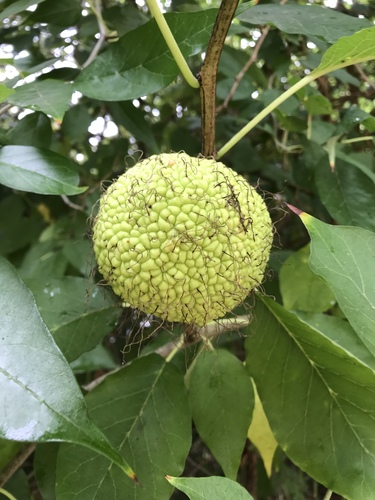
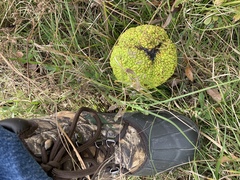
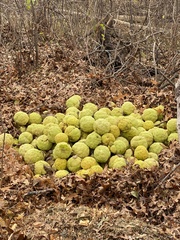
Osage-orange (Maclura pomifera (Raf.) C.K.Schneid., 1906), also called bois d’arc, is a deciduous tree or large shrub in the Moraceae family, native to the south-central United States. Wild plants are often thorny, with male and female flowers on separate trees. Females bear a large multiple fruit that turns from green to yellow-green; it is inedible. The exceptionally hard, rot-resistant wood supplied Osage bow makers and later the first American living fences, before barbed wire.
Read moreOsage-orange, Bois d’arc and Hedge apple





© photo
(c) hilliri, some rights reserved (CC BY-NC) · cc-by-nc
iNaturalist User · cc-by
Sandy Wolkenberg · cc-by
Taken Sep 15, 2003 by Photoflora - Jean-Luc TASSET (©)
Taken Aug 15, 2009 by Photoflora - Jean-Luc TASSET (©)
Taken May 20, 2018 by huy HO (cc-by-sa)
Taken Jan 4, 2022 by Ale Mac (cc-by-sa)
Taken Jun 3, 2022 by malot w (cc-by-sa)
© copyright of the Board of Trustees of the Royal Botanic Gardens, Kew.


Global distribution
POWO/WCVP places the native range in the south-central United States, from southeastern Oklahoma to Texas and Arkansas. GRIN Global includes northwestern Louisiana with a question mark and records widespread introduction in North America, China and Europe, where the species remains primarily a tree cultivated for hedges and timber.
- Native1
- Introduced2
- United States
- China
- Western Europe
Hexagons: regions where the plant occurs. Green dots: native range.1
Identity
Osage-orange (Maclura pomifera (Raf.) C.K.Schneid., 1906), also called Bois d’arc, is an accepted species in the genus Maclura, the only notable member of that genus outside Asia, in the Moraceae family. Its accepted name reflects a relatively late taxonomic transfer: Constantine Samuel Rafinesque described it in 1817 under the basionym Ioxylon pomiferum, but Camillo Karl Schneider did not place it in Maclura until 1906. 1 2
French settlers in the Mississippi basin coined the name bois d’arc after observing the Osage making highly prized bows from the dense, elastic wood; bow-wood is its direct English translation. Osage-orange instead evokes the bumpy green fruit, yellow-green when ripe, whose outline resembles an orange despite having no botanical relationship to citrus. Hedge apple is another established English name. 3 7
Recognition
A broad, rounded crown gives Maclura pomifera the outline of a deciduous tree or large shrub. The horticultural sources consulted give a height of 8–18 m (26–59 ft) with a comparable spread; exceptional specimens exceed 20 m (66 ft). The orange-brown bark thickens and becomes deeply fissured with age. 4 5
Young branches and suckers carry stout stipular thorns, 0.5–2.5 cm (0.2–1 in) long, at the leaf axils, discouraging browsing animals from passing through. The simple, oval, glossy leaves are dark green above and turn distinctly yellow in fall. Damage to a leaf, stem or fruit releases white milky sap, characteristic of the Moraceae family. 5 6
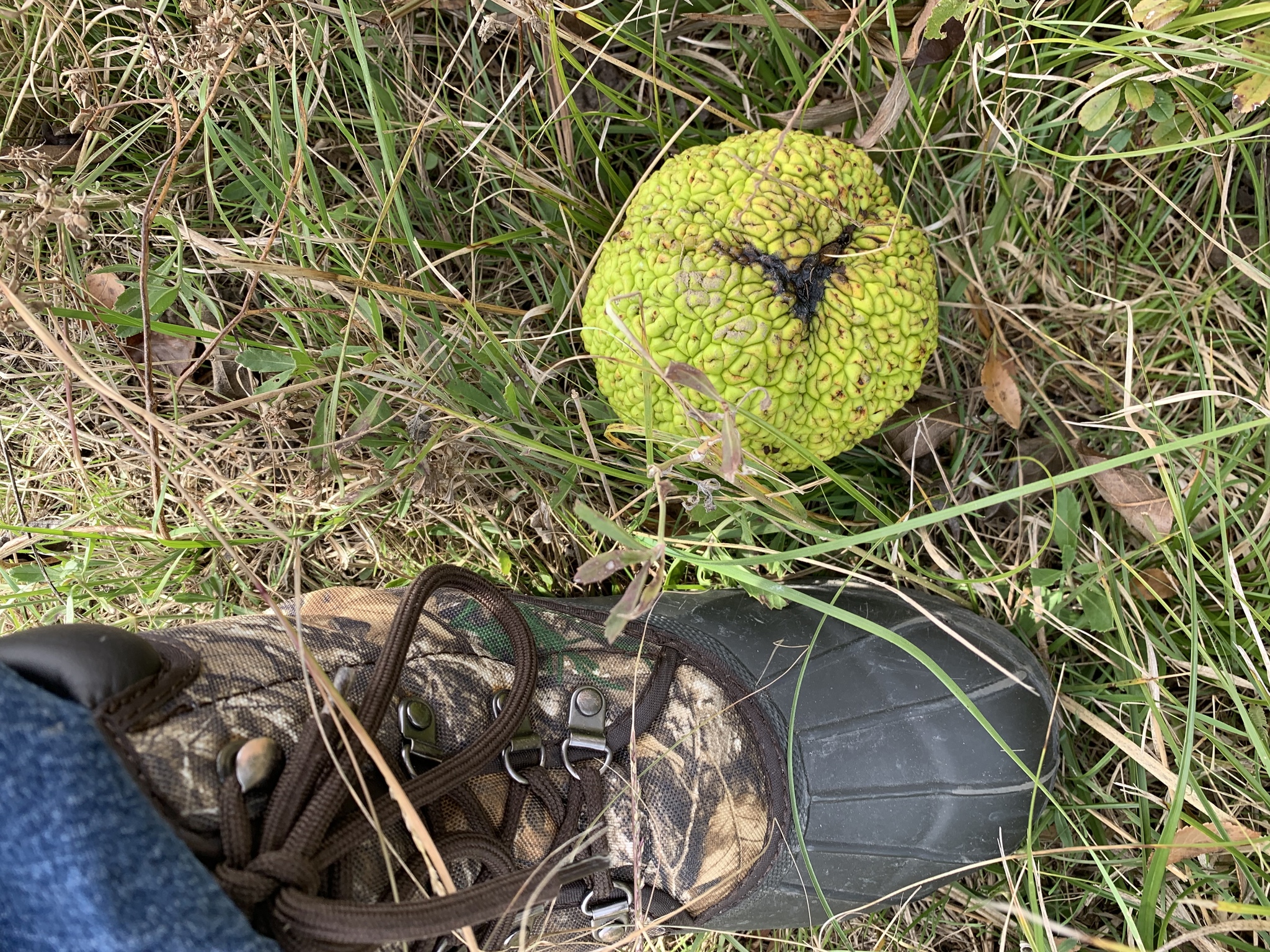
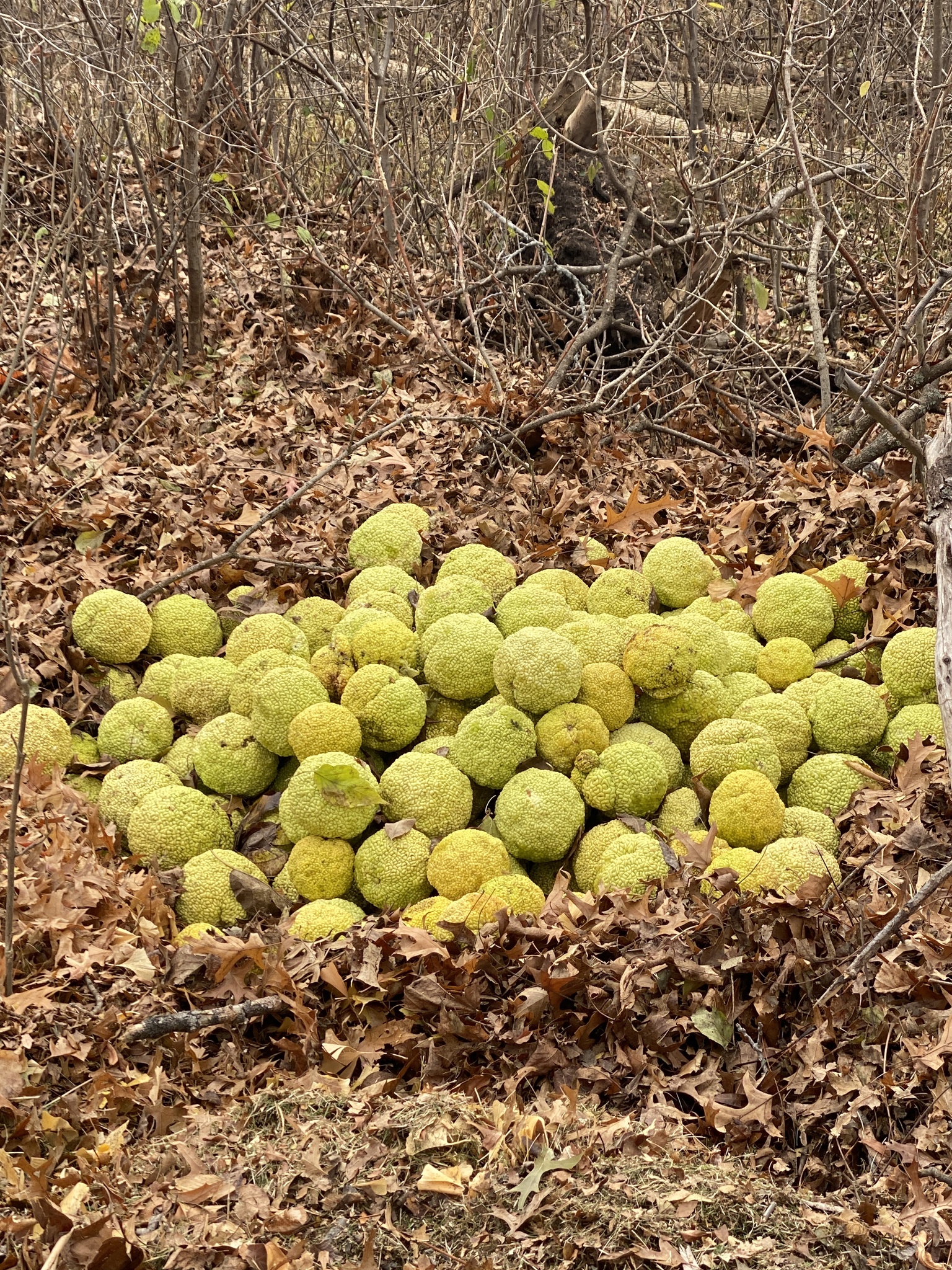
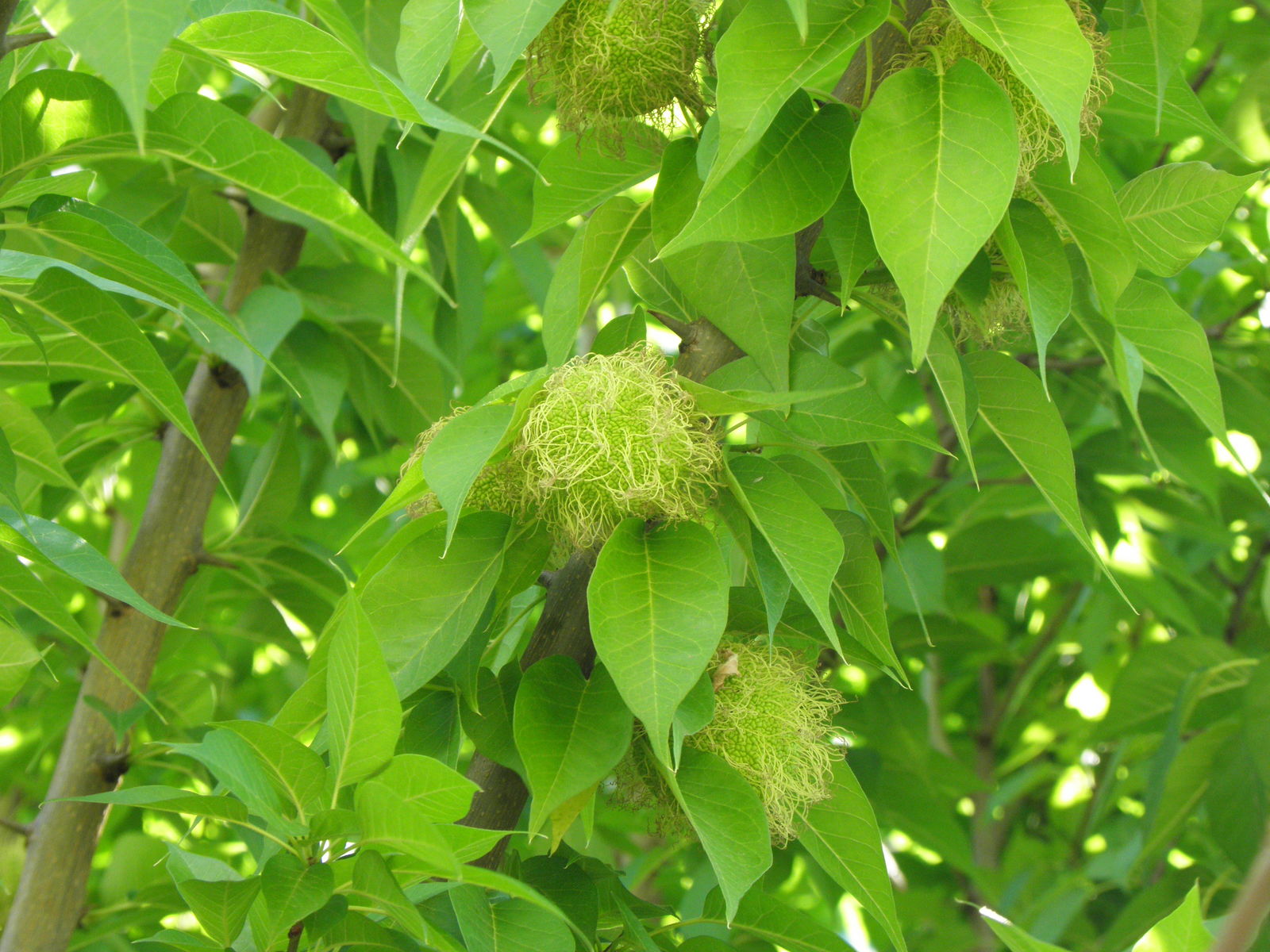
The species is dioecious: small, inconspicuous greenish flowers open after leaf emergence, in late spring or early summer, on separate male and female trees. Only females bear the enormous, bumpy multiple fruit, a syncarp 10–15 cm (4–6 in) across that changes from green to yellow-green in early to mid-fall. 5
Useful taxonomy
Repeated changes in classification have left the accepted name with a long list of synonyms. These are the main names to recognize on an old nursery label or herbarium sheet:
- Ioxylon pomiferum Raf., the 1817 basionym
- Toxylon pomiferum (Raf.) Sarg.
- Toxylon maclura Raf.
- Toxylon aurantiacum (Nutt.) Raf.
- Maclura aurantiaca Nutt.
- Maclura pomifera var. inermis (André) C.K.Schneid., the historical thornless variety
The last name, inermis, deserves attention: it denotes the thornless form from which several modern horticultural cultivars, including White Shield and Wichita, were developed. The stable reference remains the accepted name Maclura pomifera, in Moraceae alongside mulberries (Morus) and figs (Ficus). 1 3
Habitat and distribution
Southeastern Oklahoma, Texas and Arkansas form the south-central American native range recognized by POWO/WCVP; GRIN Global adds northwestern Louisiana with a question mark. Here the species grows in fertile lowland woods, fields and thickets in full sun. 1 3
Beyond its original range, Maclura pomifera was widely introduced elsewhere in North America from the 19th century onward as a living hedge. It was subsequently cultivated in China and Europe, where it remains an introduced tree used for timber, shade or windbreaks rather than a widely naturalized woodland tree. 3 9
Its soil tolerance is broad: clay, loam, sand and shallow rocky ground, whether acidic, neutral or alkaline. This wide tolerance of soil conditions helps Osage-orange spread beyond its native range wherever people have planted seedlings or hedges. 5
Life cycle, ecology and reproduction
The heavy, bumpy fruit inspired a famous hypothesis in evolutionary ecology: its size and color may be adaptations for dispersal by Pleistocene megafauna, such as mammoths or giant ground sloths that disappeared more than ten thousand years ago. This scenario is often described as a “ghost of evolution.” 10
A critical examination questioned the hypothesis's experimental support: seeds do not survive passage through the gut of a modern horse, while passage through an elephant's digestive tract reduces rather than improves germination. Natural dispersal remains limited today: squirrels gnaw the fruit and destroy most of the seeds without dispersing them effectively. 10
In practice, spread relies chiefly on root suckers, which become especially prolific after the main stem is cut, and on human planting over the past two centuries. Vigorous regrowth from the stump helps hard-pruned Osage-orange hedges thicken: the harder the cut, the denser the regrowth. 5 7
Uses and risks
Exceptionally dense, naturally rot-resistant wood underlies the tree's best-known historical use. The Osage made bows that French settlers considered superior to those fashioned from other local woods, a craft preserved in the name bois d’arc. Later uses included fence posts, tool handles and a yellow dye extracted from the bark and heartwood. 7 6
Before barbed wire was invented in 1874, thousands of kilometers of Osage-orange hedges were planted across the American Great Plains. Dense thorns and vigorous regrowth after pruning made a nearly impenetrable livestock fence. During the 1930s, the federal shelterbelt program planted thousands more kilometers to combat Dust Bowl soil erosion. These distances amount to thousands of miles of living barriers. 7
The fruit is inedible: its hard, astringent flesh has no practical food use. Milky sap from damaged stems and fruits can irritate some people's skin on contact. PFAF reports toxicity of the juice and an extract of the fruit, an observation about those preparations rather than an assurance of whole-fruit safety in animals. A widespread American folk belief also credits the fruit with repelling indoor spiders and insects. Chemical analyses show that the relevant compounds are far too dilute in the pulp to produce a measurable effect. 6 5 7
Varieties, look-alikes and related plants
Three thornless male cultivars dominate North American nursery offerings: White Shield, Wichita and Park. None bears fruit because all were selected from male trees. They provide street and shade trees without the sticky litter produced by females or the injury risk from thorns. 5
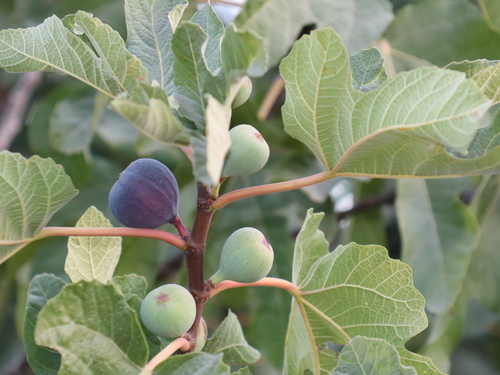
The common name itself causes the most frequent confusion. Despite “orange” in Osage-orange, this species has no botanical relationship to Citrus, in the Rutaceae family. Maclura pomifera belongs to Moraceae, the mulberry and fig family, which explains its milky sap and wood texture, much closer to a mulberry's than a citrus tree's. 1
A seedling's sex cannot be determined before its first flowering, often several years after sowing. To ensure a thornless, fruitless male tree from the outset, choose a grafted plant of a named cultivar rather than a seedling of unknown origin. 5
Main sources
- Plants of the World Online / Kew, Maclura pomifera (Raf.) C.K.Schneid.
- International Plant Names Index, Maclura pomifera
- USDA GRIN Global Taxonomy, Maclura pomifera
- Missouri Botanical Garden Plant Finder, Maclura pomifera
- NC State Extension Gardener Plant Toolbox, Maclura pomifera
- Plants For A Future, Maclura pomifera
- Buckeye Yard and Garden onLine / Ohio State University, Osage orange
- USDA NRCS, plant fact sheet Maclura pomifera
- USDA PLANTS Database, Maclura pomifera profile
- Sinnott-Armstrong et al. (2022), How to approach the study of syndromes in macroevolution and ecology, PubMed Central
Frequently asked questions
Can you eat Osage-orange fruit?
No. The flesh is hard, astringent and unappetizing, and it is not considered a food. Sap can irritate skin on contact. PFAF reports toxicity of the juice and an extract of the fruit; this does not establish an assessment of the whole fruit in animals.
Is Osage-orange related to the orange?
No, despite its name. True oranges belong to Citrus in the Rutaceae family. Maclura pomifera belongs to Moraceae, the mulberry and fig family; the resemblance ends with the shape and color of its fruit.
Why does a planted tree never bear fruit?
The species has separate male and female trees. Only females bear fruit, provided a male grows nearby for pollination. An isolated male, or a male cultivar such as White Shield, never fruits.
Why is this tree called bois d’arc?
The name comes from the historical use of its wood, prized by the Osage for making high-performance bows. French settlers in the Mississippi basin passed on the name, which was translated directly as bow-wood.
Do Osage-orange fruits really repel spiders?
This is a widespread American folk belief, but chemical analyses show that the repellent compounds in the fruit are far too dilute to have a measurable effect on indoor insects or spiders.
Why was Osage-orange planted in hedges before barbed wire?
Its dense thorns and vigorous regrowth after hard pruning made it a living fence almost impenetrable to livestock. It was widely planted across the American Great Plains in the 19th century.
Are there thornless varieties?
Yes. The male cultivars White Shield, Wichita and Park were selected for their lack of thorns and fruit, making them suitable for street planting and busy gardens.
Similar plants
If you are unsure about a plant’s toxicity, ask a botanist or veterinarian for advice.