
Orange jasmine (Murraya paniculata, )
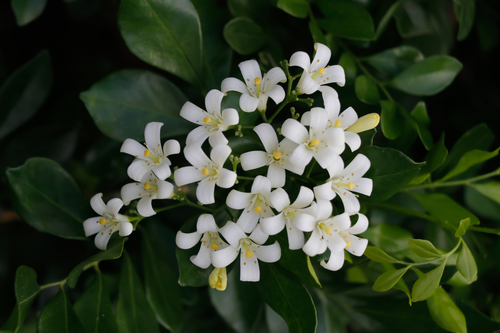
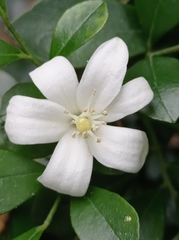

Orange jasmine (Murraya paniculata) is an evergreen shrub or small tree in the Rutaceae, native to India, southern China, Southeast Asia and northern Australia. Grown for glossy foliage and fragrant white flowers, it serves as a clipped hedge in warm climates and a conservatory plant in temperate regions.
Read moreOrange jasmine, Orange jessamine, China box, Cosmetic barktree, Mock orange and Murraya
Allow a few hours of direct sun per day, preferably morning or evening.
Full sun to light partial shade


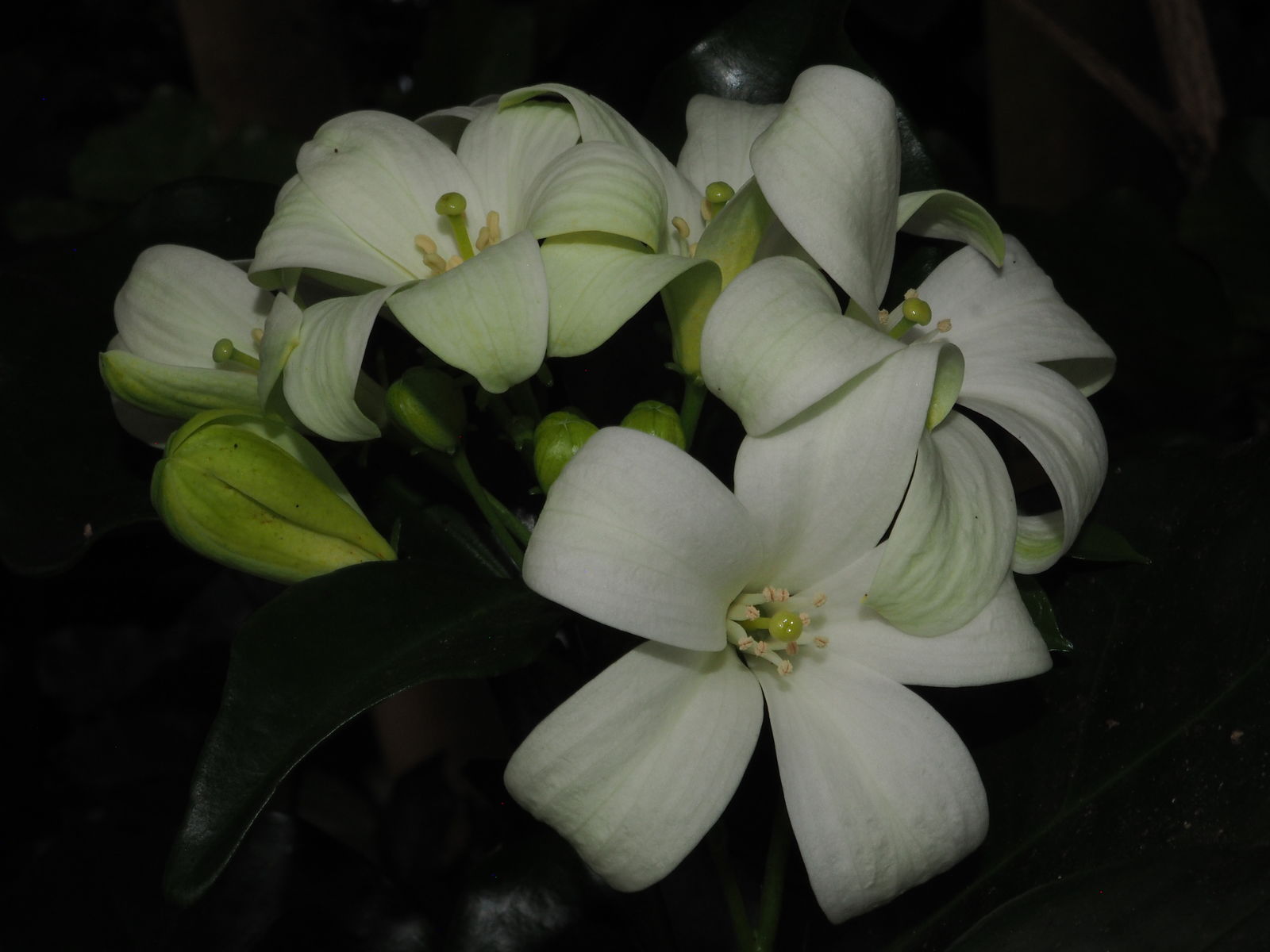
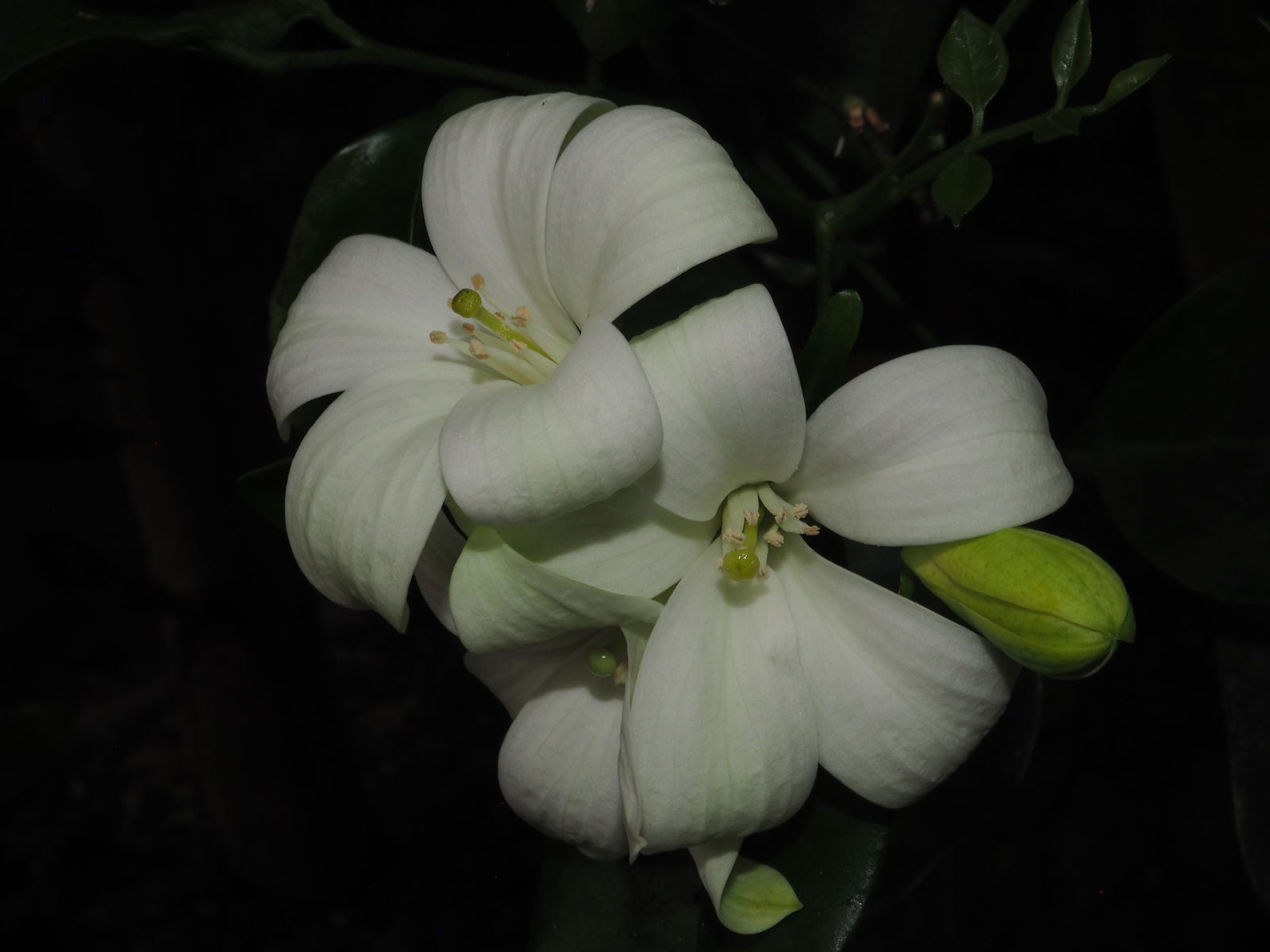
© photo
(c) jinze, some rights reserved (CC BY-NC), uploaded by jinze · cc-by-nc
Arturo Benavides Mendoza · cc-by
Wikimedia Commons · CC BY-SA or Public Domain
Taken Mar 4, 2021 by Sébastien TRASBOT (cc-by-sa)
Taken Nov 7, 2022 by شهاب الدين جابر (cc-by-sa)
Taken Feb 24, 2020 by jurus (cc-by-sa)
Taken May 11, 2014 by Tela Botanica − Céline PIRAT (cc-by-sa)
Taken Jan 25, 2020 by Chee Keong Chan (cc-by-sa)
© copyright of the Board of Trustees of the Royal Botanic Gardens, Kew.


Global distribution
Murraya paniculata is native to India, southern China, Southeast Asia and northern Australia. Naturalization beyond this range, sometimes invasive, mainly concerns southeastern Queensland, some Pacific islands and Florida; it must be distinguished from native populations farther north.
- Native4
- Invasive3
- India
- Southern China
- Indonesia
- Northern Australia (Kimberley, Northern Territory, Queensland)
- Southeastern Australia (Queensland)
- Florida (United States)
- Fiji
Hexagons: regions where the plant occurs. Green dots: native range.1
Identity
Orange jasmine (Murraya paniculata (L.) Jack, 1820), also called orange jessamine, China box, cosmetic barktree, mock orange or Murraya, is an evergreen shrub or small tree in the Rutaceae. The box-related name can mislead: it does not belong to the Buxaceae. Only its dense foliage and pale wood recall true boxwood, whose flowers are much less conspicuous. 1 5
Repeated flushes of white, fragrant flowers from spring through fall provide a useful identification clue, unlike hedge shrubs that bloom during just one season. The epithet paniculata describes the inflorescence, arranged in terminal or axillary panicles. 4
Several competing botanical synonyms have circulated for this plant. Plants of the World Online accepts Murraya paniculata (L.) Jack and treats Murraya exotica, still found on many nursery labels, as a synonym. 1 2
Recognition
Smooth, pale gray-brown bark accompanies pinnate leaves with up to seven leaflets. Glossy and oval to elliptical, the leaflets measure 2.5–10 cm (1–4 in) long, clearly larger than the much smaller leaves of true boxwood. 3 5
Planted in the ground, orange jasmine commonly reaches 2–7 m (6.5–23 ft). Regular clipping can keep a hedge at 60 cm (2 ft) to edge a path or terrace. 3
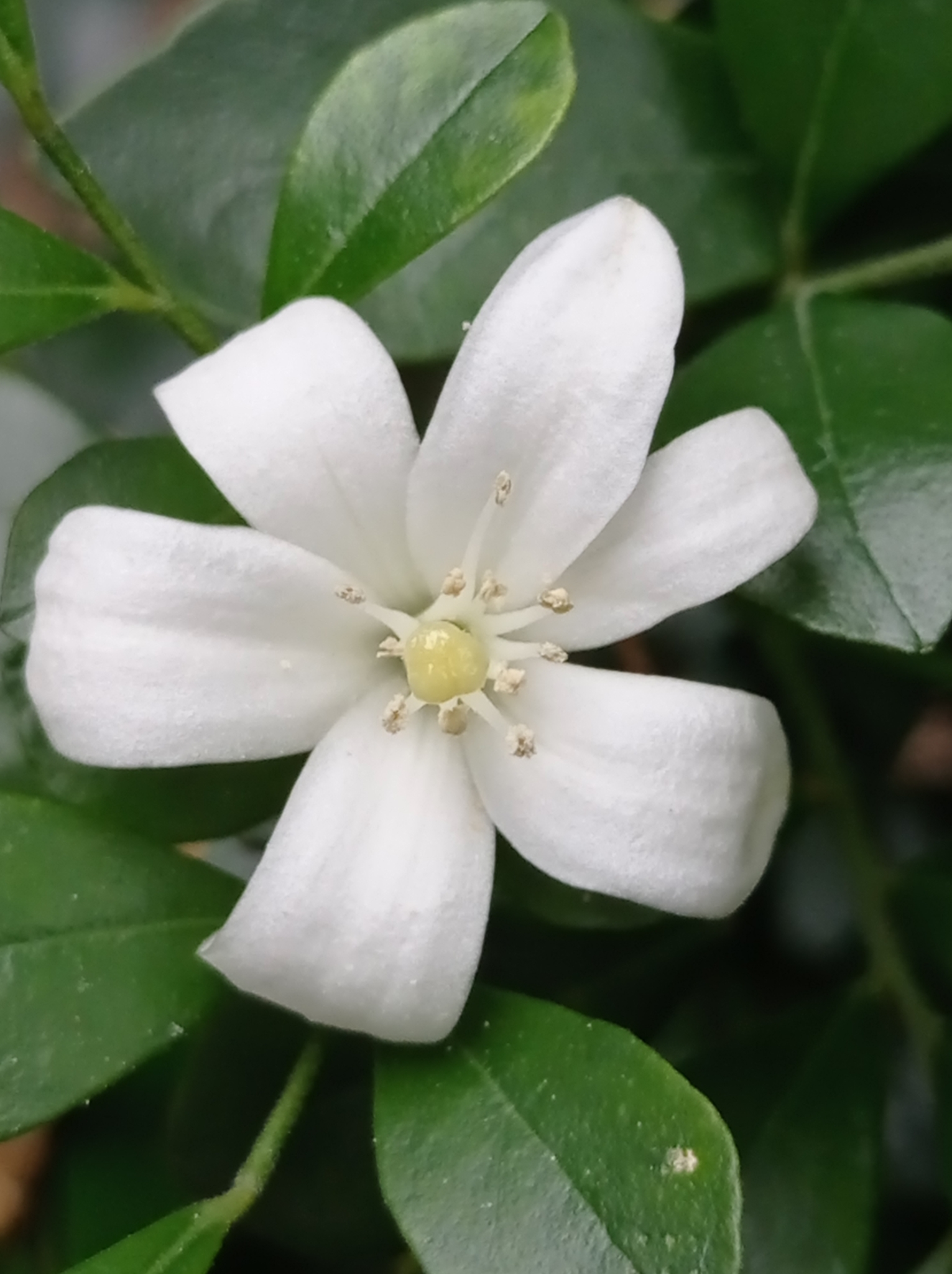
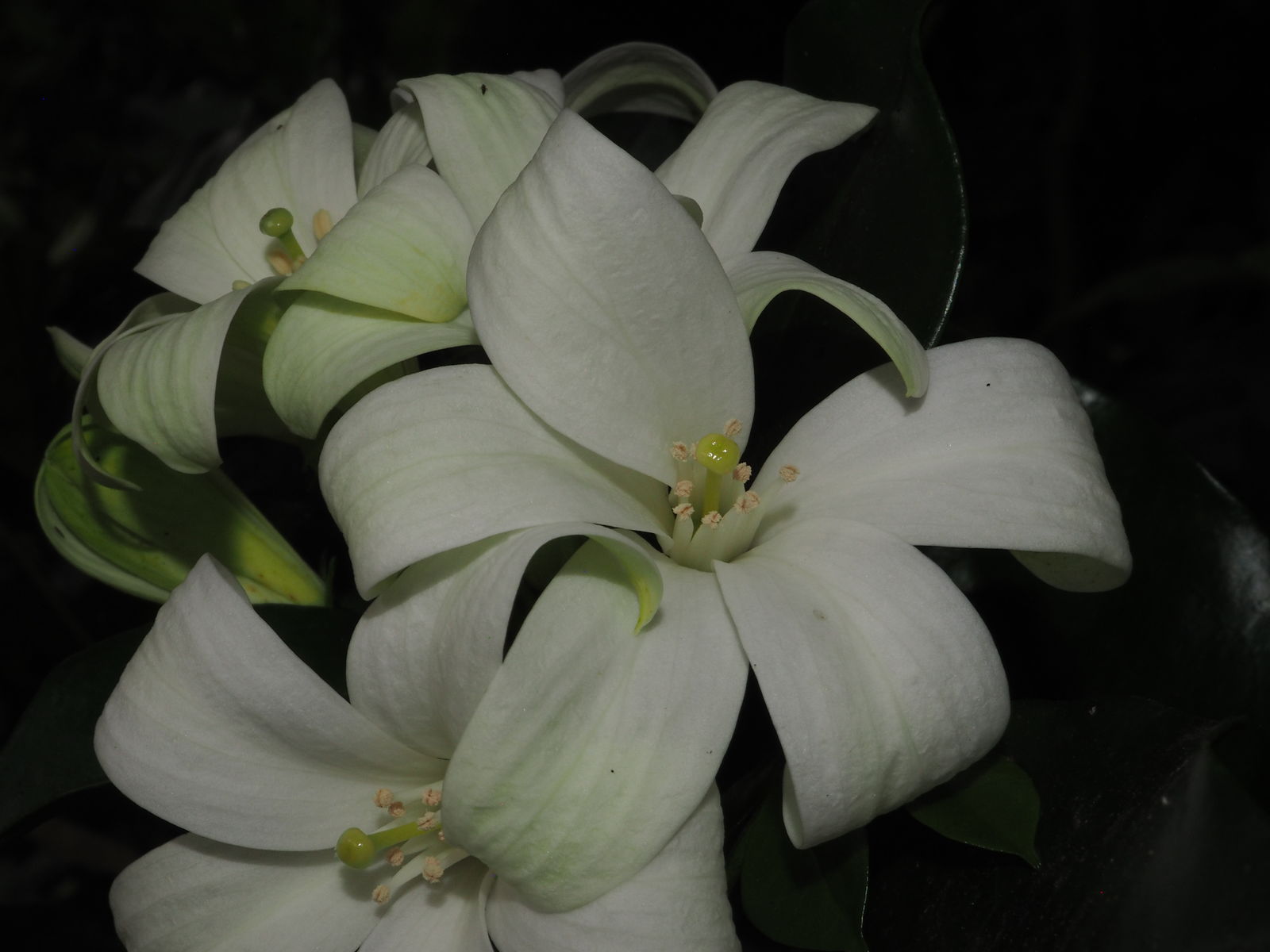
Five cream-white petals about 2 cm (0.8 in) long form each flower. The citrus fragrance increases noticeably in the evening and after rain, a response associated with falling atmospheric pressure. Flowers return several times a year rather than in a single season, distinguishing this species from many shrubs with one flowering period. 4 3
An oval orange-red berry about 12–14 mm (0.5 in) long contains hairy seeds. Foliage and fruit often occur together on mature plants, helping distinguish a sterile young plant from one already capable of flowering. 3 5
Useful taxonomy
Nursery names and botanical synonyms overlap particularly often for orange jasmine. Useful names to check include:
- Murraya exotica L., a botanical synonym
- Chalcas paniculata L., an earlier generic placement
- Chalcas exotica (L.) Millsp., another listed synonym
- Murraya paniculata var. exotica (L.) C.C.Huang, a varietal name in synonymy
The nursery name Murraya exotica remains common in North America and Asia for compact forms. It is a synonym of the same accepted taxon, rather than a separate species. The stable reference is Murraya paniculata (L.) Jack, confirmed by ITIS as TSN 28901, a unique reference for literature searches when sales names vary between suppliers. 1 6
Habitat and range
From India and southern China, the native range continues through Southeast Asia to northern Australia, including Kimberley, the Northern Territory and Queensland. There the shrub grows in tropical forest understory and coastal thickets. 1 7
Birds eat the ripe berries and disperse the seeds, explaining much of the naturalization beyond the native range. In southeastern Queensland, this dispersal has made Exotica one of the region’s most invasive plants, a situation distinct from native populations farther north in Australia. 8 5
In metropolitan France, cultivation is largely confined to containers, conservatories and cool greenhouses. Below -4 °C (25 °F), frost already destroys foliage; hardiness is insufficient for outdoor planting except in sheltered Mediterranean conditions. 3
Life cycle and reproduction
Flowering recurs several times a year and is often triggered by a fall in atmospheric pressure before rain. The storm moistens the air, and the citrus fragrance intensifies within hours. 4
Fruit takes several months to ripen after flowering, changing from green to orange-red. Softwood cuttings taken in late spring and placed in a free-draining medium root faster than seeds. Once established, however, the plant dislikes root disturbance; early repotting to limit disruption reduces stress after rooting. 5 3
Garden growth remains slow to moderate, depending on climate and plant size. A hedge therefore takes 4–6 years to become dense despite responding well to regular clipping. 5
Uses and risks
Clipped hedges, screens, specimen shrubs and bonsai account for most ornamental use, valued for glossy leaves and evening scent. Indoors or in a conservatory, a position about 30–40 cm (12–16 in) from a south- or southwest-facing window provides light while avoiding scorched foliage. 3 4
Within the native range, leaves and flowers flavor herbal teas, and ripe berries are eaten fresh locally without an established commercial supply. The pale wood, called kemuning in Malay and Indonesian, has long been carved into kris handles and made into a traditional cosmetic powder applied to the cheeks. 5
No toxicity to cats, dogs or humans is listed in the consulted references, though the usual caution applies to eating large quantities of foliage. The documented concern is agricultural: Murraya paniculata is a preferred host of the Asian citrus psyllid (Diaphorina citri), which transmits citrus greening disease. Plants near citrus orchards therefore merit closer monitoring. 3 5
Varieties, look-alikes and related plants
Nurseries offer Exotica, a commonly sold compact form that is also the most invasive cultivated form in Australia; Min-A-Min, a slow-growing dwarf suited to containers; and Lakeview, a dense selection common in North America. 8 3
Orange jasmine is most often confused with:
- Bergera koenigii formerly Murraya koenigii, curry leaf, with much more aromatic culinary foliage;
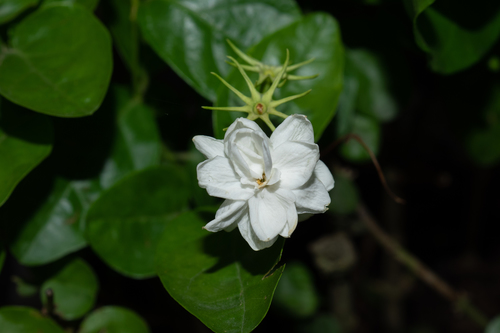
- Jasminum spp., in the Oleaceae, unrelated botanically despite a similar fragrance;
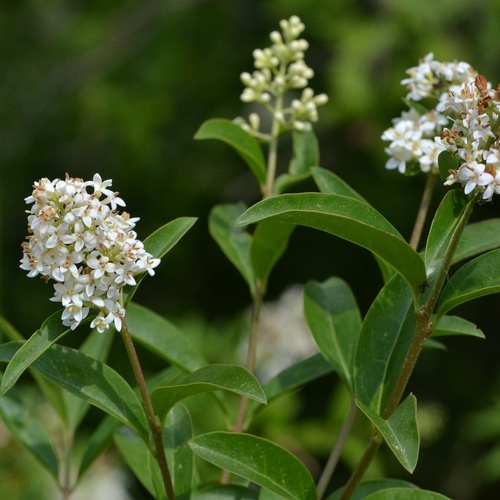
- Pittosporum tobira, another shrub sometimes given an orange-related common name, in the Pittosporaceae.
The scientific name and plant family distinguish Murraya paniculata from these visually or aromatically similar plants when common names alone cause confusion. 6
Main sources
- Plants of the World Online / Kew, Murraya paniculata (L.) Jack
- International Plant Names Index, Murraya paniculata (L.) Jack
- Missouri Botanical Garden, Plant Finder - Murraya paniculata
- Chicago Botanic Garden, Plant Finder - Murraya paniculata (Orange Jasmine)
- Useful Tropical Plants Database, Murraya paniculata
- Integrated Taxonomic Information System, Murraya paniculata (L.) Jack, TSN 28901
- USDA GRIN Global Taxonomy Detail, Murraya paniculata
- Environmental Weeds of Australia / Lucidcentral, Murraya paniculata
Frequently asked questions
Is orange jasmine a true jasmine?
No. Despite its common name, orange jasmine belongs to the Rutaceae, not the Oleaceae family of true Jasminum. Only the nighttime fragrance of the flowers is similar.
Is orange jasmine toxic to cats and dogs?
No toxicity is listed for cats, dogs or humans in the consulted references. The usual caution still applies if an animal eats large quantities of foliage.
Can orange jasmine be confused with curry leaf?
Yes. Confusion with Bergera koenigii, formerly Murraya koenigii, remains common. Curry leaf has highly aromatic culinary leaves, whereas orange jasmine foliage is mainly ornamental and little used in cooking.
Can orange jasmine survive frost?
It tolerates brief frosts down to about -4 °C (25 °F), but remains sensitive to prolonged cold. In temperate climates it is grown in a container or conservatory and brought under cover before winter.
Why is my orange jasmine not flowering?
Too little direct light or a plant that is still too young are the most common causes. A sunny position and patience are usually enough to encourage the first flowers.
Can you eat orange jasmine berries?
Ripe fruit is eaten fresh locally in its native range, without an established commercial supply or formal food-safety data. It is not a fruit grown for consumption in Europe.
Is orange jasmine invasive?
In some regions outside its native range, especially southeastern Queensland and several Pacific islands, the cultivar Exotica is considered highly invasive. This status does not apply to container growing in temperate climates.
Similar plants

If you are unsure about a plant’s toxicity, ask a botanist or veterinarian for advice.