
Yellow water-lily (Nuphar lutea, )
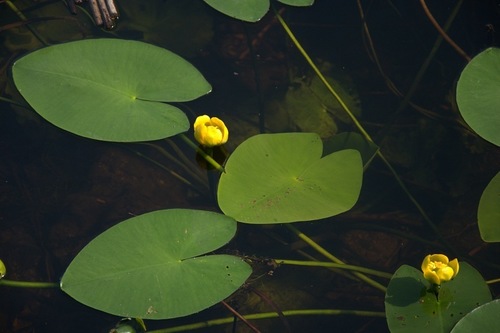

Yellow water-lily (Nuphar lutea) is an aquatic perennial in the Nymphaeaceae family, anchored by a thick rhizome in the mud of ponds, lakes and slow rivers in Europe and temperate Asia. Its leathery floating leaves and rounded yellow flowers, held just above the water, distinguish it from water-lilies of the genus Nymphaea.
Read moreYellow water-lily, Yellow pond-lily, Brandy bottle, Yellow cowlily, Yellow pondlily and Gelbe Teichrose
Allow a few hours of direct sun per day, preferably morning or evening.
Full sun to light partial shade


© photo
no rights reserved, uploaded by Татьяна Прозорова · cc0
Екатерина Гущина · cc-by
Thomas Gyselinck · cc-by
Taken Jun 13, 2019 by Waldemar Zeja (cc-by-sa)
Taken Aug 25, 2008 by Tela Botanica − Yoan MARTIN (cc-by-sa)
Taken Aug 1, 2017 by Yoan MARTIN (cc-by-sa)
Taken Jun 11, 2022 by kai Hummel (cc-by-sa)
Taken Aug 29, 2022 by Gaël Covain (cc-by-sa)
© copyright of the Board of Trustees of the Royal Botanic Gardens, Kew.



Global distribution
Nuphar lutea is native across temperate Europe to western Siberia and Xinjiang in China, extending into northern Algeria. In North America, the related Nuphar advena and Nuphar variegata occupy a comparable ecological niche. Older classifications sometimes grouped them with Nuphar lutea, so American records require caution.
- Native8
- France
- United Kingdom
- Germany
- Poland
- Netherlands
- Russia
- China
- Algeria
Hexagons: regions where the plant occurs. Green dots: native range.1
Identity
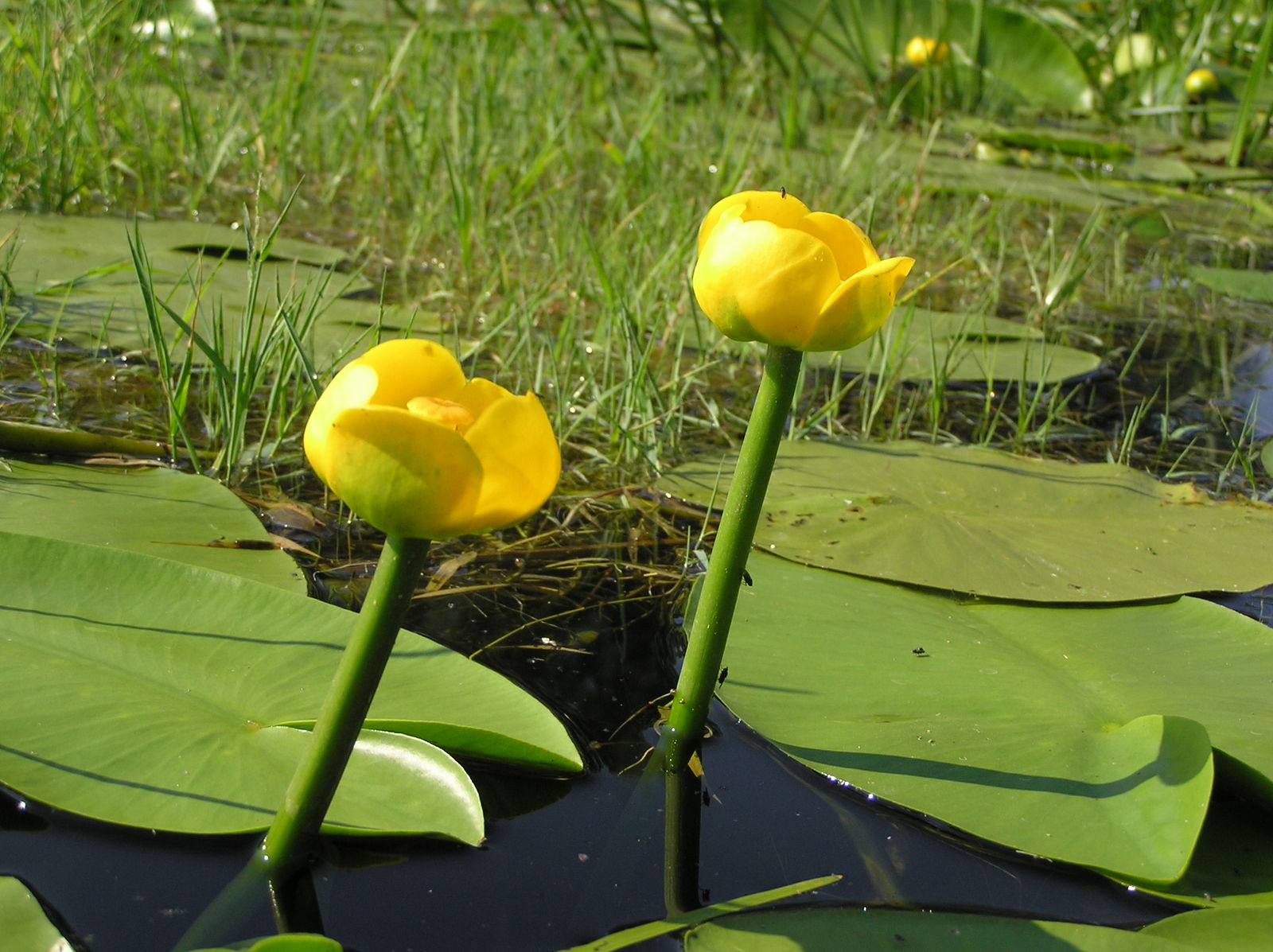
Yellow water-lily (Nuphar lutea (L.) Sm., 1809) is an aquatic perennial in the Nymphaeaceae family, rooted by a thick rhizome in the mud of ponds and slow rivers. Its leathery floating leaves, 16 to 30 cm (6 to 12 in) long, and rounded yellow cup-shaped flowers, 3 to 6.5 cm (1.2 to 2.6 in) across, distinguish it from white water-lilies of the genus Nymphaea, whose flowers open flat and wide on the water. Carl Linnaeus first described it as Nymphaea lutea in 1753; James Edward Smith transferred it to Nuphar in 1809, a distinction between the genera that still holds. 8 1
Golden yellow is the meaning of the Latin luteus, the source of the epithet lutea, directly describing the flower color. The English nickname brandy bottle combines the flower's alcoholic scent with the bottle-shaped outline of the ripe fruit. 8 5
Recognition
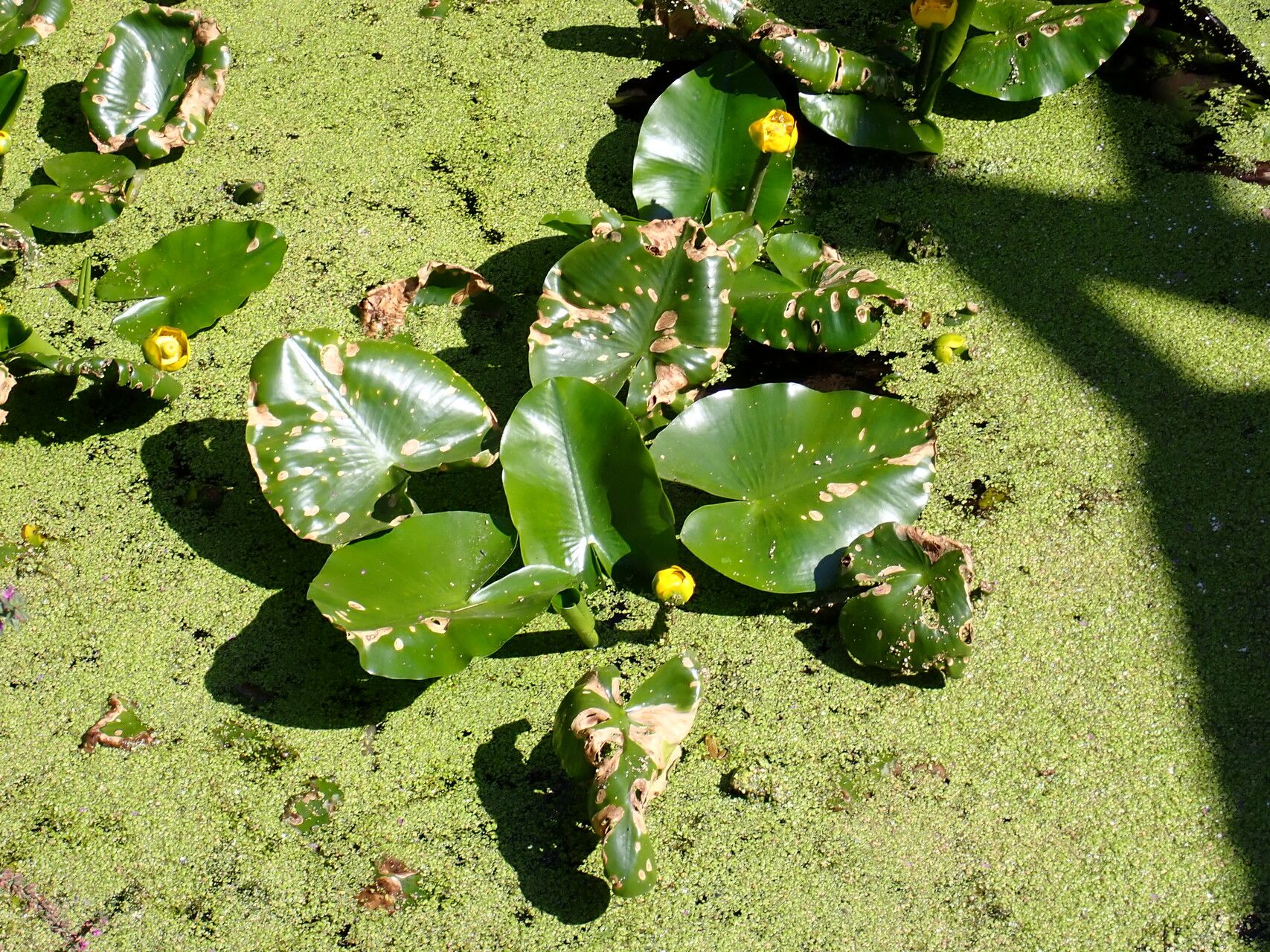
From a thick rhizome anchored in mud, Nuphar lutea produces two distinct kinds of leaves. Leathery, oval to heart-shaped floating leaves measure 16 to 30 cm (6 to 12 in) long and lie flat on the water. Thinner, pale, wavy submerged leaves remain below the surface and may be absent in clear, shallow water. A triangular cross-section to the leaf stalk distinguishes the species from many other floating-leaved plants. 7 2
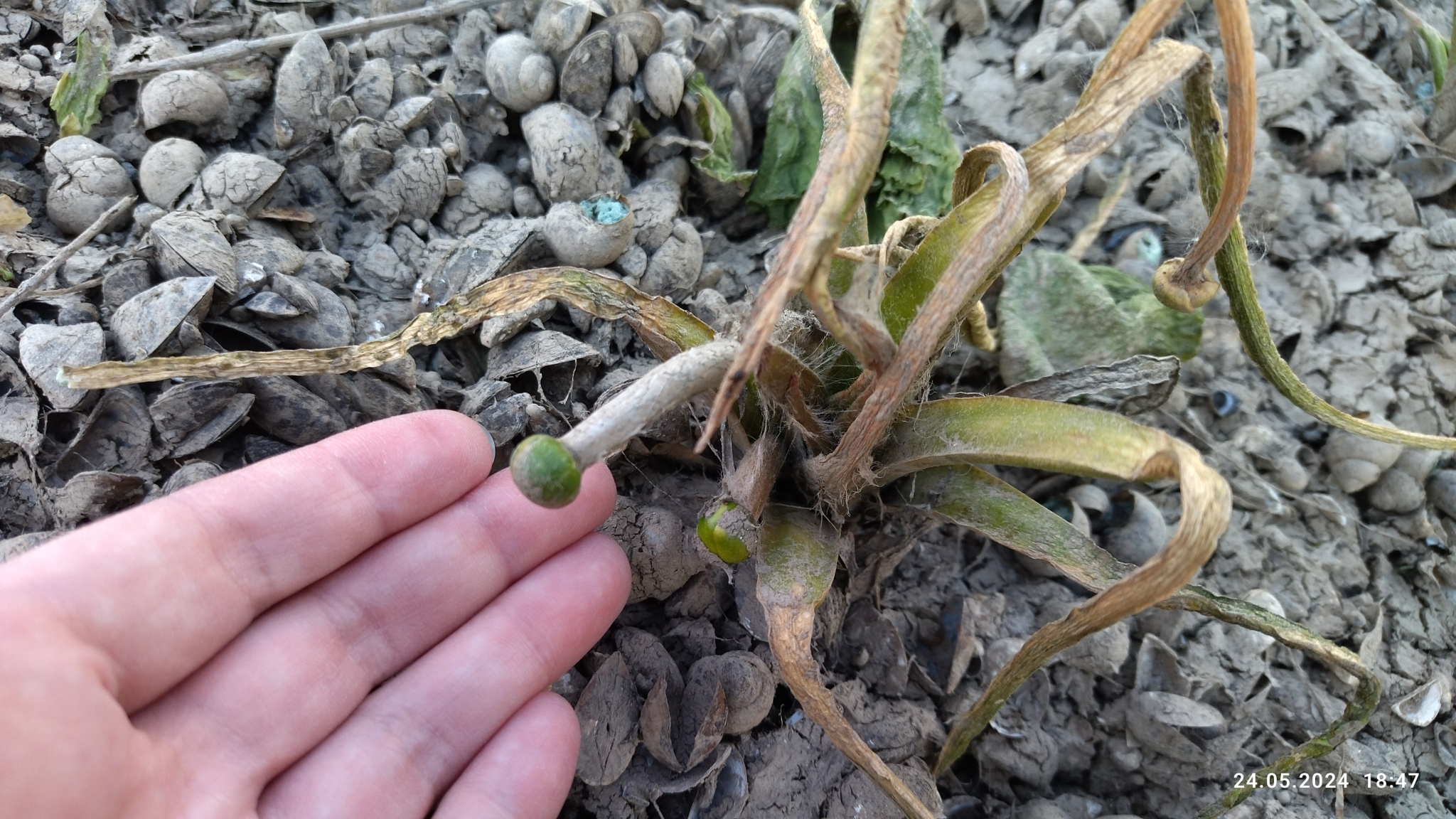
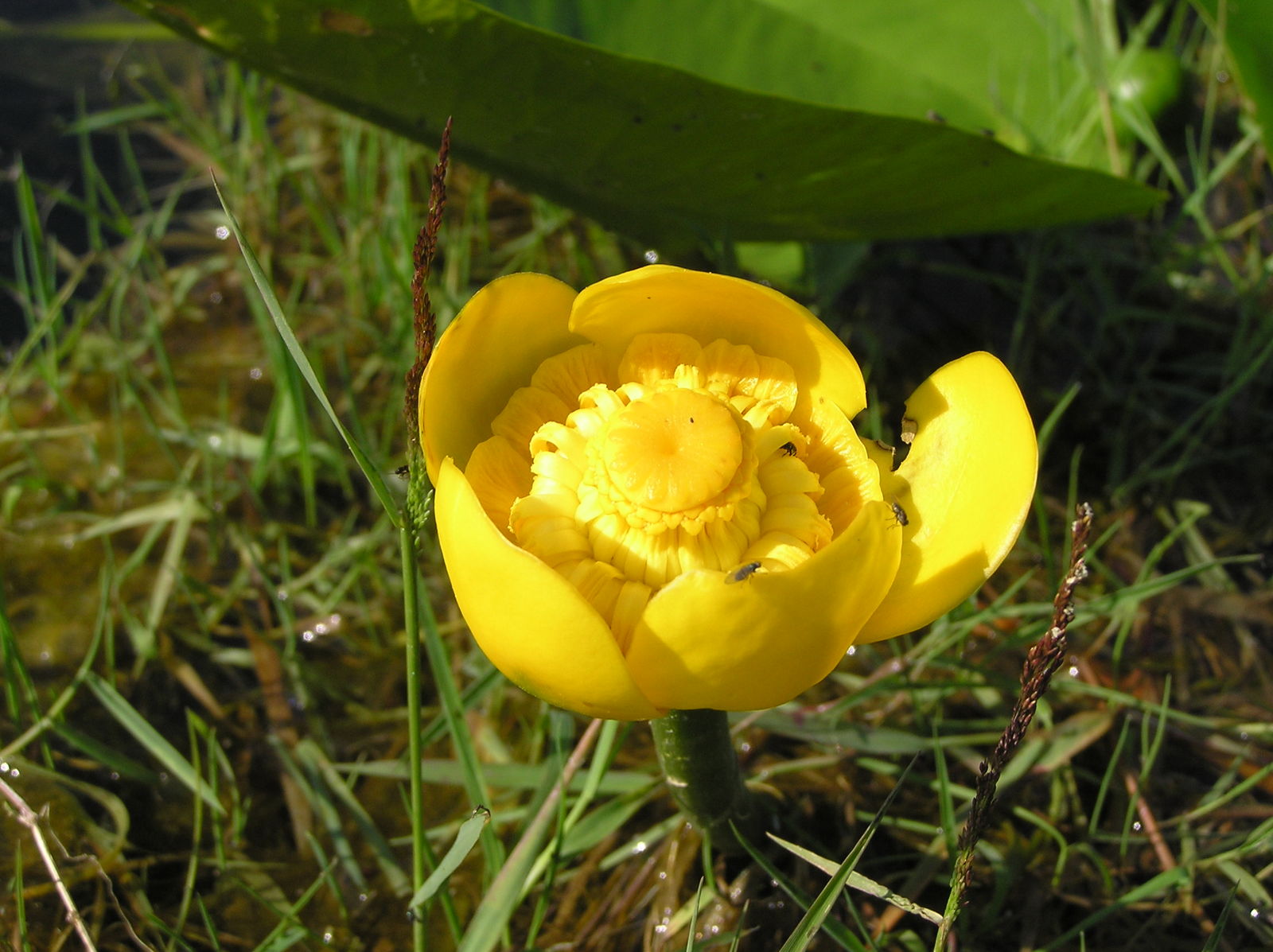
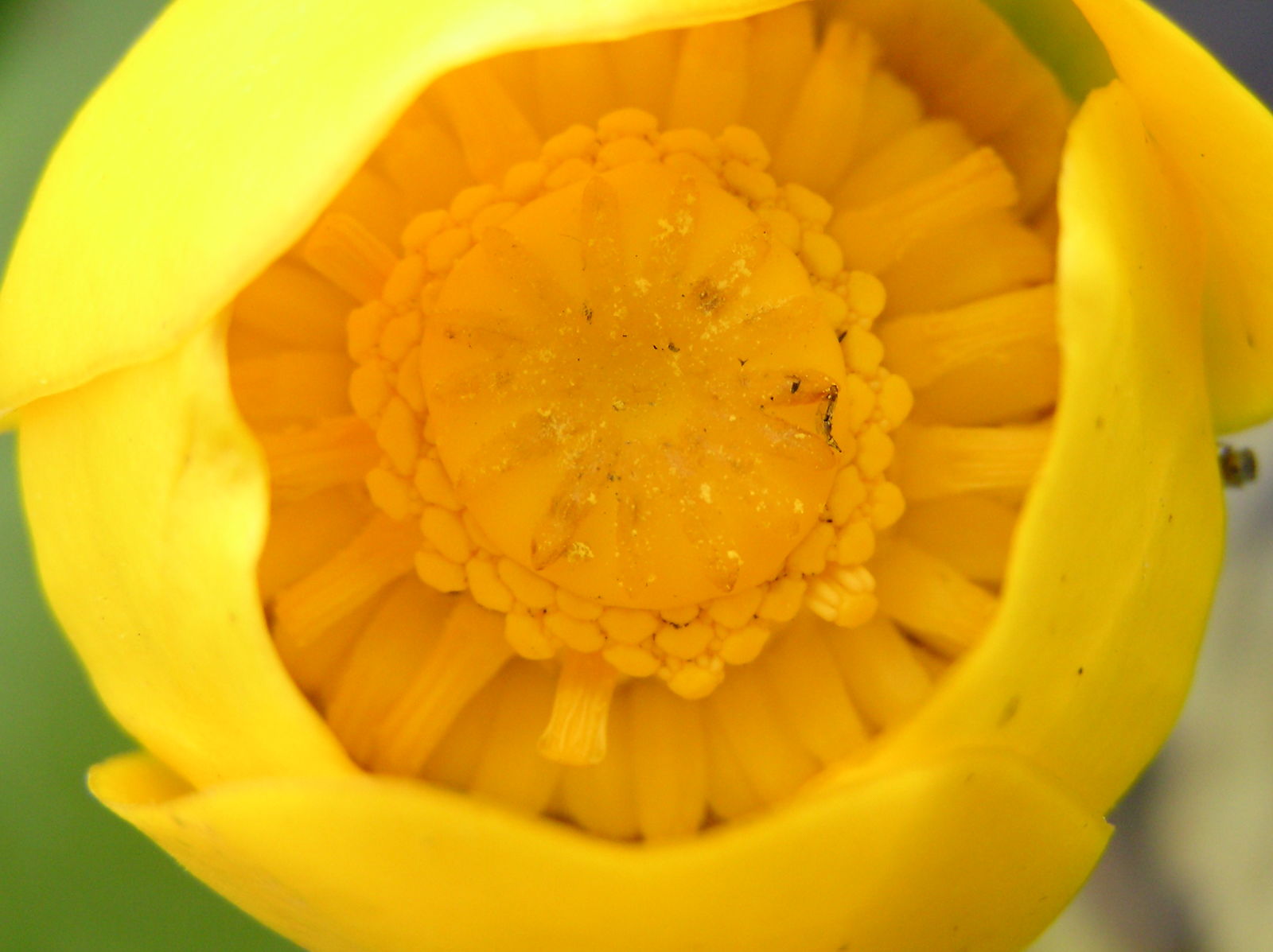
Held just above the water, each flower forms a rounded yellow cup 3 to 6.5 cm (1.2 to 2.6 in) across. Its alcoholic, brandy-like scent attracts pollinating insects. The flat, often orange stigmatic disc remains visible at the center once the petals part. After fertilization, an urn-shaped, green, bottle-like fruit 2.6 to 4.5 cm (1 to 1.8 in) long ripens above water and releases up to 400 seeds. 8 3
Useful taxonomy
For this widespread European species, POWO/WCVP accepts Nuphar lutea (L.) Sm. as the only valid combination. Several names used in nineteenth-century botanical literature are now treated as synonyms:
- Nuphar rivularis Dumort., a historical synonym
- Nuphar sericea Láng, a historical synonym
- Nuphar spathulifera Rchb., a historical synonym
- Nuphar affinis Harz, a historical synonym
- Nuphar lutea var. submersa Rouy & Foucaud, a historical synonym
These names mainly describe variation in leaf shape or water depth, rather than distinct species. The accepted name, Nuphar lutea, remains the dependable reference. 1 9
Habitat and range
Temperate Europe, western Siberia, Xinjiang in China and northern Algeria make up its native range. The plant occupies still or slow-moving fresh water in ponds, lakes and slow rivers, at depths of 2 to 3 m (6.5 to 10 ft) and occasionally 5 m (16 ft) in quiet, stable water. 1 2
Strong sunlight is required by Nuphar lutea, which tolerates neither heavily polluted water nor very alkaline or very acidic conditions, making it a useful bioindicator of water quality. The International Union for Conservation of Nature (IUCN) classifies it globally as Least Concern, but it declines locally: motorboat propellers damage rhizomes, and wetland degradation destroys colonies near the banks. 7 8
Life cycle and reproduction
Depending on climate, Nuphar lutea flowers from June to August. Each flower begins developing underwater, then opens at the surface, where many insects visit it. Usually only a single pollinator effects fertilization, limiting seed production even when flowers are plentiful. 7
Poor buoyancy makes waterborne seed dispersal inefficient. In experiments, seeds fed to carp, mallards and coots were all digested rather than dispersed intact. Vegetative propagation by rhizome division therefore predominates in practice, both in the wild and in cultivated ponds. 7 2
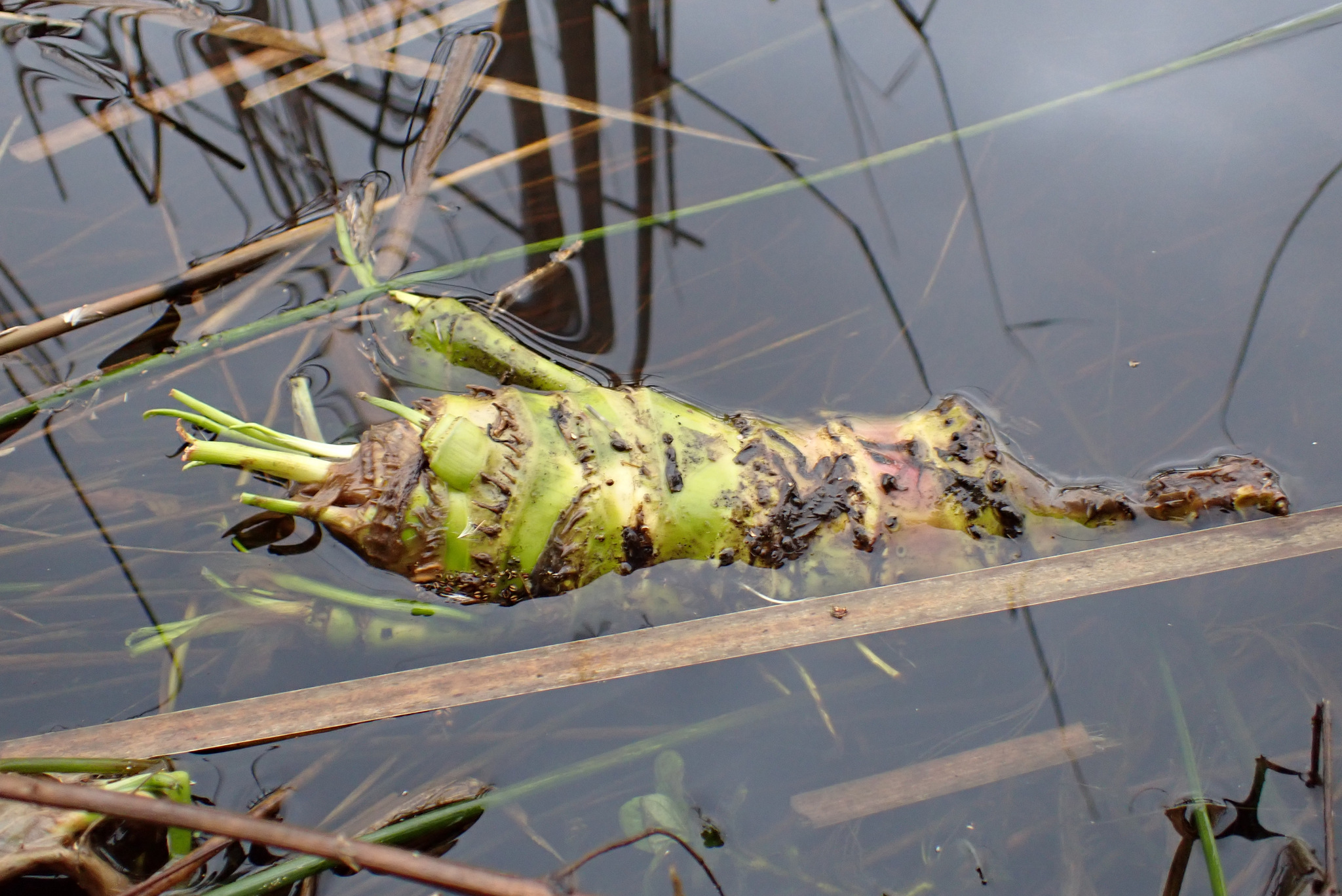
Winter kills all growth above the rhizome. Protected underwater or in mud, the rhizome survives frost and rebuilds the foliage the following spring. It tolerates severe cold down to about −20 °C (−4 °F), making it hardy across most temperate European climates. 7 3
Uses and risks
Northern European communities in Finland, Russia and Poland long harvested the rhizomes, seeds and leaf stalks for food. Dried rhizomes could be stored for winter, while boiled or roasted seeds were made into flour or porridge. 7
The whole plant, particularly the rhizome, contains an alkaloid related to nupharine, described in northern European folk medicine as having antispasmodic and blood-pressure-lowering properties. At high doses this same alkaloid becomes irritating. Plant safety references classify the species as toxic to cats and dogs, while no human toxicity is documented at traditional food quantities. 7 3
In large ornamental ponds and garden lakes, Nuphar lutea provides effective cover where water is too deep or shaded for a typical Nymphaea. Its leaves reduce the light available to algae and shelter fish and invertebrates. 2 4
Varieties, look-alikes and related plants
Horticultural selection has yielded no documented stable cultivar of Nuphar lutea: unlike water-lilies of the genus Nymphaea, it is mainly planted in its wild form. Before buying, check the scientific name, rhizome condition and intended planting depth. 2
Species commonly confused with it include:
- Nuphar pumila, smaller, with floating leaves under 10 cm (4 in) long;
- Nymphaea alba, the white water-lily, whose flowers open widely rather than forming rounded cups;
- Nuphar advena, a related North American species sometimes grouped with Nuphar lutea in older classifications;
- Nuphar variegata, also North American and subject to the same historical taxonomic confusion.
A triangular leaf stalk, rounded cup-shaped flower and bottle-shaped fruit provide the most reliable combination for distinguishing Nuphar lutea from its relatives, including Nuphar pumila, whose floating leaves are under 10 cm (4 in) long.
Main sources
- Plants of the World Online / Kew, Nuphar lutea (L.) Sm.
- Royal Horticultural Society, Nuphar lutea - yellow water-lily
- Plants For A Future, Nuphar lutea
- Missouri Botanical Garden Plant Finder, Nuphar lutea
- Encyclopaedia Britannica, yellow water-lily
- Wikidata, Nuphar lutea (Q146406)
- Wikipedia (FR), Nuphar lutea
- Wikipedia (EN), Nuphar lutea
- Tela Botanica / eFlore BDTFX, Nuphar lutea
Frequently asked questions
Is Nuphar lutea a true water-lily?
Yellow water-lily is the common name for Nuphar lutea, but botanically Nuphar and Nymphaea are distinct genera within Nymphaeaceae. The rounded yellow flowers of Nuphar lutea clearly distinguish it from Nymphaea, with more open flowers that are often white or pink.
Is yellow water-lily toxic to animals?
Yes. The plant, especially the rhizome, contains alkaloids related to nupharine that are classified as toxic to cats and dogs. No toxicity is documented in humans at traditional food quantities.
Why is my Nuphar lutea not flowering?
Too little direct light or water that is too deep and cold can hinder flowering. Moving the planting basket closer to the surface and choosing full sun generally corrects the problem.
How deep should the water be for Nuphar lutea?
Nuphar lutea tolerates depths of 0.5 to 3 m, sometimes up to 5 m in very quiet water, and copes better with shade and deep water than most cultivated Nymphaea.
How do I divide a Nuphar lutea rhizome?
Divide the rhizome in spring, retaining at least one viable growing bud on each section. Replant each piece in a weighted basket filled with clay or rich soil.
Is Nuphar lutea edible?
The rhizome, seeds and leaf stalks were traditionally eaten in northern Europe after preparation. This food use is now abandoned and should not replace specialist advice.
How does Nuphar lutea differ from Nuphar pumila?
Nuphar pumila is considerably smaller, with floating leaves under 10 cm long, compared with 16 to 30 cm in Nuphar lutea. The two species can hybridize locally where their ranges overlap.
Similar plants
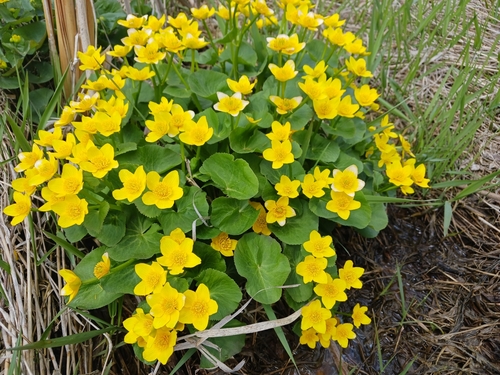
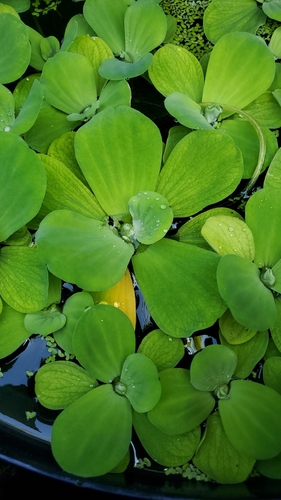
If you are unsure about a plant’s toxicity, ask a botanist or veterinarian for advice.