
Ginseng (Panax ginseng, )
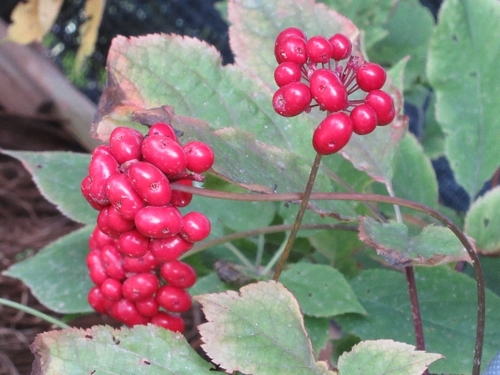

Ginseng (Panax ginseng) is an herbaceous perennial in the Araliaceae, native to cold forests in the Russian Far East, northeastern China and the Korean Peninsula. Its fleshy, often forked taproot contains ginsenosides sought in East Asian traditional medicine for millennia. Almost entirely cultivated today, its wild populations have declined by more than 80% through overharvesting.
Read moreGinseng, Korean ginseng, Asian ginseng, True ginseng and Renshen


© photo
(c) onidiras-iNaturalist, some rights reserved (CC BY-NC), uploaded by onidiras-iNaturalist · cc-by-nc
Wikimedia Commons · CC BY-SA or Public Domain
Wikipedia · CC BY-SA


Global distribution
Wild populations once occupied the Russian Far East, northeastern China and the Korean Peninsula. Commercial collection has reduced them by more than 80% since the early 20th century, leaving surviving populations only in Primorye, Russia. Almost all ginseng sold today comes from managed cultivation in South Korea, China and Japan.
- Native3
- Russia (Primorye)
- China (Manchuria)
- North Korea
Hexagons: regions where the plant occurs. Green dots: native range.1
Identity
Ginseng (Panax ginseng C.A.Mey., 1842), also called Korean ginseng, Asian ginseng or true ginseng, is an herbaceous perennial in the genus Panax, within the Araliaceae. 1 2
The genus name Panax comes from Greek panakeia, meaning 'all-healing.' The epithet ginseng derives from Chinese rénshēn (人参), also written renshen, literally 'human root.' It describes the forked shape of a mature root, often compared with a human body. 4
Around a dozen Panax species are often sold under the same commercial name. American ginseng (Panax quinquefolius), with thinner, less branched roots, and eleuthero (Eleutherococcus senticosus), misleadingly marketed as 'Siberian ginseng,' belong to distinct species or genera and do not contain the same ginsenosides as Panax ginseng. 5
Western documentation dates back to 1711, when Jesuit missionary Pierre Jartoux described the plant. In East Asia it has been cultivated and harvested for millennia for its root, used in traditional medicine rather than as a vegetable or ornamental. 6
Recognition
A small woodland perennial, Panax ginseng reaches 30–60 cm (12–24 in) tall, sometimes more in cultivation. Each year it produces a single terminal whorl of 3–6 palmately compound leaves, each with 3–5 toothed leaflets. Leaf and leaflet numbers increase with age, providing a useful field clue to maturity. 5
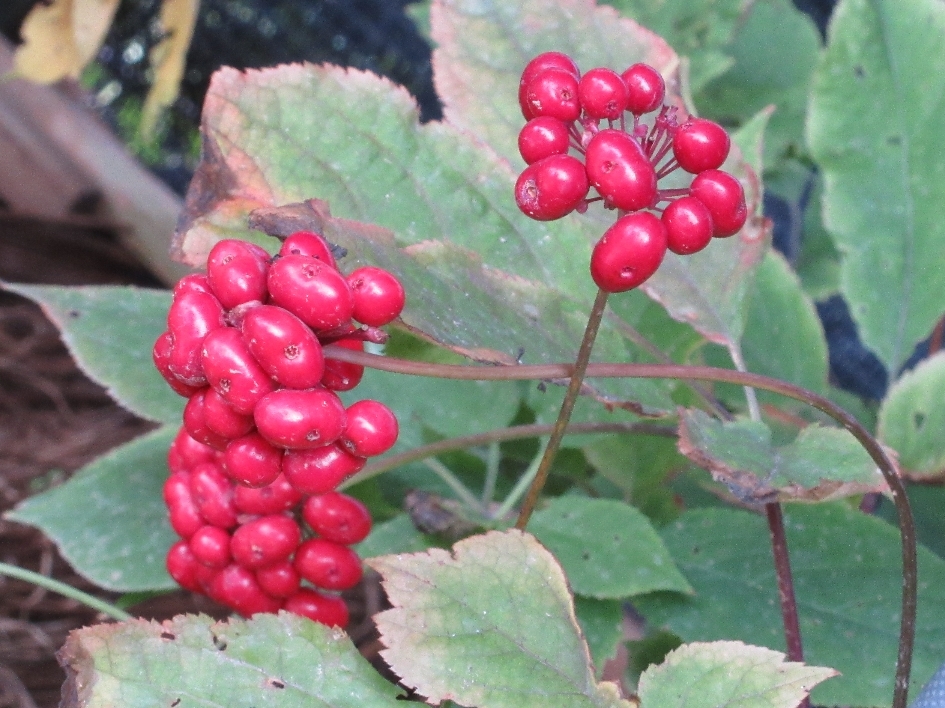
During summer, the central flower umbel bears 30–50 tiny greenish-white flowers, 3 mm (0.12 in) across, followed by bright red drupes, 6–7 mm (0.24–0.28 in) wide. Underground, a fleshy, often forked taproot slowly thickens each year. Traditional medicine and the pharmaceutical industry seek this root rather than the aboveground parts. 5 4
Useful taxonomy
The accepted name remains Panax ginseng C.A.Mey., published in 1842. Several names formerly used for the plant are now treated as synonyms. 1 3
- Aralia ginseng (C.A.Mey.) Baill.
- Panax verus Oken
- Panax schin-seng var. coraiensis T.Nees
- Panax quinquefolius var. ginseng (C.A.Mey.) Regel & Maack, historical treatment.
These historical names refer to earlier taxonomic treatments of Ginseng.
The synonym Panax quinquefolius var. ginseng illustrates a common trap: Panax ginseng is not a variety of American ginseng (Panax quinquefolius) but a separate species in the same genus. That abandoned classification confused the two on the basis of similar roots. 1
Temperate and subtropical forests in Asia and North America support around a dozen Panax species. Several share the common name 'ginseng' without being botanical synonyms of Panax ginseng, including Panax quinquefolius and Panax notoginseng, both separate species in the genus. 1 3
Habitat and range
Its original range covers cool, moist mountain forests in the Russian Far East, northeastern China (Manchuria) and the Korean Peninsula, beneath dense forest cover that filters the light. 4 8
Commercial collection throughout its range has reduced wild populations by more than 80% since the early 20th century. They have disappeared from China and the Korean Peninsula and survive only in Russia's Primorye region, where the species is listed as threatened in the local Red Data Book. 8
This near-disappearance in the wild explains why almost all ginseng sold worldwide now comes from managed cultivation in South Korea, China and Japan. Plants grow under shade structures or in planted woodland, with a 4–6-year production cycle before harvest. 6
Life cycle and reproduction
Germination is difficult without prolonged warm followed by cold stratification, taking 18–24 months before emergence. This is a major constraint on rapid propagation both in cultivation and in wild populations. 5
A first-year plant has just one leaf with three leaflets, then adds compound foliage each season. Several years are needed to reach the adult stage with four or five palmate leaves; flowering and fruiting generally begin only in the third or fourth year. 5
Commercial growers consider the root fully valuable only after 4–6 years of cultivation. Younger roots contain fewer ginsenosides, the saponins responsible for most of the activity sought in the plant. 6
Uses and risks
Dried roots are used in decoctions, powders or standardized extracts. Two preparations dominate the Korean market: white ginseng, simply peeled and sun-dried, and red ginseng, steamed at 98–100 °C (208–212 °F) for 2–3 hours before drying. A Korean text described this process as early as 1123; steaming produces characteristic ginsenosides. 6
Short-term use, up to six months at usual doses, is generally considered safe. The most frequent adverse effects are insomnia, headaches and digestive upset, with rare reports of severe allergic reactions or liver injury. 4
Children and people who are pregnant or breastfeeding are advised against using the plant. It can interact with anticoagulants, diabetes medicines and psychotropic drugs; seek advice from a healthcare professional before prolonged use. 4 5
Varieties, look-alikes and related plants
Selected South Korean cultivars now shape production: Chunpoong, resistant to root rust and valued for red ginseng quality; Yunpoong, with thick roots and early flowering; and Gopoong, recognized by reddish stems and high saponin content. 7
American ginseng (Panax quinquefolius), with thinner, less branched roots, is a frequent source of confusion. So is eleuthero (Eleutherococcus senticosus), long sold misleadingly as 'Siberian ginseng' despite belonging to another genus. It contains different compounds, eleutherosides, rather than ginsenosides. 5
Another useful comparison is Panax notoginseng, or Yunnan ginseng. It is cultivated in southern China for related traditional uses but differs in appearance and cultivation range. 7
Main sources
- Plants of the World Online / Kew, Panax ginseng C.A.Mey.
- USDA GRIN Global Taxonomy, Panax ginseng
- Integrated Taxonomic Information System, Panax ginseng C.A. Meyer
- National Center for Complementary and Integrative Health, Asian Ginseng
- Plants For A Future, Panax ginseng
- Characterization of Korean Red Ginseng, history and preparation method (PMC)
- Characteristics of Panax ginseng cultivars in Korea and China (PMC)
- Genetic variability and population structure of endangered Panax ginseng in the Russian Primorye (PMC)
Frequently asked questions
Is Ginseng the same plant as American ginseng?
No. Panax ginseng and Panax quinquefolius are separate species in the same genus, with related uses but different roots; the latter is mainly cultivated in North America.
Is Ginseng toxic?
Not strictly, but prolonged use or high doses can cause insomnia, headache and digestive upset. It is not recommended for children or during pregnancy.
What is the difference between red and white ginseng?
These are two preparations of the same root, not two varieties. White ginseng is peeled and sun-dried; red ginseng is steamed at high temperature before drying, changing its ginsenoside content.
How long does a harvestable root take to grow?
Allow 4 to 6 years in woodland or under shade structures for a root to reach a size and ginsenoside content suitable for sale.
Does wild Ginseng still exist?
Very little remains. Wild populations have declined by more than 80% and survive only in Primorye, Russia; they have disappeared from China and the Korean Peninsula.
Is Siberian ginseng a true ginseng?
No. Eleutherococcus senticosus, sold as Siberian ginseng, belongs to a different genus and contains eleutherosides rather than ginsenosides.
Can Ginseng be grown in France?
It can grow in cool, shaded woodland, but growth is slow and seeds need a long stratification period. Few growers cultivate it outside East Asia.
Similar plants
If you are unsure about a plant’s toxicity, ask a botanist or veterinarian for advice.