
Sea daffodil (Pancratium maritimum, )
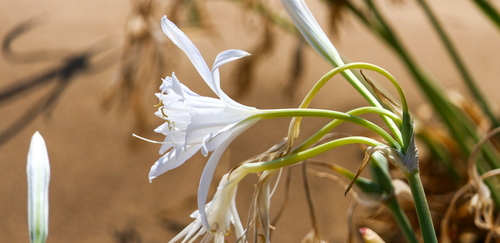
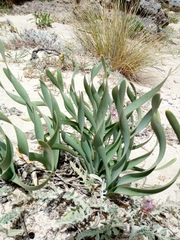
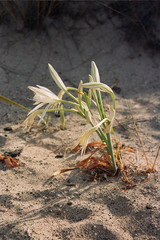
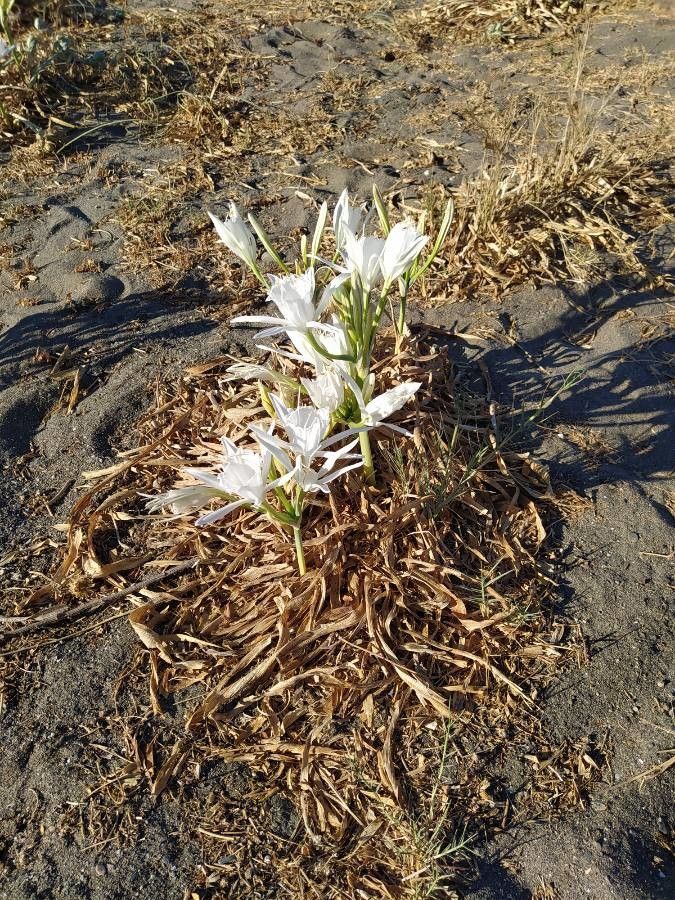
Sea daffodil (Pancratium maritimum) is a bulbous perennial in the Amaryllidaceae, found on beaches and dunes around the Mediterranean and Black Sea and along Atlantic shores from Brittany to Morocco. Fragrant white flowers open at night in summer on a bare stalk emerging from the sand. Strap-shaped leaves often disappear during flowering and return mainly after summer. Tourism puts pressure on its dune habitat, and the species has regional protection in parts of France.
Read moreSea daffodil, Sea lily, Sand lily and Giglio di mare



© photo
(c) Falk Viczian Solarboot-Projekte gGmbH, some rights reserved (CC BY-NC), uploaded by Falk Viczian Solarboot-Projekte gGmbH · cc-by-nc
Mattia Aaron Miroddi · cc0
Rafael Medina · cc-by
Taken Aug 13, 2022 by manumanu4691 (cc-by-sa)
Taken Aug 6, 2021 by Álvarez Héctor (cc-by-sa)
Taken Oct 15, 2011 by Photoflora - Benoit BOCK (©)
Taken Aug 22, 2020 by maire sofia (cc-by-sa)
Taken Aug 21, 2021 by Marek Durajczyk (cc-by-sa)
© copyright of the Board of Trustees of the Royal Botanic Gardens, Kew.




Global distribution
Pancratium maritimum is native to both Mediterranean shores and the Black Sea, from the Canary Islands, Portugal and Morocco east to Turkey, Israel and the Caucasus. In France it reaches Brittany on the Atlantic coast. It has also naturalized in Southern California, outside its native range.
- Native9
- Introduced1
- France
- Spain
- Portugal
- Italy
- Greece
- Turkey
- Morocco
- Israel
- Georgia
- United States
Hexagons: regions where the plant occurs. Green dots: native range.1
Identity
Sea daffodil (Pancratium maritimum L., 1753), also called sea lily or sand lily, is a bulbous perennial in the genus Pancratium, family Amaryllidaceae. Despite its lily names, it is not a true lily: true lilies belong to Lilium, in a different botanical family. 1 2
Ancient Greek pankration, meaning “all power,” gave the genus its name, referring to medicinal virtues once attributed to the plant. The Latin epithet maritimum, “of the sea,” describes its strictly coastal habitat. It grows directly in beach and dune sand, with the bulb and often part of the flower stalk buried. 9
Recognition
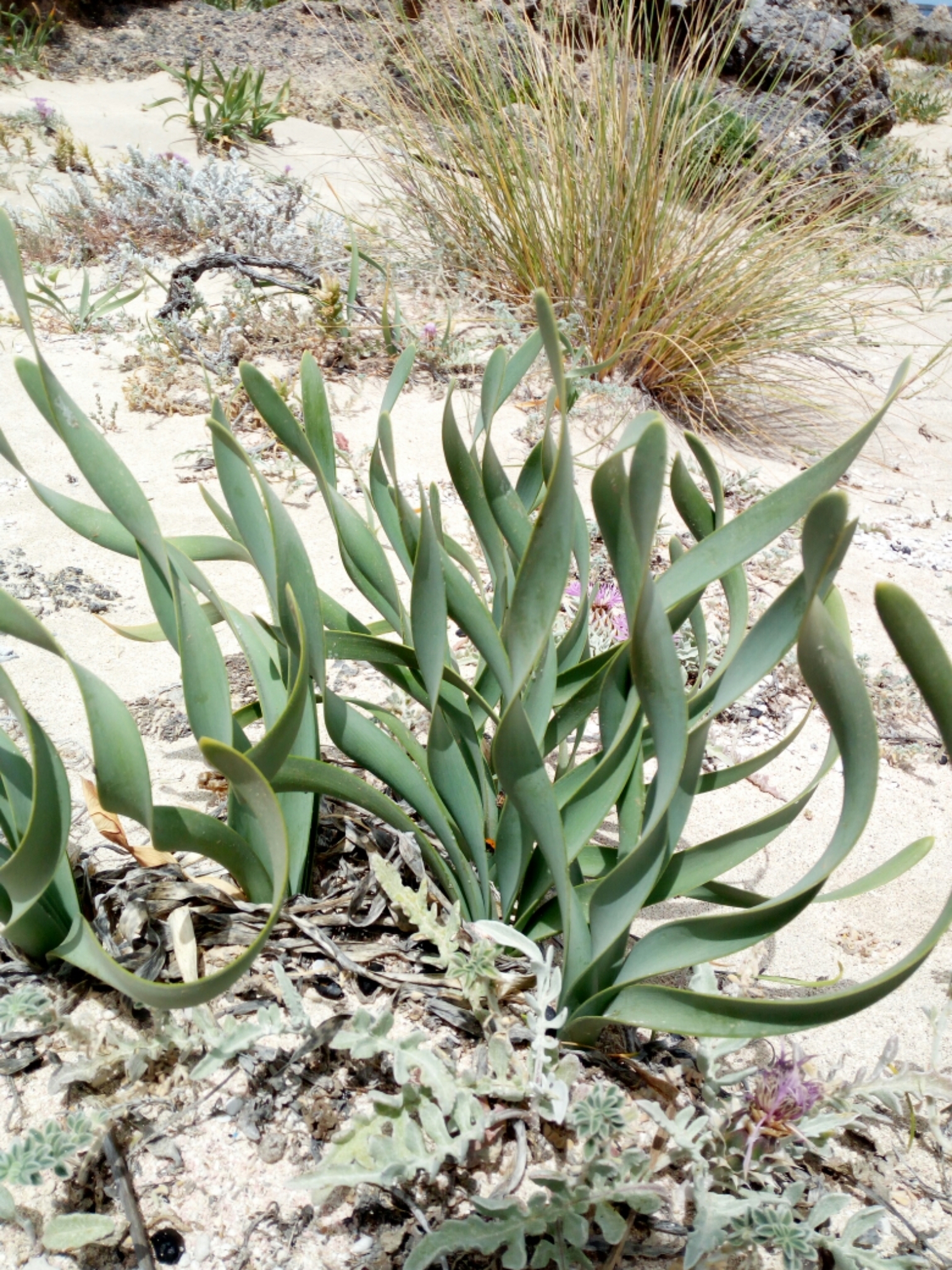
A deep bulb with a long neck may sit more than 50 cm (20 in) below the sand surface, protected from surface drought and salt spray. Its glaucous, strap-shaped leaves reach 75 cm (30 in) long but only 1–2 cm (0.4–0.8 in) wide. A flat rosette of 5–6 leaves appears mainly after flowering and often dries out during hot summers. 9 4
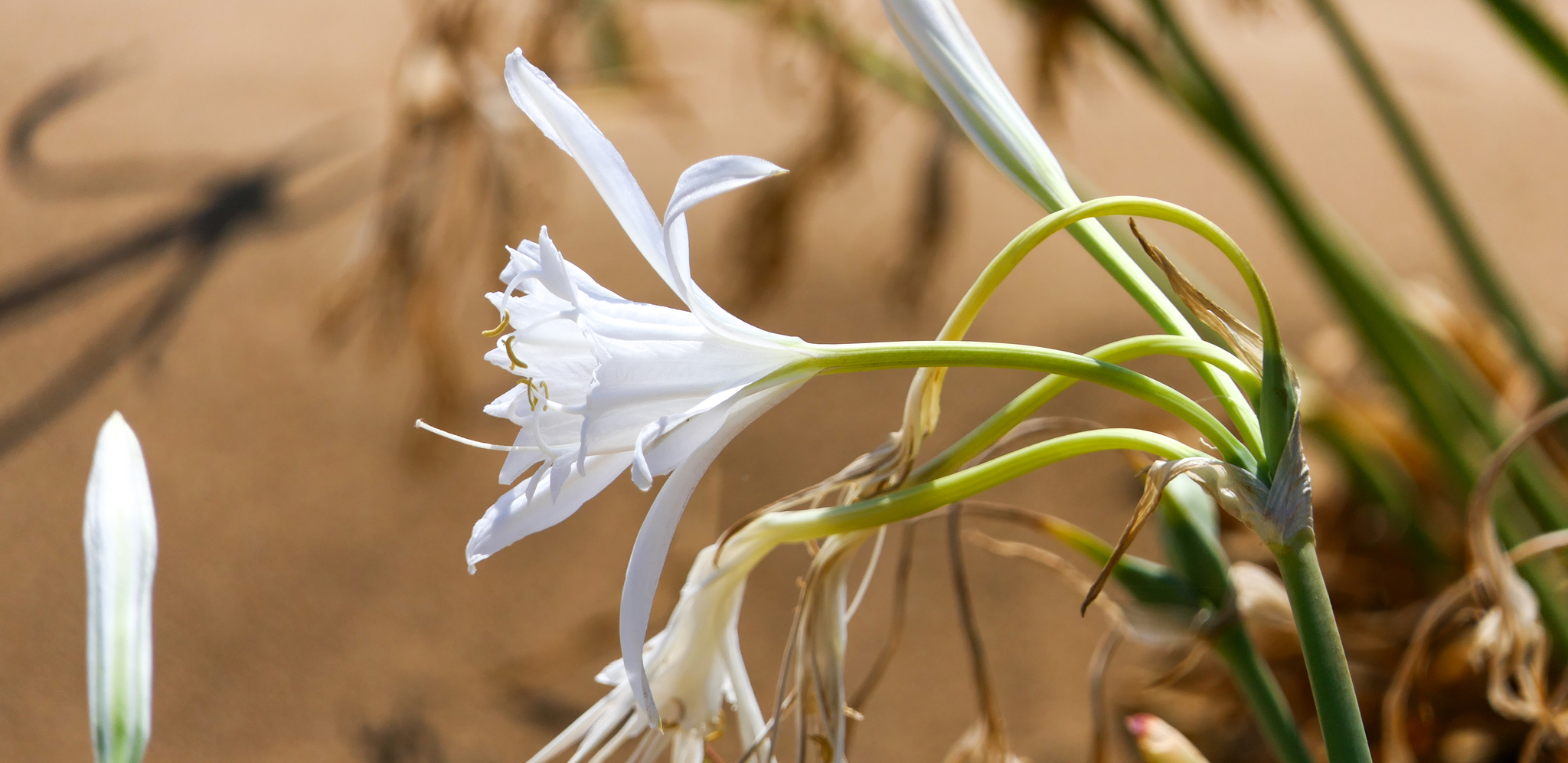
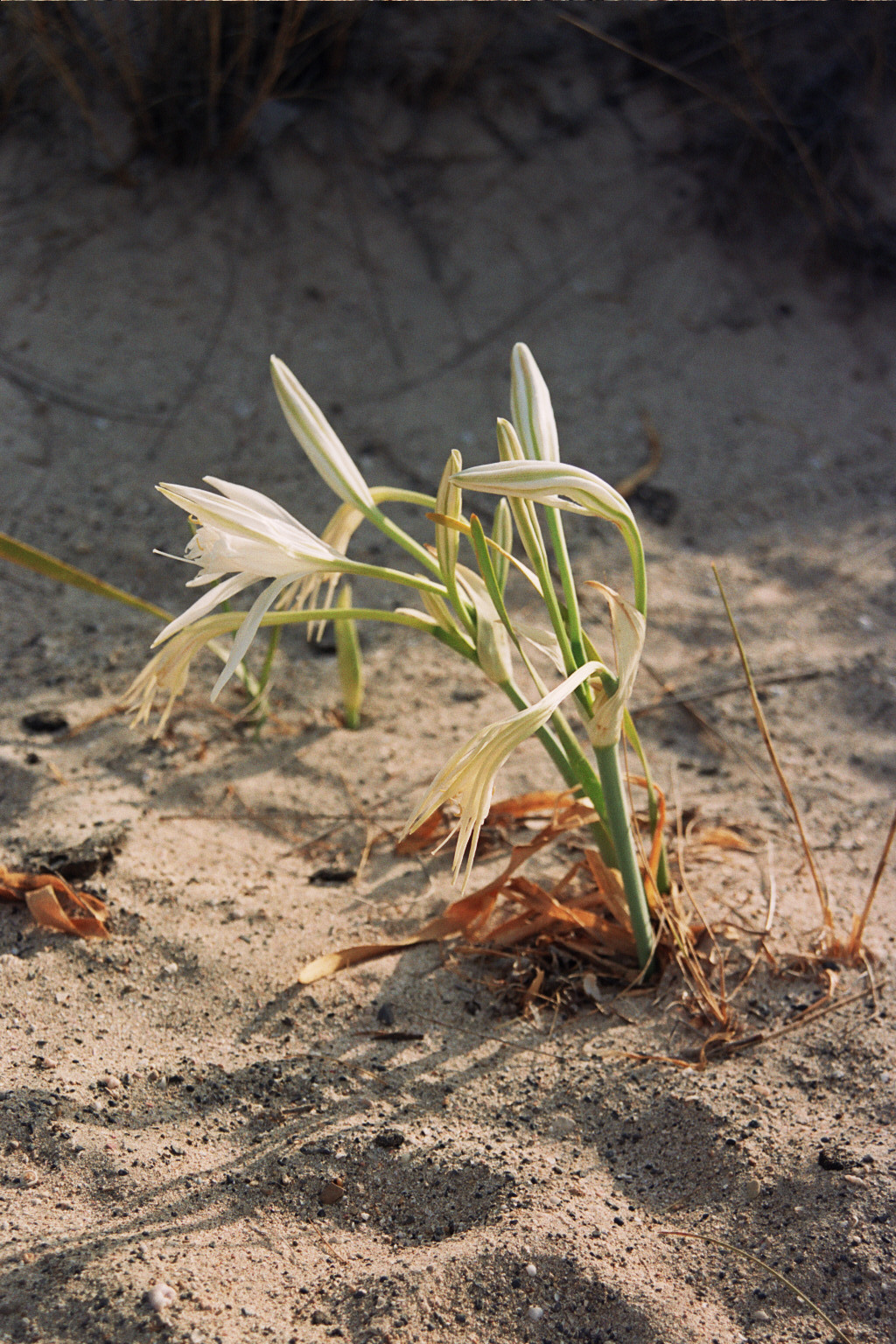
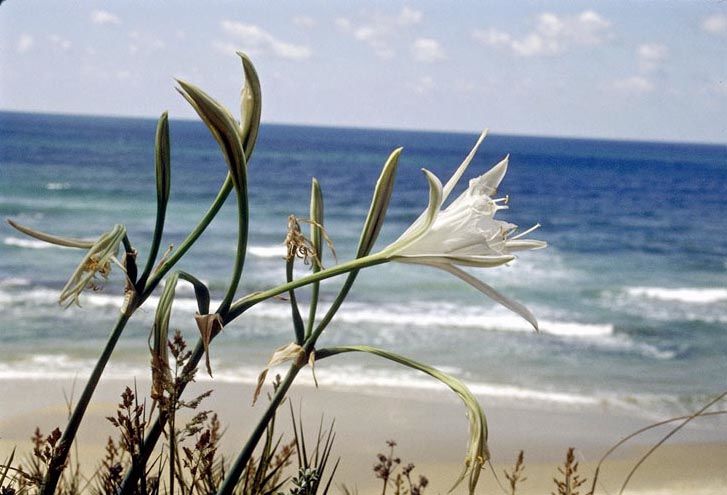
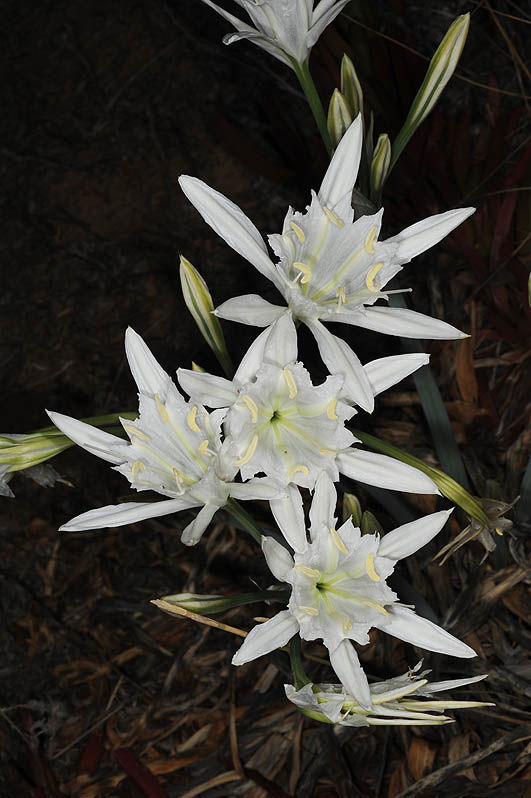
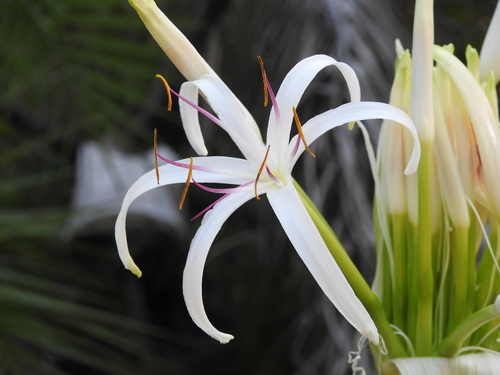
Bare, upright flower stalks stand 30–75 cm (12–30 in) tall, depending on the population. Each ends in an umbel of 3–15 white flowers, with funnels 9–15 cm (3.5–6 in) long and a subtle but distinct lily scent. Unlike many sun-loving bulbs, the flowers open from afternoon until the following morning. 4 10
Useful taxonomy
For this coastal bulb, POWO and WCVP accept Pancratium maritimum L. Taxonomic revisions have left six synonyms, some still encountered in older literature:
- Hymenocallis maritima (L.) M.Roem. (botanical synonym)
- Pancratium angustifolium M.Roem. (botanical synonym)
- Pancratium carolinianum L. (botanical synonym)
- Pancratium aegyptiacum M.Roem. (botanical synonym)
- Pancratium abchasicum Regel (botanical synonym)
- Pancratium barcinonense Sennen (botanical synonym)
Historical placement in Hymenocallis explains some continuing horticultural confusion. The accepted binomial Pancratium maritimum provides a reliable reference: it is the only member of the genus present on French coasts. 1 10
Habitat and range
Both Mediterranean shores and the Black Sea lie within its native range, stretching from the Canary Islands, Portugal and Morocco east to Turkey, Israel and the Caucasus. Along the French Atlantic coast it reaches Brittany. It has also naturalized in Southern California, far from its native area. 5 10
Characteristic of white dunes, sea daffodil occupies upper beaches, often only a few meters from the strandline, in poor, freely draining sand. As sand accumulates, the bulb buries itself more deeply or lengthens its flower stalk when burial becomes excessive. These responses suit the shifting ground of a mobile dune ridge. 9
Globally, the IUCN classifies the species as Least Concern, but trampling and beach development reduce its habitat by compacting sand and preventing bulbs from establishing again. In France it has regional protection, notably in Provence, and is regarded as rare in Poitou-Charentes and Loire-Atlantique. 3 10
Life cycle and reproduction
In its Northern Hemisphere coastal range, flowers appear from July to October, often peaking in August and September according to local climate. Effective pollination depends on the nocturnal hawkmoth Agrius convolvuli, which visits only when wind speed stays below about 2 m/s (4.5 mph). Even hand-pollination attempted in windy conditions fails. The plant does not accept its own pollen and depends on cross-pollination. 8 10
A capsule holds flat, angular black seeds. They remain afloat for long periods, allowing ocean-current dispersal as well as wind dispersal along the shore. Freshly sown seeds germinate slowly, and seedlings take 3–4 years to produce their first flowers. 9 4
Uses and risks
Within its bulb, Pancratium maritimum produces several lycorine-type alkaloids, including maritidine, lycoramine and galantamine, together with flavans and chromones characteristic of the species. 7
Bulbs are poisonous if swallowed. The documented comparison with other lycorine-rich Amaryllidaceae, such as amaryllis, indicates vomiting, excessive salivation, diarrhea and abdominal pain in cats, dogs and horses, as described by the ASPCA. 6 7
Cultivation outside its natural range remains uncommon. Flowering requires poor sand, uninterrupted full sun and a hot, dry summer, a combination difficult to reproduce in an ordinary garden. Collecting flowers or bulbs is prohibited in several protected French and Italian regions; these restrictions are specific to those areas. 4
Varieties, look-alikes and related plants
Few named forms have entered horticulture, and Pancratium maritimum has no stable horticultural cultivars. Botanical names such as var. aureum and f. barcinonense remain synonyms or local forms without commercial distribution. 1
The main plants confused with sea daffodil are:
- Pancratium illyricum, endemic to Corsica and Sardinia, flowering in spring on rocky ground rather than in summer on sand;
- ornamental Hymenocallis, with similar foliage and large white flowers, but American in origin and historically placed in the same genus;
- late-flowering daffodils, whose fragrant umbels resemble sea daffodil without sharing its season or dune habitat.
Flowering season and origin resolve most confusion. Spring flowers on rocky ground distinguish P. illyricum; American origins distinguish ornamental Hymenocallis despite similar flowers; and late-flowering daffodils lack the same summer dune habitat. Among these plants, Pancratium maritimum flowers in summer on a bare stalk rising directly from sand.
Main sources
- Plants of the World Online / Kew, Pancratium maritimum L.
- International Plant Names Index, Pancratium maritimum
- IUCN Red List, Pancratium maritimum assessment (Vicedo, 2018)
- Plants For A Future, Pancratium maritimum
- USDA PLANTS Database, Pancratium maritimum - sea-daffodil
- ASPCA, Amaryllis toxicity entry (lycorine, related Amaryllidaceae)
- Youssef & Frahm, 1998, Alkaloids of the Flowers of Pancratium maritimum, Planta Medica
- Eisikowitch & Galil, 1971, Effect of Wind on the Pollination of Pancratium maritimum by Hawkmoths
- Tela Botanica, BDTFX profile Pancratium maritimum L.
- Wikipedia EN, Pancratium maritimum
Frequently asked questions
Is sea daffodil a true lily?
No. Pancratium maritimum belongs to the Amaryllidaceae, while true lilies belong to Lilium in a different family. The common lily names reflect only the flowers’ visual resemblance.
Is sea daffodil poisonous?
Yes. Its bulb contains lycorine-type alkaloids, the chemical group documented by the ASPCA in amaryllis, which are toxic to cats, dogs and horses when swallowed.
Why do sea daffodil leaves disappear in summer?
The foliage becomes dormant before summer flowering. A flower stalk rises from apparently bare ground, and the strap-shaped leaves return mainly after summer.
Can sea daffodil grow in an inland garden?
It can, with poor, sharply drained sand and constant full sun. Flowering may remain sparse without a hot, dry summer to ripen the bulb.
Is sea daffodil protected in France?
It has regional protection in several coastal areas, notably Provence, and remains rare in Poitou-Charentes and Loire-Atlantique as its dune habitat shrinks.
How does sea daffodil spread along coasts?
Its flat black seeds float for long periods, allowing ocean currents to disperse them as well as the wind.
What pollinates sea daffodil?
The nocturnal hawkmoth Agrius convolvuli provides most cross-pollination, but only in light winds.
Similar plants
If you are unsure about a plant’s toxicity, ask a botanist or veterinarian for advice.