
Common bean (Phaseolus vulgaris, )


Common bean (Phaseolus vulgaris) is an annual vegetable in the Fabaceae family, native to tropical America. Bush and climbing pole forms are grown for green pods or dried seeds. A nitrogen-fixing legume, it is a vegetable-garden staple whose raw seeds are toxic and must be thoroughly cooked.
Read moreCommon bean, French bean, Green bean and Dry bean


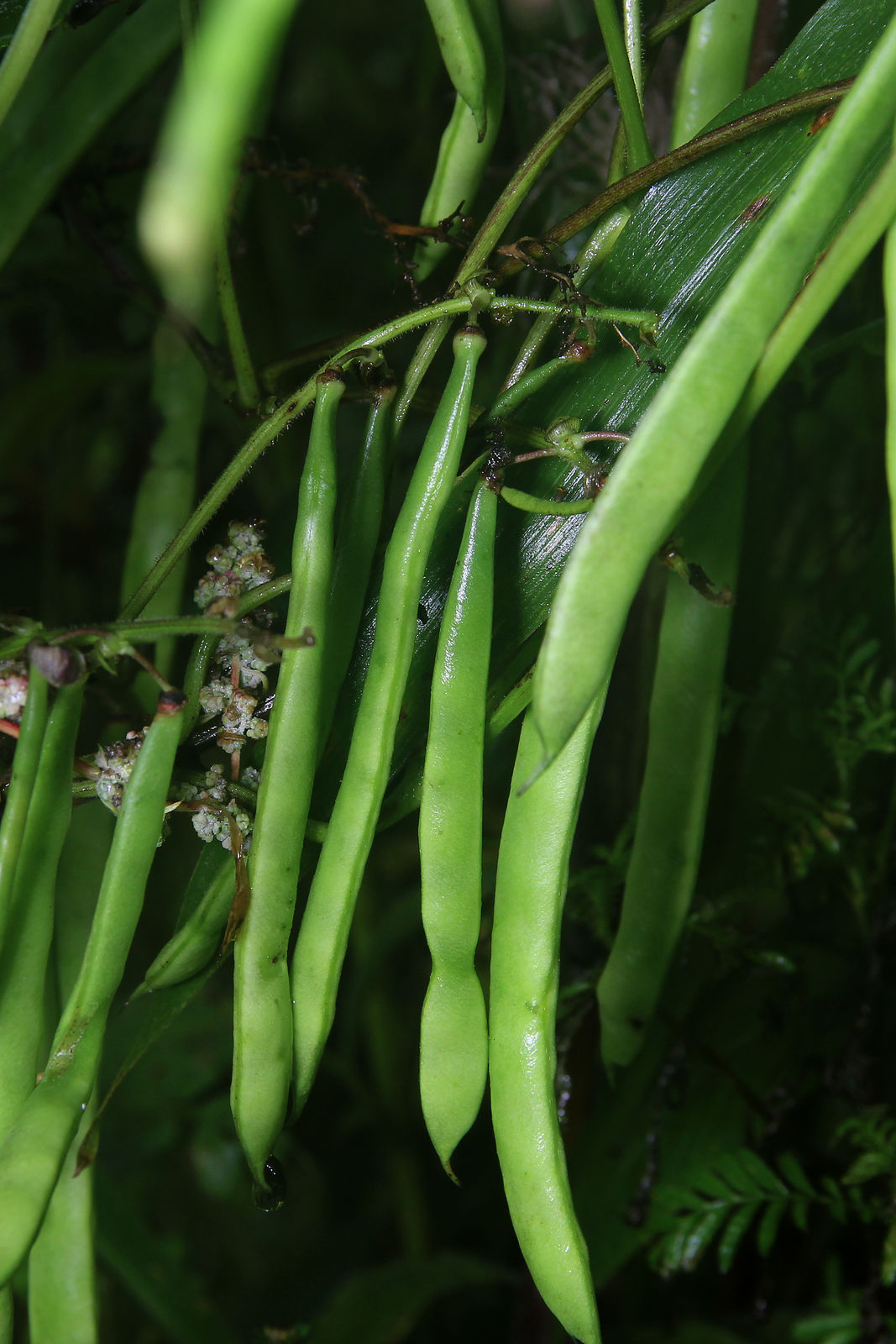
© photo
Wikimedia Commons · CC BY-SA or Public Domain
Wikipedia · CC BY-SA
Taken Aug 31, 2020 by engel maria (cc-by-sa)
Taken Jul 29, 2012 by Tela Botanica − Yoan MARTIN (cc-by-sa)
Taken May 28, 2015 by Tela Botanica − Julie Chouquette (cc-by-sa)
Taken Aug 21, 2006 by selber pflanzen (cc-by-sa)
Taken Jun 19, 2010 by Tela Botanica − Yoan MARTIN (cc-by-sa)
© copyright of the Board of Trustees of the Royal Botanic Gardens, Kew.


Global distribution
Phaseolus vulgaris descends from wild forms of tropical America, ranging from Mexico to northern Argentina. Independently domesticated in Mesoamerica and the Andes, common bean spread worldwide after Europeans arrived in the Americas. Outside that range, its presence represents cultivation.
- Native4
- Mexico
- Guatemala
- Peru
- Argentina
Hexagons: regions where the plant occurs. Green dots: native range.1
Identity
Common bean (Phaseolus vulgaris L., 1753) is a vegetable in the Fabaceae family and the genus Phaseolus. One of the world’s most widely grown food legumes, it is cultivated either for its green pods, eaten whole, or for protein-rich dried seeds. The plant is annual and fixes atmospheric nitrogen through its roots. 1 4
Vegetable gardeners distinguish two main habits: low, branching bush beans and twining pole beans trained on supports. Names such as French bean, green bean and dry bean describe uses and harvest stages more often than separate plants. The same species can therefore supply a tender whole pod or a mature seed for shelling. 2 3
Recognition
Three broad, pointed leaflets form each trifoliate leaf, bright green and arranged alternately along the stem. Bush varieties have upright, branching stems; pole varieties become twining climbers, wrapping around supports to reach 2–3 m (6.5–10 ft). This difference in habit does not change the species’ basic leaf structure. 3 5
Typical pea-shaped flowers are white, pink or violet, depending on the variety. They develop into elongated pods that may be straight or slightly curved, green, yellow or red-marbled, and contain several seeds. The kidney-shaped seeds display an exceptionally wide color range, from pure white through red and patterned forms to black. 4 6
A less obvious identifying feature appears below ground. An uprooted plant bears small root nodules, swellings that house the nitrogen-fixing bacteria associated with legumes. 5 4
Flower color, pod shape and especially seed color vary greatly between varieties. This is variation within the species: trifoliate leaves, pea-shaped flowers and a multi-seeded pod remain consistent identifying characters, even when two cultivars look quite different at harvest. 6 3
Useful taxonomy
Common bean received the name Phaseolus vulgaris L. from Linnaeus in 1753. Several species in Phaseolus are cultivated, and many old names for common bean and its forms still circulate. Important names include:
- Phaseolus vulgaris var. vulgaris, the nominate variety;
- Phaseolus vulgaris var. nanus (L.) Asch., an older dwarf-form name;
- Phaseolus nanus L., an older synonym;
- Phaseolus communis Pritz., an older synonym;
- Phaseolus esculentus Salisb., an older synonym.
The name nanus long separated dwarf beans from climbing forms before both were included in the single species Phaseolus vulgaris. The accepted scientific name remains the stable reference: vegetable cultivar names identify cultivated selections rather than separate botanical species. 1 5
Habitat and range
Wild tropical American forms, ranging from Mexico to northern Argentina, gave rise to Phaseolus vulgaris. Common bean was domesticated within this area, where related wild populations still grow in tropical climates with a pronounced dry season. 1 4
Its remarkable history includes two independent domestications, one in Mesoamerica around Mexico and another in the Andes. These two centers help explain the genetic and morphological diversity of modern varieties, from small Mesoamerican seeds to large Andean ones. 4 3
After Europeans arrived in the Americas, bean cultivation spread throughout the Mediterranean and then through temperate and warm regions worldwide. Outside its original range it is deliberately sown: the crop rarely naturalizes and is not generally part of the spontaneous flora. Its broad cultivated distribution should therefore be distinguished from its native range. 6 7 5
Life cycle and reproduction
One warm season contains the entire annual cycle, from sowing to seed production. Seedlings emerge one to two weeks after sowing, followed by rapid growth and self-pollinating flowers. Most flowers pollinate themselves before they even open. 5 4
Each fertilized flower develops a pod containing several seeds. Young, tender pods can be harvested as green beans about 50–70 days after sowing. Alternatively, they can mature and dry on the plant for a dry-seed harvest at roughly 80–100 days. Harvest stage determines culinary use more strongly than variety alone. 2 3
Propagation is only by seed, sown directly after the last frost once soil has warmed above 12 °C (54 °F). Cold or waterlogged soil rots the large seeds before emergence, explaining why sowing waits until late spring in frost-prone temperate climates. Bush forms are sown in rows or small groups; pole beans are sown at the base of a sturdy support. 2 6
Uses and risks
Beans are primarily food crops. Immature pods are eaten whole as green beans, while fresh or dried seeds provide protein and fiber in dishes worldwide. In the garden, bacteria in the root nodules help enrich the soil with nitrogen, making beans useful early in a crop rotation. 4 5
The principal risk is from raw seeds. They contain the lectin phytohemagglutinin, which causes nausea, vomiting and diarrhea when beans are eaten raw or undercooked. Thorough cooking destroys this substance: dried beans must be soaked and brought to a full rolling boil before eating. Properly cooked pods and seeds are safe to consume. 4 6
For cats and dogs, the ASPCA lists bean as non-toxic. As a precaution, avoid giving animals raw seeds containing the same lectin that affects people. Any leftovers offered to pets should be cooked and unseasoned. 8 5
Varieties, look-alikes and related plants
Garden varieties are cultivated selections rather than distinct species. Contender and Phénomène are bush green beans; Coco de Paimpol is harvested semi-dry for shelling; Tarbais and Borlotto are shelling or drying beans. Before sowing, check bush versus pole habit, green-pod versus dry-seed use and time to harvest.
Other vegetable legumes most often cause confusion:
- Phaseolus coccineus, runner bean, with large red flowers and long pods;
- Phaseolus lunatus, lima bean, with broad, flattened seeds;
- Vicia faba, fava bean, a different lineage grown for its large seeds.
Trifoliate leaves, pea-shaped flowers and a pod containing several seeds remain the most reliable combination for confirming common bean, Phaseolus vulgaris. Seed color or growth habit alone is much less useful because both vary so widely among its cultivated selections. 3 1
Main sources
- Plants of the World Online / Kew, Phaseolus vulgaris L.
- Royal Horticultural Society, French beans - grow your own
- Missouri Botanical Garden, Phaseolus vulgaris
- Encyclopaedia Britannica, common bean
- Plants For A Future, Phaseolus vulgaris
- North Carolina State Extension, Phaseolus vulgaris
- USDA PLANTS Database, Phaseolus vulgaris L.
- ASPCA, toxic and non-toxic plants list
Frequently asked questions
Are common beans toxic?
Raw seeds contain phytohemagglutinin, a lectin that causes nausea, vomiting and diarrhea. Thorough cooking destroys it; fully cooked pods and seeds are safe. The ASPCA lists beans as non-toxic to animals, but avoid giving them raw seeds.
Why do dried beans need thorough cooking?
Raw or undercooked seeds contain concentrated phytohemagglutinin, a lectin responsible for digestive upset. Soaking followed by a full rolling boil destroys this substance and makes the seeds edible.
What is the difference between bush and pole beans?
Bush beans form low plants that crop quickly without support. Pole beans are twining climbers that need support and produce over a longer period, but start later.
When should I sow common beans?
Sow directly after the last frost, once the soil exceeds 12 °C (54 °F), usually from late spring into summer in temperate climates. Soil that is too cold causes seeds to rot before they emerge.
Do common beans need nitrogen fertilizer?
No. Common bean fixes atmospheric nitrogen through bacteria in its root nodules. Excess nitrogen favors foliage over pods; loose soil and a little compost are enough.
Which plants look like common bean?
Confusion mainly involves other Phaseolus species, such as red-flowered runner bean and lima bean with its large, flat seeds. Trifoliate leaves and pods remain useful clues.
Where does common bean come from?
It descends from wild tropical American forms and was domesticated twice, in Mesoamerica and the Andes. Cultivation spread worldwide after Europeans arrived in the Americas.
Similar plants
If you are unsure about a plant’s toxicity, ask a botanist or veterinarian for advice.