
Tahitian gooseberry tree (Phyllanthus acidus, )
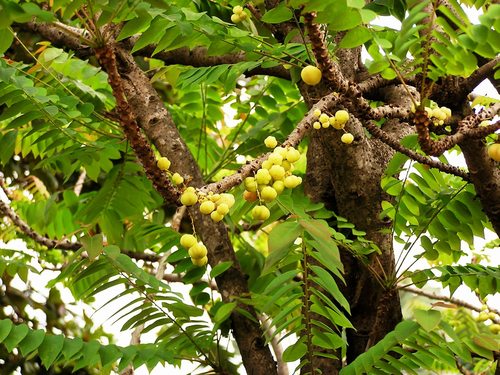

Tahitian gooseberry tree (Phyllanthus acidus), also called Otaheite gooseberry, is a fruiting shrub or small tree in the Phyllanthaceae family, with uncertain origins often traced to Madagascar. Its small ribbed fruits are too sour to eat raw in quantity and are mainly made into jams, syrups and preserves across the tropics.
Read moreTahitian gooseberry tree, Otaheite gooseberry, Star gooseberry and Malay gooseberry
Allow a few hours of direct sun per day, preferably morning or evening.
Full sun preferred; young plants tolerate light partial shade



© photo
(c) Nasser Halaweh, some rights reserved (CC BY), uploaded by Nasser Halaweh · cc-by
Wikimedia Commons · CC BY-SA or Public Domain
Wikipedia · CC BY-SA
Taken Nov 19, 2019 by Tela Botanica − Sylvain Piry (cc-by-sa)
© copyright of the Board of Trustees of the Royal Botanic Gardens, Kew.




Global distribution
The exact origin of Phyllanthus acidus remains uncertain. The most widely cited theory points to Madagascar, from where it may have spread to Southeast Asia and the Pacific. Introduced to Jamaica from Timor in 1793, it spread across the Caribbean and Central America to southern Mexico, becoming locally naturalized. Widely cultivated throughout the tropics today, it remains rare in truly wild conditions.
- Native1
- Introduced3
- Madagascar
- Jamaica
- Hawaii
- Mexico
Hexagons: regions where the plant occurs. Green dots: native range.1
Identity
Tahitian gooseberry tree (Phyllanthus acidus (L.) Skeels, 1909), also known as Otaheite gooseberry, is a fruiting shrub or small tree in the genus Phyllanthus, family Phyllanthaceae. Linnaeus first described it in 1753 as Averrhoa acida. Botanist Homer D. Skeels transferred it to Phyllanthus in 1909, establishing the name accepted by modern taxonomic databases. 2 1
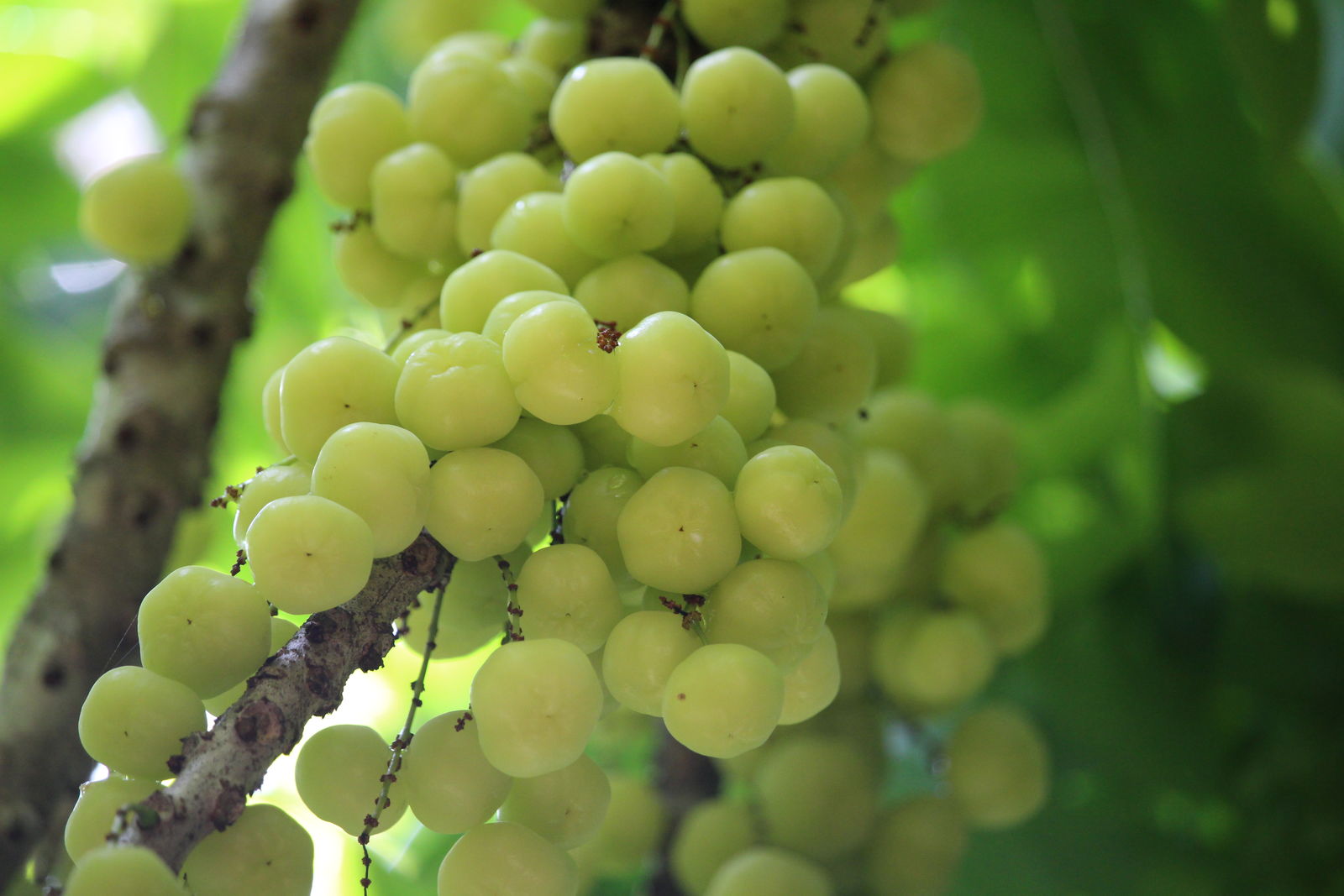
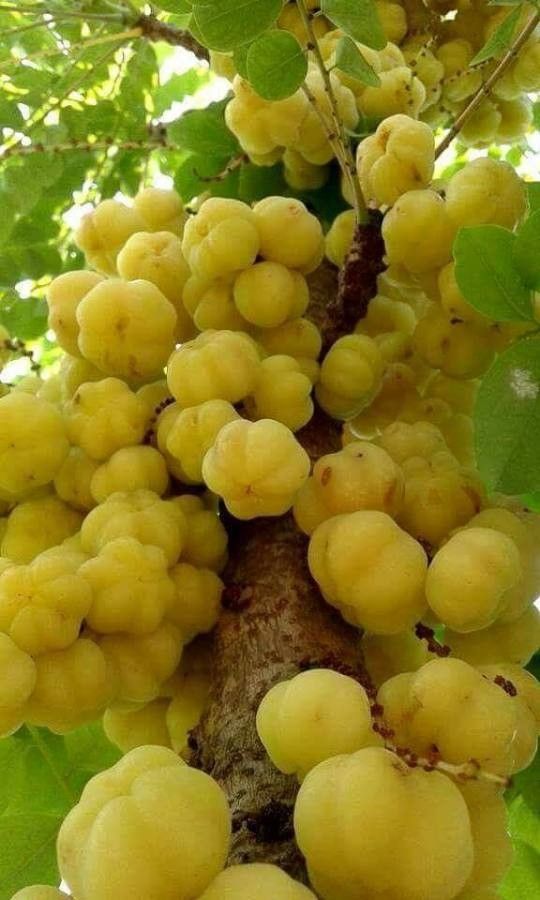
The English name star gooseberry describes the fruit's cross section, marked by six to eight prominent ribs. This resemblance does not imply a close botanical relationship with European gooseberries: acidity is what the fruits share. In the field, the deep grooves and tightly packed clusters also help distinguish it from starfruit, whose larger fruits grow individually along the branch. 3 6
Recognition
A dense, spreading crown on thick, knotted branches gives this shrub or small tree a height of 2–9 m (6.5–30 ft). Its terminal branchlets, 15–30 cm (6–12 in) long, are deciduous. They periodically fall with their leaves, while the trunk and main branches remain in place throughout the year. 4 3
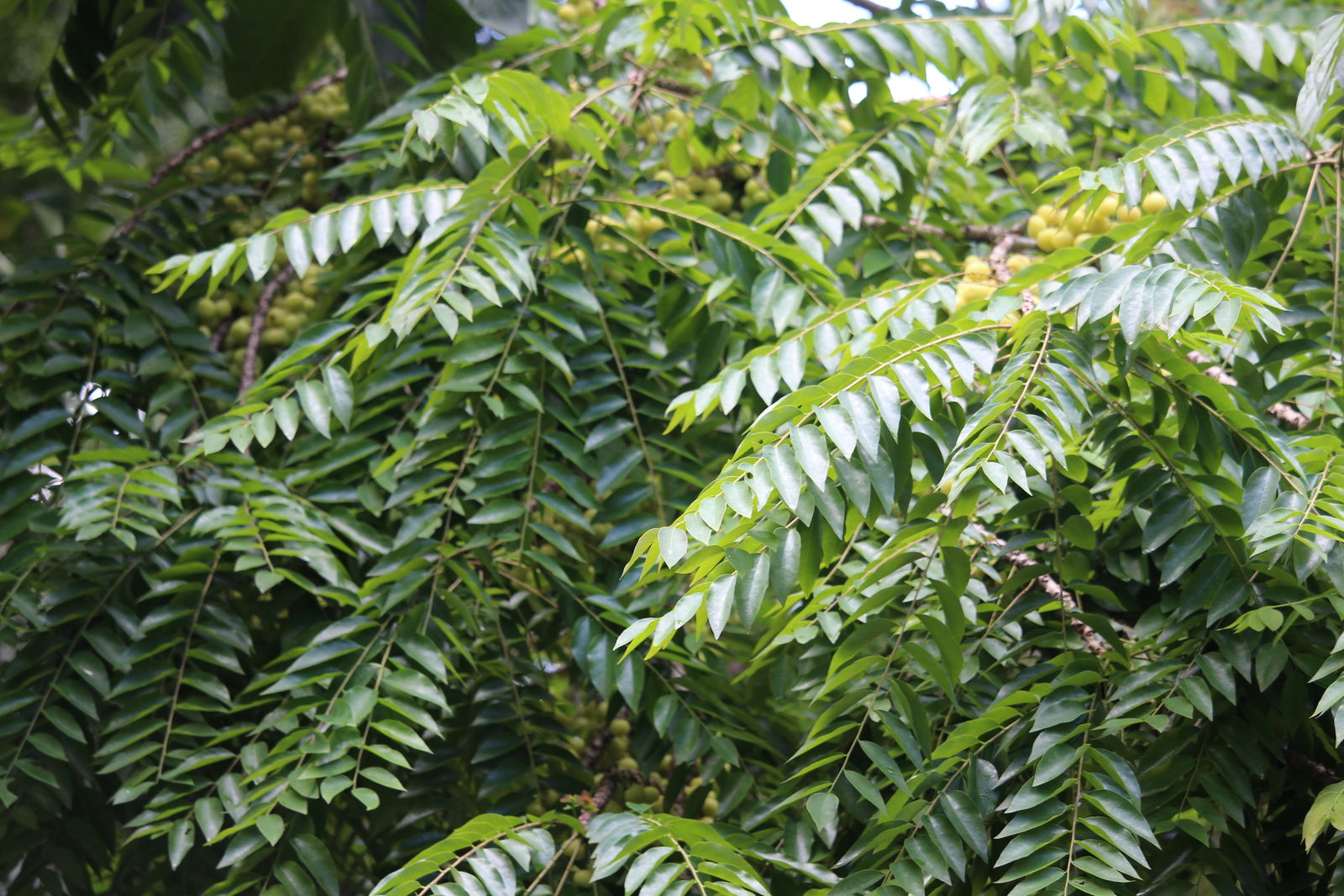
Alternate, oval to lance-shaped leaves measure 2–7.5 cm (0.8–3 in) long, with bright green upper surfaces and paler undersides. Tiny pinkish to reddish flowers, just 3–5 mm (0.1–0.2 in) across, gather in dense clusters along branchlets and in leaf axils. This grouping helps insect pollinators locate them. 6 3
The resulting fruit is flattened and round, with six to eight ribs, measuring 1.5–2.5 cm (0.6–1 in) across. Green fruit ripens to pale, almost whitish yellow. Its waxy, juicy, very sour flesh surrounds a hard stone containing four to six seeds. The dense clusters along the branches are a useful clue even when the ribs cannot be counted precisely. 3 4
Useful taxonomy
Several changes of genus lie behind the accepted name Phyllanthus acidus, now placed in Phyllanthaceae. The principal synonyms are:
- Averrhoa acida L., the basionym published by Linnaeus in 1753
- Cicca acida (L.) Merr., a later combination
- Cicca disticha L., a historical synonym
The basionym's genus, Averrhoa, does not indicate a close relationship with the current genus. Today it includes members of the separate family Oxalidaceae, such as starfruit. Nevertheless, taxonomic databases treat Averrhoa acida as the same species as the accepted Phyllanthus acidus. The accepted scientific name provides a steadier reference than old generic combinations. 1 2 8
The World Checklist of Vascular Plants links the current combination's description to type material from Pará, Brazil. This publication detail should not be confused with the species' native range: most botanical and horticultural accounts favor a Madagascan origin. 2 3
Habitat and range
Uncertainty surrounds the original home of Phyllanthus acidus. The most frequently cited hypothesis points to Madagascar, followed by spread to the East Indies and, across the Indian Ocean, Réunion and Mauritius, before it crossed the Pacific. 3 6
Introduction from Timor to Jamaica in 1793 opened the way for its spread through the Caribbean and Central America. It subsequently became naturalized in parts of southern Mexico, although it remains mainly a cultivated fruit tree rather than a wild species throughout much of its current range. 3
In tropical regions it grows in many soil types with a pH of 5.5–7.5, provided they stay moist, and reaches about 900 m (3,000 ft) elevation in El Salvador. In drier subtropical conditions it still fruits as far north as Tampa, Florida, where it is considered neither native nor naturalized in the wild. 3 5
Life cycle and reproduction
Pink flowers appear mainly in spring and summer, followed by a fruiting period generally extending from May to October where the climate is favorable. Insects pollinate the small flowers before they develop into clusters of ribbed fruit. 6
A seed-grown tree often needs 3–4 years to produce its first substantial crop. Propagation from softwood cuttings or by air layering shortens that wait. Grafting requires more skill and is mainly used in intensive commercial production. 3
Periodic shedding and regrowth of the terminal branchlets mark the tree's annual cycle and renew its flowering sites. Losing entire branchlets does not itself indicate disease or water stress: this is part of the species' normal development. 4
Uses and risks
Sharp acidity shapes the fruit's main culinary uses. Too sour to eat plain in quantity, it is made into jam, syrup, chutney or preserves with sugar or salt, depending on the region. Young leaves are also cooked as leafy vegetables in India and Indonesia. 3 7
Ripe fruit is not listed as toxic to cats, dogs or horses. By contrast, the roots and acidic latex are traditionally described as purgatives, and the root has historically been associated with poisoning practices in Malaysia. This risk concerns particular preparations rather than ordinary consumption of ripe fruit. 3
Traditional medicine uses leaf poultices for rheumatic pain, seeds as purgatives and roots as a diuretic. Properly treated wood is strong enough for small practical objects. Fruit production nevertheless remains the chief reason for cultivating the tree. 3
Varieties, look-alikes and related plants
Fruit acidity distinguishes cultivated forms more clearly than major botanical differences. The widespread sour form, usually processed, coexists with a sweeter form sometimes eaten fresh in Southeast Asia. Checking the complete scientific name before planting is useful because commercial labels vary considerably between regions. 3
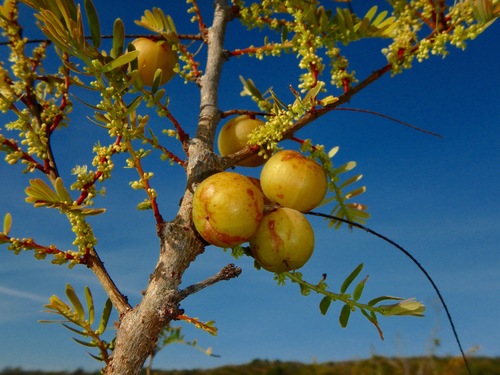
Its close relative Indian gooseberry (Phyllanthus emblica), or amla, is the most frequent source of confusion. That species has smooth, unribbed fruit growing more separately along the branch, unlike the tight clusters of Tahitian gooseberry tree. More distant confusion with starfruit, Averrhoa carambola, is possible, but its much larger fruit has a regular star-shaped cross section. 4
Fruit size and position on the branch, the number of ribs and the clustered arrangement provide more reliable identification clues than a commercial name alone when distinguishing Phyllanthus acidus from other tropical fruit trees.
Main sources
- Plants of the World Online / Kew, Phyllanthus acidus (L.) Skeels
- International Plant Names Index, Phyllanthus acidus (L.) Skeels
- Purdue University NewCROP, Morton, Otaheite Gooseberry
- Missouri Botanical Garden Plant Finder, Phyllanthus acidus
- Florida Plant Atlas, Phyllanthus acidus
- Monaco Nature Encyclopedia, Phyllanthus acidus
- Fruitiers.org, Phyllanthus acidus (girembellier)
- USDA GRIN Global Taxonomy, Phyllanthus acidus (L.) Skeels
Frequently asked questions
Is Tahitian gooseberry tree toxic?
Ripe fruit is not recorded as toxic to cats, dogs or horses. Roots and latex are traditionally described as purgative and irritating at high doses, a use separate from eating the fruit.
Why is the fruit so sour?
Its flesh is naturally very acidic, so it is seldom eaten raw in large amounts. It is mainly used for jam, syrup, chutney or preserves made with sugar or salt.
Why do entire sections of branchlets fall off?
The long terminal branchlets of Phyllanthus acidus are deciduous and periodically fall with their leaves. This differs from evergreen foliage or individual leaves falling separately.
Where did Tahitian gooseberry tree originate?
Its origin is uncertain. The most widely cited theory points to Madagascar, followed by spread to Southeast Asia and the Pacific before its introduction to the Caribbean in 1793.
Which plants look like Tahitian gooseberry tree?
The most frequent confusion is with Phyllanthus emblica, a close relative with smooth, unribbed fruit that is less densely clustered on the branch. Fruit ribs are the most reliable distinction.
How long does the first harvest take?
Seed-grown trees often take 3–4 years to produce their first substantial crop. Cuttings and air layering shorten this wait compared with simple seed propagation.
Is the wood useful?
Properly treated wood is strong and sometimes used for small practical objects. The tree is too small and too valuable for its fruit to be grown as a construction timber.
Similar plants
If you are unsure about a plant’s toxicity, ask a botanist or veterinarian for advice.