
Patchouli (Pogostemon cablin, )


Patchouli (Pogostemon cablin) is an aromatic subshrub in the Lamiaceae family, cultivated in Southeast Asia and Madagascar for its essential oil. Fresh leaves have almost no scent; drying releases the characteristic fragrance used in perfumes and incense. The species is no longer known in a truly wild state and is propagated almost entirely by cuttings.
Read morePatchouli, Patchouly, Puchaput and Nilam
Allow a few hours of direct sun per day, preferably morning or evening.
Bright light; tolerates light partial shade in tropical midsummer




© photo
Wikimedia Commons · CC BY-SA or Public Domain
© copyright of the Board of Trustees of the Royal Botanic Gardens, Kew.


Global distribution
Taxonomic records associate Pogostemon cablin with the Philippines, Sri Lanka, western and central island Malaysia, and Papua New Guinea. However, it is no longer found in a truly wild state and now exists only in cultivation, mainly in Indonesia, India, China, Madagascar and the Caribbean for essential oil production.
- Native3
- Philippines
- Sri Lanka
- Papua New Guinea
Hexagons: regions where the plant occurs. Green dots: native range.1
Identity
Patchouli (Pogostemon cablin (Blanco) Benth., 1848) is an aromatic subshrub in the Lamiaceae family. Manuel Blanco first described it as Mentha cablin from specimens collected in the Philippines. George Bentham transferred it to Pogostemon in 1848, establishing the scientific name still in use. Its early placement among mints remains visible in that original name. 2 3
Two Tamil words, patchai (green) and ilai (leaf), give patchouli its name: the word describes the leaf rather than the perfume. Fresh foliage is almost odorless. Drying or slight fermentation breaks cell walls and releases the essential oil carrying the fragrance sought by perfume and incense makers. 5
The French trade name “patchouli d'Inde,” or Indian patchouli, reflects an old trading route through India rather than an Indian botanical origin. Taxonomic records instead associate the species with the Philippines and island Southeast Asia. Commercial geography and the recorded origin of the plant should therefore be distinguished. 6
Recognition
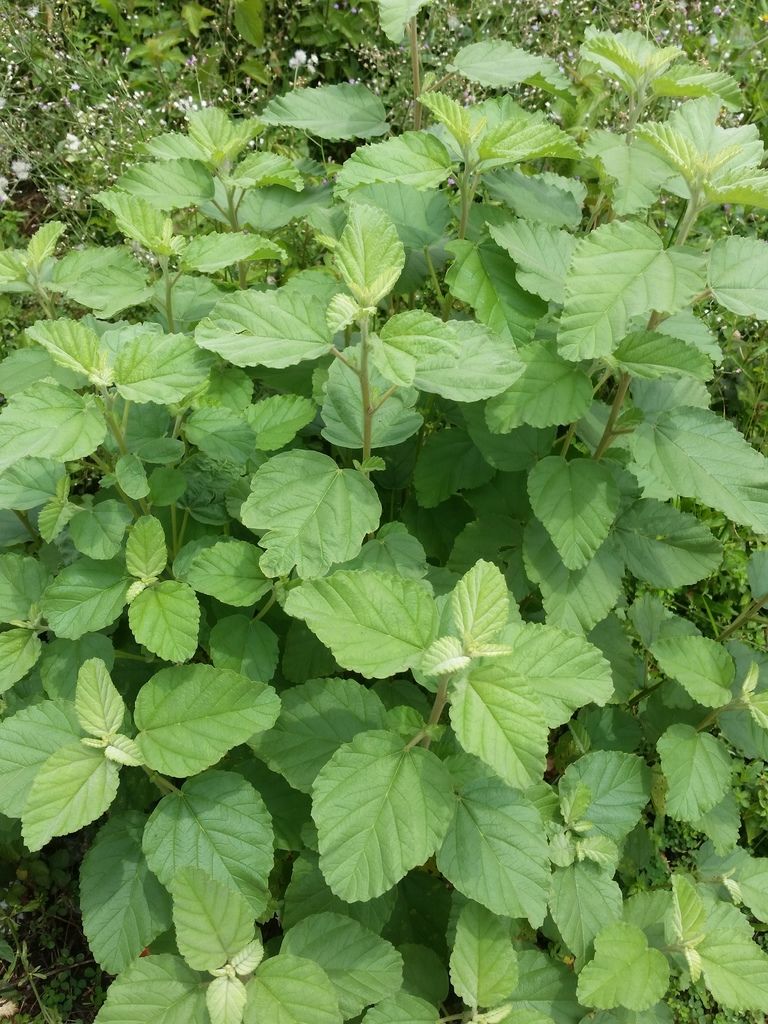
A bushy clump of patchouli normally reaches 50 cm to 1 m (20–39 in), approaching 1.5 m (5 ft) under ideal conditions. Its hairy, square-sectioned stems are typical of Lamiaceae. Young shoots remain soft and brittle, while the base becomes woody with age, making a mature clump more resilient than a recently rooted cutting. 4
Oval leaves have toothed margins and hairy undersides. Crushing the plant releases some aroma, but its intensity remains low while the foliage is fresh. The strong, musky smell associated with patchouli develops only after the harvested leaves have dried, so a fresh leaf is a poor guide to the eventual oil's fragrance. 5 4
Small white flowers tinged purple or pink appear in dense terminal and axillary spikes. Flowering is only occasional in cultivation: plants are harvested for their leaves well before they have time to flower. The commercial crop is thus usually recognized through its leafy, bushy growth rather than a floral display. 5
Useful taxonomy
The accepted combination, Pogostemon cablin (Blanco) Benth., was published in 1848 from a basionym Blanco had described eleven years earlier. Several other names occur in the species' botanical and commercial history:
- Mentha cablin Blanco, the basionym.
- Pogostemon patchouly Pellet.-Saut., a historical name.
- Pogostemon heyneanus var. patchouly (Pellet.-Saut.) Kuntze, a historical combination.
- Pogostemon hortensis Backer ex K.Heyne, a name also encountered in trade.
- Mentha auricularia Blanco, a misapplied name.
Two names in this history, Pogostemon heyneanus and Pogostemon hortensis, designate botanically distinct species rather than simple synonyms. Both may nevertheless be sold as patchouli, helping explain why some oils on the market are considered disappointing. The full binomial matters more than the shared trade name. 1 2
Habitat and range
Taxonomic records connect patchouli's range with the Philippines, Sri Lanka, western and central island Malaysia, and Papua New Guinea. Yet recent wild floristic records do not establish genuinely wild populations: the species is now known only in cultivation. Its recorded geographic associations should be read with that limitation in mind. 1
Commercial production has shifted toward Indonesia, the world's leading essential-oil producer, as well as India, China, Madagascar and Caribbean islands such as Haiti. Haitian oil has historically been valued for its quality. These production regions describe where the crop is grown, rather than demonstrating a separate native origin in each country. 4
Abundant rainfall of about 2,200–2,600 mm (87–102 in) annually, steady warmth of 23–28 °C (73–82 °F) and fertile, loose, well-drained soil at pH 5.5–7 favor rapid growth. Heavy or waterlogged soil quickly causes root rot. Cold below 5 °C (41 °F) damages and eventually kills plants, so temperate regions require heated winter shelter rather than year-round planting outdoors. 4
Life cycle and reproduction
Commercial propagation depends almost entirely on semi-ripe stem cuttings with a heel. Seeds do occur, but they are rare and poorly viable. Large plantations therefore rely on continuing vegetative cloning instead of conventional seed sowing, maintaining the crop through rooted pieces of existing plants. 5 4
First leaf harvest comes about 180–210 days after planting, followed by harvests every 120–180 days. Essential-oil yield peaks in the first year, with roughly one metric ton of dried leaves per hectare, then declines over a productive lifespan of two to three years. Harvest intervals and the total life of a plantation are separate timescales. 4
Steam distillation extracts the oil from previously dried or slightly fermented leaves. This preparation breaks cell walls and releases aromatic compounds, including patchoulol, the principal sesquiterpene responsible for patchouli's smell. Drying is therefore part of producing the fragrance rather than simply a way to store the crop. 5
Uses and risks
Perfume making is patchouli's main use. Its oil acts as a fixative in perfumes, cosmetics and cleaning products, a role it has maintained since the fashion for incense associated with the hippie movement of the 1960s and 1970s. The fragrance's cultural prominence is closely tied to these aromatic uses. 5
Traditional Chinese and Indonesian medicine uses the leaves for colds, nausea and headaches. The oil is reputed to have antifungal and mosquito-repellent properties. These are traditional or reported uses; no routine food use is documented apart from occasional flavoring. 4
No toxic principle is documented in the fresh plant itself. Concentrated essential oil, however, requires particular care around cats, which poorly metabolize some phenolic compounds present in it. Exposure can cause drooling, tremors or respiratory distress. Safety statements about the living plant cannot simply be transferred to the concentrated oil. 7
Varieties, look-alikes and related plants
Unlike many ornamentals, patchouli has no variegated or dwarf horticultural cultivars described here. Commercial production relies on a standard vegetative clone, propagated only by cuttings to maintain a consistent oil composition from one harvest to the next. The aim is stability of the aromatic crop rather than a range of decorative foliage forms. 4
Two related species are particularly liable to appear under the same trade name:
- Pogostemon heyneanus, sometimes called false patchouli, produces oil considered inferior.
- Pogostemon hortensis is another species cultivated locally in Southeast Asia under a similar label.
Checking the complete binomial, Pogostemon cablin, before buying oil or a plant helps avoid these commercial substitutions. A familiar scent name alone does not confirm botanical identity, especially where several related aromatic species circulate through the same market. 1 2
Main sources
- Plants of the World Online / Kew, Pogostemon cablin (Blanco) Benth.
- International Plant Names Index, Pogostemon cablin (Blanco) Benth.
- Integrated Taxonomic Information System, Pogostemon cablin
- Useful Tropical Plants Database, Pogostemon cablin
- Wikipedia (EN), Patchouli
- Wikipedia (FR), Patchouli
- Catster, Is Patchouli Safe for Cats? Vet-Reviewed Health Facts
Frequently asked questions
Is patchouli toxic to cats and dogs?
No toxic principle is documented in the plant itself. Concentrated essential oil does pose risks, especially to cats, which poorly metabolize certain phenolic compounds it contains.
Why do fresh patchouli leaves have almost no scent?
The characteristic smell develops only after drying or slight fermentation, which breaks down cell walls and releases the essential oil. A freshly crushed leaf remains almost odorless.
How is patchouli related to mint?
The connection is historical classification rather than a shared horticultural use. The species was first described as Mentha cablin before being transferred to Pogostemon.
Is patchouli sold at garden centers always the correct species?
Not always. Pogostemon heyneanus and Pogostemon hortensis sometimes circulate under the same trade name, with essential oil of markedly lower quality than Pogostemon cablin.
Can patchouli grow indoors in a temperate climate?
Yes, mainly in a warm, humid greenhouse or well-heated conservatory. It does not tolerate dry cold and cannot survive below about 5 °C (41 °F).
Where does patchouli originate, despite its association with India?
Taxonomic records place the species around the Philippines and island Southeast Asia. The trade name Indian patchouli reflects a historical trading route rather than an Indian botanical origin.
How do you propagate patchouli?
Almost entirely from semi-ripe stem cuttings with a heel. Seeds exist but are rare and poorly viable, which explains the commercial industry’s dependence on vegetative cloning.
Similar plants

If you are unsure about a plant’s toxicity, ask a botanist or veterinarian for advice.