
Chinese plum (Prunus salicina, )
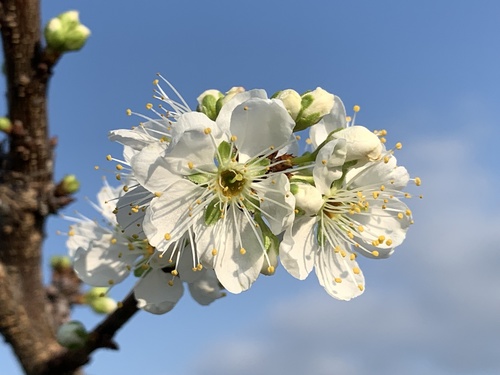

Chinese plum (Prunus salicina Lindl., 1830), also called Japanese plum, is a deciduous fruit tree in the Rosaceae family, native to China, the Russian Far East, northern Vietnam and Taiwan despite its Japanese common name. It flowers in early spring and produces juicy summer drupes with yellow, red or purple skin. Leaves, stems and stones remain toxic to domestic animals.
Read moreChinese plum, Japanese plum, Asian plum and Willow-leaf cherry
Allow a few hours of direct sun per day, preferably morning or evening.
Full sun in a sheltered position


© photo
(c) Shin-Ming Ku, some rights reserved (CC BY-NC), uploaded by Shin-Ming Ku · cc-by-nc
Wikimedia Commons · CC BY-SA or Public Domain
Wikipedia · CC BY-SA
© copyright of the Board of Trustees of the Royal Botanic Gardens, Kew.


Global distribution
POWO places the native range of Prunus salicina from the Russian Far East through China to northern Vietnam and Taiwan. The species was introduced to Korea and then Japan centuries ago, according to French Wikipedia, before reaching the United States around 1870 and Australia. In France, it now accounts for 25–30% of the area devoted to dessert plums.
- Native4
- Introduced4
- China
- Russian Far East
- Northern Vietnam
- Taiwan
- Korea
- Japan
- United States
- Australia
Hexagons: regions where the plant occurs. Green dots: native range.1
Identity
Chinese plum (Prunus salicina Lindl., 1830), also known as Japanese plum, is a deciduous fruit tree in the genus Prunus, within the Rosaceae family. Despite the Japanese name, POWO places its actual native range in China, the Russian Far East, northern Vietnam and Taiwan, rather than Japan. 1 7
The epithet salicina comes from the Latin salicinus, meaning “willowlike,” from Salix. It describes the elongated, finely toothed leaves, which visually resemble willow foliage more closely than the leaves of a European plum. 3
The name Japanese plum reflects its horticultural history: the species was grown in Japan for centuries before Japanese selections reached California in the late 19th century. Those introductions gave rise to most of the fresh plums sold in North America today. 2
Recognition
Wild trees reach 9–12 m (30–39 ft) tall, but annual pruning keeps most orchard trees at 3–5 m (10–16 ft). RHS gives 5–10 years as the time to full maturity for a compact cultivar such as Shiro. 2 3
Oblong to obovate leaves measure 6–12 cm (2.5–5 in) long and 2.5–5 cm (1–2 in) wide. They have finely toothed edges and shiny, dark green upper surfaces. Young branches are purplish red and current-season shoots yellowish red, useful winter clues when flowers and foliage are absent. 3
Flowers open before or alongside the leaves in early spring. Each white flower is about 2 cm (0.8 in) across, with five petals; groups of two or three grow on one-year-old wood. Most cultivars are self-incompatible and need a second compatible Japanese plum nearby to bear fruit. 2 4
The fruit is a drupe 4–7 cm (1.5–2.8 in) across, with yellow, red, green or purple skin beneath a fine waxy bloom, and juicy yellow-pink flesh. Ripening falls between late May and August in the Northern Hemisphere, depending on cultivar and climate. 3 4
Useful taxonomy
For Chinese plum, the accepted botanical name in POWO is Prunus salicina Lindl. Older botanical and horticultural literature also contains several competing names:
- Prunus trifolia Roxb., an older name
- Cerasus salicina (Lindl.) Loudon, an older combination
- Prunus botan hort. ex Chow, a historical horticultural name
- Prunus salicina var. mandshurica (Skvortsov) Skvortsov & A.I.Baranov, a botanical variety name
- Prunus salicina var. pubipes (Koehne) L.H.Bailey, another botanical variety name
Four botanical varieties are recognized within the species: var. salicina, var. pubipes, var. mandshurica and var. cordata. This distinction matters because cultivar names such as Santa Rosa or Shiro do not correspond to these botanical varieties. They are horticultural selections assigned to the species. 1
Habitat and range
From the Russian Far East through China to northern Vietnam and Taiwan lies the native range recorded by POWO for Prunus salicina. In China it grows in open forests, woodland edges, thickets and along valley streams at 200–2,600 m (650–8,500 ft) above sea level. 1 3
Cultivation spread from this East Asian center to Korea and then Japan several centuries ago, before crossing the Pacific to California around 1870 and becoming established in Australia. In France, the species now represents about 25–30% of the land planted with dessert plums. 7
Orchard trees accept a broad range of soils, from sand and loam to clay, provided drainage is good. Waterlogged ground encourages root rot, a risk shared with other fruiting Prunus species, so soil texture alone does not determine whether a site is suitable. 3 2
Life cycle and reproduction
A stone given 2–3 months of cold stratification can germinate, but seedlings do not reproduce the parent cultivar faithfully. Commercial fruit trees are therefore almost always grafted, preserving the selected fruit characteristics rather than relying on variable seedlings. 3
Early spring flowering precedes or accompanies leaf budbreak. A late frost of only −2 °C (28 °F) can destroy an entire display of blossoms and eliminate that year’s crop. Because most cultivars are self-incompatible, cross-pollination between two compatible Japanese plums remains necessary for good fruit set. 2 4
Fruit then ripens through summer, but storage life is short: 3–4 days at room temperature or 1–2 weeks when chilled. This helps explain frequent processing into jam, fruit wine or dried preparations instead of prolonged storage on a shelf. 3
Uses and risks
Fruit production is the principal use: ripe flesh is eaten raw or cooked and made into jams and fruit wines. In East Asia, whole fruits also feature in candies or fruit liqueurs. 3
As with other stone-fruited Prunus, the essential distinction is that ripe fruit flesh is edible, but the whole tree is not. The ASPCA lists plum among plants toxic to cats, dogs and horses. 5
Cyanogenic glycosides occur in the stems, leaves and especially the stone, with danger increasing as foliage wilts. Reported signs following a concerning ingestion include brick-red mucous membranes, dilated pupils, respiratory distress, panting and shock. 5
After a substantial ingestion of foliage, twigs or broken stones, contact a veterinarian or poison control center and identify the species involved. Avoid attempting a home treatment when the amount or plant part raises concern. 5
Cultivars and related plants
Commercial Chinese plum cultivars are horticultural selections rather than botanical varieties. Santa Rosa, raised by nurseryman Luther Burbank, is often regarded as a flavor benchmark. Shiro bears golden-yellow fruit on a smaller tree; Methley is self-fertile with dark red fruit; Ozark Premier suits hot summers. 2 4
European plum, Prunus domestica, is the most frequent source of confusion. It is hexaploid, whereas Prunus salicina is diploid, and its fruit is often more elongated and suited to drying as prunes. Chinese plum usually bears rounder fruit with smooth, bloom-covered skin. 1
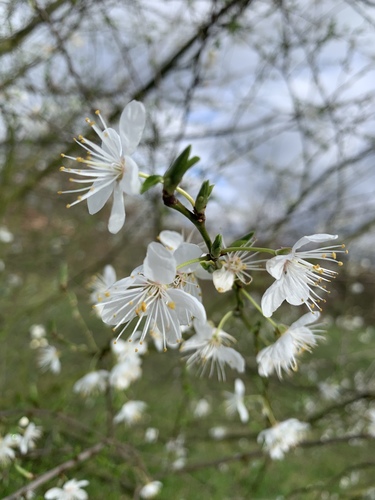
Cherry-plum, Prunus cerasifera, can also cause confusion. Often planted as a rootstock or flowering hedge, it bears much smaller fruit than cultivated Prunus salicina. For a young nursery tree, the botanical name and rootstock are the most reliable identification guides. 1
Main sources
- Plants of the World Online / Kew, Prunus salicina Lindl.
- Royal Horticultural Society, Prunus salicina 'Shiro' plant details
- Plants For A Future, Prunus salicina
- NC State Extension Gardener Plant Toolbox, Prunus salicina 'Methley'
- ASPCA, Plum toxicity entry
- IUCN Red List, Prunus salicina assessment
- Integrated Taxonomic Information System, Prunus salicina Lindl., TSN 506232
- Wikidata, Prunus salicina (Q1250033)
Frequently asked questions
Does Japanese plum really come from Japan?
No. POWO places its actual native range in China, the Russian Far East, northern Vietnam and Taiwan. Japan cultivated the species for centuries before it was taken to California in the late 19th century.
How do Chinese and European plums differ?
Prunus salicina is diploid and produces generally round fruit with smooth, bloom-covered skin. European plum, Prunus domestica, is hexaploid and often has more elongated fruit suited to drying as prunes.
Is Chinese plum toxic to cats and dogs?
Yes, the plant as a whole is hazardous. The ASPCA lists plum as toxic to cats, dogs and horses because of cyanogenic glycosides in its leaves, stems and stones.
Why does a Chinese plum flower well but bear no fruit?
Most cultivars are self-incompatible and need another compatible Japanese plum nearby. A late frost of −2 °C (28 °F) can also destroy all the blossoms before fertilization.
Which Prunus salicina cultivars are best known?
Widely grown selections include Santa Rosa, raised by Luther Burbank and often regarded as a flavor benchmark; golden-yellow Shiro; self-fertile, dark red Methley; and Ozark Premier for hot summers.
Can you eat the kernel inside a plum stone?
No, it is best avoided. Stones and leaves contain amygdalin, a cyanogenic glycoside that releases hydrogen cyanide. Only the flesh of the ripe fruit is intended for eating.
Why do Japanese plums keep for such a short time?
Fruit keeps for only 3–4 days at room temperature and 1–2 weeks when chilled. This short storage life helps explain its frequent processing into jam, fruit wine or dried preparations.
Similar plants
If you are unsure about a plant’s toxicity, ask a botanist or veterinarian for advice.