
Common guava (Psidium guajava, )
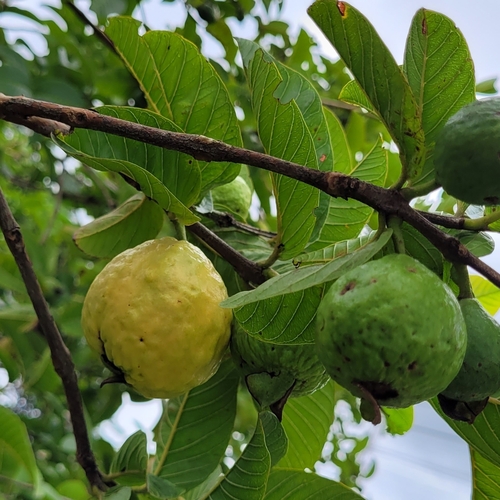

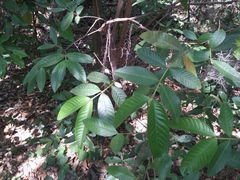
Common guava (Psidium guajava) is an evergreen fruiting shrub or small tree in the Myrtaceae family. Its precise origin remains debated between southern tropical America and southern Mexico. Cultivated for centuries for its vitamin C-rich fruit, it has also naturalized widely in tropical regions and become invasive in some.
Read moreCommon guava, Guava, Apple guava and Yellow guava


© photo
(c) Daniel Dias, some rights reserved (CC BY-SA), uploaded by Daniel Dias · cc-by-sa
Jack Hartfelder · cc0
Daniel Estabrooks · cc0
Taken Jul 3, 2016 by christiane Fazer (cc-by-sa)
Taken Apr 23, 2017 by christiane Fazer (cc-by-sa)
Taken Aug 18, 2019 by ARoDSC (cc-by-sa)
Taken Dec 4, 2016 by Eric Leeuwerck (cc-by-sa)
© copyright of the Board of Trustees of the Royal Botanic Gardens, Kew.




Global distribution
The exact native range of common guava remains debated. Plants of the World Online places it in southern tropical America, while other authors suggest a more northerly origin between southern Mexico and Central America. Millennia of cultivation and bird dispersal have blurred the distinction between wild populations and garden escapes across almost all tropical America.
- Native3
- Introduced2
- Invasive4
- Mexico
- Peru
- Brazil
- Florida (United States)
- India
- Hawaii
- Galápagos Islands (Ecuador)
- Southern Africa
- New Zealand
Hexagons: regions where the plant occurs. Green dots: native range.1
Identity
Common guava (Psidium guajava L., 1753), also called Guava, is an evergreen fruiting shrub or small tree in the genus Psidium and family Myrtaceae. It commonly reaches 3–10 m (10–33 ft), with full production beginning after 5–8 years. Its coppery bark peels in thin flakes from an early age. The French vernacular name derives from Arawak guaiaba, passed through Spanish guayaba to the French Caribbean and then to other French-speaking regions. 1 6
Although described in 1753, guava still has no firmly established geographical origin. Plants of the World Online places its native range in southern tropical America; other authors suggest southern Mexico through Central America. Millennia of human cultivation and bird dispersal have blurred the distinction between wild populations and garden escapes. 1 3
Recognition
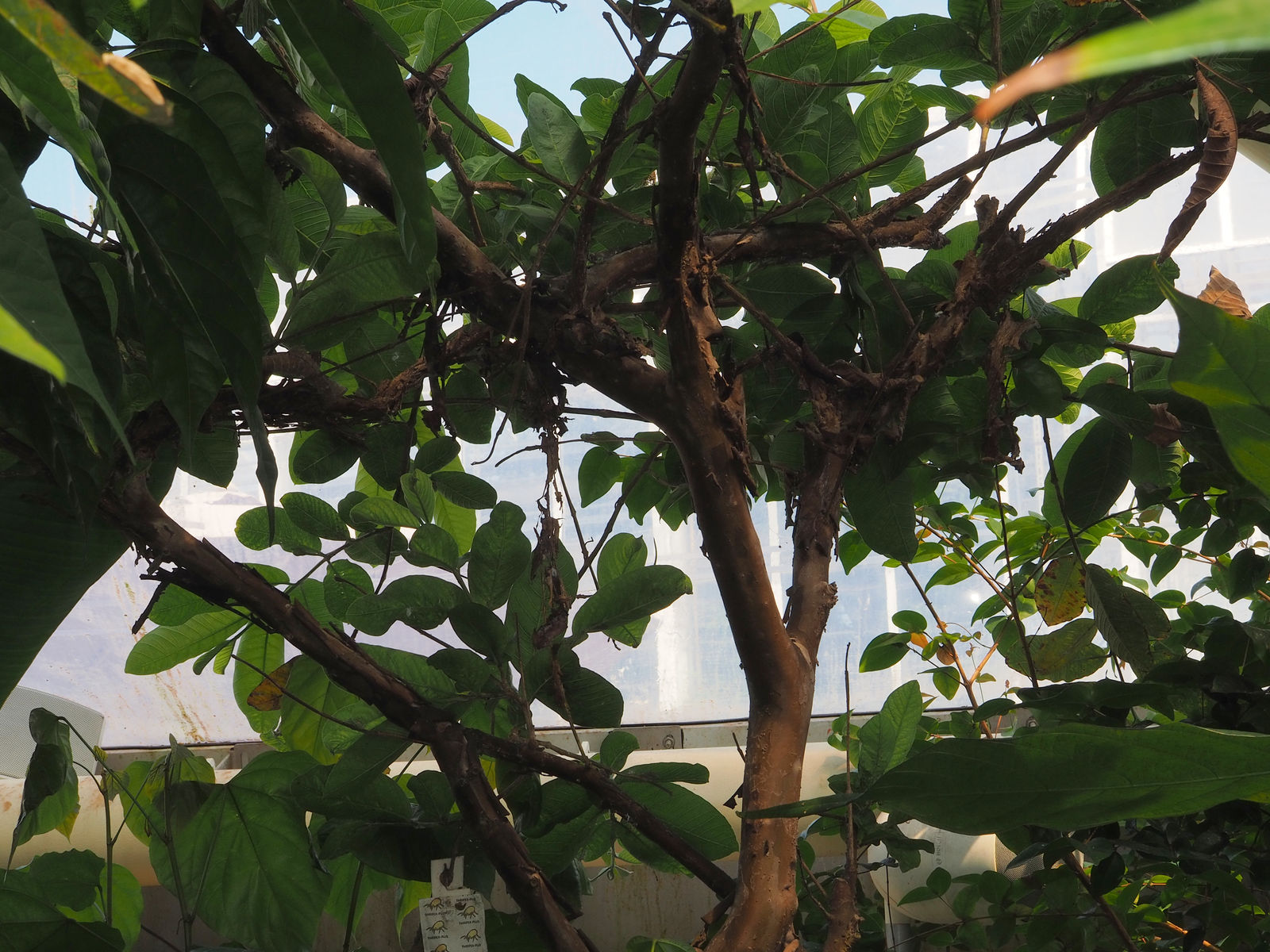
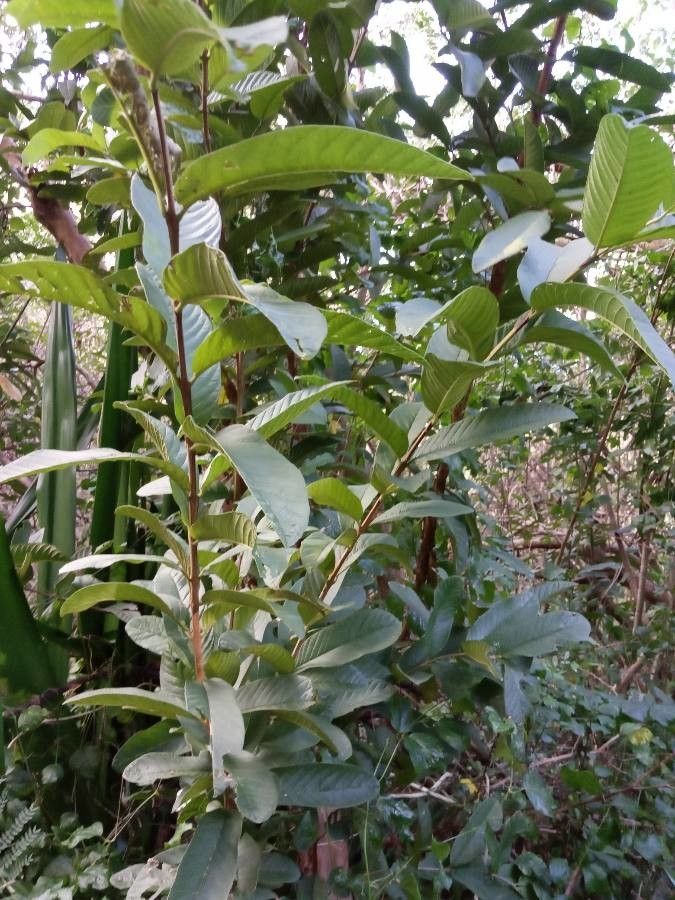
In tropical ground plantings, guava trunks sometimes exceed 25 cm (10 in) in diameter. For British container or greenhouse cultivation, the Royal Horticultural Society gives a height of 4–8 m (13–26 ft), compared with 3–10 m (10–33 ft) in open ground. Thin, coppery bark peels in flakes to reveal a greenish layer underneath, helping identify the tree outside the fruiting season. 3 2
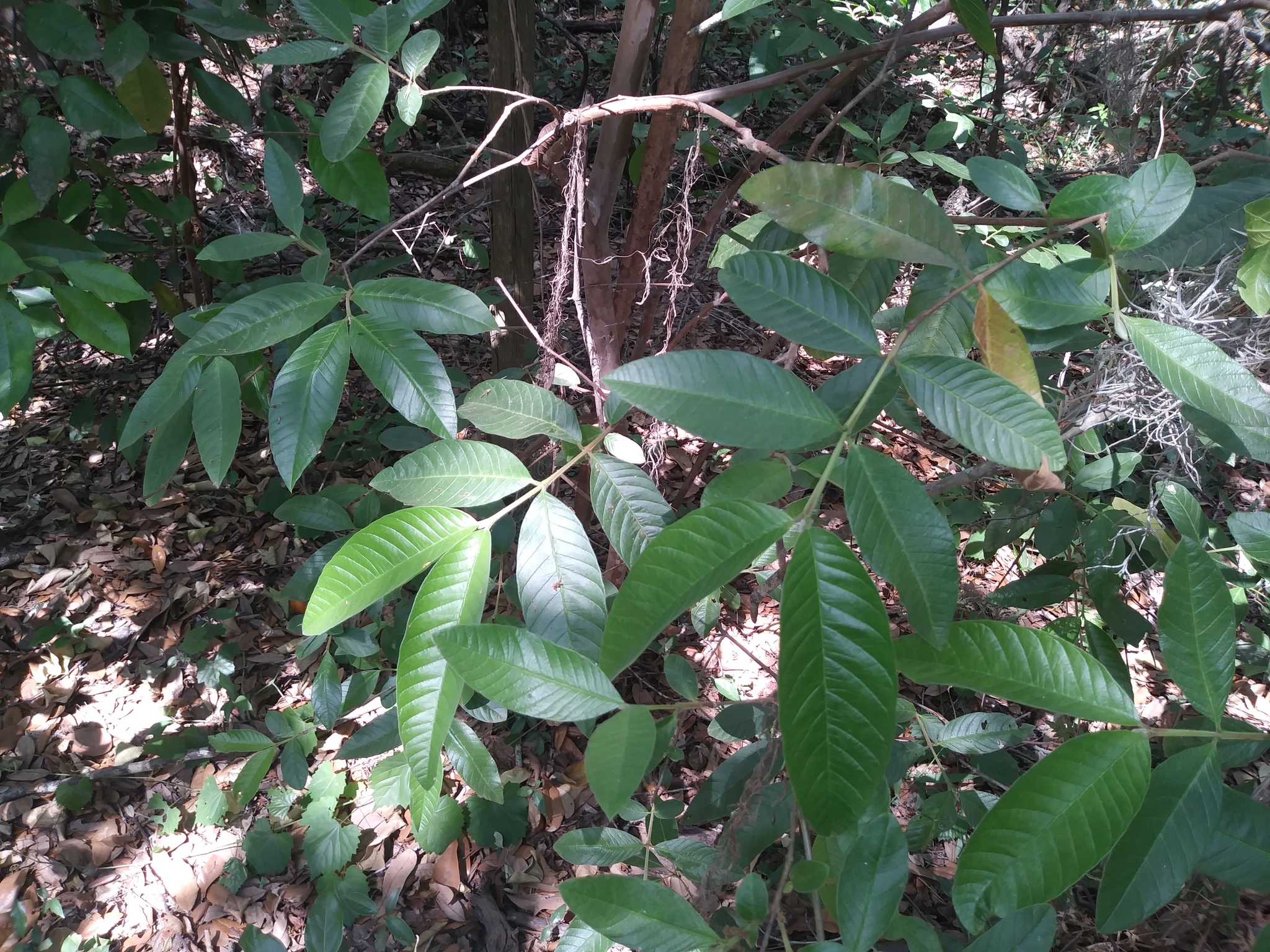
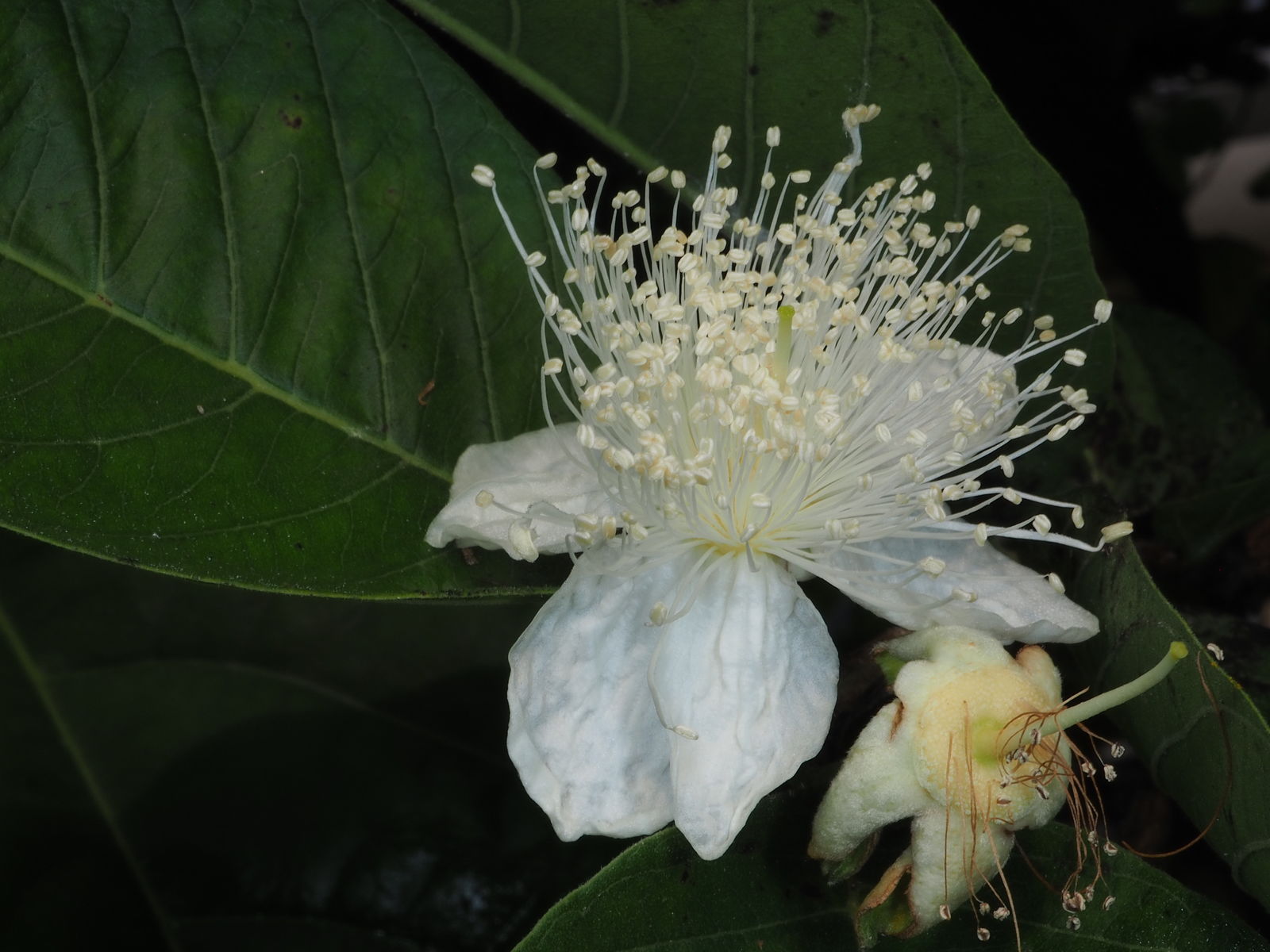
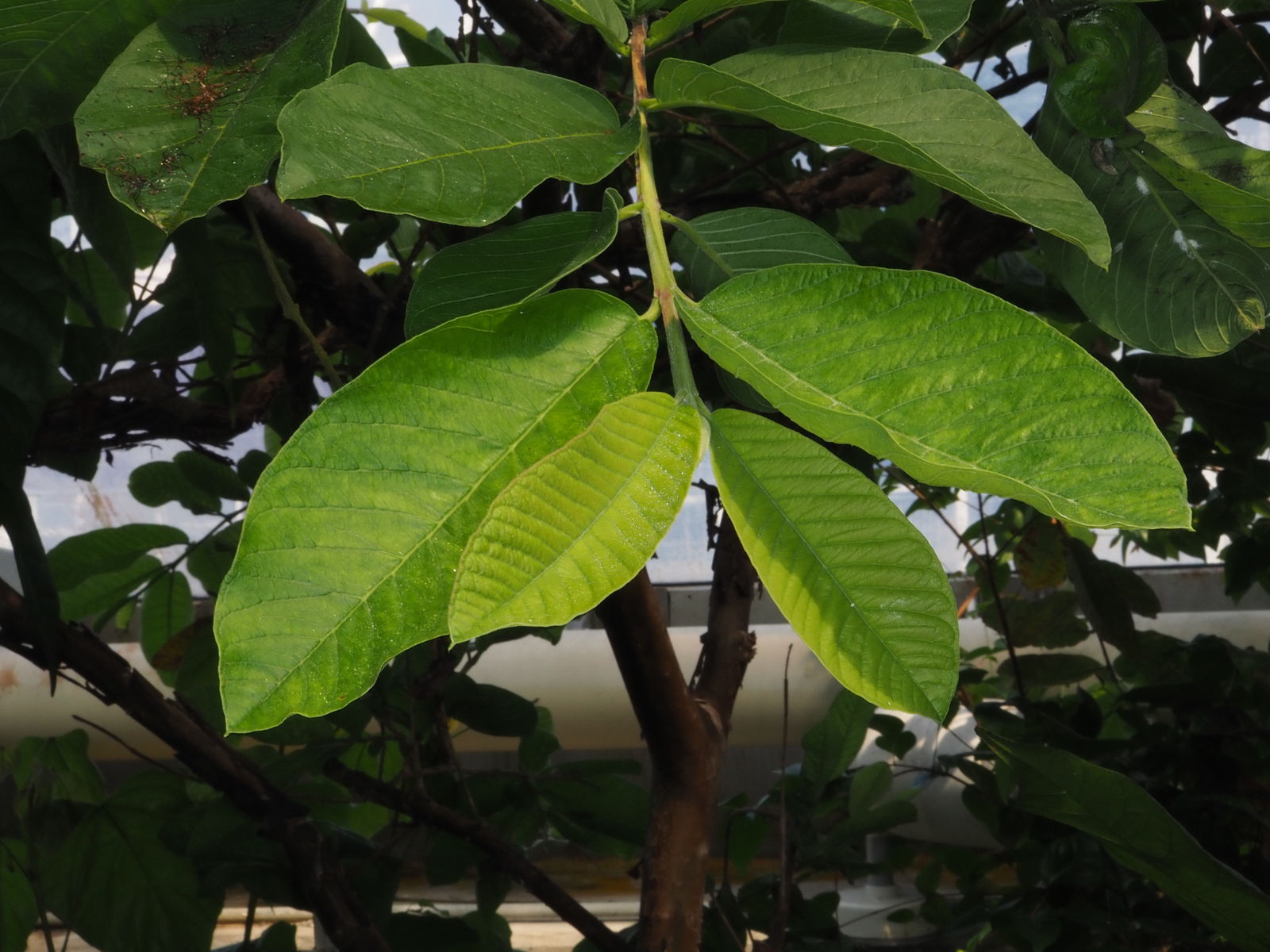
Opposite, oval to elliptical leaves measure 7–15 cm (2.8–5.9 in), with prominent veins and a strong aromatic scent when crushed. The white flowers, solitary or in groups of two or three, have about 250 stamens with pale yellow anthers. 2 3
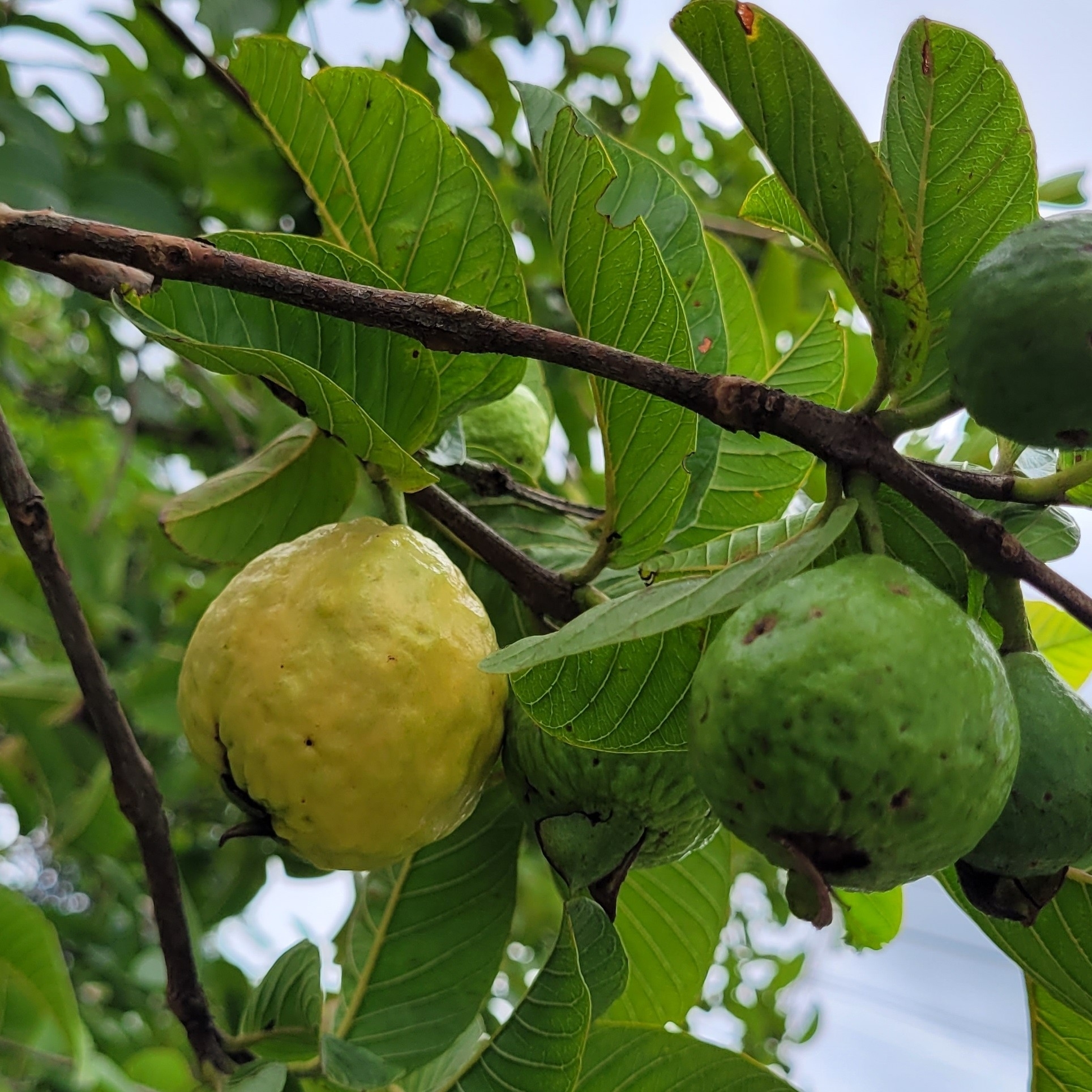
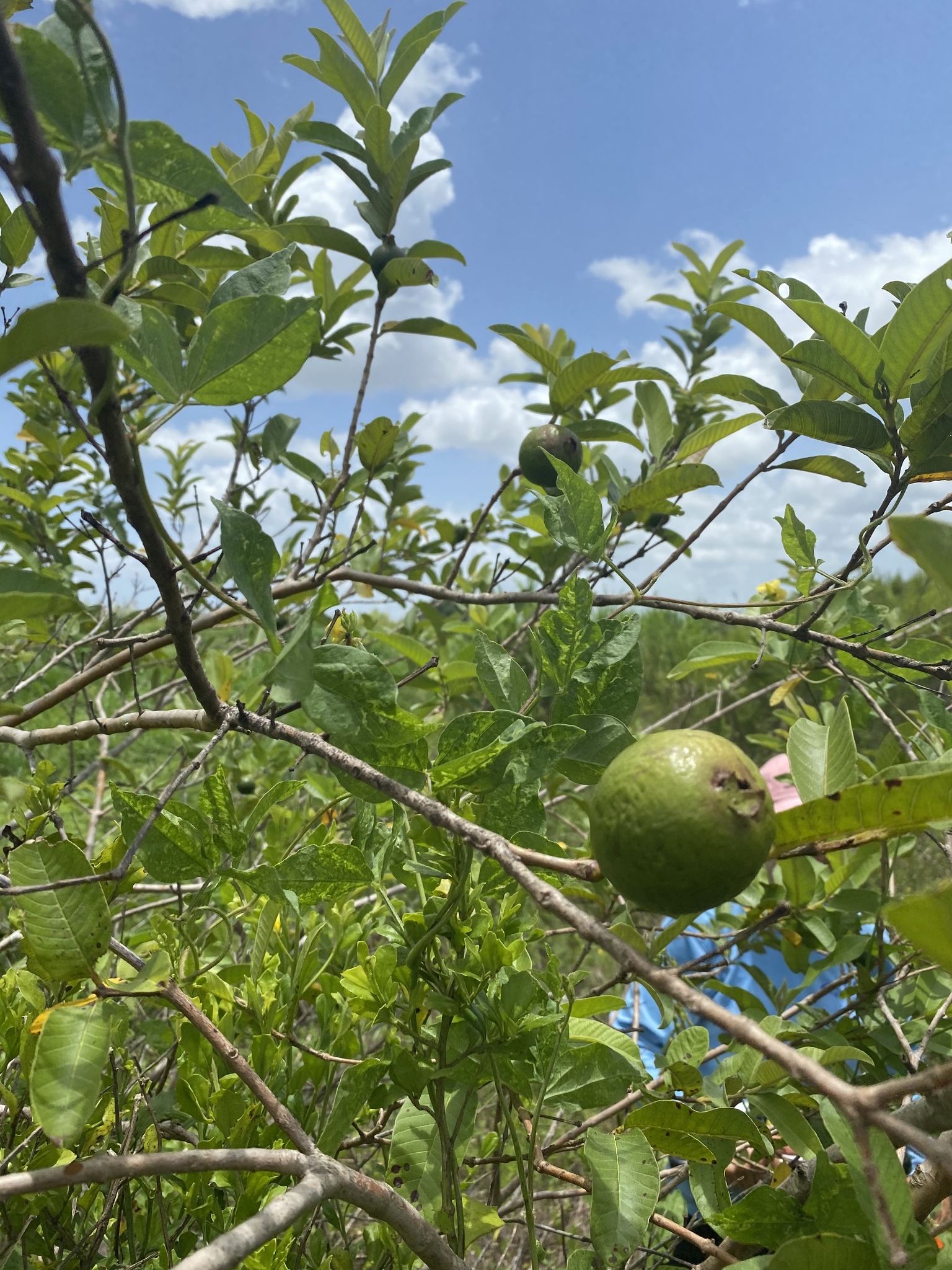
Guava fruit measures 5–10 cm (2–4 in) long and may be round, egg-shaped or pear-shaped, depending on the variety. Thin greenish-yellow skin, sometimes flushed pink, encloses white, pink or red flesh containing 112–535 hard seeds in unimproved forms. Fruit shape varies between trees, but the coppery bark remains useful outside the harvest season. 3 2
Useful taxonomy
Several botanical synonyms belong under the accepted name Psidium guajava. Some overlap with names still used horticulturally to describe fruit shapes:
- Myrtus guajava (L.) Kuntze; botanical synonym
- Psidium pomiferum L.; apple-fruited name
- Psidium pyriferum L.; pear-fruited name
- Psidium cujavus L.; botanical synonym
- Psidium vulgare Rich.; botanical synonym
- Psidium angustifolium Lam.; botanical synonym
The epithets pomiferum and pyriferum are particularly useful to recognize. Meaning “apple-fruited” and “pear-fruited,” respectively, they appear both in botanical synonymy and in current horticultural catalogs describing fruit shape. Use the accepted scientific name, Psidium guajava, to establish which species is meant. 1 2
Habitat and range
Naturalized guava colonizes disturbed ground, abandoned pastures and forest edges in tropical and subtropical regions, from sea level to about 2,300 m (7,546 ft) depending on the region. This pioneer is undemanding about soil and establishes on poor as well as calcareous ground. 3 4
Introduced to the Caribbean by 1526 and to Florida in the mid-nineteenth century, guava is now cultivated and naturalized across almost every tropical continent. In the French Caribbean, it is described as a plant of Creole gardens that has naturalized locally, without the reputation for aggressive spread it has elsewhere. 3 6
Hawaii, the Galápagos Islands, southern Africa and New Zealand present a different picture: guava forms dense thickets that compete directly with native vegetation. The IUCN Global Invasive Species Database identifies it as a documented risk to at least six threatened species. 5
Life cycle and reproduction
Self-fertilization is effective in common guava: most varieties fruit alone without relying on a specific pollinator, explaining the heavy crops possible on an isolated garden tree. Seedlings may flower from 2 years old, though full production takes 5–8 years, depending on climate. 4
Seed sowing is the simplest propagation method. Scarified seed germinates in 2–8 weeks, with full rooting in 4–8 weeks. Semi-ripe cuttings and air layering preserve the characteristics of a particular cultivar, something seed cannot guarantee because it recombines parental traits. 3 4
After pollination, white flowers set fruits that take several months to ripen. Harvests may recur up to twice a year in a stable tropical climate; under cover in a temperate climate, they are concentrated mainly in summer and fall. 3
Uses and risks
Fresh fruit, cooked fruit, juice and guava paste are the main uses, and the flesh is known for its high vitamin C content. Leaves, bark and unripe fruits also feature in traditional remedies for digestive complaints, a long-documented use that does not replace medical advice. 3 2
No toxicity is documented in humans or domestic animals: ripe guava fruit has no known toxic risk for cats, dogs or horses. The main caution concerns its many hard seeds, which may cause digestive discomfort or even obstruction if a small animal swallows a large quantity. 4 8
Ecological spread is common guava’s principal risk. Birds and bats that eat the fruit disperse seeds efficiently; these germinate readily in disturbed habitats, allowing the species to become invasive where natural predators are absent. 5
Varieties, look-alikes and related plants
Fruit cultivars are selections rather than separate species. Cuttings or layering preserve traits such as flesh color, sugar content or seedlessness. Red-fleshed Redland and Ruby are reference selections in North America, while white-fleshed Lucknow-49 dominates Indian commercial production. 3
A close relative, strawberry guava (Psidium cattleianum), is the most useful look-alike to distinguish. Its much smaller fruits have smooth reddish or yellow skin, and it lacks common guava’s large, strongly veined leaves and peeling coppery bark. It is this relative, rather than Psidium guajava, that has a reputation for especially aggressive spread on Réunion.
- Strawberry guava (Psidium cattleianum) has smaller, smooth-skinned fruit;
- Brazilian guava (Psidium guineense) has narrower, hairy leaves;
- Psidium littorale, often grown under glass, has purple fruit quite different from common guava.
Peeling coppery bark, broad leaves with prominent veins and variation in fruit shape on a single tree remain the most reliable features for distinguishing Psidium guajava from its relatives. 7 2
Main sources
- Plants of the World Online / Kew, Psidium guajava L.
- Royal Horticultural Society, Psidium guajava (F) - common guava
- Julia F. Morton, Fruits of Warm Climates, guava (Purdue University New Crop Resource Online Program)
- Plants For A Future, Psidium guajava
- IUCN Global Invasive Species Database, Psidium guajava
- Inventaire National du Patrimoine Naturel, Psidium guajava L., 1753 - common guava
- National Tropical Botanical Garden, Tropical Plants Database, Psidium guajava
- USDA PLANTS Database, Psidium guajava L.
Frequently asked questions
Is common guava poisonous to pets?
No toxicity is documented for ripe common guava fruit in cats, dogs or horses. Swallowing large amounts of the many hard seeds mainly poses a risk of digestive obstruction rather than poisoning.
How does common guava differ from strawberry guava?
Strawberry guava, Psidium cattleianum, has much smaller fruits with smooth reddish or yellow skin. It lacks common guava’s large, strongly veined leaves and peeling coppery bark. It is the species with a reputation for particularly invasive behavior on Réunion, rather than Psidium guajava.
Where does common guava grow naturally?
Its precise origin remains debated between southern tropical America and southern Mexico. Millennia of cultivation and bird dispersal have blurred the distinction between wild populations and garden escapes throughout tropical America.
Why is common guava invasive in some countries?
Birds and bats disperse its seeds effectively, and these germinate readily in disturbed habitats. Common guava forms dense thickets that compete with native vegetation, as documented in Hawaii, the Galápagos, southern Africa and New Zealand.
Can common guava grow outdoors in a cool temperate climate?
It needs a container that can be moved to a greenhouse or bright conservatory for winter. Young shoots are damaged at -1 °C (30 °F), ruling out permanent outdoor cultivation except in tropical or distinctly mild climates.
When are guavas harvested?
In a stable tropical climate, fruiting extends over much of the year, with up to two harvest waves. Under cover in temperate climates, most fruit ripens in summer and fall.
Does common guava need a pollination partner?
No. Common guava self-fertilizes well and usually fruits on its own in a garden or orchard without depending on a specific insect pollinator.
Similar plants
If you are unsure about a plant’s toxicity, ask a botanist or veterinarian for advice.