
Pilated-leaved blackberry (Rubus fruticosus, )
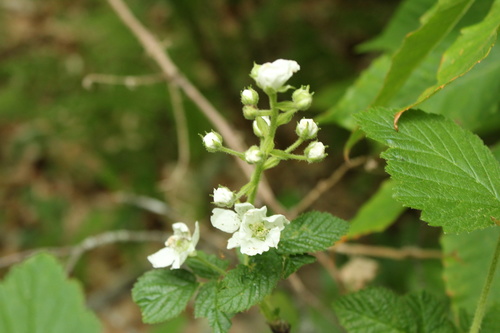

Pilated-leaved blackberry (Rubus fruticosus) is a prickly shrub in the Rosaceae family, native to temperate Europe and grown for its blackberry, an aggregate of small black drupelets. The scientific name covers several hundred closely related microspecies formed through hybridization and maintained by apomixis.
Read morePilated-leaved blackberry, Blackberry, Bramble, European blackberry and Shrubby blackberry


© photo
(c) abourne, some rights reserved (CC BY-NC) · cc-by-nc
iNaturalist User · cc-by
Wikimedia Commons · CC BY-SA or Public Domain
© copyright of the Board of Trustees of the Royal Botanic Gardens, Kew.
Global distribution
The native range of Rubus fruticosus covers northern, central and eastern Europe in temperate climates. Introduced outside Europe as a fruit crop from the 19th century onward, it has become widely naturalized and is among the most troublesome weeds in several Southern Hemisphere countries.
- Native4
- Introduced3
- Invasive2
- Mainland France
- Germany
- United Kingdom
- Poland
- United States
- Chile
- South Africa
- New Zealand
- Australia
Hexagons: regions where the plant occurs. Green dots: native range.1
Identity
Pilated-leaved blackberry (Rubus fruticosus L., 1753), commonly called blackberry or bramble, is a prickly shrub in the Rosaceae family. Its scientific name covers an aggregate of several hundred microspecies so similar that no field key reliably separates them all. For gardening, foraging and hedgerow identification, Rubus fruticosus therefore serves as a name for this whole aggregate. 1 2
Blackberries have been gathered since the Neolithic: archaeological finds document their use several millennia before raspberry domestication. In French, the similar names for blackberry and mulberry can cause confusion, although brambles and mulberry trees (Morus) belong to separate botanical genera. 5
Recognition
Arching, angular canes usually carry hooked prickles and can exceed 3–4 m (10–13 ft) in length when supported. Without support they bend down into a low, tangled dome. This thicket-forming habit, more than height alone, helps reveal a bramble in a mixed hedgerow from a distance. 2 5
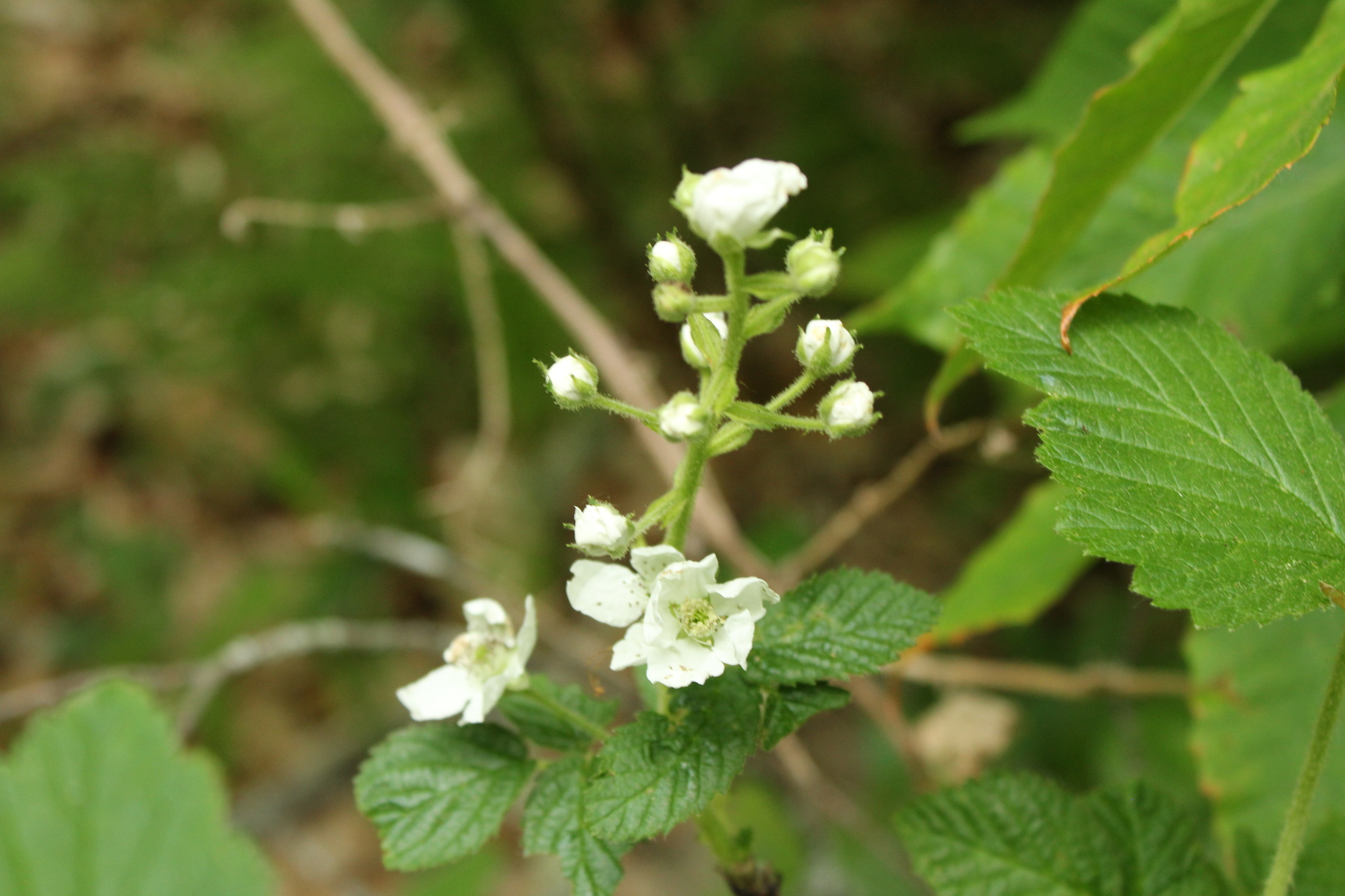
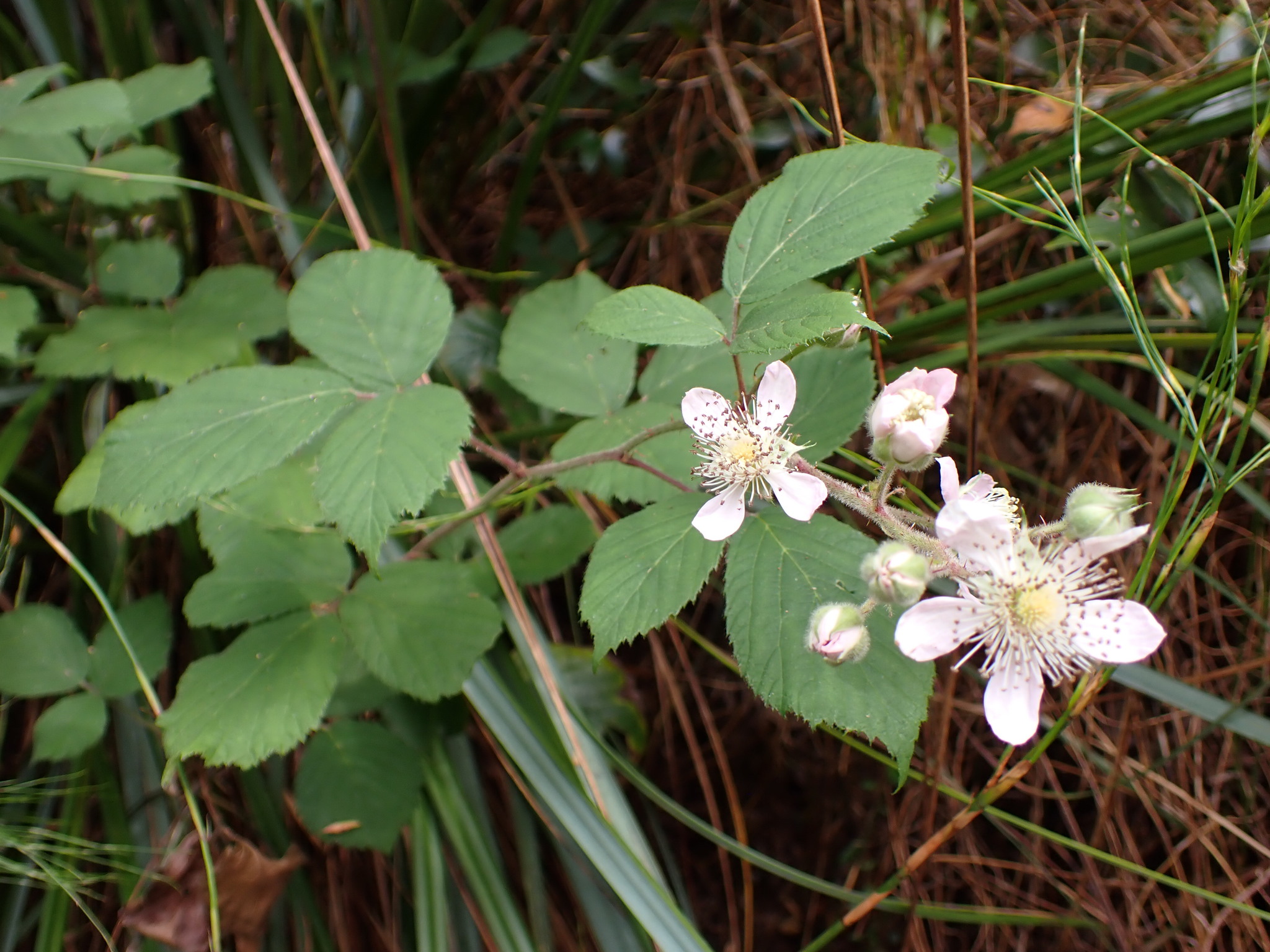
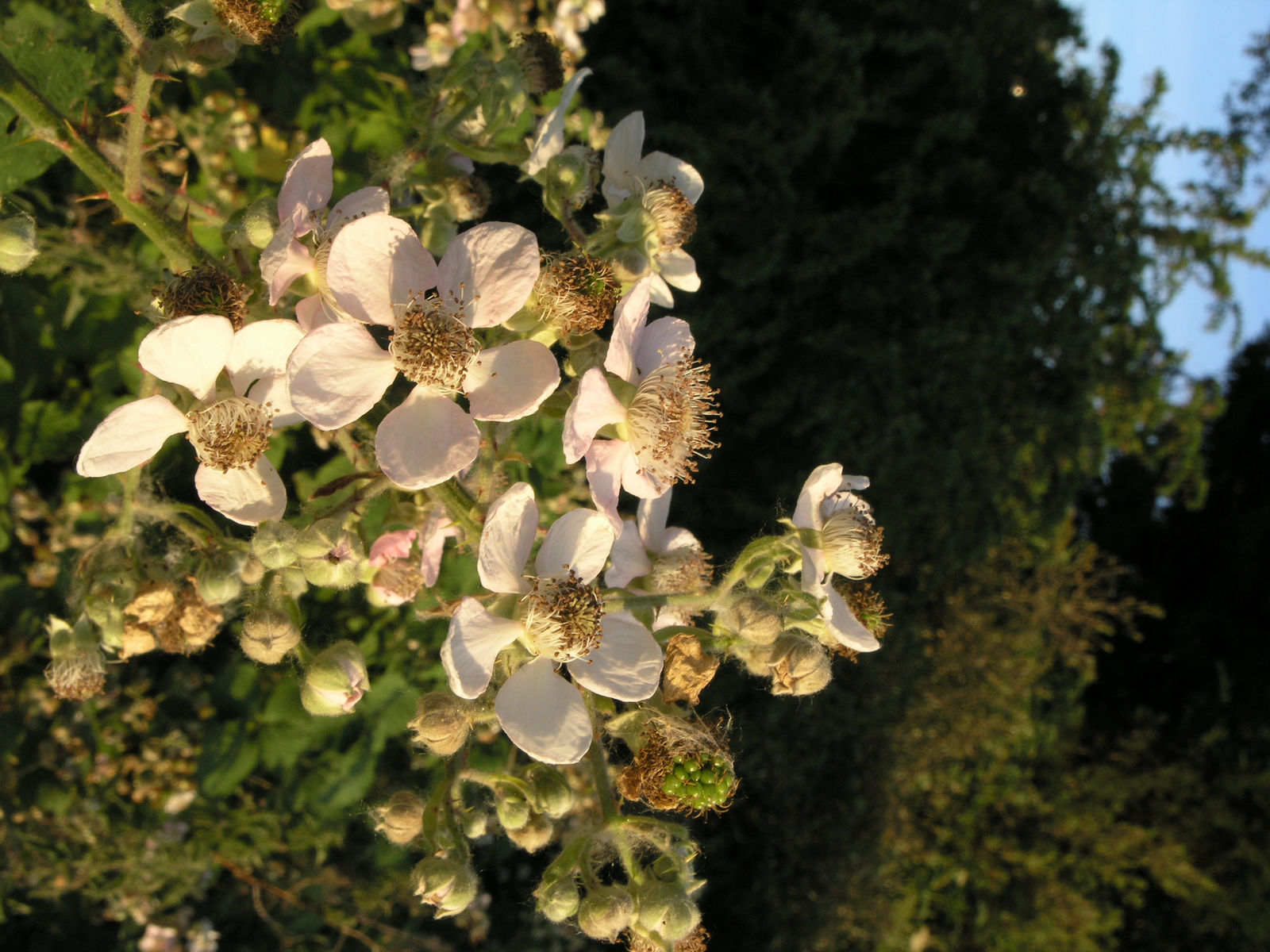
Three to five toothed leaflets form each compound leaf, dark green above and paler below; the leaf stalk also bears prickles. From late May to July, white or pink flowers, 2–3 cm (0.8–1.2 in) across with five petals, open in small clusters heavily visited by bees. 5 3
Green fruit turns red before becoming black at maturity in late July or August. Each blackberry is made of many drupelets joined together and remains attached to its receptacle when picked. A raspberry, by contrast, separates from its receptacle and leaves a hollow center. 5
Useful taxonomy
Ambiguity is built into the name Rubus fruticosus L. Linnaeus described it in 1753 using mixed specimens now assigned to distinct species, including Rubus plicatus and Rubus ulmifolius. The type specimen corresponds to R. plicatus, but everyday use of the name is much broader. 1
Botanists use Rubus fruticosus agg., meaning aggregate, for several hundred microspecies in subgenus Rubus. Repeated hybridization between neighboring sections produced these forms, which became fixed through apomixis: seeds reproduce the mother plant without complete genetic reshuffling, maintaining stable but very similar lineages. 2
An aggregate name is sufficient for ordinary gardening, foraging and hedgerow identification. Separating every microspecies belongs to the specialist study of brambles, known as batology, and relies on reference herbarium material. 1
Habitat and range
Northern, central and eastern Europe make up the native temperate range. Hedgerows, woodland edges, scrub, banks and waste ground support the plant, on poor or rich soils and in full sun or partial shade. 1 3
Introductions as a fruit crop began outside Europe in the 19th century, followed by widespread naturalization. Planted in Australia from the 1840s, the Rubus fruticosus aggregate now infests nearly 9 million hectares (22 million acres) and ranks among the country’s worst weeds. Comparable spread has occurred in New Zealand, the United States and Chile. 4
Life cycle and reproduction
Each blackberry cane is biennial on a perennial rootstock, as in raspberry. In its first year the primocane grows without flowering; in its second year the floricane flowers, fruits and dies back while a new primocane develops. 2
Natural tip layering is a particularly effective means of spread. As soon as a cane tip touches the ground, it can root and form a new clump, allowing patches to expand rapidly without any need for pollination. 4
Birds and mammals disperse seeds after eating blackberries. Foxes are especially important in Australia, accelerating colonization of disturbed ground once the plant has been introduced. 4
Uses and risks
Fresh or cooked blackberries go into jam, syrup and baked dishes, with harvests from late July to November depending on climate. Peeled young spring shoots are eaten in salads. Dried leaves make a traditional astringent herbal tea used for diarrhea or sore throats. 3
Two growing conditions strongly affect the crop. Full sun produces sweeter fruit and reduces fungal disease, while partial shade markedly reduces flowering and fruiting. Excess nitrogen favors foliage over fruit and also makes the canes more susceptible to botrytis. 2
No notable toxicity is recorded for humans or common domestic animals. Only large quantities of unripe blackberries may cause mild digestive upset. 3
Outside the native range, the main risk is invasive spread. In Australia, annual control costs and agricultural losses exceed 100 million dollars, despite introduction of the rust fungus Phragmidium violaceum as a biological control agent with limited effectiveness. 4
Varieties, look-alikes and related plants
Most cultivated fruit varieties are thornless selections derived from the Rubus fruticosus aggregate. Chester, Triple Crown, Loch Ness and Navaho combine upright or semi-erect growth, no prickles and large, consistent fruit, making harvest much easier than on wild brambles. 2
The main plants to distinguish from this aggregate are:
- Rubus idaeus, red raspberry, whose fruit separates from the receptacle and leaves a hollow center;
- Rubus caesius, European dewberry, with a bluish bloom on its fruit and a tendency to hybridize with blackberry;
- Rubus ulmifolius, a major member of the aggregate, with more strongly evergreen foliage.
A prickly, dome-shaped thicket, fruit that stays attached to its receptacle and cane tips that root on contact with soil provide the most reliable field clues for recognizing this blackberry aggregate. 5 2
Main sources
- Plants of the World Online / Kew, Rubus fruticosus L.
- Royal Horticultural Society, Rubus fruticosus agg. - blackberry
- Plants For A Future, Rubus fruticosus
- Weeds Australia, European Blackberry (Rubus fruticosus aggregate)
- Woodland Trust, Bramble (Rubus fruticosus)
- Tela Botanica, Rubus fruticosus L.
- INPN / MNHN, Rubus fruticosus L., 1753
- GBIF, Rubus fruticosus L.
Frequently asked questions
Is Pilated-leaved blackberry (Rubus fruticosus) poisonous?
No. Fruit, young shoots and dried leaves in herbal tea are traditionally consumed without notable danger to humans or common domestic animals. Only unripe blackberries may cause mild digestive upset when eaten in large quantities.
Why is the name Rubus fruticosus considered ambiguous?
Linnaeus described it in 1753 from a mixture of specimens now assigned to several distinct species. In practice, the name covers an aggregate of several hundred very similar microspecies, a useful level of identification for ordinary gardening and foraging.
What is the difference between a blackberry and a raspberry?
Both fruits are aggregates of drupelets, but a blackberry stays attached to its receptacle when picked, while a raspberry separates from it and is hollow inside. Raspberry is Rubus idaeus.
How do you prune a garden blackberry?
After harvest, cut the canes that have fruited, called floricanes, down to ground level; they naturally die back. Keep and train the current year’s young canes to fruit the following year.
Can Pilated-leaved blackberry become invasive?
Outside its native range, yes. In Australia, the Rubus fruticosus aggregate infests nearly 9 million hectares and is among the country’s worst weeds, despite the introduction of a rust fungus for biological control.
Are there thornless varieties for gardens?
Yes. Chester, Triple Crown, Loch Ness and Navaho are thornless fruit selections with upright or semi-erect growth, much easier to harvest than wild brambles.
Why do the French words for blackberry and mulberry sound alike?
The French word mûre comes from Latin morum, originally the fruit of the mulberry tree (Morus). It was later applied to blackberry because of the similar color, although the plants are botanically unrelated.
Similar plants
If you are unsure about a plant’s toxicity, ask a botanist or veterinarian for advice.