
Curled dock (Rumex crispus, )
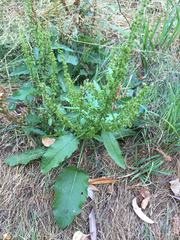
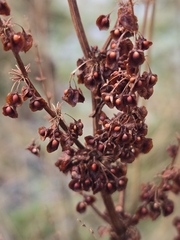
Curled dock (Rumex crispus L., 1753) is an herbaceous perennial in the Polygonaceae family, native to temperate Eurasia, Macaronesia and North Africa. Its rosette of wavy-edged leaves, saffron-yellow taproot and spike of greenish flowers turning reddish brown make it a familiar weed of damp waste ground, with edible young leaves but a persistent root system.
Read moreCurled dock, Curly dock and Yellow dock
Allow a few hours of direct sun per day, preferably morning or evening.
Full sun to light partial shade
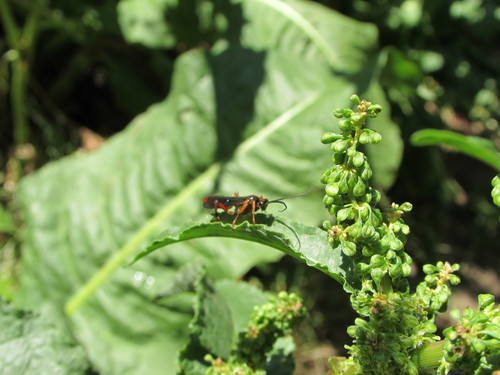

© photo
(c) Joseph Knight, some rights reserved (CC BY-NC), uploaded by Joseph Knight · cc-by-nc
Lindsey K. Wise · cc0
Daniel Atha · cc0
(c) Justin Johnsen, some rights reserved (CC BY) · cc-by
(c) Douglas Goldman, some rights reserved (CC BY-SA) · cc-by-sa
Global distribution
The native range of Rumex crispus covers temperate Eurasia, Macaronesia and North Africa. Introduced elsewhere, it has become widely established on other continents, with noxious-weed regulation reported in several regions.
- Native3
- Introduced2
- Invasive2
- Metropolitan France
- Europe
- North Africa
- United States
- South America
- New Zealand
- Australia
Hexagons: regions where the plant occurs. Green dots: native range.1
Identity
Curled dock (Rumex crispus L., 1753), also called Curly dock or Yellow dock, is an herbaceous perennial in the genus Rumex, family Polygonaceae. Plants of the World Online accepts this name, published by Carl Linnaeus in 1753. 1 7
Even before flowering, a saffron-yellow taproot can often identify Curled dock in the field. Its color becomes visible when soil is moved away from the plant’s base.
An older taxonomic connection links this dock to Rumex patientia, patience dock. Plants of the World Online still lists Rumex patientia var. crispus (L.) Kuntze among its synonyms. 1
Both curled and curly describe the foliage directly: the lower leaves have conspicuously wavy, crinkled edges. These margins account for the familiar English names. 5
Recognition
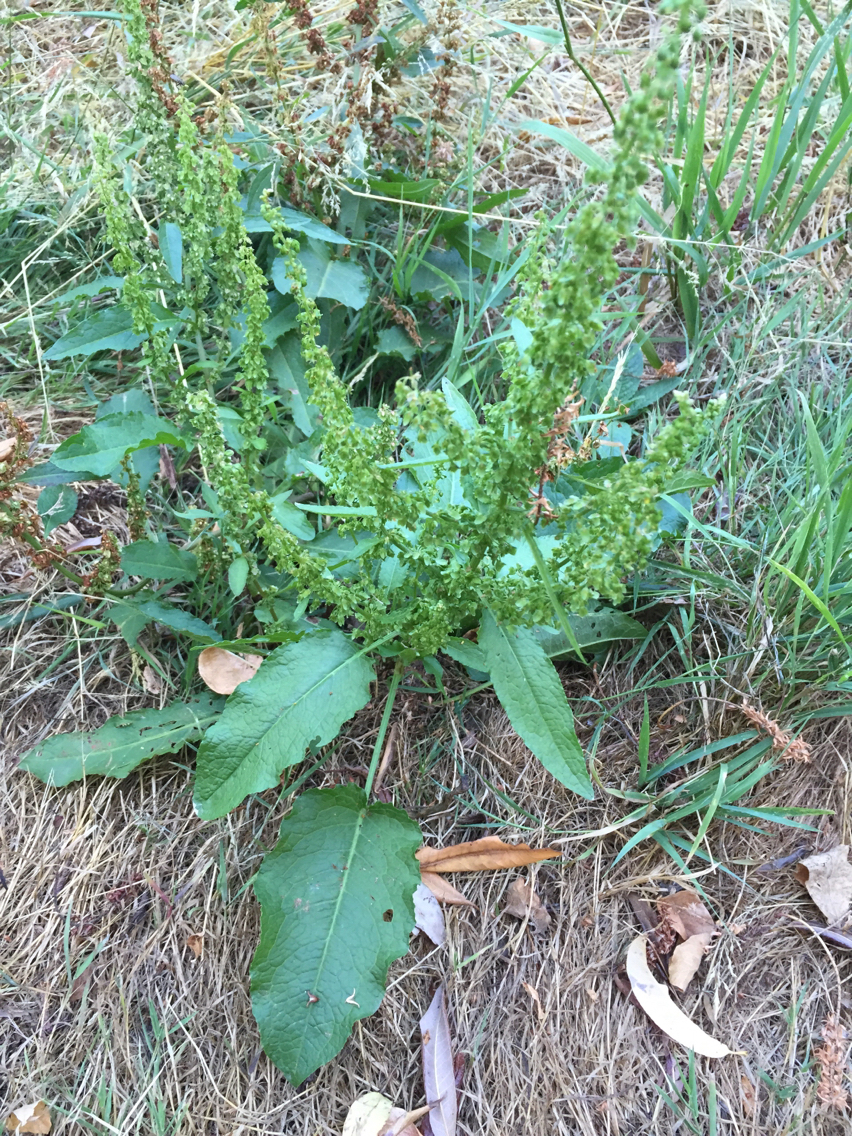
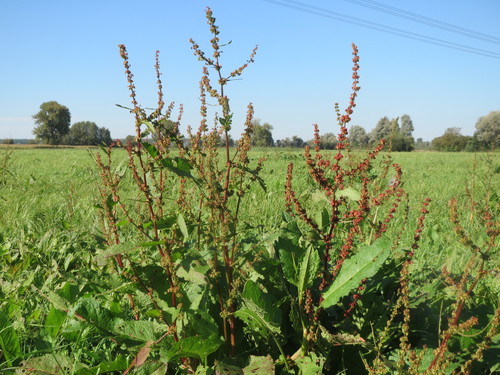
A basal rosette is the first visible stage of Rumex crispus, followed by a sturdy upright flowering stem with swollen nodes. It reaches 50 cm–1.5 m (20–59 in). 6 3
Lower leaves are oblong to lance-shaped and 14–24 cm (5.5–9.5 in) long. Their strongly wavy, crinkled edges often distinguish the plant from most other wild sorrels and docks even outside flowering. 5 2
Moving soil aside reveals a fleshy, forked saffron-yellow taproot in Rumex crispus. Its color contrasts sharply with the green foliage. 6 5
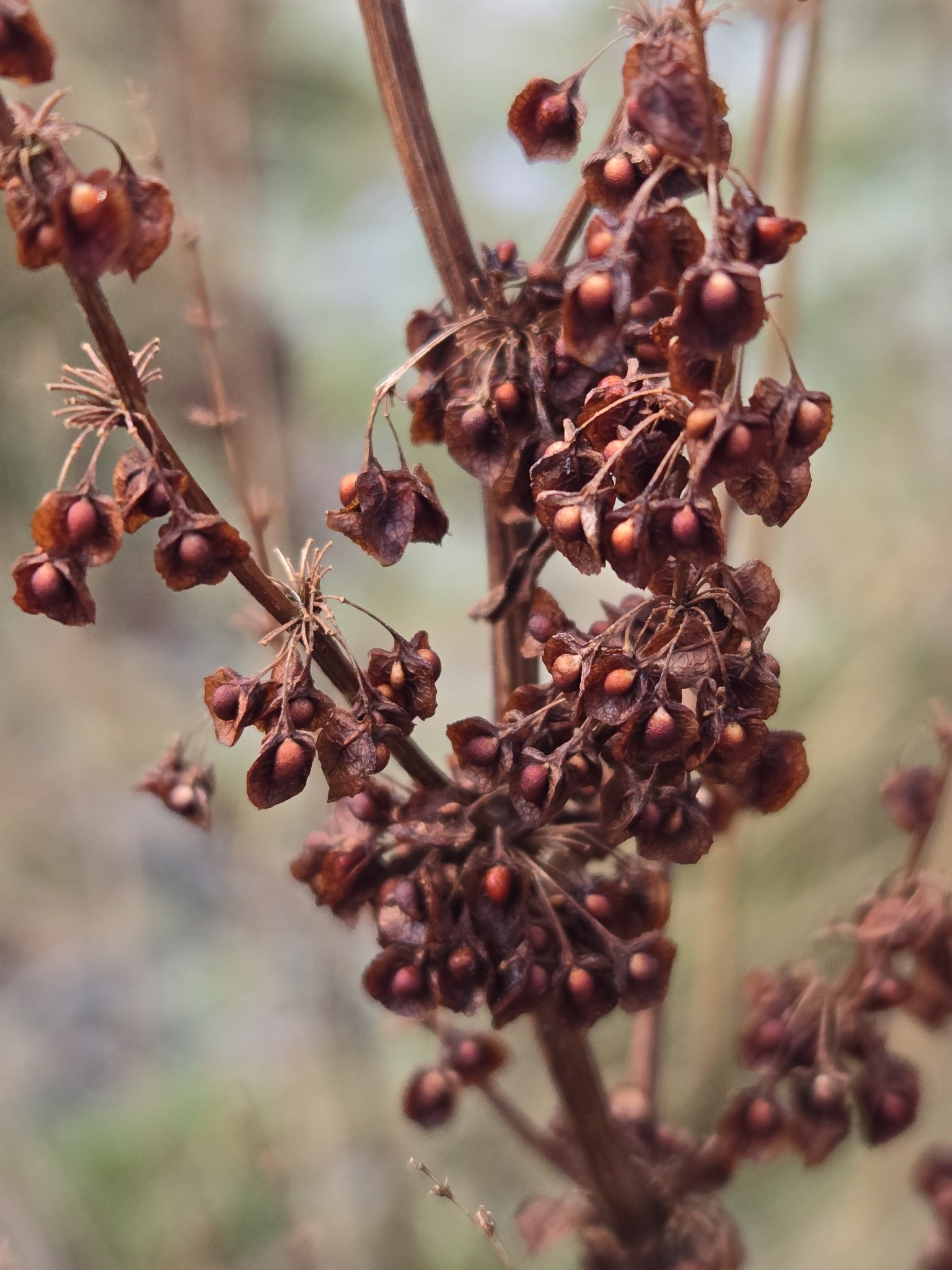
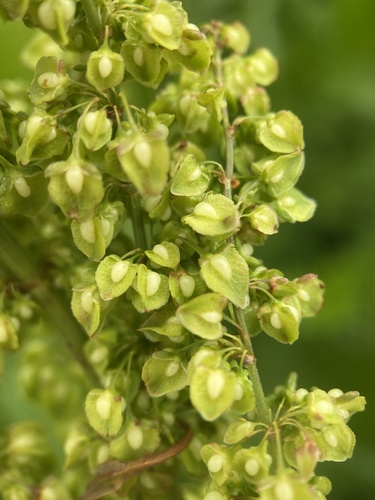
Dense whorls of ten to twenty-five flowers line the flowering spike, changing from greenish to reddish brown as they mature. Each fruit remains enclosed by persistent valves capable of floating, allowing water to carry seeds along shores and ditches. 2 5
Useful taxonomy
For Curled dock, Kew retains Rumex crispus L., published in 1753, as the accepted name. Subsp. crispus is the most widespread; subsp. littoreus (Hardy) Akeroyd occurs on northern and western European coasts; subsp. robustus (Rech.) Pestova occurs in central and eastern Europe; and subsp. strictissimus (Rech.f.) Pestova ranges from southeastern Europe to Afghanistan. 1
Recorded synonyms include Lapathum crispum (L.) Scop., based on the now-abandoned genus Lapathum, and Rumex patientia var. crispus (L.) Kuntze, reflecting its connection with patience dock. 1
Edible sorrels such as Rumex acetosa share the genus Rumex with more robust docks. With its sturdy habit and edibility limited to young leaves, Curled dock occupies an intermediate position in everyday descriptions. 3
Habitat and range
Temperate Eurasia, Macaronesia and North Africa form the native range of Rumex crispus. 1
Within France, its native distribution covers the metropolitan territory, including Corsica. The French national natural heritage inventory records it under the French name for Curled dock. 8
Introduced populations are widely established in North and South America, New Zealand and Australia. The cited account reports Curled dock as an injurious weed under the UK Weeds Act 1959, and as a regulated noxious weed in Arkansas and Iowa in the United States; these are jurisdiction-specific examples. 5
Rich, wet, often heavy or waterlogged soils are favored by Rumex crispus. Typical sites include agricultural and urban waste ground, roadsides, damp meadows and watersides. 6 2
Life cycle and reproduction
Seed production drives reproduction in Rumex crispus almost exclusively. Abundant seeds develop along the flowering spike between summer and autumn. 3
Persistent perianth valves protect each seed and allow it to float at the water surface. This buoyancy explains the plant’s frequent occurrence beside shores and ditches. 5
Waterlogged soils rich in organic matter provide the main conditions for seedling emergence. Colonies of Curled dock can therefore indicate soils shaped by prolonged wetness. 6
Two moth caterpillars recorded feeding on Rumex crispus foliage are Aedia leucomelas and the black cutworm moth, Agrotis ipsilon. Several lepidopteran inventories document this host-plant role. 6 5
Uses and risks
Traditional food preparation uses young leaves cooked in several changes of water to reduce their oxalic acid content. Small amounts of raw leaves have also been added to salads. 3 5
A portion of 100 g (3.5 oz) of leaves provides about 5.6 mg of iron, together with vitamins A and C. These nutritional associations help explain the root’s historical use in Western herbalism for anemia. 3
ASPCA lists Rumex crispus as toxic to dogs, cats and horses. Soluble calcium oxalates can cause tremors, excessive salivation and, more rarely, kidney failure. 4
Excessive consumption of raw leaves poses related risks for humans: oxalic acid can irritate the urinary tract and contribute to kidney stones. The cited accounts call for particular caution during pregnancy and breastfeeding. 5 3
Varieties, look-alikes and related plants
Curled dock remains a wild species without a recognized horticultural cultivar or documented selection for ornamental use.
Broad-leaved dock, Rumex obtusifolius, is the closest common look-alike, with broader and much less wavy leaves. Fruit valves provide a more dependable distinction than seasonal changes in leaf width: Rumex crispus has three toothless valves, each with a clear tubercle, whereas Rumex obtusifolius has toothed margins and usually only one tubercle overall. 2
Patience dock, Rumex patientia, is another potential source of confusion. Larger and long cultivated as a vegetable, it shares a taproot and similar overall silhouette with Curled dock. Its much less wavy leaves and more massive habit distinguish it; without fruits, smooth foliage is more useful than size alone. 1
Main sources
- Plants of the World Online / Kew, Rumex crispus L.
- Go Botany / Native Plant Trust, Rumex crispus - Curly dock
- Plants For A Future, Rumex crispus
- ASPCA, Dock (Rumex crispus) toxicity entry
- Wikipedia (EN), Rumex crispus
- Wikipedia (FR), Rumex crispus
- Tela Botanica / eFlore bdtfx, Rumex crispus L.
- INPN / MNHN, Rumex crispus L., 1753 - Curled dock
Frequently asked questions
Is Curled dock poisonous?
Yes. The ASPCA lists Rumex crispus as toxic to dogs, cats and horses because soluble calcium oxalates may cause tremors, salivation and, more rarely, kidney failure.
Can you eat Curled dock?
Young leaves have been eaten after cooking in several changes of water to reduce oxalic acid. Excessive consumption, especially raw, exposes humans to the same risks as animals, particularly kidney problems.
Why is Curled dock so difficult to remove?
It regrows from fragments of taproot left in the ground and produces abundant seeds that float on water and form a persistent soil seed bank.
How can you tell Curled dock from Broad-leaved dock?
Fruit valves are the most reliable feature. The three valves of Rumex crispus lack teeth and each bears a clear tubercle; those of Rumex obtusifolius have marginal teeth and usually only one tubercle overall.
Where does Curled dock come from?
Its native range covers temperate Eurasia, Macaronesia and North Africa. It is now widely introduced in the Americas, New Zealand and Australia.
Is Curled dock invasive?
It is invasive in some areas outside its native range. The cited account reports its listing under the UK Weeds Act 1959 and noxious-weed regulation in Arkansas and Iowa in the United States. These examples are specific to those jurisdictions.
Why is the root of Curled dock yellow?
The saffron-yellow color is characteristic of this species’ fleshy taproot and explains the name yellow dock. It is a useful identifying feature outside the flowering season.
Similar plants
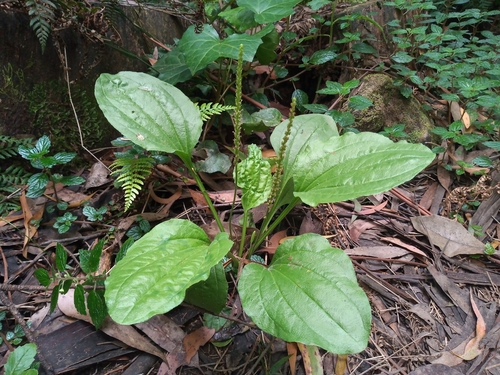
If you are unsure about a plant’s toxicity, ask a botanist or veterinarian for advice.