
Night-blooming cereus (Selenicereus undatus, )
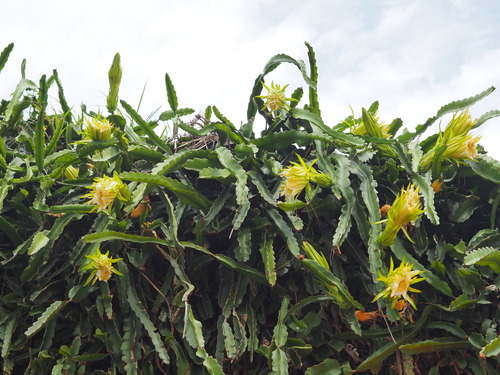
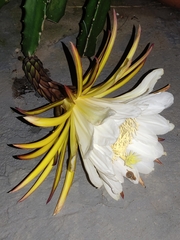

Night-blooming cereus (Selenicereus undatus) is a climbing cactus in the Cactaceae family, native from southern Mexico to Honduras. Its triangular stems cling to trunks and rocks with aerial roots. Giant white flowers open for a single night and, after pollination, develop into the scaly, white-fleshed fruit known as pitaya.
Read moreNight-blooming cereus, Pitaya, Dragon fruit, White-fleshed pitahaya, Strawberry pear and Belle of the Night
Allow a few hours of direct sun per day, preferably morning or evening.
Full sun to light partial shade
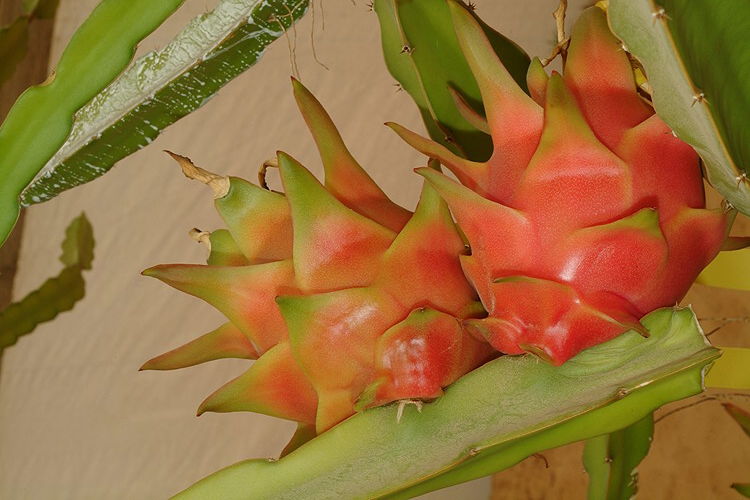


© photo
no rights reserved, uploaded by 葉子 · cc0
andré · cc0
Vítor Jorge · cc-by
© copyright of the Board of Trustees of the Royal Botanic Gardens, Kew.
Global distribution
Taxonomic references place the native range from southern Mexico to Honduras, but its precise limits remain debated because Selenicereus undatus has been cultivated for centuries and widely escaped. IUCN assesses the species as Data Deficient rather than assigning a more precise conservation category.
- Native4
- Invasive2
- Mexico
- Guatemala
- Belize
- Honduras
- Réunion
- Florida, United States
Hexagons: regions where the plant occurs. Green dots: native range.1
Identity
Night-blooming cereus (Selenicereus undatus (Haw.) D.R.Hunt, 2017), also called pitaya, dragon fruit or white-fleshed pitahaya, is a climbing member of the Cactaceae family. The genus name combines the Greek selene, meaning moon, with Cereus, referring to its giant white flowers that open only at night. The epithet undatus describes the wavy edges of the stems. 1 2
Adrian Hardy Haworth first described the species as Cereus undatus in 1830. Britton and Rose moved it to Hylocereus undatus in 1918. A phylogenetic revision of the Hylocereeae tribe published in 2017 placed Hylocereus within Selenicereus, producing the currently accepted name. 8
Recognition
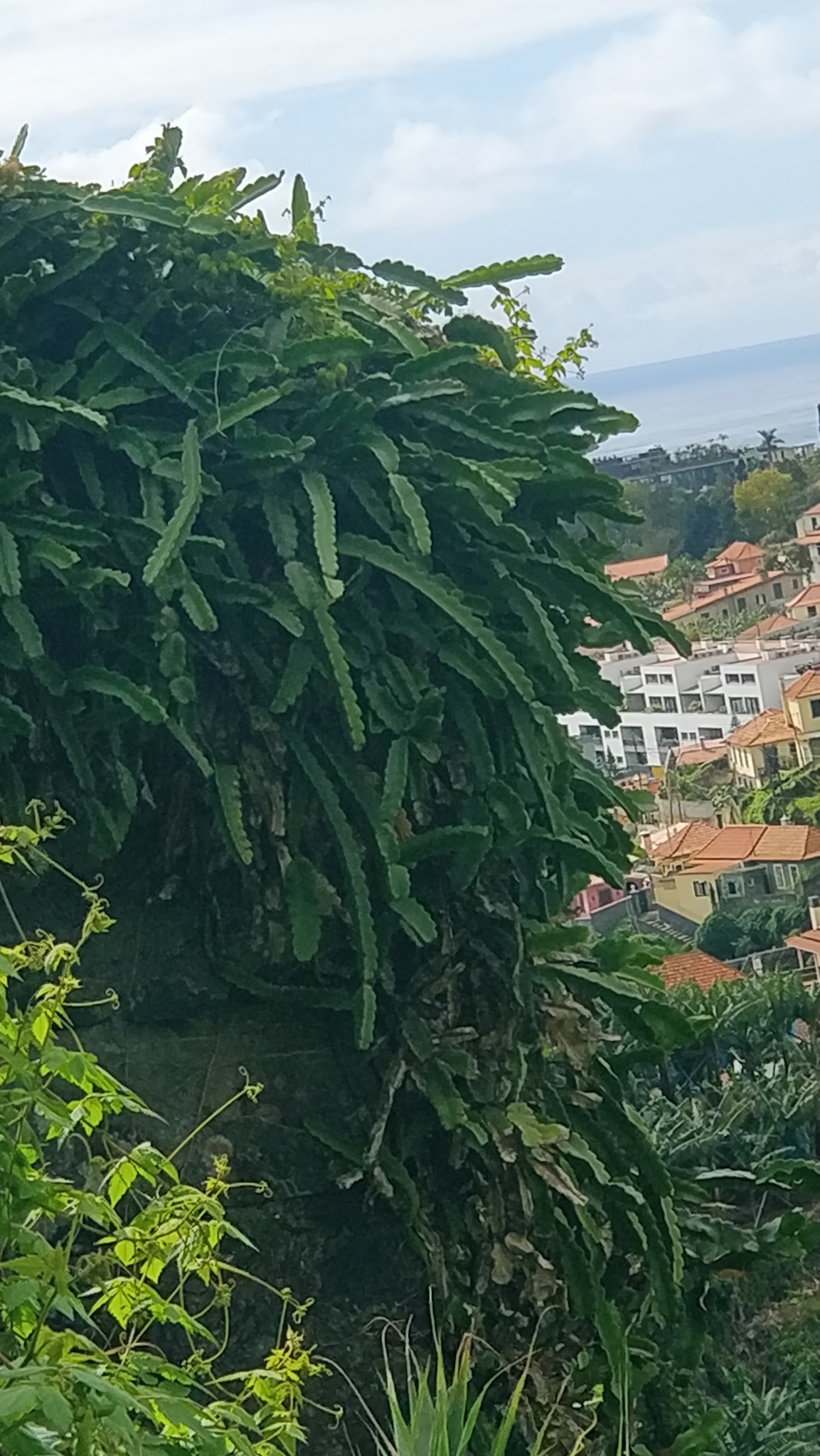
Long fleshy stems with three triangular, wavy-edged ribs first trail over the ground, then climb a trunk or support using numerous aerial roots. They commonly reach 5–12 m (16–39 ft) in length. Small grayish spines cluster at the areoles spaced along the ribs, so the climbing stems need to be handled with care. 2 8
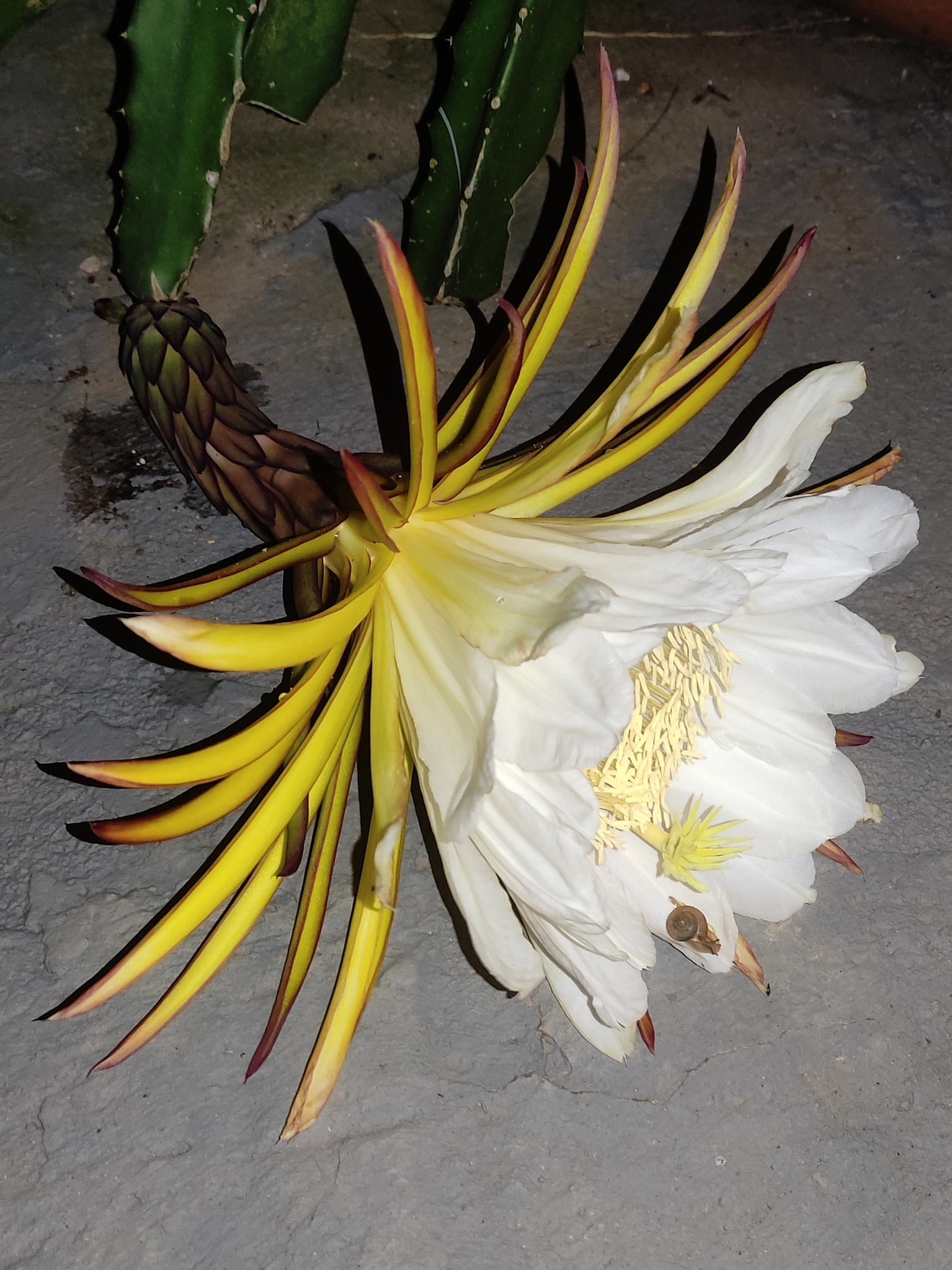
An exceptionally large flower is another distinctive feature: a long creamy-white floral tube and greenish outer tepals open into a bloom up to 35 cm (14 in) across. Each flower opens for just one night, mainly from late spring into early summer, and fades before sunrise the next day. 2 7
The pitaya fruit is an oval berry with pink or red scaly skin, measuring 6–12 cm (2.5–5 in) long. Its white flesh contains small edible black seeds. This white interior distinguishes the fruit of Selenicereus undatus from red-fleshed pitayas produced by other species in the same genus. 2 8
Useful taxonomy
Within Cactaceae, Selenicereus undatus is the accepted name. Older literature and horticultural labels frequently use the following synonyms and historical combinations:
- Cereus undatus Haw., the original published name, 1830;
- Hylocereus undatus (Haw.) Britton & Rose, long the commonly used name;
- Cactus triangularis var. aphyllus, an older synonym.
Phylogenetic evidence led to the inclusion of Hylocereus in Selenicereus in 2017. Nevertheless, Hylocereus undatus remains common on fruit packaging and in horticultural trade. These two names can therefore refer to the same species, rather than to two different kinds of dragon fruit. 8
IUCN assesses the species as Data Deficient. Its precise native range remains uncertain because genuinely wild populations are difficult to separate from old, widely distributed escapes from cultivation. This uncertainty concerns the evidence available for assessment rather than establishing a particular level of extinction risk. 4
Habitat and range
Southern Mexico to Honduras is the native range recognized by taxonomic references. There the cactus grows in Neotropical arid areas and dry tropical forest, as a hemiepiphyte or lithophyte, climbing tree trunks and rock faces. Its aerial-rooted climbing habit suits these natural supports. 1 6
Cultivation has a long history. People were already growing the plant on the Yucatán Peninsula before Europeans arrived, valuing both its edible fruit and its large ornamental flowers. That long relationship with cultivation also makes the original distribution harder to reconstruct precisely. 5
Outside its original range, the species remained a horticultural curiosity and was little known internationally before the 1990s. Its spread later accelerated in Southeast Asia, where Vietnam became the leading pitaya producer. This expansion concerns cultivated fruit production rather than the species' native distribution. 6
Grown in greenhouses or outdoors in warm regions, Selenicereus undatus has also naturalized in tropical territories including Réunion and Florida, where it appears on watch lists for escaped cultivated plants. Frost below 0 °C (32 °F) destroys the plant, restricting in-ground cultivation to USDA hardiness zones 10 and 11. 8 2
Life cycle and reproduction
Bats and moths pollinate the flowers at night. The species is largely self-incompatible, so commercial growing outside its native range often relies on hand pollination with a brush between two genetically different plants. A spectacular flower alone therefore does not guarantee a crop of fruit. 7 6
A successfully pollinated flower develops a fruit within a few weeks, sometimes weighing 700 g (1.5 lb). Without a strong vertical support, stems remain low and trailing. Flowering and fruiting maturity generally arrives 2–3 years after propagation by cuttings, on a trellis or trunk strong enough to carry the heavy stems. 7 2
At least 6 hours of direct sun per day favors regular flowering. In shade, stems remain thin and fail to flower. Light exposure is therefore a central consideration for a plant intended to produce fruit, rather than simply to grow vegetatively. 2
Cultivated plants are usually propagated by stem cuttings with a node. A 10–15 cm (4–6 in) segment is left to dry for a few days so the cut can heal before planting. Roots develop in 2–4 weeks. Seeds are also possible, but considerably delay the first flowers compared with vegetative propagation. 2
Uses and risks
Ripe fruit is eaten fresh, juiced or added to fruit salads. Unopened flower buds are sometimes cooked as a vegetable, particularly in China. The fruit and the ornamental flowers are distinct reasons for cultivating this large climbing cactus, even when the same plant serves both purposes. 5
ASPCA lists Selenicereus undatus as non-toxic to cats and dogs, and no toxic principle is documented for horses in this genus. The practical hazard is mechanical: chewing or swallowing a spine may irritate an animal's mouth or digestive tract, without an associated chemical poisoning mechanism. 3 2
Some traditional medical practices use stem sap and flowers in preparations for fever or lung complaints. These are traditional uses rather than a substitute for medical advice. The existence of such preparations should not be taken as evidence that a home treatment is effective or appropriate. 5
Varieties, look-alikes and related plants
Commercial pitayas with white flesh mostly belong to Selenicereus undatus. Red- or pink-fleshed fruits come from other species or hybrids, notably Selenicereus costaricensis and Selenicereus monacanthus, long grouped with undatus under Hylocereus. On the plant, skin changing from green to pink or red signals harvest readiness between summer and autumn. 8
Other frequent look-alikes include:
- Selenicereus grandiflorus, with angular ribbed stems rather than triangular ones, also called queen of the night;
- Selenicereus megalanthus, yellow pitahaya, with small yellow fruits covered in spiny scales;
- Epiphyllum oxypetalum, with flattened, spineless stems, often sold under the same night-flowering common names.
Check the full scientific name together with stem shape when buying a pitaya or a plant intended for fruit production. Triangular, spiny stems are the most useful visible reference for Selenicereus undatus. Shared night-flowering names alone do not reliably distinguish it from related ornamental cacti. 2
Main sources
- Plants of the World Online / Kew, Selenicereus undatus (Haw.) D.R.Hunt
- NC State Extension Gardener Plant Toolbox, Selenicereus undatus
- ASPCA, Pitaya toxicity entry
- IUCN Red List, Selenicereus undatus assessment 2017
- Useful Tropical Plants (PFAF network), Selenicereus undatus
- Pl@ntUse / Prota4U, Selenicereus undatus
- Wikipedia FR, Selenicereus undatus
- Wikipedia EN, Selenicereus undatus
Frequently asked questions
Is Selenicereus undatus a true cactus?
Yes. It belongs to the Cactaceae family, but is a climber from dry tropical forest rather than a compact desert cactus. Its triangular stems attach to supports with aerial roots.
Is dragon fruit toxic to cats and dogs?
No. ASPCA lists this species as non-toxic to cats and dogs. The small spines are the main risk because repeated chewing can mechanically irritate the mouth.
Why does my Selenicereus undatus flower without producing fruit?
The species is largely self-incompatible. Without a genetically different second plant or hand pollination with a brush, successful natural pollination is uncommon.
What is the difference between white and red pitaya?
Selenicereus undatus produces white-fleshed pitaya. Red- or pink-fleshed fruits come from other species in the genus, particularly Selenicereus costaricensis, long confused with undatus under the name Hylocereus.
How long does a Selenicereus undatus flower last?
Just one night. The flower opens at dusk, releases its scent for several hours and fades before sunrise the following day.
How do I propagate Selenicereus undatus?
A stem cutting with a node, dried for a few days before planting, is the quickest and most reliable method. Seeds also work but significantly delay first flowering.
Does Selenicereus undatus need a lot of sun?
Yes. Unlike some epiphytic cacti grown in light shade, this species needs direct full sun for normal flowering and fruiting.
Similar plants
If you are unsure about a plant’s toxicity, ask a botanist or veterinarian for advice.