
Tamarillo (Solanum betaceum, )
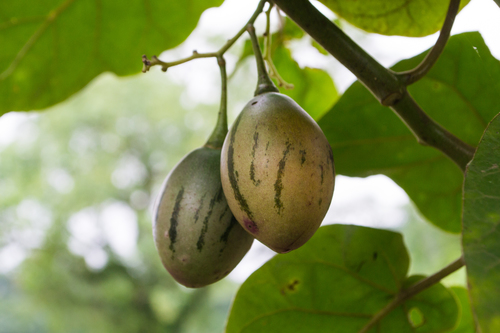
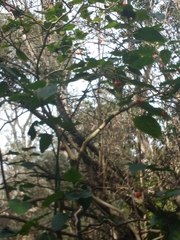

Tamarillo (Solanum betaceum), also called tree tomato, is an Andean shrub or small tree in the Solanaceae family. Native to the subtropical slopes of Colombia, Ecuador, Peru and Bolivia, it bears egg-shaped red, orange or yellow fruit eaten when ripe. Its foliage and green fruit remain irritant, as in many other nightshades.
Read moreTamarillo and Tree tomato
Allow a few hours of direct sun per day, preferably morning or evening.
Full sun to light partial shade



© photo
(c) Juan Peña, some rights reserved (CC BY-NC), uploaded by Juan Peña · cc-by-nc
Abril Bastons · cc-by-nc
Wikimedia Commons · CC BY-SA or Public Domain
Taken Sep 27, 2020 by Gonçalves Teresa (cc-by-sa)
Taken Sep 10, 2020 by codecas (cc-by-sa)
Taken Nov 17, 2014 by Tela Botanica − Liliane Roubaudi (cc-by-sa)
Taken Dec 21, 2011 by Tela Botanica − Yoan MARTIN (cc-by-sa)
© copyright of the Board of Trustees of the Royal Botanic Gardens, Kew.




Global distribution
Solanum betaceum is native to Andean slopes from Colombia to Bolivia, with traditional populations in Peru and Ecuador. Commercial cultivation later spread it to East Africa, Asia and Oceania, where it is introduced rather than native.
- Native4
- Introduced1
- Invasive1
- Colombia
- Ecuador
- Peru
- Bolivia
- New Zealand
- Australia (Victoria)
Hexagons: regions where the plant occurs. Green dots: native range.1
Identity
Tamarillo (Solanum betaceum Cav., 1799), also called tree tomato, is a shrub or small tree in the Solanaceae family, closely related to tomato and eggplant. Its epithet betaceum recalls the shape of a beet, although there is no close botanical relationship between them. 1 2
The commercial name tamarillo dates to 1966, when New Zealand’s Tree Tomato Promotions Council sought a subtropical-sounding word that would be easy to pronounce in several languages. It combines a Spanish-like sound with a Māori reference to Tama-te-kapua, captain of a founding canoe. From 1966, this coined name replaced “tree tomato,” considered too close to the supermarket vegetable to market a distinct fruit. 4
Recognition
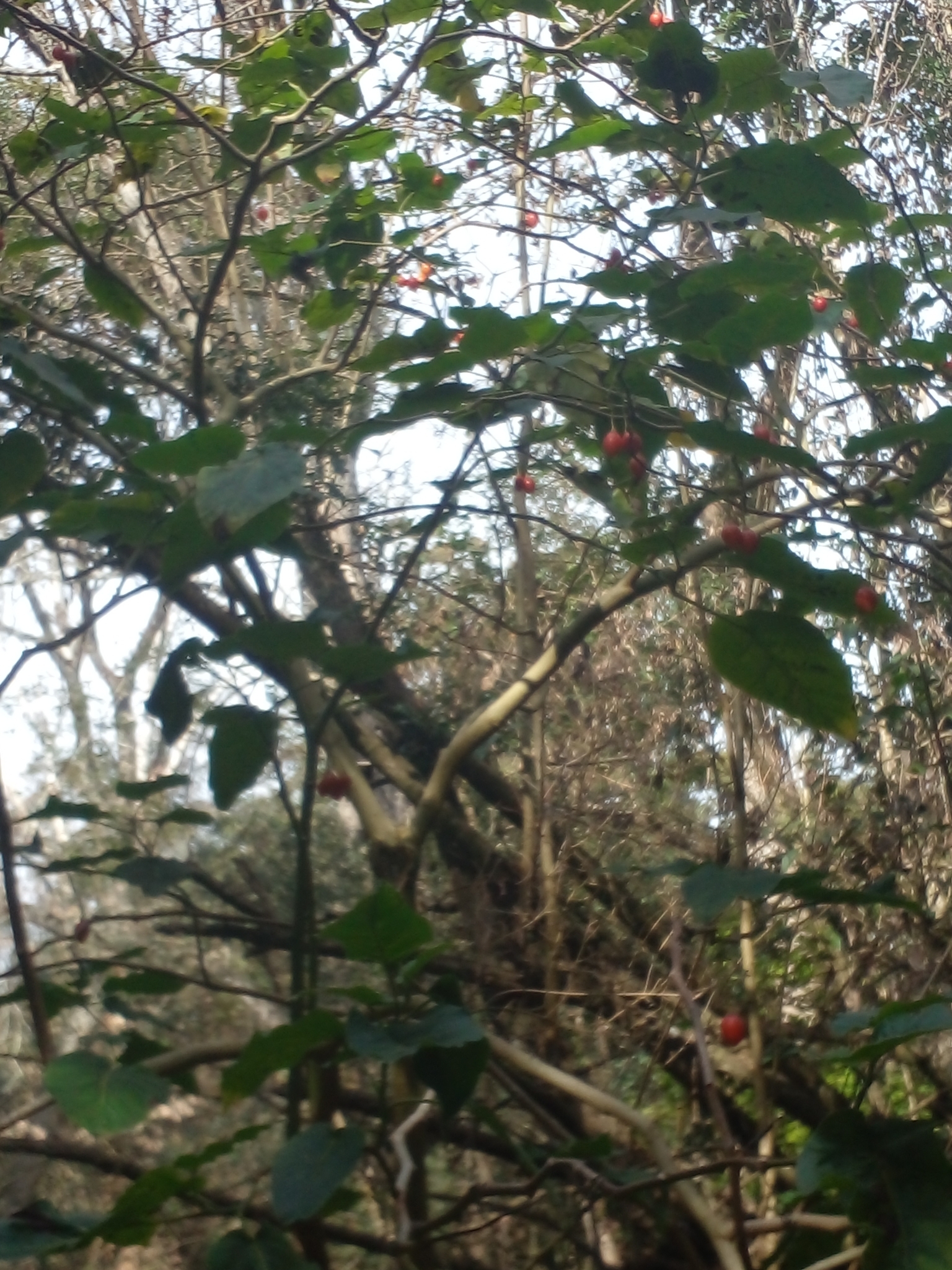
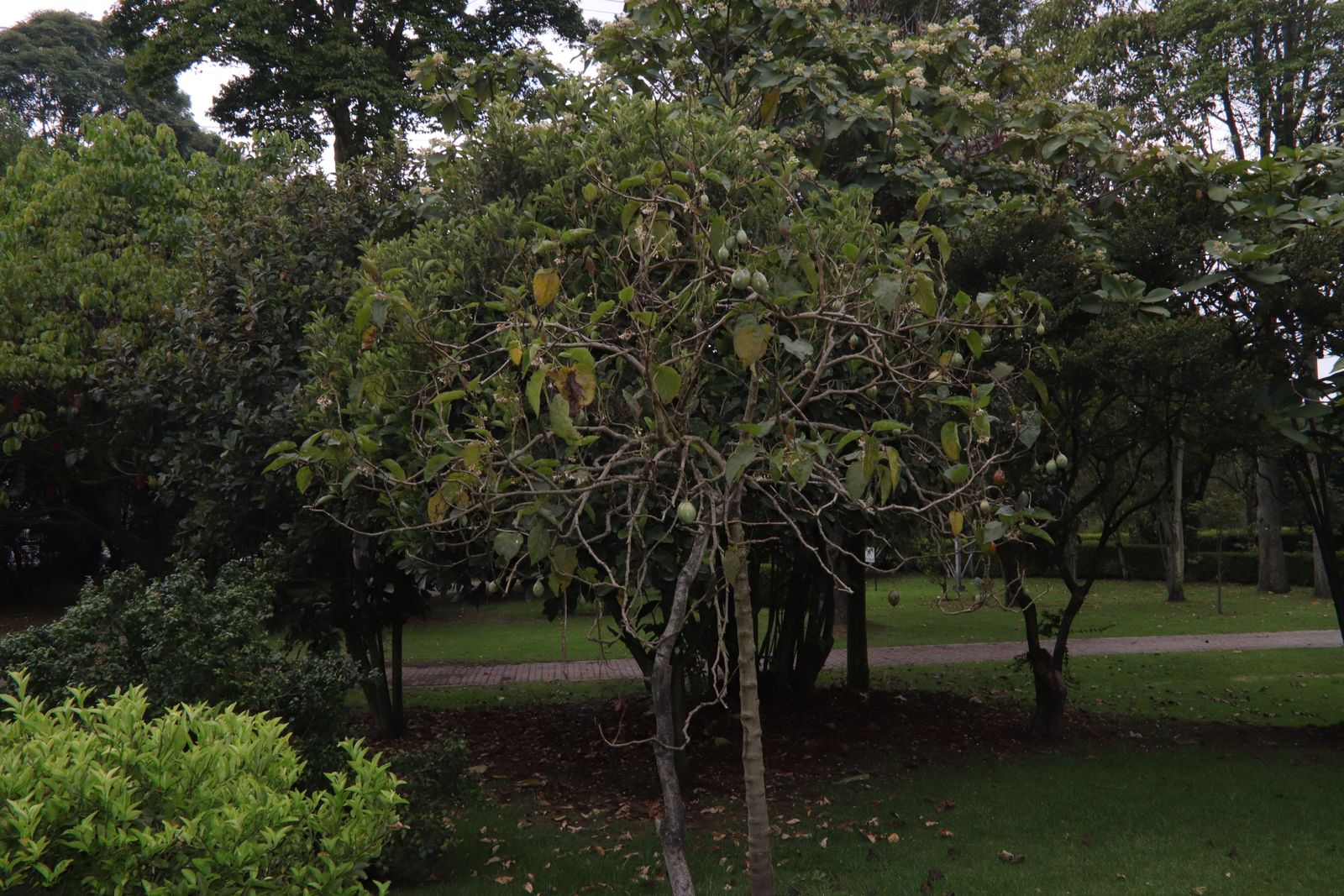
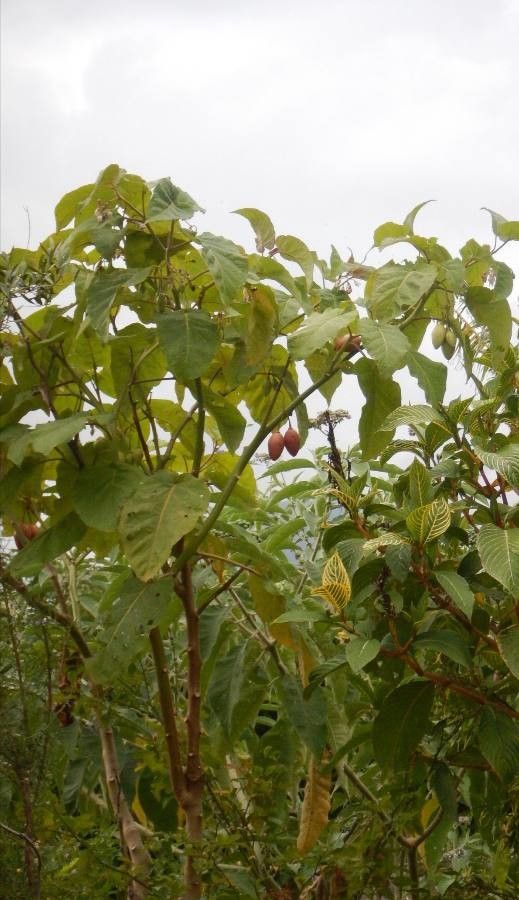
A single trunk with lateral branches gives Solanum betaceum its small-tree habit. It grows quickly to 3–5 m (10–16 ft), with grayish bark and brittle wood. Shallow roots leave it vulnerable to wind and drought. 6 3
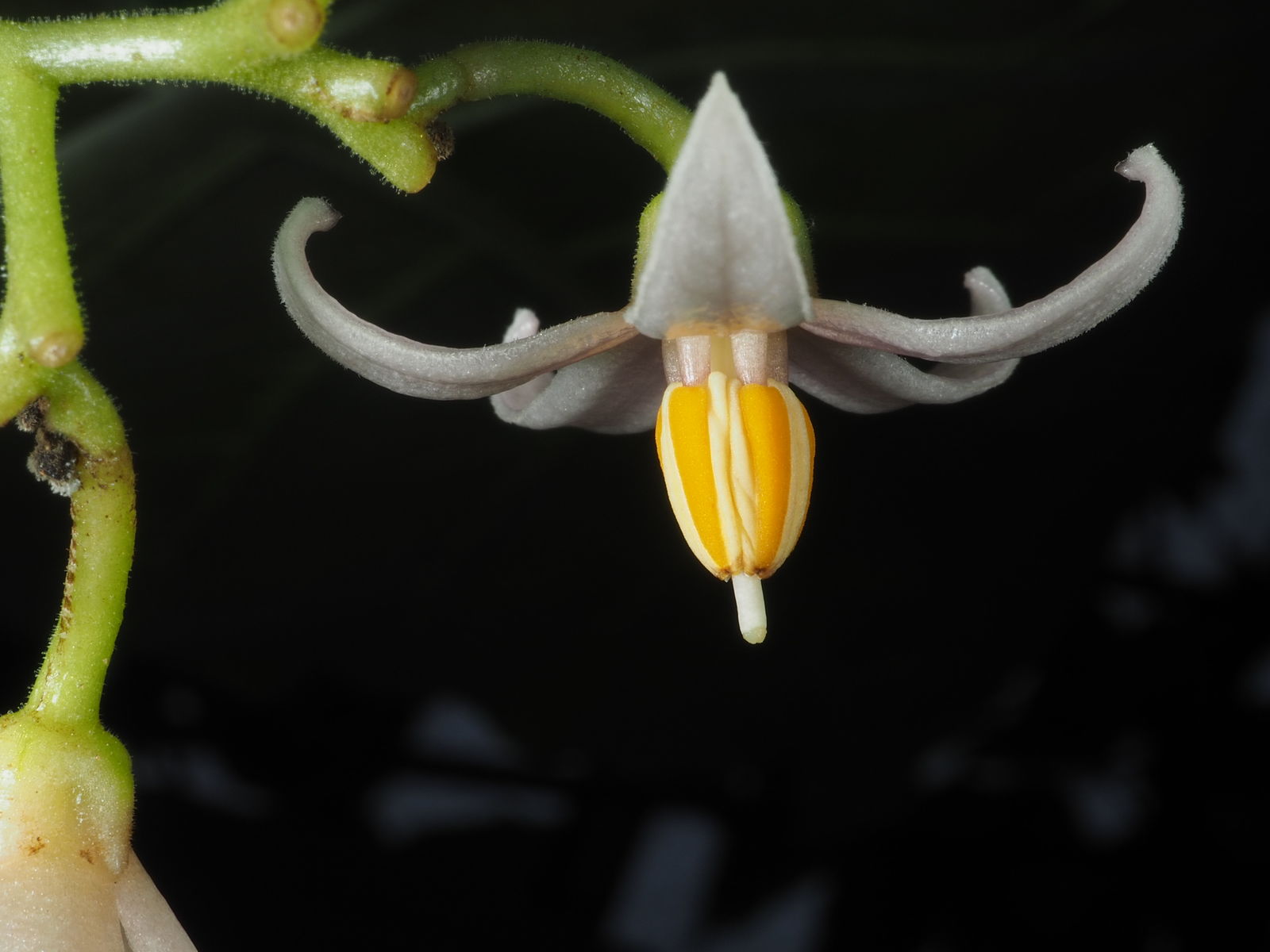
Broad leaves with heart-shaped bases measure 8–20 cm (3–8 in) long and release a strong, almost fetid smell when crushed. Fragrant flowers appear in clusters of 10–50, each with a pinkish-white, star-shaped corolla about 2 cm (0.8 in) across. 3 3 4
Egg-shaped berries measure 4–10 cm (1.6–4 in) long. Their smooth, satin-like skin may be yellow, orange, red or almost purple, sometimes with dark stripes. The orange flesh contains many seeds and has a tart flavor reminiscent of a slightly unripe tomato, followed by a resinous aftertaste. 6 4
Useful taxonomy
Kew accepts Solanum betaceum Cav. in the Solanaceae family. For more than a century the species was placed in another genus, and that older name remains common in horticultural catalogs and some databases: 1
- Cyphomandra betacea (Cav.) Sendtn. remains the homotypic synonym most often used in current horticultural catalogs, ahead of the following two names.
- Cyphomandra crassifolia Kuntze is also a recognized synonym but has little current horticultural use.
- Solanum crassifolium Ortega completes this group of historical names recognized by Kew.
Returning tamarillo to Solanum, as confirmed by Kew and the US GRIN database, formally places it alongside tomato and eggplant, its most widely cultivated relatives. 1 2
Habitat and range
Andean slopes from Colombia to Bolivia form its native range, with traditional populations in Peru and Ecuador at 1,500–3,000 m (4,900–9,800 ft). It favors subtropical rather than tropical conditions: annual temperatures of 15–20 °C (59–68 °F), rainfall of 600–4,000 mm (24–157 in) and light, deep soil. 3 6 4
Commercial cultivation carried the species far beyond the Andes. New Zealand introduced it in 1891 from Indian seed, became a major producer from around 1920 and later coined “tamarillo” for export. It is also grown in Kenya, Rwanda, Ethiopia, India and China. In Victoria, Australia, garden escapes have become locally naturalized along wet temperate forest edges. 6 4 3
Life cycle and reproduction
From seed, tamarillo germinates in 2–4 weeks and starts fruiting after 18 months to 2 years. Production peaks around the fourth year, while total lifespan ranges from 5–12 years, depending on climate and care. 4 6
Both seeds and cuttings are used for propagation. Seedlings develop an upright trunk suited to sheltered sites; cuttings produce lower, bushier plants better suited to windy locations. Fruit ripens about 2–3 months after flowering, which may continue almost year-round in favorable climates. 6 3
Uses and risks
Ripe tamarillos can be halved and eaten with a spoon, or made into juice, jam, chutney and sauces. Sweeter yellow fruit is used in Ecuadorian ceviches, while tarter red fruit is more often used in desserts. The bitter skin is rarely eaten raw. 4 6
Green tamarillo parts require the same caution as those of many other Solanaceae: the skin of immature fruit and the rest of the plant contain solanine-type glycoalkaloids. Several Solanum species are too toxic for unguarded household use, warranting caution even without a dedicated entry for tamarillo itself. The ASPCA has no tamarillo-specific listing, but identifies tomato, a related nightshade with a similar toxic mechanism, as toxic to cats, dogs and horses. Precautions used for tomato foliage also apply to unripe tamarillo. 5 7 8
Varieties, look-alikes and related plants
Two fruit forms dominate trade: the widespread, tarter red form and the sweeter yellow or golden form, valued in Ecuador. The regional Naga tree tomato, grown in Nagaland, India, under the local names si binyano and khwüdi, has a protected geographical indication. 4
The plants most often confused with tamarillo are:
- Solanum quitoense, naranjilla, another tree-like Andean Solanum with edible fruit;
- Solanum mammosum, whose inedible fruit has a vaguely similar outline;
- Solanum lycopersicum, tomato, an herbaceous relative with markedly smaller fruit.
The single woody trunk of Solanum betaceum, absent from Solanum lycopersicum, readily separates it from tomato. Smooth fruit measuring 4–10 cm (1.6–4 in) and the fetid smell of crushed foliage help distinguish it from Solanum quitoense and Solanum mammosum.
Main sources
- Plants of the World Online / Kew, Solanum betaceum Cav.
- USDA ARS GRIN Global, Solanum betaceum taxonomy record
- VicFlora / Royal Botanic Gardens Victoria, Solanum betaceum
- Wikipedia (EN), Tamarillo
- Wikipedia (FR), Tamarillo
- Purdue Center for New Crops, Morton, Fruits of Warm Climates — Tree Tomato
- NC State Extension Gardener Plant Toolbox, Solanum genus
- ASPCA, Toxic and Non-Toxic Plants — Tomato Plant
Frequently asked questions
Are tamarillo and tree tomato the same plant?
Yes. Tamarillo and tree tomato both refer to Solanum betaceum. Tamarillo was coined as a commercial name in New Zealand in 1966 to replace tree tomato, which sounded too much like the familiar supermarket vegetable.
Is tamarillo toxic to cats and dogs?
The foliage and unripe green fruit contain solanine-type glycoalkaloids, as in many Solanaceae. Fully ripe fruit is the edible part; keep green parts away from animals.
Can you eat tamarillo skin?
The smooth, satin-like skin is edible on ripe fruit but much more bitter than the flesh. Most preparations discard it by halving the fruit and scooping out the pulp.
How much cold can tamarillo tolerate?
The shrub tolerates brief frosts down to -2 °C, below which its aboveground parts die. In temperate climates, growing it in a pot and bringing it indoors for winter is more reliable than planting it in the ground.
How do red and yellow tamarillos differ?
They are two commercial forms of the same species. The more common red form has tarter flesh; the sweeter yellow or golden form is favored in Ecuador for ceviches and condiments.
Can tamarillo grow in France?
It is grown on Réunion, where it is called tomate de la Paz and the subtropical climate suits it. In mainland France, frost sensitivity below -2 °C restricts outdoor planting to the mildest regions; elsewhere it needs a conservatory or heated greenhouse.
Which plants resemble Solanum betaceum?
The most frequent look-alikes are Solanum quitoense, the Andean naranjilla, and Solanum lycopersicum, the tomato. Its tree-like habit, the strong smell of crushed leaves and fruit size are the most reliable distinctions.
Similar plants
If you are unsure about a plant’s toxicity, ask a botanist or veterinarian for advice.