
Japanese pagoda tree (Styphnolobium japonicum, )
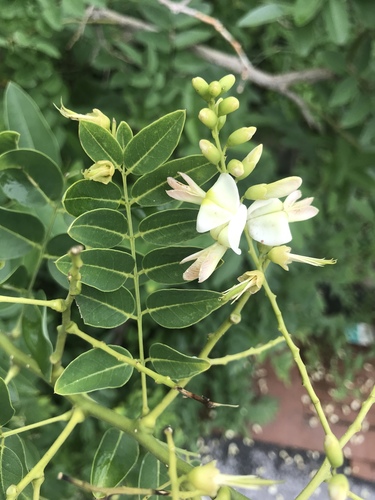

Japanese pagoda tree (Styphnolobium japonicum) is a large deciduous tree in the Fabaceae family, cultivated in Europe since the 18th century despite its Chinese and Korean origins. Late summer flowering, when most other trees have finished blooming, and hanging bead-like pods distinguish it.
Read moreJapanese pagoda tree, Chinese scholar tree, Scholar tree and Pagoda tree
Allow a few hours of direct sun per day, preferably morning or evening.




© photo
(c) Michael Ellis, some rights reserved (CC BY), uploaded by Michael Ellis · cc-by
Iehllmore · CC BY-NC
Wikimedia Commons · CC BY-SA or Public Domain
Taken Aug 27, 2021 by R. de Castro Ricardo (cc-by-sa)
Taken Oct 10, 2019 by Fedan Hacizade (cc-by-sa)
Taken Apr 8, 2022 by Corredoira Marta (cc-by-sa)
Taken Feb 26, 2022 by Ha Anna (cc-by-sa)
© copyright of the Board of Trustees of the Royal Botanic Gardens, Kew.


Global distribution
The native range of Styphnolobium japonicum covers central, southern and eastern China and Korea, despite an epithet suggesting Japan. Introduced to Europe in the 18th century and later spread worldwide as an ornamental and avenue tree, it is now almost exclusively cultivated there. In the United States it is reported as an emerging invasive threat in parts of the Mid-Atlantic region.
- Native2
- Introduced1
- China
- South Korea
- United States
Hexagons: regions where the plant occurs. Green dots: native range.1
Identity
Japanese pagoda tree (Styphnolobium japonicum (L.) Schott, 1829), also called Chinese scholar tree, scholar tree or pagoda tree, is a large deciduous tree in Fabaceae, subfamily Faboideae. Despite its common name, it is not native to Japan. Wild populations grow in central, southern and eastern China, as well as Korea. 1 3
An error about its origin survives in the scientific name. Carl Linnaeus named the species Sophora japonica in 1767 from a herbarium specimen he mistakenly believed had been collected in Japan. Botanist Heinrich Wilhelm Schott transferred it to Styphnolobium in 1829. A French common name meaning “honey tree” refers instead to its late flowers, highly attractive to bees when few other trees still offer nectar. 8
Recognition
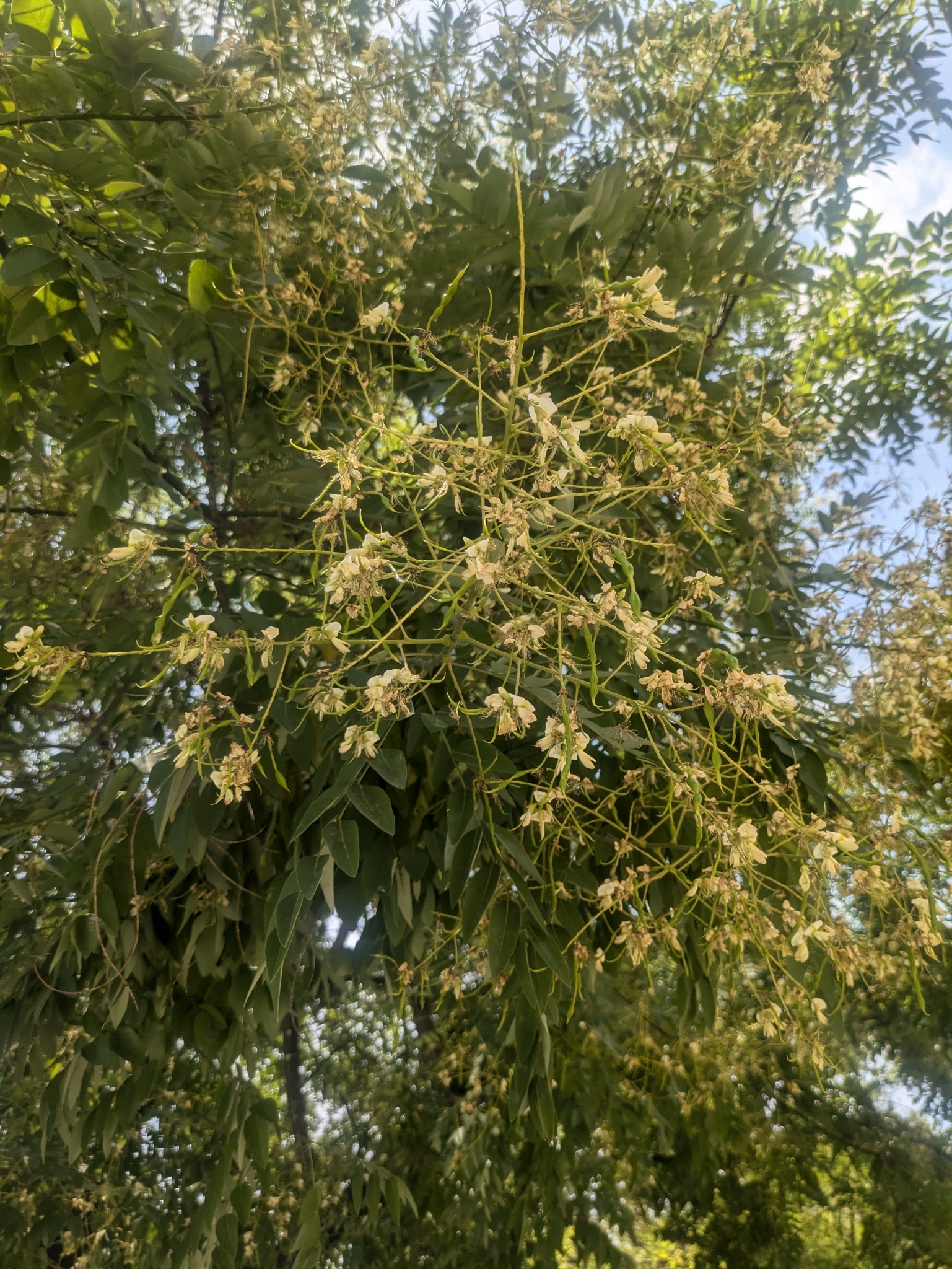
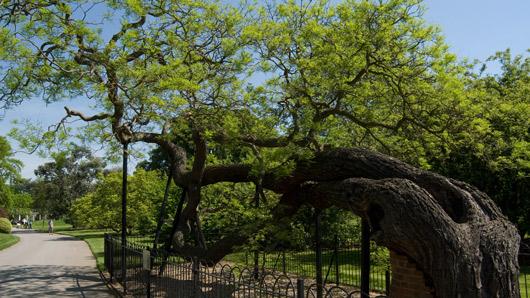
Mature trees commonly stand 15–25 m (49–82 ft) tall, with a spreading crown 10–20 m (33–66 ft) wide and an often short trunk. Gray-brown bark becomes fissured and cracked with age. Young shoots remain pale green for 3–4 years before turning brown. 4 2
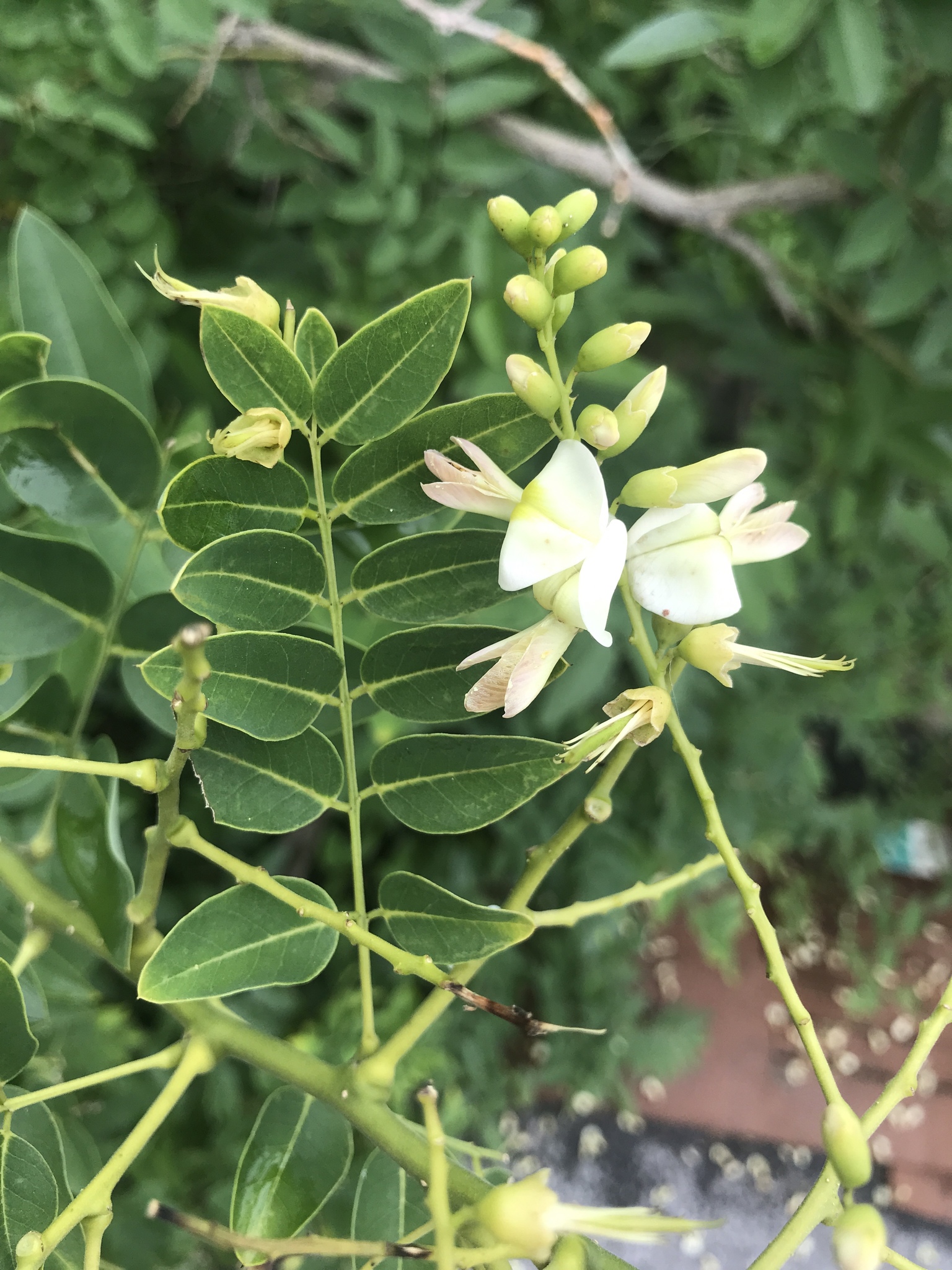
Deciduous, alternate, pinnate leaves carry 7–17 oval leaflets, glossy dark green above and paler below. The whole leaf often exceeds 25 cm (10 in) long. Foliage stays green late into fall, followed by a modest final yellowing rather than a vivid display of autumn colors. 3
Late, fragrant summer flowers open in the period corresponding to July–August in the Northern Hemisphere. Small cream-colored, pea-like blooms gather in broad terminal panicles 15–30 cm (6–12 in) long. The hanging pods that follow are constricted between seeds, like strings of beads. They turn brown in fall and remain on the tree well into winter. 4 2
Useful taxonomy
Under POWO/WCVP, the accepted name is Styphnolobium japonicum (L.) Schott. It is the only member of its genus widely cultivated outside its native range. The basionym and several older combinations remain common, particularly in horticulture and older botanical literature:
- Sophora japonica L., the original name (basionym)
- Sophora japonica var. pubescens (Tausch) Bosse, an older variety name
- Sophora japonica f. pendula Lodd. ex Sweet, an older form name
- Sophora japonica f. violacea (Carrière) Zabel, another older form name
Nurseries and older catalogs still widely use Sophora japonica, even though the accepted botanical name changed genera in 1829. For identification, the epithet japonicum or japonica, together with the Fabaceae family, therefore remains a useful point of reference across those older and newer names. 1 6
Habitat and range
Open ground in a temperate climate supports wild Japanese pagoda trees, often at 300–1,000 m (980–3,280 ft) elevation in western China. 5
European plantings date from the 18th century. The species is now almost exclusively cultivated there as an ornamental, avenue or shade tree, valued for tolerating urban pollution and drought once established. Japanese pagoda tree is among the common street trees in Paris. 4 8
Seeds of an “unknown tree” reached Paris from China in 1747, sent by Jesuit missionary Pierre Nicolas Le Chéron d’Incarville to Bernard de Jussieu, then superintendent of the royal garden. A tree grown from them, planted in what is now the Jardin des Plantes, did not flower until 1779. That first flowering finally allowed the Paris seedlings to be linked to Linnaeus’s species. Now more than 270 years old, it ranks among Europe’s oldest known trees. 8
Parts of the United States Mid-Atlantic region report the species as an emerging invasive threat, with seedlings sometimes colonizing waste ground and woodland edges. In France, by contrast, it remains confined to urban plantings, with no reported spontaneous colonization. These observations describe regional behavior rather than a uniform status wherever the tree is grown. 4
Life cycle and reproduction
Seed-grown trees need maturity before flowering, generally 20–30 years, sometimes longer. A specimen planted young in a city may therefore require as much as 30 years before its first bloom. The long wait can reflect the tree’s age rather than a failure of establishment. 2 5
Bees strongly favor the nectar-rich flowers at a time in summer when nectar elsewhere is becoming scarce. After pollination, the flowers develop into fleshy pods that ripen slowly toward fall, turn brown and remain on the branches for a substantial part of winter. 8 4
Propagation mainly uses seed, soaked first in hot water, or heel cuttings of semiripe shoots taken in summer, corresponding to July–August in the Northern Hemisphere. The weeping cultivar 'Pendula', which almost never flowers, is propagated exclusively by grafting onto a tall stem. 5
Uses and risks
Ornamental planting is the tree’s main role: avenues, solitary specimens and shade trees in parks all make use of its broad crown. Japanese pagoda tree tolerates urban pollution and compacted city soils well, helping explain its frequent use in streets and public spaces. 4
Seeds and pods contain cytisine, an alkaloid toxic if swallowed. Reported symptoms include digestive upset and agitation, with more severe effects possible after large quantities are ingested. The foliage and flowers do not present this same risk and are also harvested for traditional uses. 3
Traditional Chinese medicine uses the flower buds and dried pods for high blood pressure and circulatory disorders. The leaves are also a source of rutin, a flavonoid found at a higher concentration than in buckwheat, the more usual commercial source of this compound. These are accounts of traditional use and plant chemistry. 5
Varieties, look-alikes and related plants
Three cultivars dominate horticultural trade, each with a distinct habit or flowering pattern. 'Pendula' is a weeping form always grafted onto a tall stem, with rare or almost absent flowering. 'Regent', a North American selection, grows faster and flowers earlier and more abundantly than the species type. 'Princeton Upright' is a patented columnar form suited to urban sites where planting width is restricted.
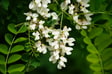
Black locust, Robinia pseudoacacia, is the closest common source of confusion. Both trees have pinnate compound leaves and white pea-like flowers. Three features distinguish black locust: spring flowering, thorns on young shoots and deeply furrowed bark. Japanese pagoda tree has no thorns and flowers later, during summer.
Main sources
- Plants of the World Online / Kew, Styphnolobium japonicum (L.) Schott
- Royal Horticultural Society, Styphnolobium japonicum
- Missouri Botanical Garden Plant Finder, Styphnolobium japonicum
- North Carolina Extension Gardener Plant Toolbox, Styphnolobium japonicum
- Plants For A Future, Styphnolobium japonicum
- GBIF Backbone Taxonomy, Styphnolobium japonicum (L.) Schott
- International Plant Names Index, Styphnolobium japonicum (L.) Schott
- The Conversation / MNHN, What is this tree in my city? The Japanese pagoda tree
Frequently asked questions
Does Japanese pagoda tree really come from Japan?
No. Styphnolobium japonicum is native to central, southern and eastern China and Korea. Its epithet comes from a herbarium specimen that Linnaeus mistakenly believed had been collected in Japan when he named the species in 1767.
Is Japanese pagoda tree toxic?
The seeds and pods contain cytisine, an alkaloid toxic if swallowed, with possible digestive upset and agitation. The foliage and flowers do not pose that risk and are also harvested for traditional uses.
Why is my young Japanese pagoda tree not flowering?
Flowering usually begins only 20–30 years after sowing, sometimes later. A tree planted while young in a city can therefore take several decades to flower for the first time.
How can I tell Japanese pagoda tree from black locust?
Both have pinnate compound leaves and white pea-like flowers. Black locust flowers in spring and has thorns on young shoots; Japanese pagoda tree is thornless and flowers in late summer.
Is Japanese pagoda tree invasive?
In the United States, it is reported as an emerging invasive threat in parts of the Mid-Atlantic region. In France, it remains largely confined to urban plantings and is not documented as invasive.
Does Japanese pagoda tree have medicinal uses?
Traditional Chinese medicine uses its flower buds and dried pods for high blood pressure and circulatory disorders. The leaves also provide rutin, a flavonoid found at higher concentrations than in buckwheat.
How does Pendula differ from the usual Japanese pagoda tree?
The cultivar Pendula is a weeping form always grafted onto a tall stem, with hanging branches and rare or absent flowering. Its growing requirements remain those of the species.
Similar plants
If you are unsure about a plant’s toxicity, ask a botanist or veterinarian for advice.