
Wax apple (Syzygium samarangense, )
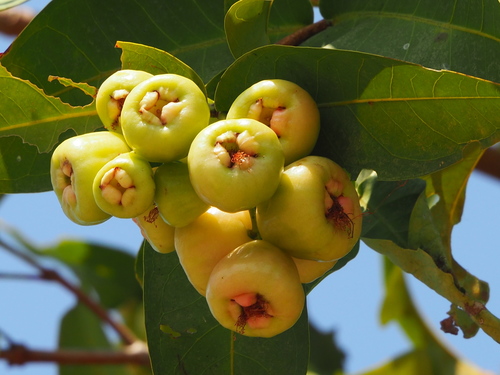

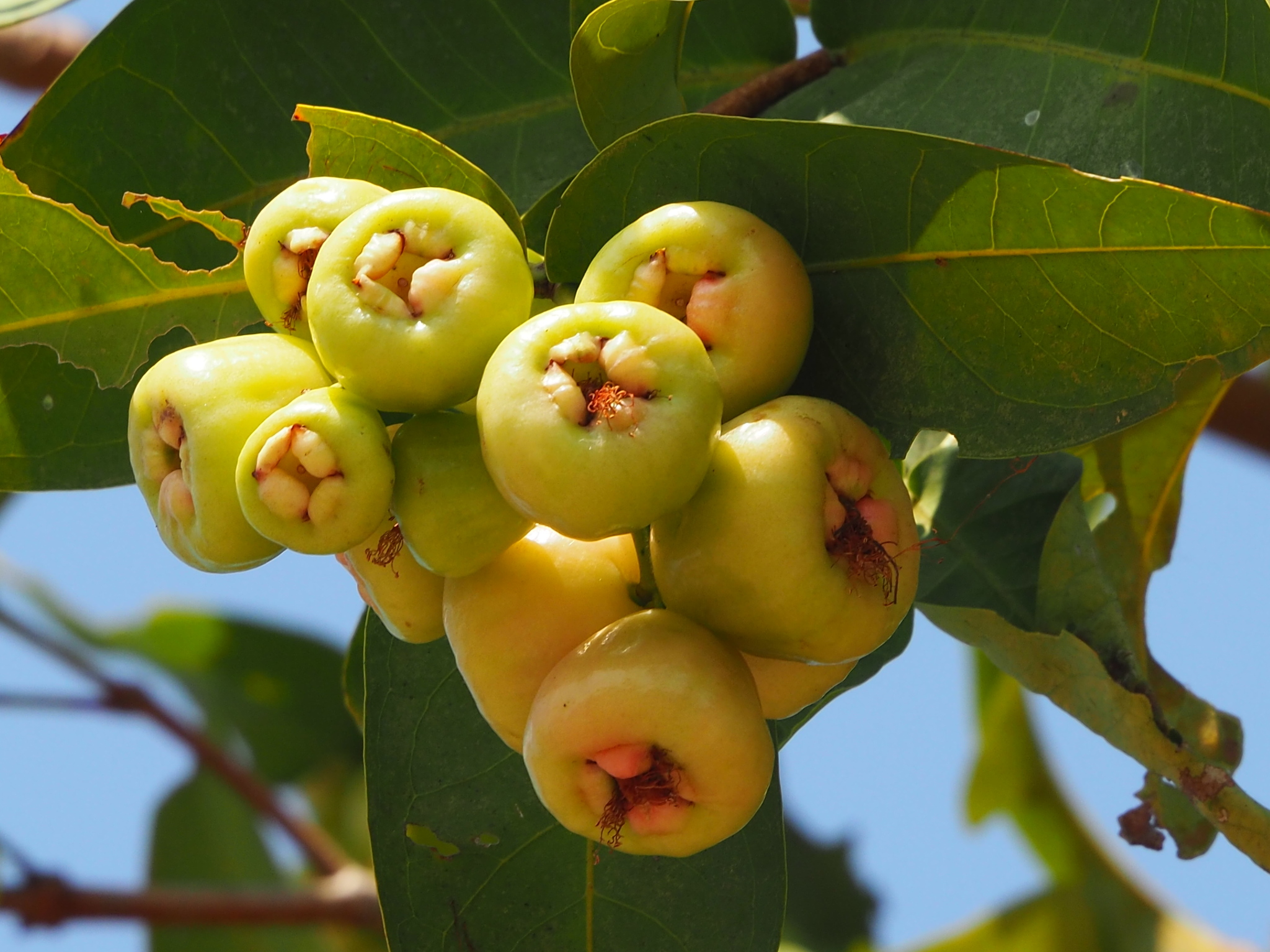
Wax apple (Syzygium samarangense) is an evergreen fruit tree in the Myrtaceae family, originating in the Malay Peninsula and the Andaman and Nicobar Islands. Its bell- or pear-shaped fruit has very thin, waxy skin and four fleshy calyx lobes at the tip. Widely spread through the tropics since ancient times, it is also known as Java apple and wax jambu.
Read moreWax apple, Java apple, Wax jambu, Semarang rose-apple, Java rose apple and Makopa



© photo
no rights reserved, uploaded by 葉子 · cc0
Wikimedia Commons · CC BY-SA or Public Domain
Wikipedia · CC BY-SA
Taken Oct 16, 2021 by Munashe Madez (cc-by-sa)
Taken Feb 12, 2001 by Tela Botanica − Liliane Roubaudi (cc-by-sa)
© copyright of the Board of Trustees of the Royal Botanic Gardens, Kew.




Global distribution
USDA GRIN lists Myanmar, Thailand, Indonesia, Malaysia, the Philippines, Papua New Guinea and the Solomon Islands as native range. Other sources place the original range more narrowly in the Malay Peninsula and the Andaman and Nicobar Islands, with prehistoric spread elsewhere. The difference chiefly reflects the difficulty of dating such ancient introductions.
- Native6
- Introduced2
- Malaysia
- Indonesia
- Philippines
- Thailand
- Papua New Guinea
- India (Andaman and Nicobar Islands)
- Hawaii (United States)
- Australia
Hexagons: regions where the plant occurs. Green dots: native range.1
Identity
Wax apple (Syzygium samarangense (Blume) Merr. & L.M.Perry, 1938), also known as Java apple and wax jambu, is an evergreen fruit tree in the Myrtaceae family and genus Syzygium. The epithet samarangense refers to Semarang, a port in Java where the tree had long been cultivated before its formal botanical description. 3 9
Four fleshy, persistent calyx lobes at the fruit tip offer a reliable identification feature when buying wax apples. They are more consistent than skin color, which ranges from pale red to creamy white or almost black among varieties. 4
Carl Ludwig Blume first described the species as Myrtus samarangensis in 1826; Merrill and Perry transferred it to Syzygium in 1938. The name wax apple describes the ripe fruit’s thin, glossy, waxy skin. Its sheen differs from the matte skin of a Malus apple, to which wax apple has no close botanical relationship. 1 2
Recognition
An open, spreading crown sits above a short trunk in this evergreen tree, commonly reaching 12 m (39 ft) tall. The trunk measures 25–30 cm (10–12 in) across and has pinkish-gray bark that flakes off in thin plates. 2 4
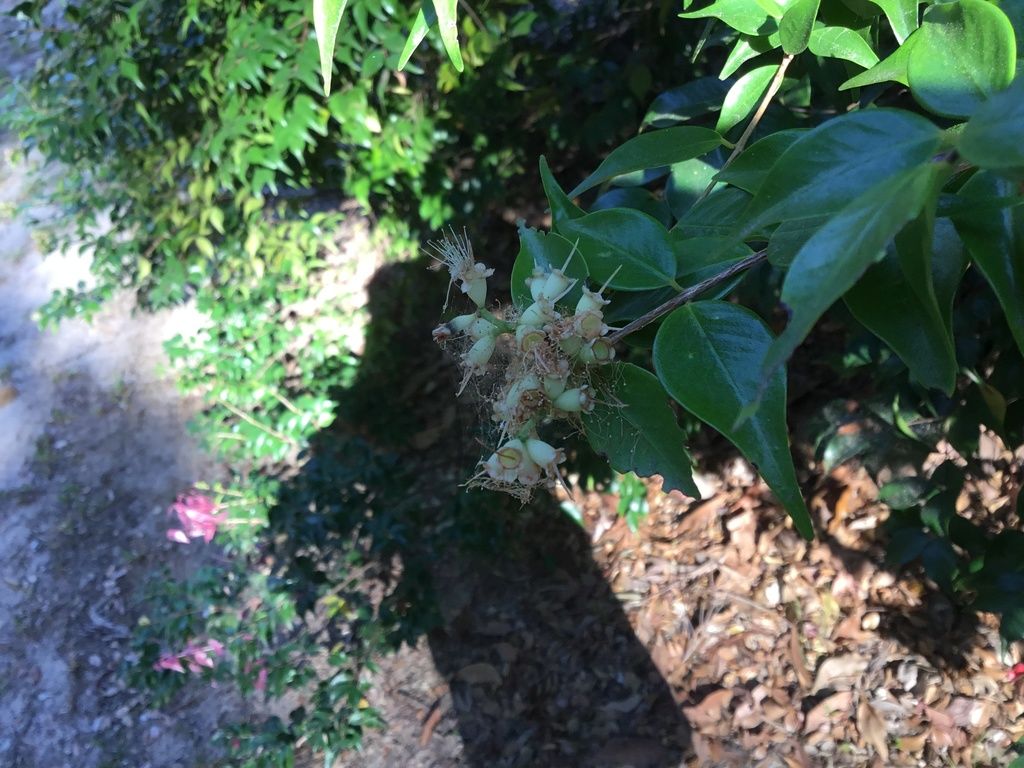
Opposite, elliptical to oblong leaves are 10–25 cm (4–10 in) long and release a distinct aromatic scent when crushed. White to yellowish flowers grow in fragrant panicles of 3–30, each with four petals and numerous stamens 1.5–2.5 cm (0.6–1 in) long. 2
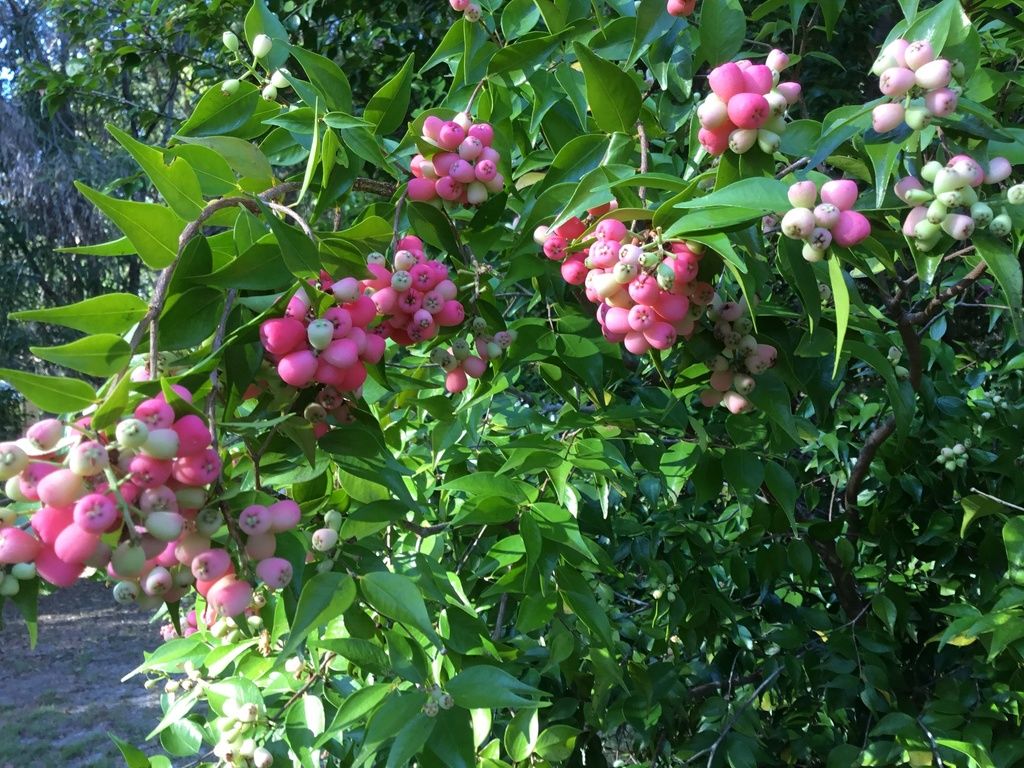
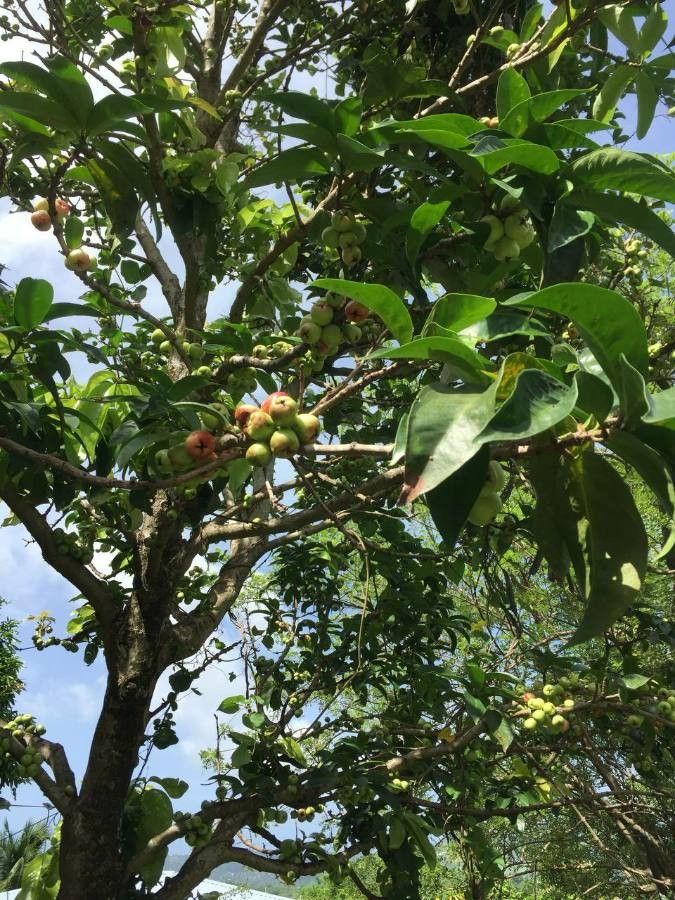
Bell- or pear-shaped fruit measures 4–6 cm (1.6–2.4 in) long. Its exceptionally thin, waxy skin may be pale red, creamy white, pale green or almost black. White, spongy, crisp flesh surrounds zero to two small seeds less than 1 cm (0.4 in) across. The four fleshy calyx lobes remaining at the tip distinguish wax apple more reliably than color. 4 5
Useful taxonomy
Nearly a thousand species belong to Syzygium, making it one of the largest tropical tree genera. In horticultural literature, Syzygium samarangense has long circulated as Eugenia javanica, a confusion that still appears on some commercial labels. 3
Principal botanical synonyms encountered in older accounts include:
- Myrtus samarangensis Blume, the original name
- Eugenia samarangensis (Blume) O.Berg, an earlier combination
- Jambosa samarangensis (Blume) DC., an older combination
- Eugenia javanica Lam., a name used in horticultural literature
For a consistent identification, use the name accepted by POWO, Syzygium samarangense, published by Merrill and Perry in 1938. 1
Habitat and range
USDA GRIN describes a native range extending from Myanmar and Thailand to Indonesia, the Philippines, Papua New Guinea and the Solomon Islands. Other sources locate the original range more narrowly in the Malay Peninsula and the Andaman and Nicobar Islands, followed by prehistoric spread elsewhere in that wider area. 3 8 2
Dating an introduction this ancient is difficult, which largely explains the difference between those accounts rather than a fundamental scientific dispute. Wax apple grows at elevations up to 1,300 m (4,265 ft) with annual rainfall of 1,500–2,300 mm (59–91 in), favoring well-drained soil at pH 6–7.5. 4
Cultivation now extends widely through Taiwan and mainland Southeast Asia to Réunion. The IUCN assesses wax apple as Least Concern, and Hawaii’s HPWRA screening program considers its invasion risk low. 6 7
Life cycle and reproduction
Fresh seed can propagate wax apple, but results are variable. Seeds are often partly sterile and must be sown soon after removal from the fruit because their viability falls rapidly. 4
Commercial growers in Southeast Asia chiefly use air layering, which brings trees into bearing considerably sooner than seed propagation. Grafting onto Syzygium densiflorum or rose apple (Syzygium jambos) offers another way to retain a commercial variety’s characteristics. 2
Air-layered or grafted trees flower in 2–5 years, compared with 5–6 years from seed. Under stable tropical conditions, an established mature tree can yield up to 700 fruits per crop. Harvest timing depends on location, running from March to May in Sri Lanka, May to June in India and June to August in Java. 2
Uses and risks
Unripe wax apple is salted or cooked in sauces in several Southeast Asian cuisines. Ripe fruit is eaten fresh, skin included, for its juicy crunch, a texture compared with sliced miniature watermelon. 5 2
Tannin-rich flowers have traditionally been brewed into an astringent tea for fever and diarrhea. Weak antibiotic activity has also been observed in laboratory work; this observation is distinct from an established treatment effect in people. 4
No toxicity is documented in cats, dogs or humans, and the fruit is a common food in producing regions. Crop damage is the main practical concern in humid climates: anthracnose, caused by Colletotrichum fungi, and fruit flies can spoil the harvest. Netting over the crown during fruiting keeps fruit flies away without chemical treatment. This preventive step is simpler to apply than treating established anthracnose with a contact fungicide. 4
Varieties, look-alikes and related plants
Fruit color provides the main distinction between commercial wax apple varieties. The Thai cultivar Srinark, introduced to Florida in 1960, is a longstanding benchmark alongside Kong Wan Pink and Delima, pink-fruited selections with sweet flesh. Nearly black fruit sold as Black Pearl in Taiwan remains uncommon beside the red and pink varieties more widely available at markets. 5
Two close relatives cause frequent confusion. Malay apple, Syzygium malaccense, has larger, bright red fruit; rose apple, Syzygium jambos, has a pronounced rose scent and sometimes serves as rootstock for S. samarangense. Wax apple’s four persistent calyx lobes and very thin skin provide steadier clues than fruit color, which varies considerably among varieties. 2
Main sources
- Plants of the World Online / Kew, Syzygium samarangense (Blume) Merr. & L.M.Perry
- Purdue University NewCrop, Morton, Java Apple (Syzygium samarangense)
- USDA GRIN Global Taxonomy, Syzygium samarangense (Blume) Merr. & L.M.Perry
- Useful Tropical Plants Database, Syzygium samarangense
- Growables.org, Wax Jambu (Syzygium samarangense)
- IUCN Red List, Syzygium samarangense assessment 2018
- Plant Pono / HPWRA, Syzygium samarangense — low-risk screening dated 26 April 2013; original page archived 12 June 2026
- National Tropical Botanical Garden, Syzygium samarangense
- INPN, Syzygium samarangense (wax apple) species account
Frequently asked questions
Is wax apple poisonous?
No toxicity is documented in cats, dogs or humans. The fruit and flowers are traditionally eaten in producing regions.
Why is it called wax apple?
The name describes the very thin, waxy, glossy skin of ripe fruit. The skin is eaten without peeling, unlike that of many other tropical fruits.
How does it differ from Malay apple?
Malay apple, Syzygium malaccense, produces larger, bright red fruit. Wax apple has four persistent calyx lobes and much thinner skin.
Can you eat unripe wax apple?
Yes, in some Southeast Asian cuisines. Unripe fruit is salted or cooked in sauces; ripe fruit is eaten fresh for its juicy, crisp flesh.
How long until the first harvest?
An air-layered or grafted tree can flower in 2–5 years, compared with 5–6 years from seed. An established mature tree can yield up to 700 fruits per crop.
What climate suits wax apple?
The tree needs tropical or warm subtropical conditions, USDA zones 10–12. Damage occurs below 7 °C (45 °F), and frost near 0 °C (32 °F) is fatal, limiting outdoor cultivation in temperate climates.
Similar plants

If you are unsure about a plant’s toxicity, ask a botanist or veterinarian for advice.