
Eastern hemlock (Tsuga canadensis, )
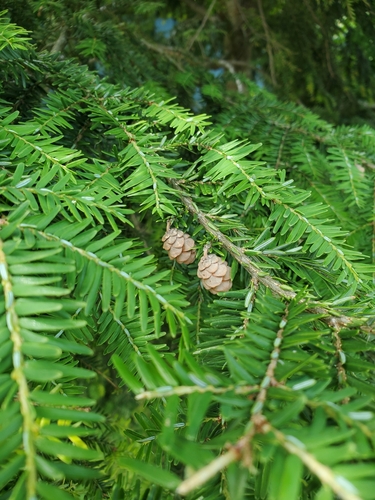
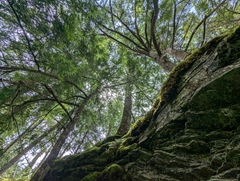
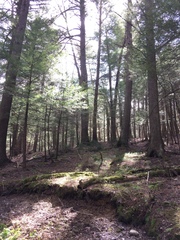
Eastern hemlock (Tsuga canadensis) is a large conifer in the Pinaceae family, native to cool, moist forests of eastern North America. Short, flat needles arranged in two rows, tiny hanging cones and exceptional shade tolerance distinguish it. It is unrelated to poisonous hemlock; the tree is now threatened by the hemlock woolly adelgid, a sap-feeding insect from Asia.
Read moreEastern hemlock, Canadian hemlock, Eastern hemlock-spruce and Canada hemlock


© photo
(c) jaskir, some rights reserved (CC BY-NC), uploaded by jaskir · cc-by-nc
iNaturalist User · cc0
naturalist charlie · cc0
Taken Nov 14, 2018 by Tela Botanica − Lydie Dufeu (cc-by-sa)
Taken Nov 22, 2020 by Otakar Pitrmuc (cc-by-sa)
Taken Aug 19, 2019 by Melissa Melissa Keneely (cc-by-sa)
Taken Oct 29, 2021 by Fortier Marie-Josée (cc-by-sa)
Taken May 15, 2022 by Tristan Jaton-Maria (cc-by-sa)
© copyright of the Board of Trustees of the Royal Botanic Gardens, Kew.




Global distribution
Tsuga canadensis ranges from Nova Scotia and southern Quebec to northeastern Minnesota, then south along the Appalachians to northern Georgia and Alabama. It mainly occupies cool ravines, north-facing slopes and stream banks, rarely wind-exposed ridges. Introduced to Europe as an ornamental in the 18th century, it remains cultivated there without notable naturalization.
Identity
Eastern hemlock (Tsuga canadensis (L.) Carrière, 1855) is a large conifer in the Pinaceae family, commonly reaching 20–30 m (66–98 ft) in its native range. Carl Linnaeus first described it in 1763 as Pinus canadensis. The French botanist Elie-Abel Carrière transferred it to Tsuga in his 1855 work on conifers, and that combination remains accepted today. 1 2
The genus name Tsuga comes from Japanese and originally refers to a related species, Tsuga sieboldii. Also known as Canadian hemlock or Canada hemlock, this tree ranges far south of Canada, reaching Georgia and Alabama along the Appalachians. 7 8
Recognition
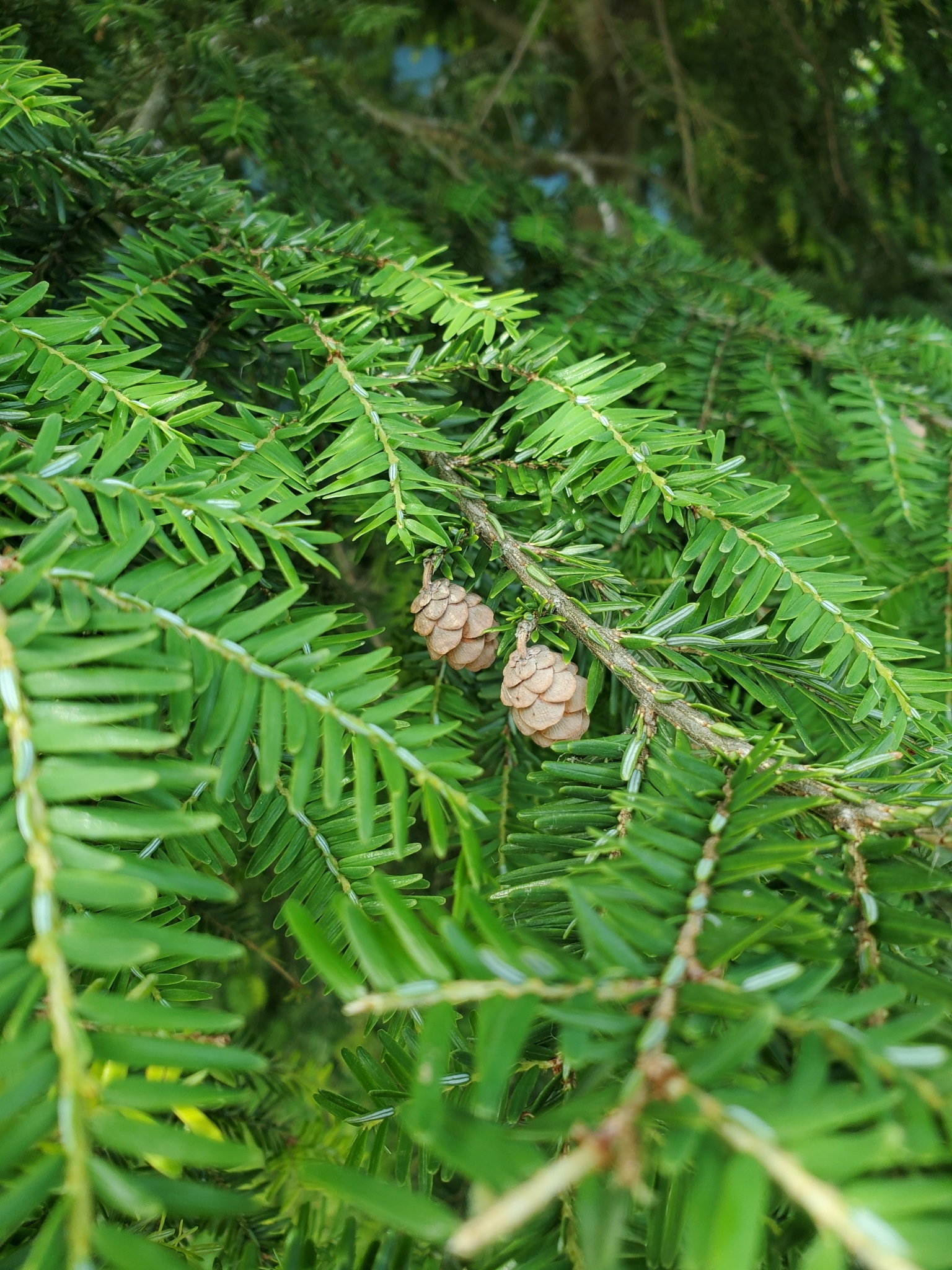
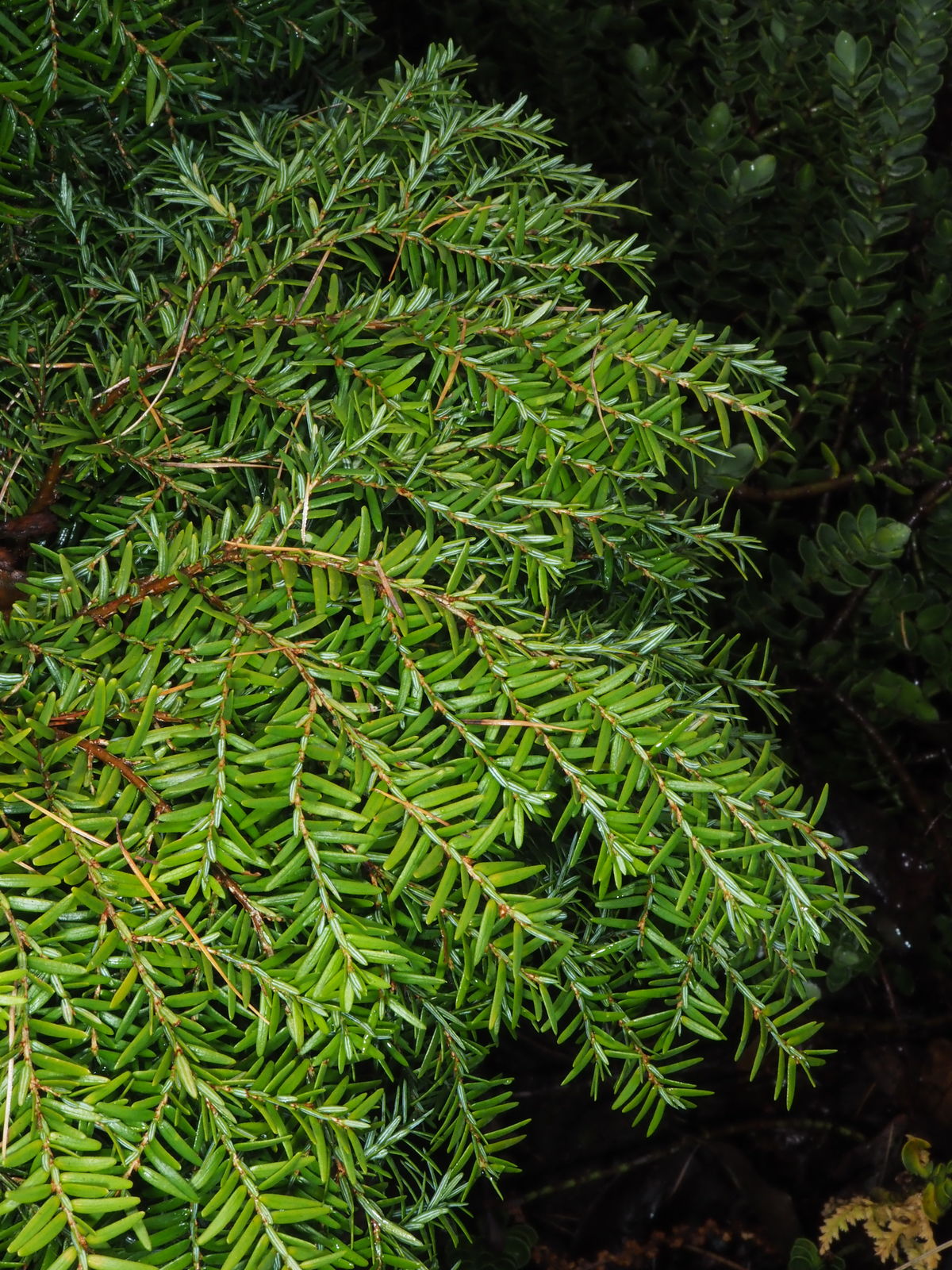
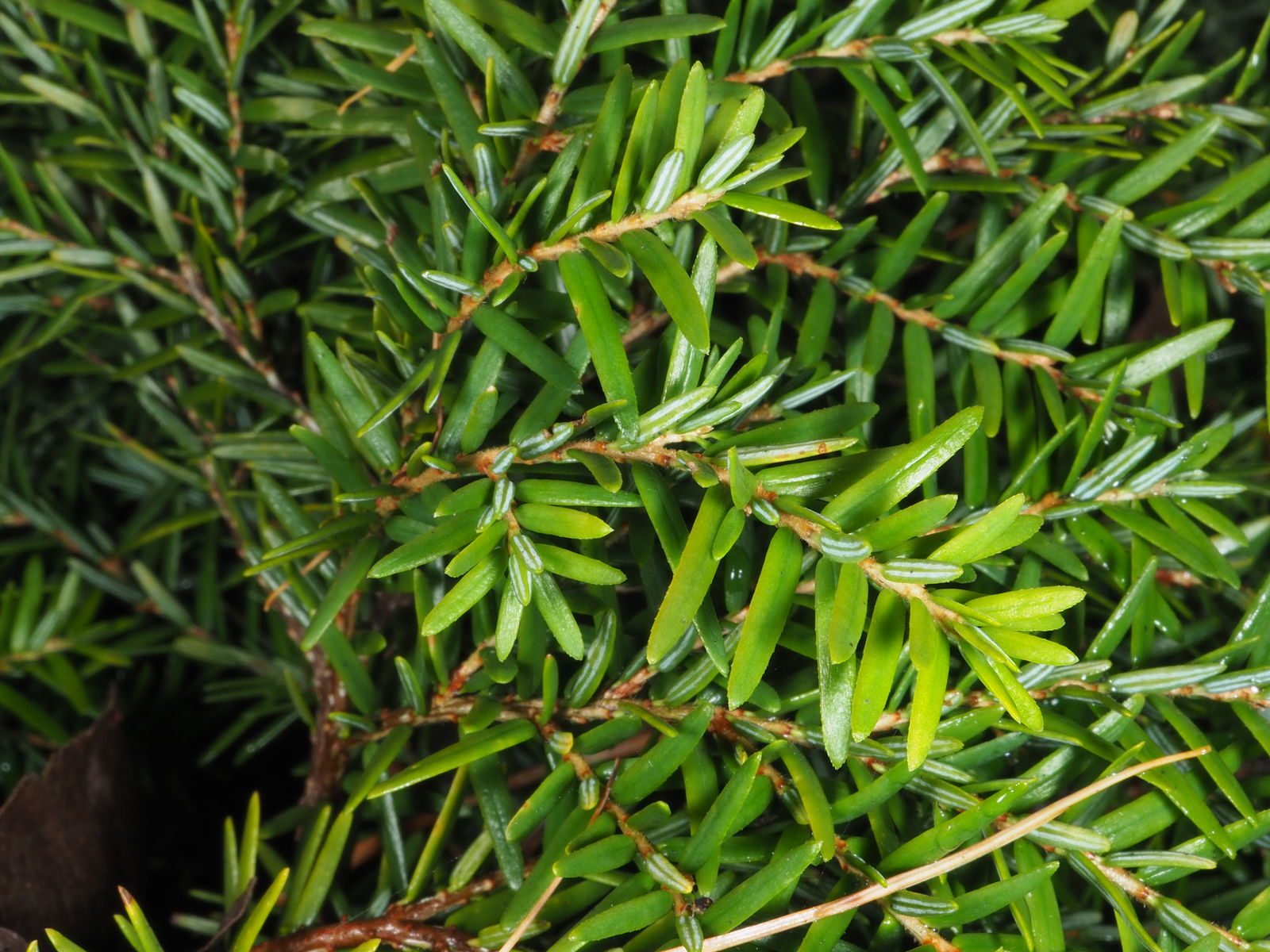
Short, flat needles, 1–2 cm (0.4–0.8 in) long, lie in two clear rows on opposite sides of the twig. Two distinct white bands mark the undersides, contrasting with the dark green upper surfaces. The flattened arrangement, compared with the rounder appearance of fir or spruce shoots, is a useful field clue even without cones. 4 6
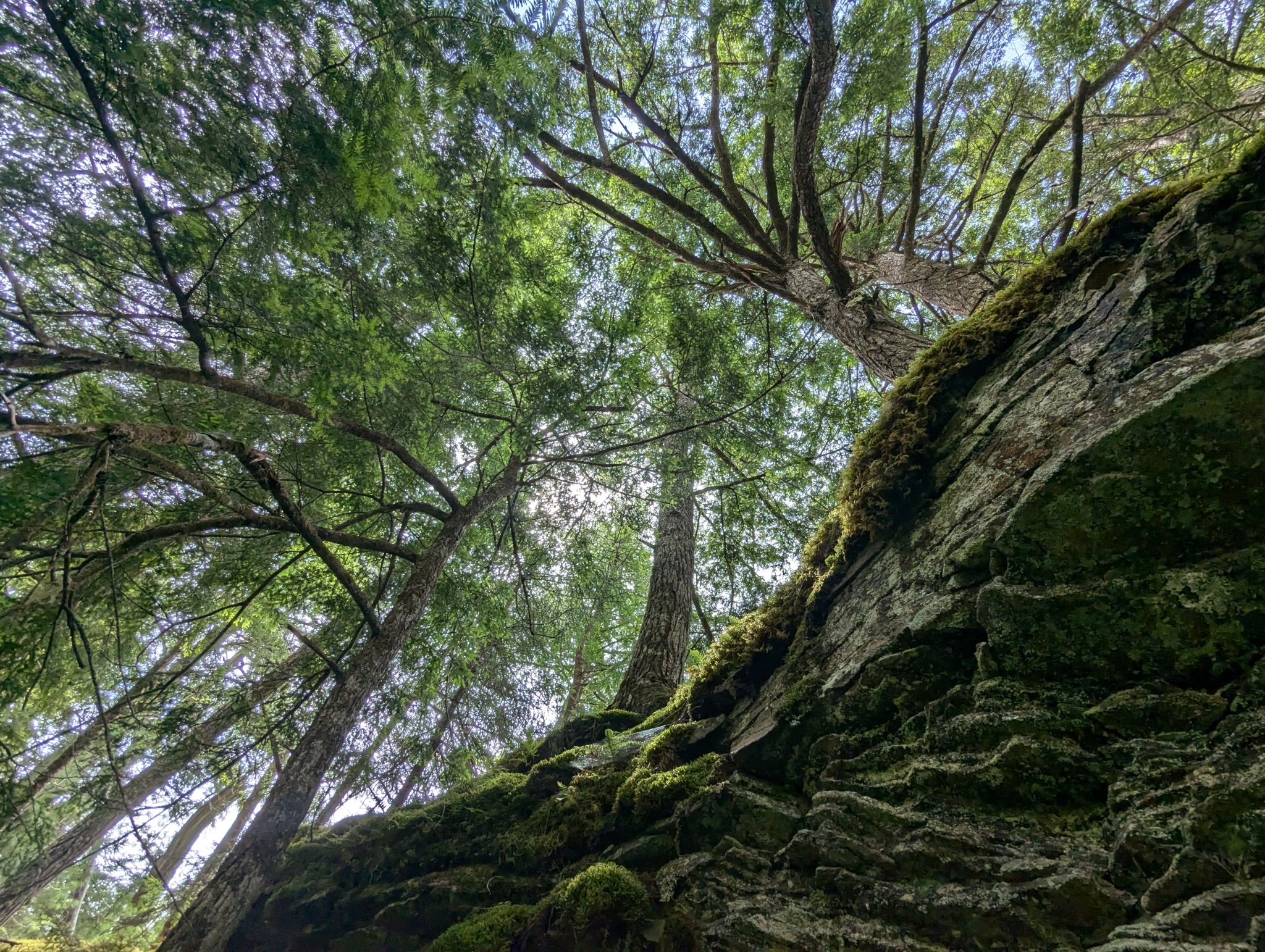
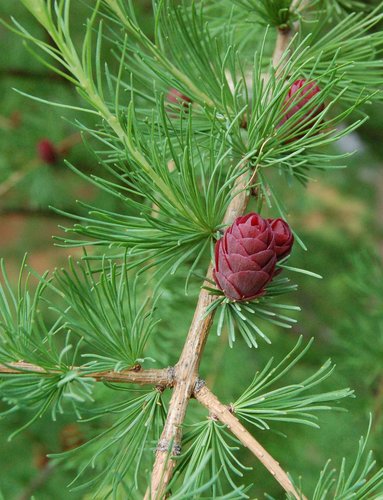
Oval, hanging cones are only 1.5–2.5 cm (0.6–1 in) long in the typical species, among the smallest in Tsuga and the entire Pinaceae family. Bark is reddish brown to gray-brown, thick and deeply furrowed on old trees. A flexible, drooping leader often marks the crown of a young tree, an almost unique feature among conifers of this size. 4 7
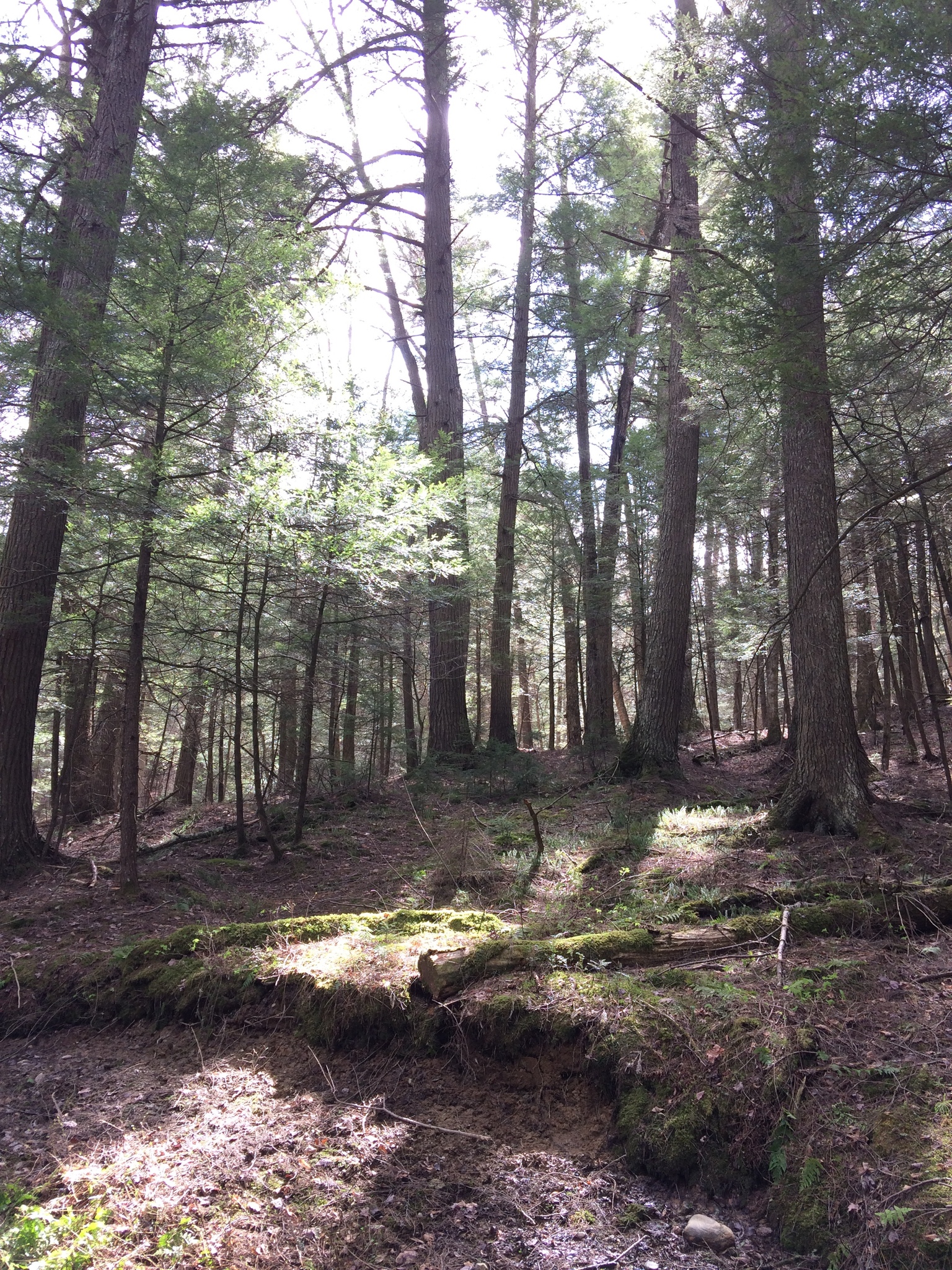
Mature trees commonly stand 20–30 m (66–98 ft) tall, with exceptional specimens exceeding 50 m (164 ft) in the Great Smoky Mountains. Their pyramidal crowns spread 7–12 m (23–39 ft). Young trees grow slowly in the understory because the species tolerates dense shade better than most other North American conifers. 8 10
Useful taxonomy
The combination Tsuga canadensis traces back to Linnaeus’s description as Pinus canadensis in the second edition of Species Plantarum in 1763. Carrière transferred it to Tsuga in 1855, 92 years after the original description. Principal synonyms include:
- Pinus canadensis L., the basionym
- Abies canadensis (L.) Poir.
- Tsuga canadensis var. pendula Beissn., the earliest described weeping variety
For consistent identification, use the accepted scientific name Tsuga canadensis. Worldwide, Tsuga comprises about ten species distributed between North America and temperate Asia, including the closely related Tsuga heterophylla, or western hemlock, distinguished by larger cones. 1 2
Habitat and range
From Nova Scotia and southern Quebec, eastern hemlock extends west to northeastern Minnesota and south along the Appalachians to northern Georgia and Alabama. It mainly occupies cool ravines, north-facing slopes and stream banks, rarely ridges exposed to wind or drought. 7 10
Soil should be moist, humus-rich and well drained, acidic to neutral, with an ideal pH of 4.5–6.5. In excessively lime-rich soil, growth slows sharply and needles become paler, a sign of stress that can precede patchy dieback on poorly sited trees. Exceptional shade tolerance makes this an understory tree or climax species in old forests, able to regenerate beneath dense cover where most other conifers cannot. 3 5
British gardens received the species in the 18th century, and it remains widely cultivated as an ornamental in Europe without notable naturalization outside its native range. Within that range, however, conditions have deteriorated. The hemlock woolly adelgid (Adelges tsugae), a sap-feeding insect introduced from East Asia in 1924, was detected in the native range in the late 1960s. It has since devastated thousands of hectares, especially in the southern Appalachians. 7 9
Life cycle and reproduction
As a monoecious gymnosperm, Tsuga canadensis bears separate male and female cones on each tree, with wind carrying the pollen. Small female cones form at branch tips and mature within one season. Their winged seeds are released in fall and dispersed by wind; after cold stratification, sown seeds germinate in 4–8 weeks, often unevenly. 8 6
Centuries of life are possible for an individual trunk. A specimen felled at Tionesta, Pennsylvania, was dated by its growth rings to at least 554 years, one of the highest documented ages for the species in its native range. 10
Forestry and garden propagation mainly use seed, with cold stratification improving often uneven germination. Ornamental cultivars are instead propagated from semi-ripe cuttings taken in late summer to preserve their dwarf or weeping habit. 6 3
Uses and risks
Bark rich in tannins (8–14%) once supplied a major raw material for North American leather tanning, driving the felling of large stands before synthetic tannins became widespread. Today the soft, coarse-grained wood is used mainly for construction, crates and paper pulp. Its ability to hold nails well is also useful for railroad ties. 6 8
Despite sharing the name hemlock with poison hemlock (Conium maculatum, associated with Socrates’s death), Tsuga canadensis is botanically unrelated to that poisonous herb. Early English-speaking settlers considered the crushed foliage similar in smell, giving rise to the shared name. The tree is non-toxic to people and domestic animals; its bark and young shoots have traditionally been used for teas rich in vitamin C. 5 11
Ecological decline is the principal current threat. The IUCN lists eastern hemlock as Near Threatened because of the severe losses caused by the hemlock woolly adelgid in native stands. 9
Varieties, look-alikes and related plants
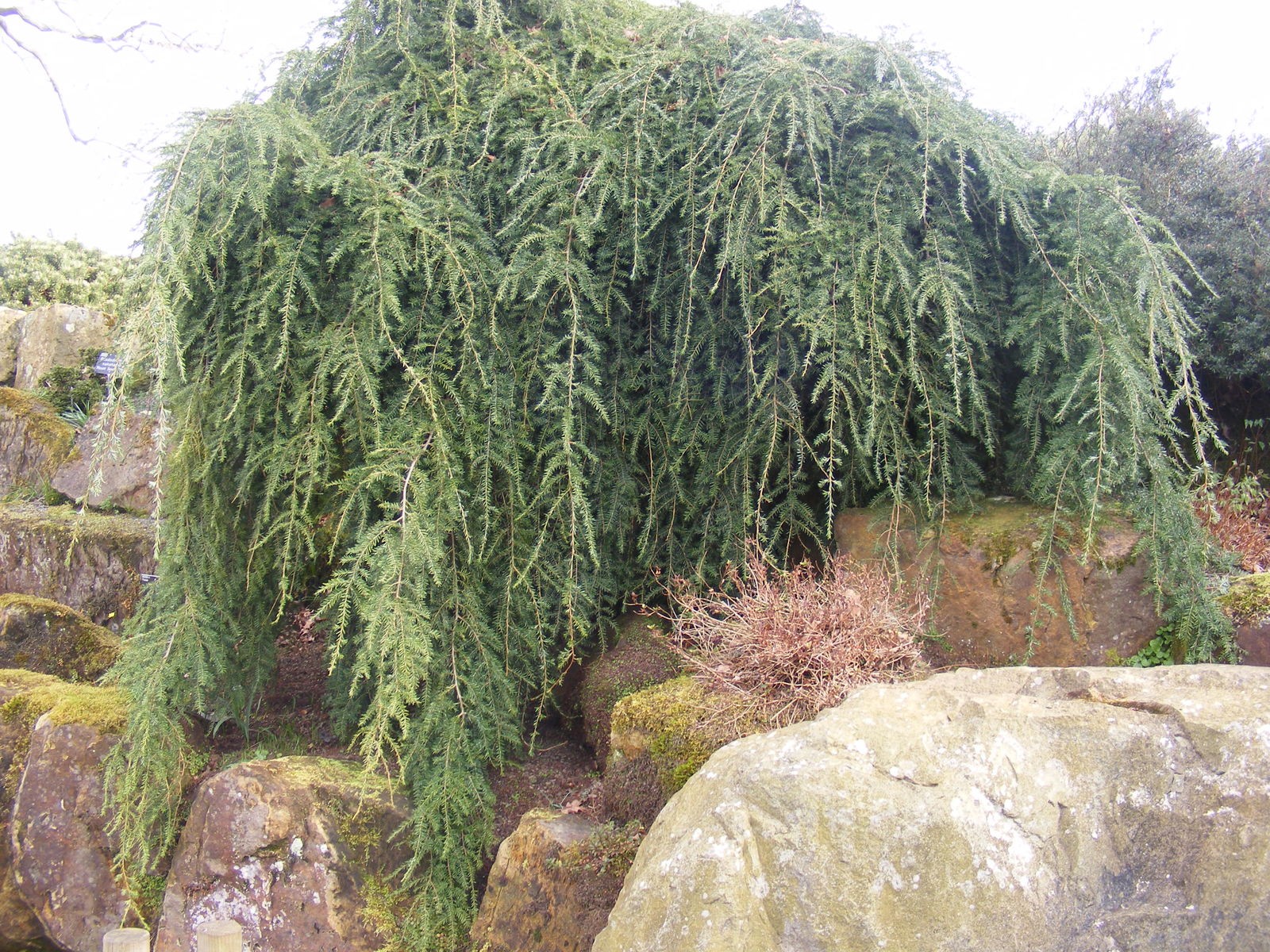
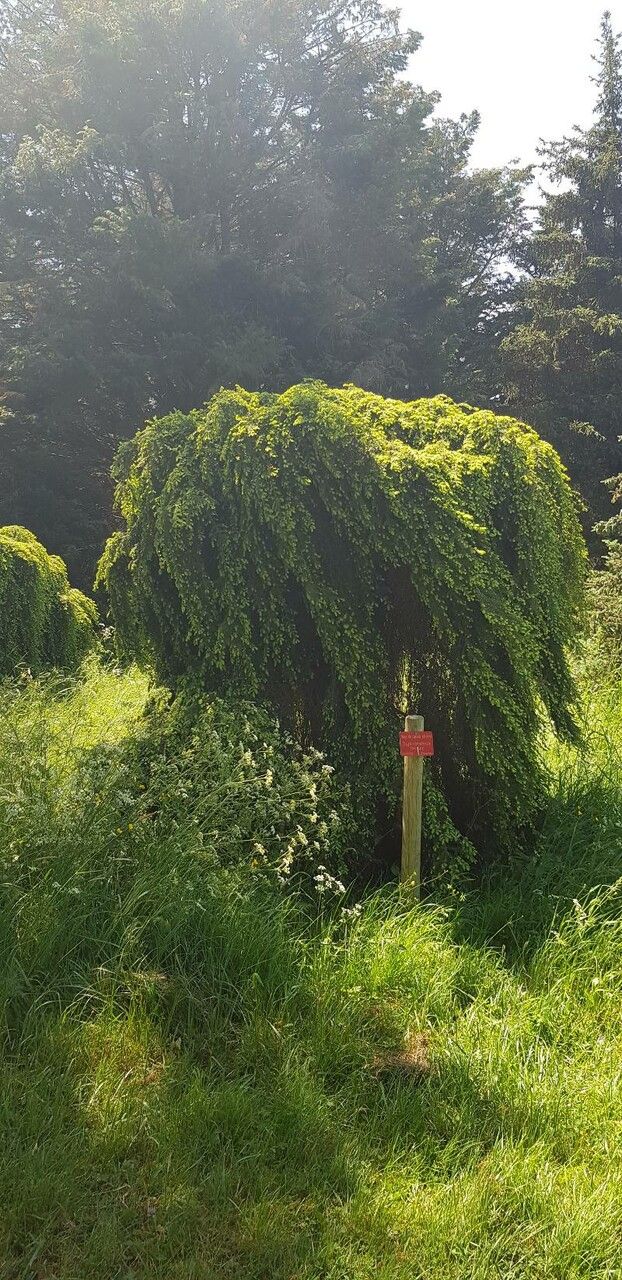
Several hundred ornamental cultivars have been selected, including Sargentii, an old weeping form with a broad, low habit; Jeddeloh, an RHS-recognized dwarf cushion; and Cole’s Prostrate, a creeping, almost ground-covering form. Unlike many conifers, the typical species tolerates regular hard pruning and makes a useful screening hedge in cool climates. 3 7
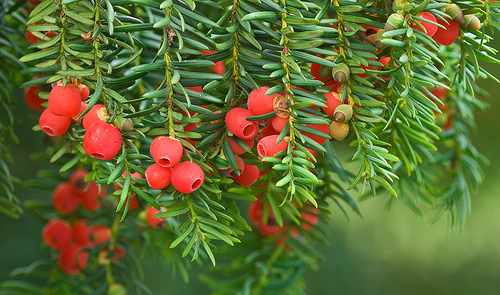
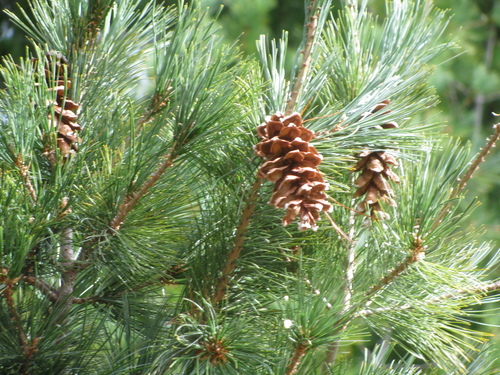
Fir (Abies) and yew (Taxus) can be mistaken for eastern hemlock at a distance; the regular pair of white bands under its needles is a useful identifying clue. Its close relative Tsuga heterophylla, western hemlock, has somewhat larger cones and a native range limited to the Pacific coast. A white, waxy fluff at the needle bases betrays hemlock woolly adelgid infestation and should be checked for each spring.
Main sources
- Plants of the World Online / Kew, Tsuga canadensis (L.) Carrière
- International Plant Names Index, Tsuga canadensis (L.) Carrière
- Royal Horticultural Society, Tsuga canadensis - eastern hemlock
- NC State Extension, Tsuga canadensis (Canadian Hemlock)
- Missouri Botanical Garden Plant Finder, Tsuga canadensis
- Plants For A Future, Tsuga canadensis
- Trees and Shrubs Online / International Dendrology Society, Tsuga canadensis
- Encyclopaedia Britannica, eastern hemlock
- IUCN Red List, Tsuga canadensis assessment
- USDA Forest Service, Fire Effects Information System, Tsuga canadensis
- ASPCA, toxic and non-toxic plants list reference for conifers
Frequently asked questions
Is eastern hemlock poisonous like poison hemlock?
No. Although the name hemlock is shared with poisonous Conium maculatum, Tsuga canadensis is botanically unrelated to that herb and is non-toxic to people and domestic animals.
Why have hemlock forests declined in recent decades?
The hemlock woolly adelgid (Adelges tsugae), a sap-feeding insect introduced from East Asia in 1924, was detected in the native range in the late 1960s. It has since devastated thousands of hectares, especially in the southern Appalachians, and the IUCN lists the tree as Near Threatened.
How can you tell eastern hemlock from a fir?
Hemlock needles are short and flat, with two clear white bands underneath, and lie in two flattened rows. Its oval, hanging cones are among the smallest of conifers, much smaller than fir or spruce cones.
How long can an eastern hemlock live?
An individual trunk can live for centuries. A tree felled at Tionesta, Pennsylvania, was dated to at least 554 years by counting its rings, one of the highest documented ages for the species.
What was eastern hemlock bark used for?
Rich in tannins, the bark was a major raw material for North American leather tanning before synthetic tannins became widespread in the 20th century.
Is eastern hemlock suitable for a small garden?
The typical species becomes a large tree, but many dwarf or weeping cultivars, including Jeddeloh and Cole’s Prostrate, stay compact and suit rock gardens and small shaded gardens.
Can eastern hemlock be clipped as a hedge?
Yes. Unlike many conifers, it tolerates regular, hard pruning and makes a dense screening hedge in cool climates.
Similar plants
If you are unsure about a plant’s toxicity, ask a botanist or veterinarian for advice.