
Common cocklebur (Xanthium strumarium, )
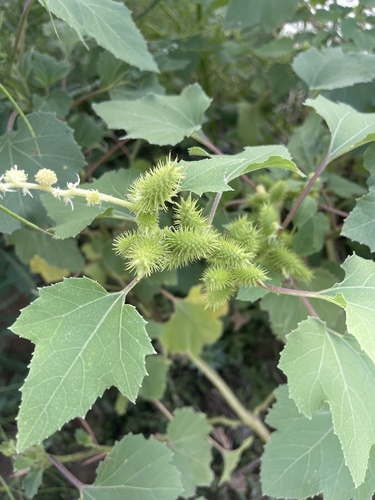
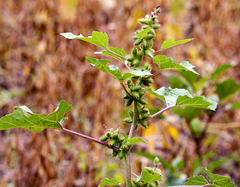

Common cocklebur (Xanthium strumarium) is an annual member of the Asteraceae with hooked burs, widespread in the Old World and now naturalized on several continents. It is a weed to recognize and manage, with a documented risk to livestock at the seedling stage.
Read moreCommon cocklebur, Cocklebur, Rough cocklebur and Cang er zi
Place in full sun, with intense direct light all day long.
Full sun; tolerates light partial shade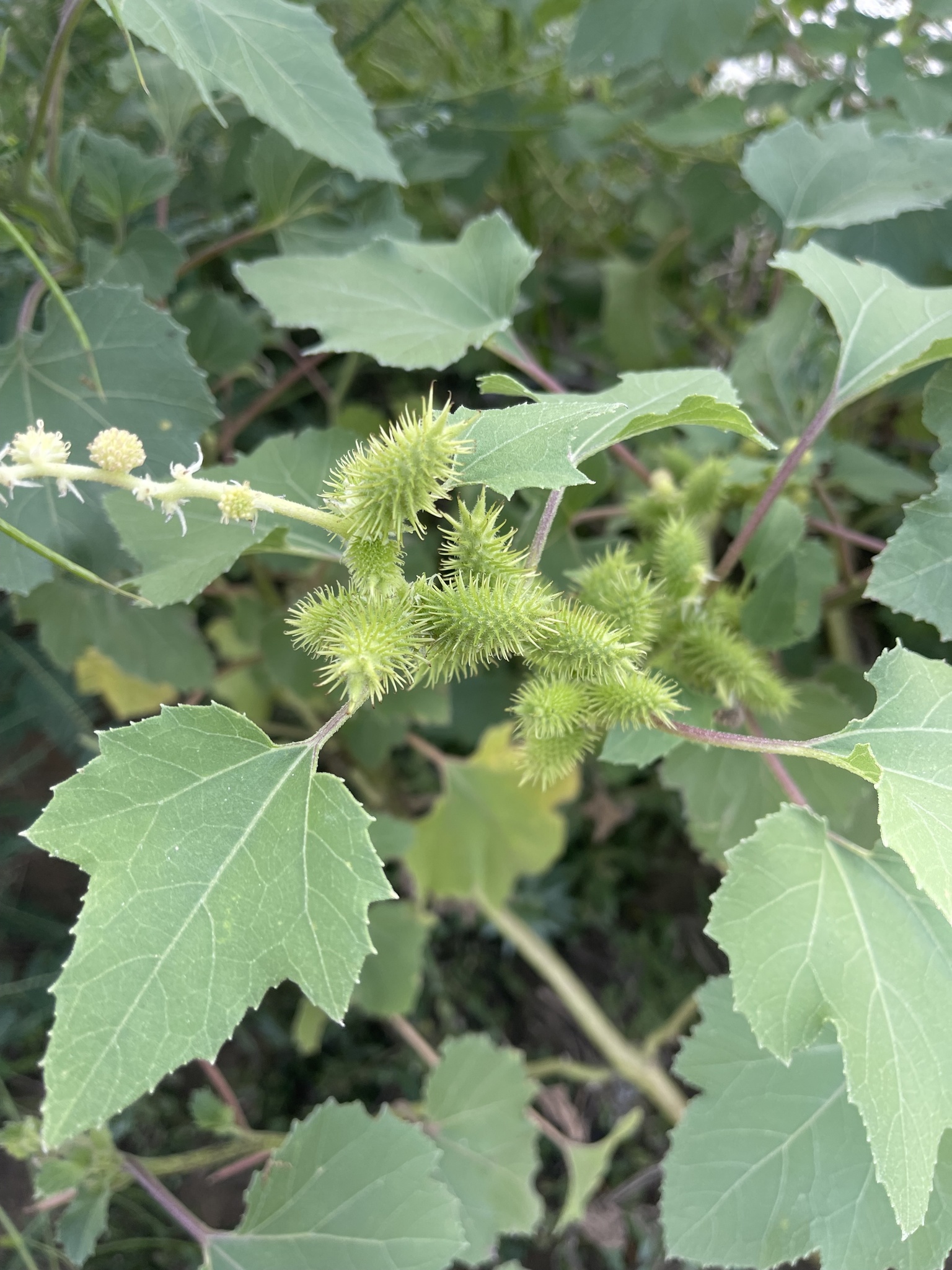


© photo
(c) Troos van der Merwe, some rights reserved (CC BY-NC), uploaded by Troos van der Merwe · cc-by-nc
iNaturalist User · cc0
Alan Weakley · cc0
Taken Sep 21, 2021 by Claudio Malpede (cc-by-sa)
Taken Oct 17, 2020 by Chiquiarce (cc-by-sa)
Taken Sep 9, 2021 by Thierry LE COM (cc-by-sa)
Taken Sep 13, 2021 by Sam Khashmanian (cc-by-sa)
© copyright of the Board of Trustees of the Royal Botanic Gardens, Kew.




Global distribution
Plants of the World Online places the native range from central and southern Europe to China, Taiwan and Indochina, extending into northwestern Africa. North American populations long assigned this name are now classified as a separate species, Xanthium orientale, explaining some overly broad range descriptions in general literature.
- Native6
- Introduced2
- France
- Spain
- Italy
- China
- Taiwan
- Morocco
- India
- United States
Hexagons: regions where the plant occurs. Green dots: native range.1
Identity
Common cocklebur (Xanthium strumarium L., 1753) is an accepted species of Xanthium in the Asteraceae family. Carl Linnaeus established the name in 1753. The binomial is useful because vernacular names such as cocklebur can also refer to related species, including Xanthium orientale and Xanthium spinosum. 1 2
Traditional Chinese medicine calls the dried fruit cang er zi and uses it in preparations for nasal congestion. This medicinal name applies to processed fruit: the fresh plant, especially its young seedlings, remains toxic to livestock. 9 7
An ornamental role is not appropriate for common cocklebur. Treat it as a weed to identify and remove before fruiting, particularly wherever livestock or young animals might have access to seedlings. 6
Recognition
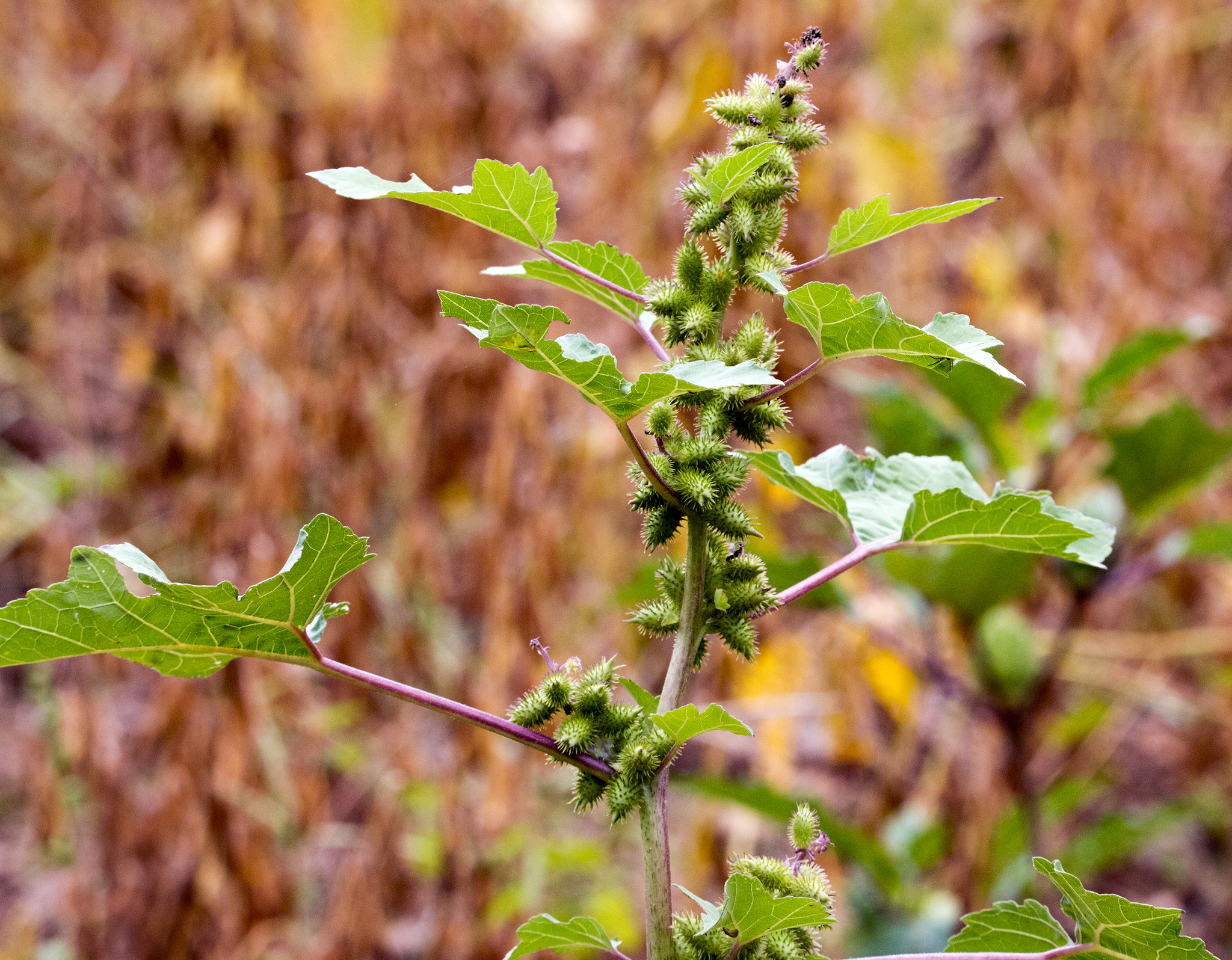
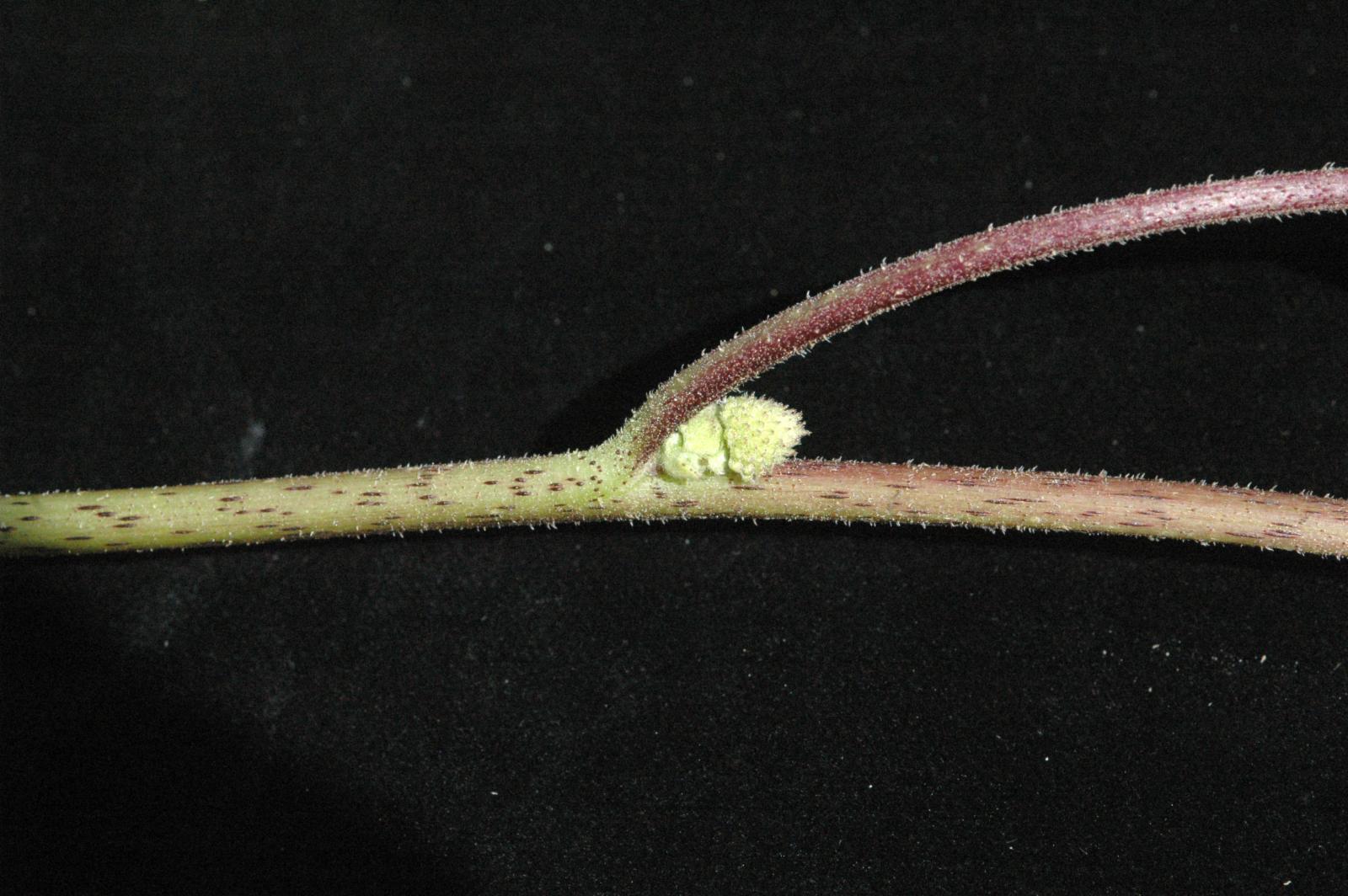
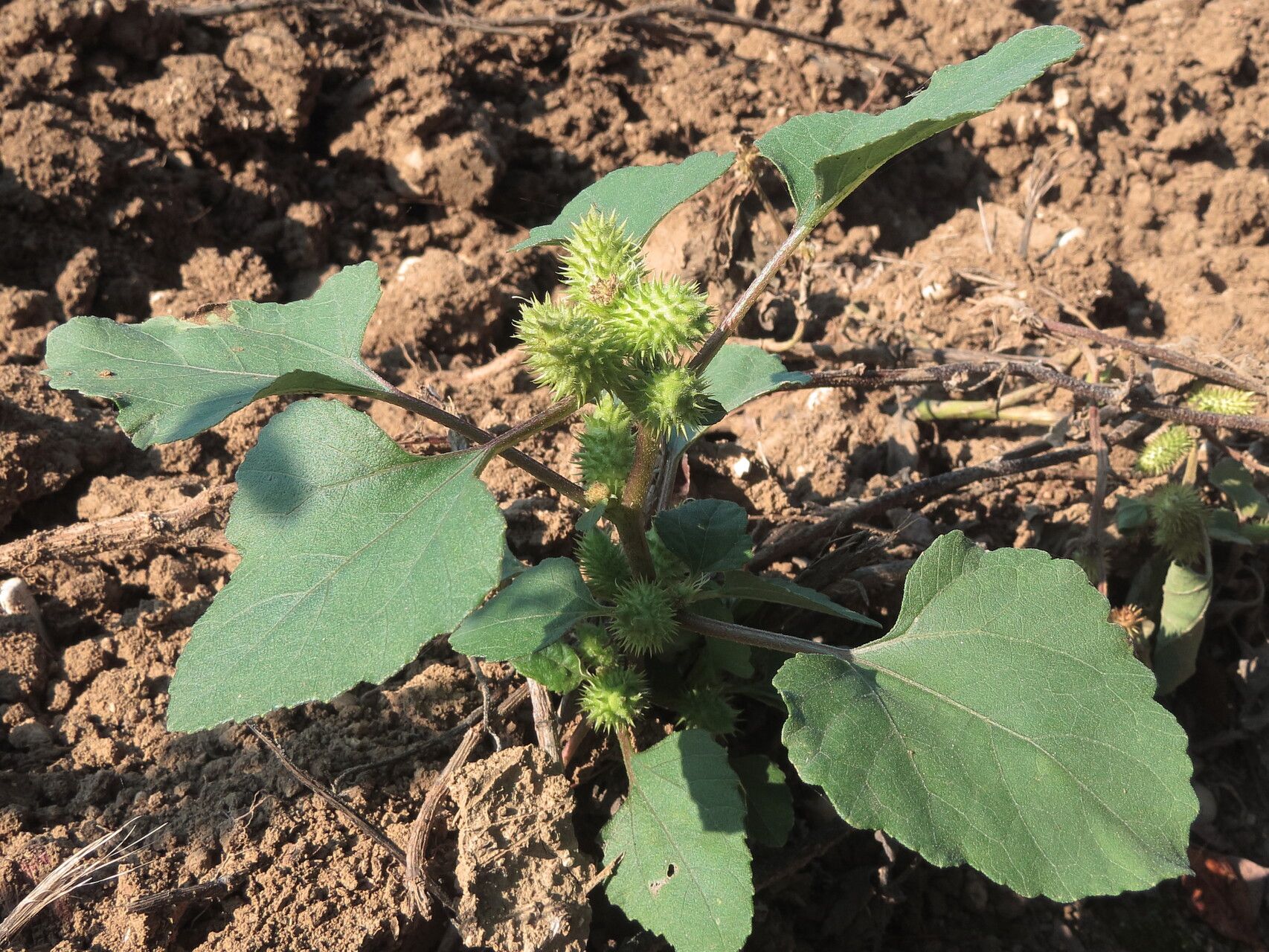
An upright annual herb, Xanthium strumarium usually reaches 0.3–1.2 m (1–4 ft) and can exceed 2 m (6.6 ft) in rich, sunny ground. The rough stem has brown-purple spots and no spines at the nodes; the related Xanthium spinosum bears two spines at each node. 3 4
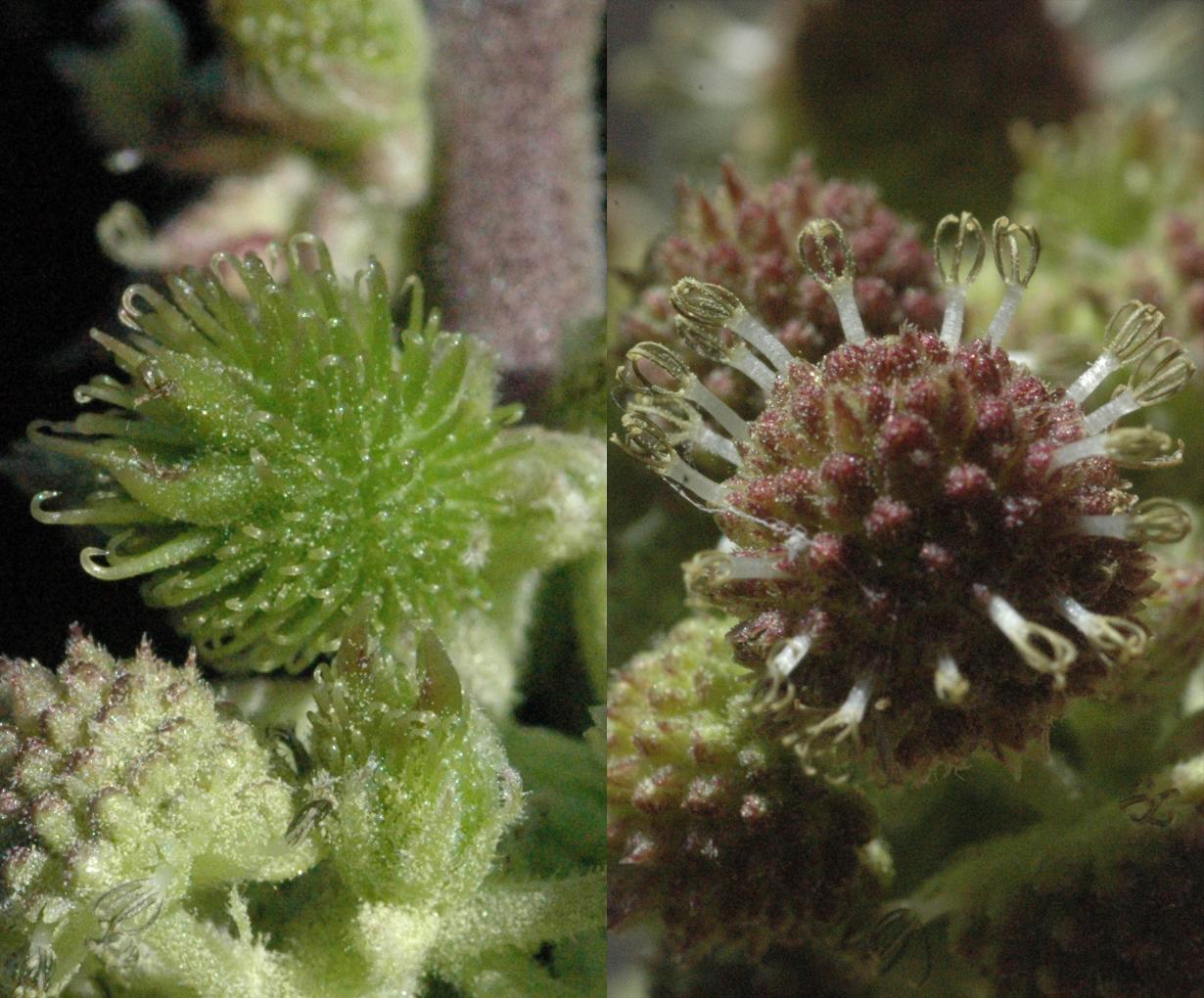
Long-stalked, alternate leaves are triangular to oval, with irregularly toothed edges and upper surfaces as rough as fine sandpaper. Male and female flowers occur on the same plant: small greenish male heads sit toward the stem tip, while female flowers develop near branch bases. 3
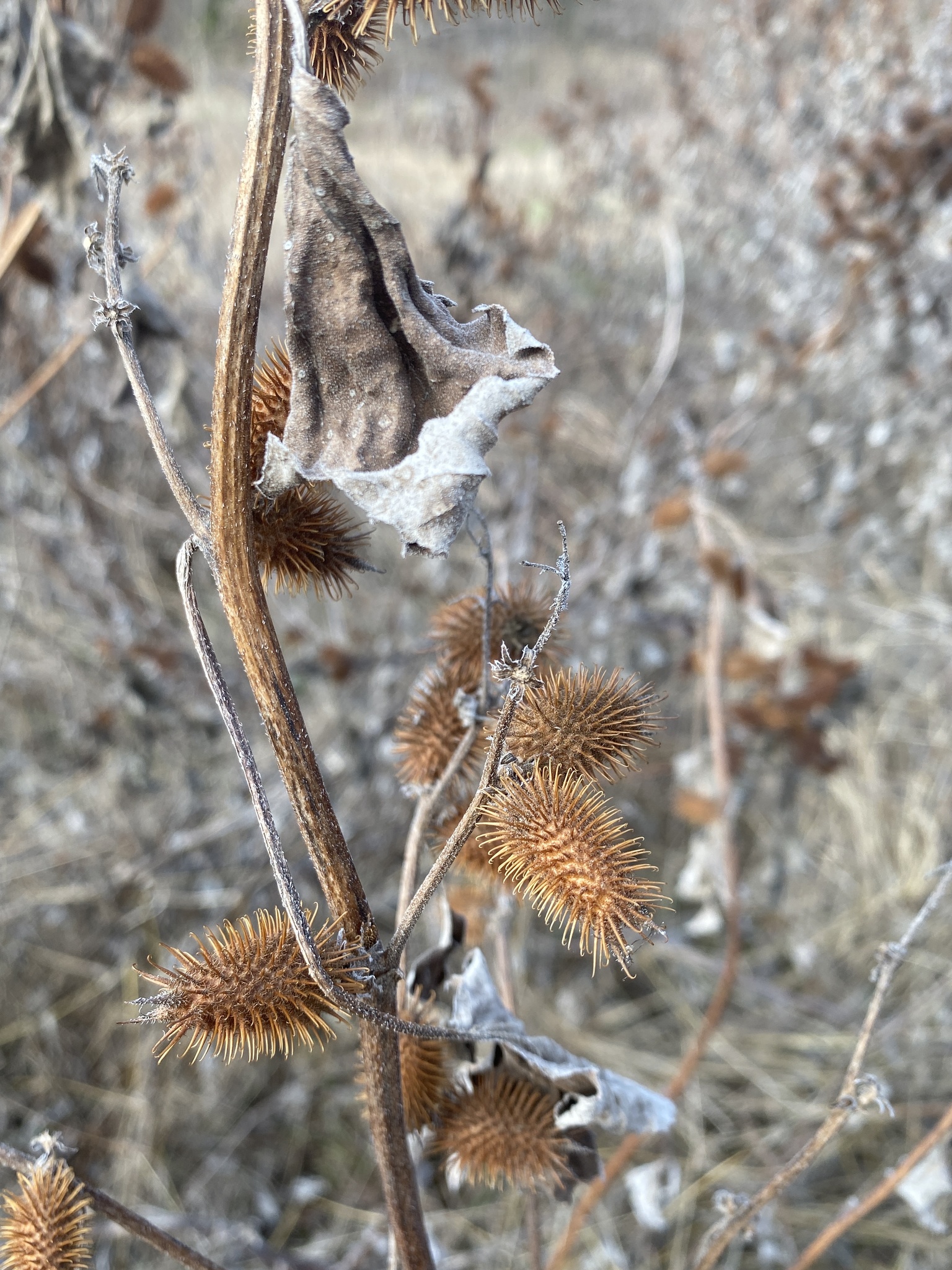
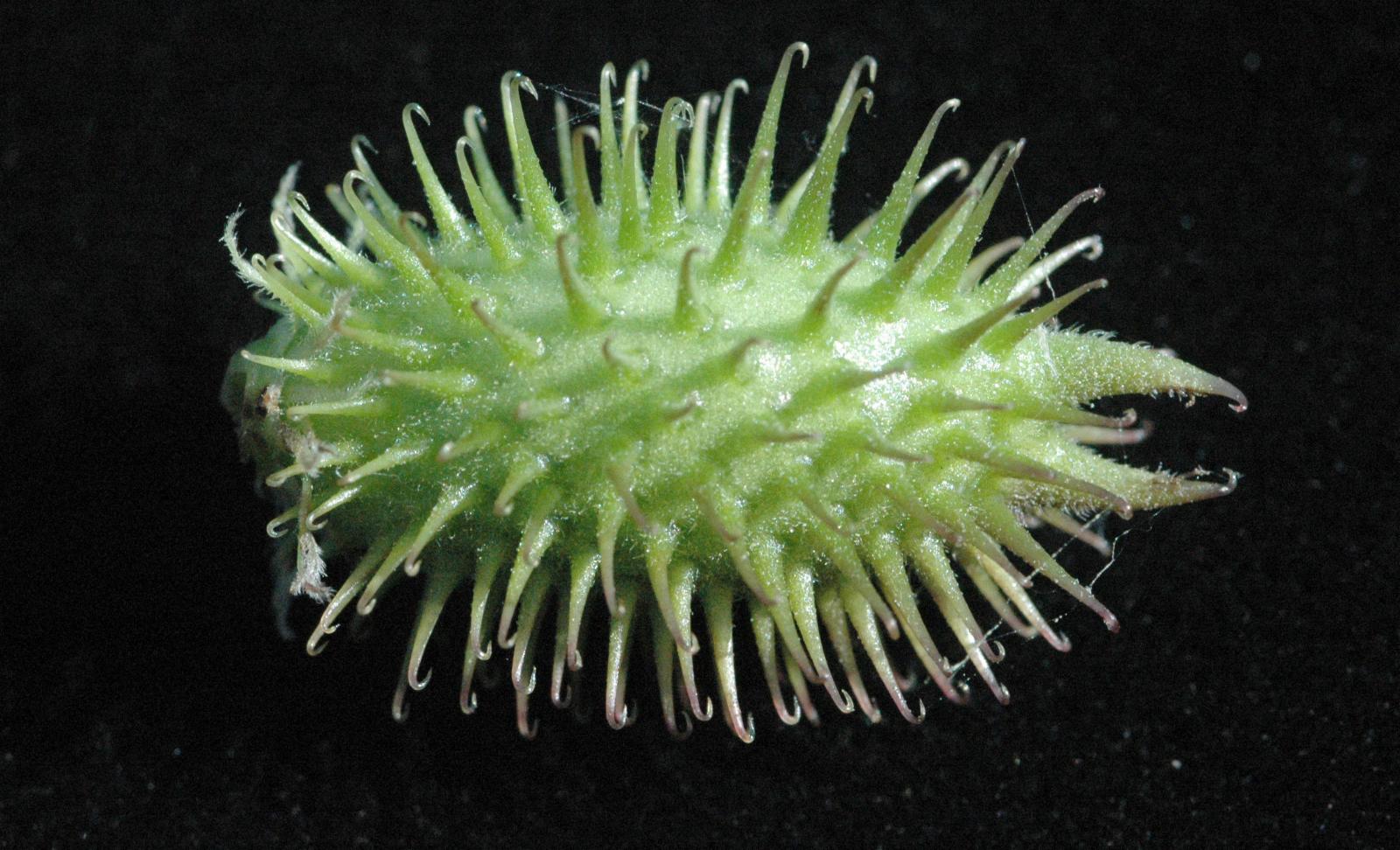
Each bur is 1.5–3.5 cm (0.6–1.4 in) long, oval and covered in rigid hooks, with two curved beaks at its end. It contains two seeds with unequal dormancy. This difference spreads germination over several months, making a single weeding pass insufficient. 3 4
Taxonomy and names
Botanical identification rests on Xanthium strumarium L. where common names overlap between regions. Plants of the World Online associates at least three Asian synonyms with it: Xanthium sibiricum Patrin ex Widder, Xanthium indicum J.Koenig ex Roxb. and Xanthium japonicum Widder. 1
North American varieties formerly assigned to this species, including Xanthium strumarium var. canadense (Mill.) Torr. & A.Gray and var. echinatum (Murray) A.Gray, are now placed in Xanthium orientale. This revision explains why some general sources still give cocklebur an exclusively North American origin, while recent taxonomic references restrict the native range of Xanthium strumarium to the Old World. 1 5
Habitat and range
POWO records a native range running from central and southern Europe to China, Taiwan and Indochina, extending into northwestern Africa. In France, the national natural heritage inventory lists the species under the French names lampourde glouteron and herbe aux écrouelles. 1 2
Naturalized populations occur widely beyond that range, notably in India and North America. They occupy rubble, waste ground and disturbed farmland. 5 8
Moist to wet, nitrogen-rich soils favor common cocklebur, especially beside waterways and in flood-prone areas. Animal fur and flowing water carry the burs, helping create isolated colonies far from the original germination site. 4 3
Life cycle and reproduction
One warm season is enough to complete the annual cycle from germination to fruiting. Emergence can extend from May to September in the populations described, reflecting unequal dormancy of the two seeds inside each bur. 4
After inconspicuous flowers, each plant produces numerous burs that ripen in late summer and often remain on the stem after frost. The resulting soil seed bank stays viable for several seasons, complicating one-off eradication. 3
Toxicity and safety
The seedling stage carries the greatest livestock risk. Fleshy cotyledons contain carboxyatractyloside, a diterpene glycoside that directly damages the liver. Rougher, less palatable adult plants are much less dangerous, except when crushed seeds contaminate forage. 6 9
Poisoning causes depression, weakness, muscle spasms and convulsions; severely exposed pigs, cattle and horses may die within hours. Young animals grazing fields full of seedlings face the main risk, before the less palatable adult leaves develop. 6
Experimental pig studies place toxic intake around 0.75–3% of body weight in fresh seedlings, or 20–30% of the ration as crushed burs. This narrow margin helps explain how contamination of harvested forage can sometimes poison a group of animals. 10
Varieties, look-alikes and related plants
Two close relatives account for the main identification problems. Xanthium orientale includes North American populations long placed in Xanthium strumarium, and separating them requires detailed taxonomic examination beyond a quick field check. Xanthium spinosum is easier to recognize: its long yellowish spines at the nodes are absent from Xanthium strumarium. 1 8
Other clinging burs can look similar from a distance, especially those of greater burdock (Arctium lappa), which are larger and spherical on a biennial with broad, heart-shaped leaves. Checking whether stem nodes carry spines is a quick field distinction, even before consulting a botanical guide. 7
Main sources
- Plants of the World Online / Kew, Xanthium strumarium L.
- INPN / MNHN, Xanthium strumarium L., 1753
- North Carolina Extension Gardener Plant Toolbox, Xanthium strumarium
- Iowa State University Extension, Common cocklebur
- Purdue University Center for New Crops, Xanthium strumarium factsheet
- Merck Veterinary Manual, Hepatotoxins in large animals
- Plants For A Future, Xanthium strumarium database entry
- USDA PLANTS Database, Xanthium strumarium plant profile
- PMC, Traditional Uses, Botany, Phytochemistry, Pharmacology of Xanthium strumarium L.
- PubMed, Cocklebur intoxication in swine, review and redefinition of the toxic principle
Frequently asked questions
Is common cocklebur poisonous?
Yes, especially as a seedling. The cotyledons concentrate carboxyatractyloside, a glycoside that damages the liver and can kill pigs, cattle and horses within hours if enough is eaten.
Why do cocklebur burs stick so easily?
Their rigid hooks grip animal fur and clothing. This dispersal mechanism explains why plants appear far from where the original plant germinated.
Can common cocklebur be confused with another species?
The main look-alikes are Xanthium orientale, which includes North American populations long assigned the same name, and Xanthium spinosum, recognizable by spines at its nodes that Xanthium strumarium lacks.
Why does common cocklebur cause problems in crops?
Seedlings emerge in successive waves from May to September in the documented growing season, making one-pass weed control difficult. Rapid growth in rich soil puts the weed in direct competition with spring crops for light, water and nitrogen.
Does common cocklebur have medicinal uses?
The dried fruit, called cang er zi, is used in traditional Chinese medicine for nasal congestion under supervision. That use does not extend to the fresh plant or its toxic seedlings.
How can I recognize a toxic cocklebur seedling?
Its cotyledons are fleshy and elongated, without the rough texture of mature leaves. This stage is the most dangerous to livestock and needs to be recognized before grazing.
Similar plants


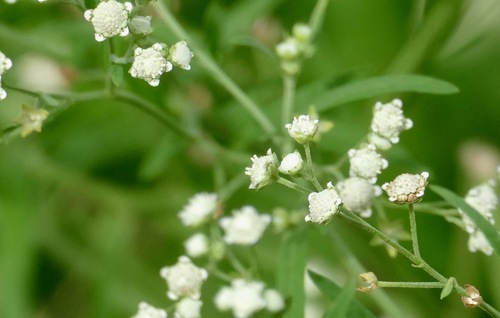
If you are unsure about a plant’s toxicity, ask a botanist or veterinarian for advice.