
Okra (Abelmoschus esculentus, )
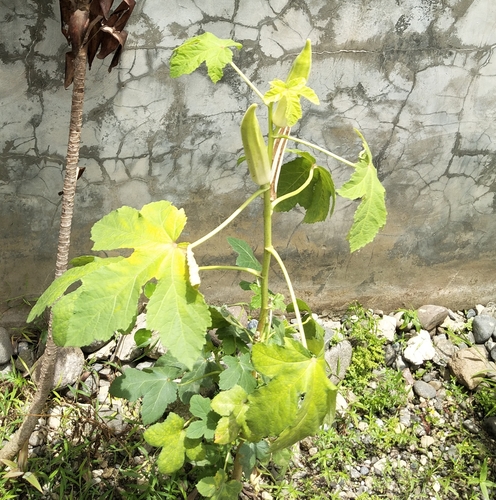


Okra (Abelmoschus esculentus) is an herbaceous perennial in the Malvaceae, grown as an annual in temperate climates. Its origin remains disputed between East Africa and northern India. It produces five-sided, mucilaginous pods harvested young for cooking, and hibiscus-like flowers with creamy-white to yellow petals marked purple at the base.
Read moreOkra, Lady's fingers, Gombo, Bamia and Bhindi
Place in full sun, with intense direct light all day long.


© photo
Greg III Espera · cc-by
Wikimedia Commons · CC BY-SA or Public Domain
Taken Aug 11, 2021 by Siva Kumar (cc-by-sa)
Taken Mar 30, 2019 by Francisco Francisco Augusto Schio (cc-by-sa)
Taken Jan 1, 1900 by EOL − Marco Schmidt (cc-by-nc-sa)
Taken Nov 13, 2008 by EOL − Ahmad Fuad Morad (cc-by-nc-sa)
Taken Jan 1, 1900 by EOL − Ramon FVelasquez (cc-by-sa)
© copyright of the Board of Trustees of the Royal Botanic Gardens, Kew.




Global distribution
The origin of Abelmoschus esculentus remains disputed. POWO/WCVP recognizes a native range from southwestern Uttarakhand to western and central India. Another widely repeated hypothesis, developed notably by the National Research Council, places its origin in East Africa, in Ethiopia, Eritrea and eastern Sudan. With no truly wild population confirmed in either region, the species is sometimes described as a cultigen.
Identity
Okra (Abelmoschus esculentus (L.) Moench, 1794) is an herbaceous plant in the mallow family, Malvaceae, related to cotton, cacao and hibiscus. Linnaeus first described it as Hibiscus esculentus in 1753; Moench transferred it to Abelmoschus in 1794, explaining the two authors recorded in its botanical name. 1 2
The English name okra probably comes from a West African language, perhaps Igbo; lady's fingers refers to the slender pods. French gombo derives from the Bantu ki-ngombo used in Angola. The genus name Abelmoschus comes from Arabic abū al-misk, “father of musk,” referring to the scent released by some crushed seeds, while Latin esculentus means “edible.” 5 6
Recognition
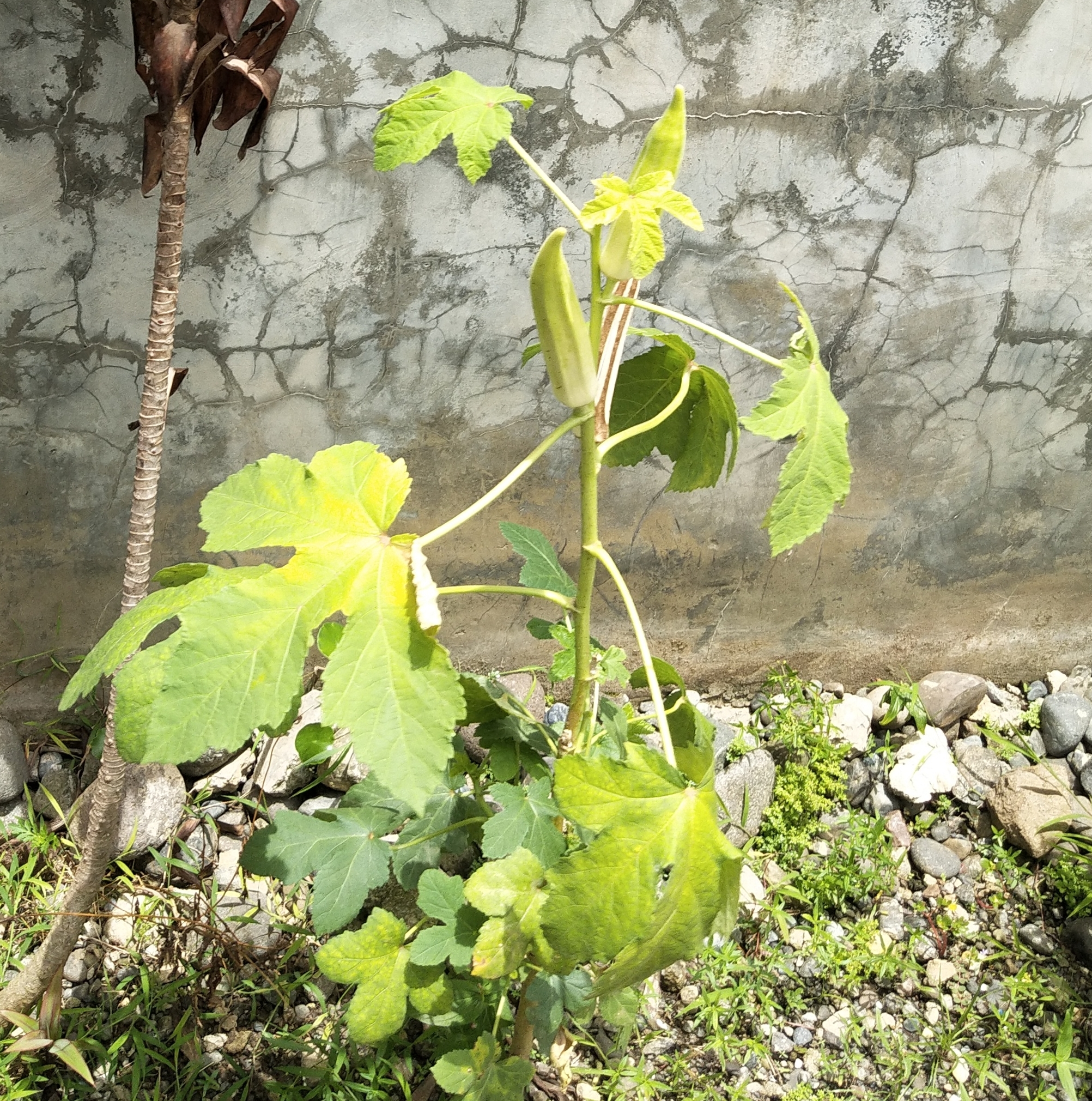
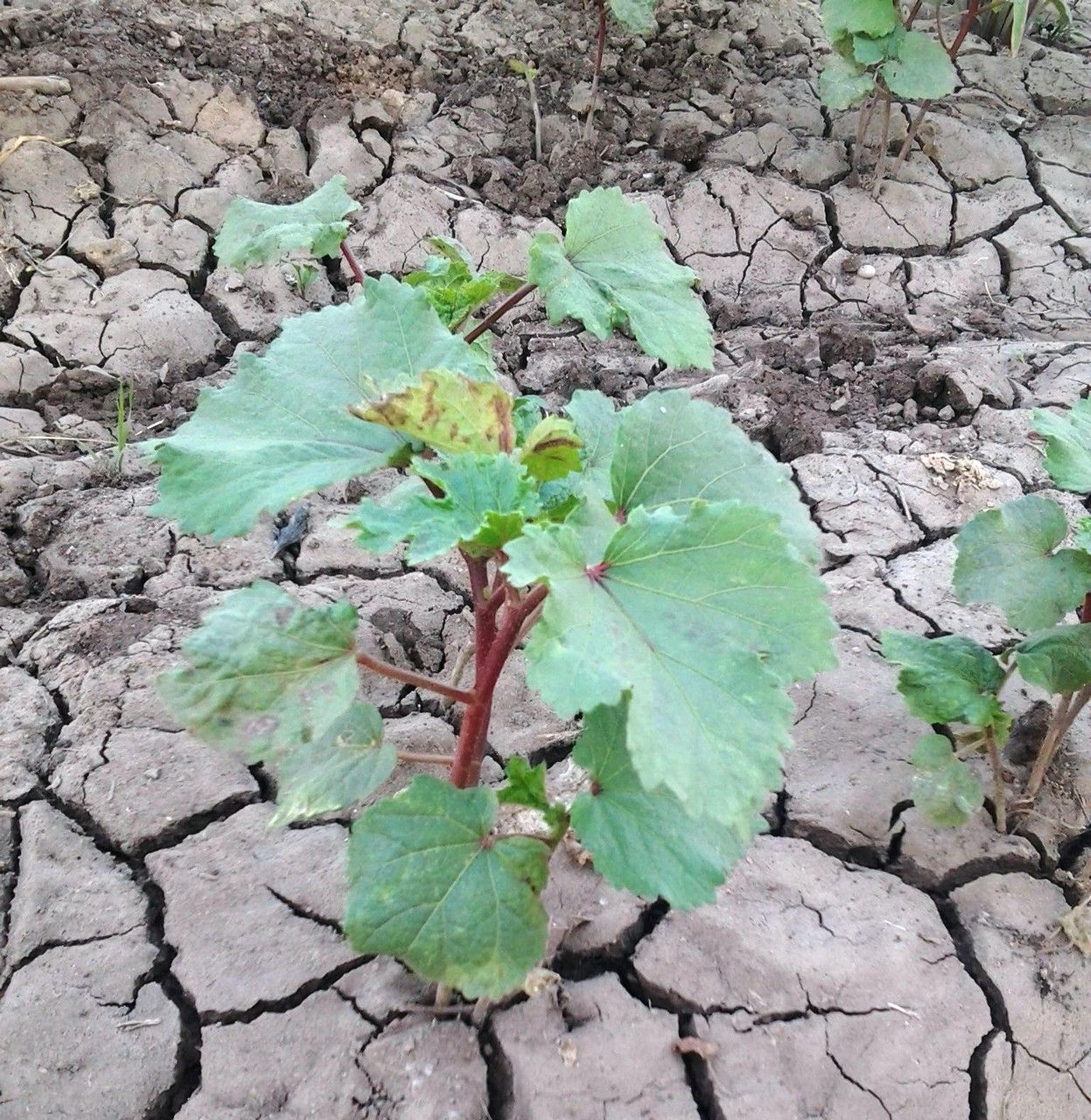
An upright, often angular stem reaches 1–2.5 m (3.3–8.2 ft) tall, depending on climate. Alternate, palmately lobed leaves measure 10–20 cm (4–8 in) across and have five to seven lobes. 5 3
Solitary flowers arise in the leaf axils and measure 4–8 cm (1.6–3.1 in) across. Five creamy-white to yellow petals, often marked purple at the base, give them a familiar hibiscus-like form. The hairy fruit is a five-sided capsule, reaching 18–25 cm (7–10 in) long and containing numerous round seeds; cutting or cooking it releases its characteristic mucilage. The commonly confused Abelmoschus manihot has flowers more than 10 cm (4 in) across, compared with 4–8 cm (1.6–3.1 in) in okra, and lacks the same sharply angular fruit. 5 6
Useful taxonomy
Kew accepts Abelmoschus esculentus as the accepted name, with Hibiscus esculentus L. as a homotypic synonym. Other names in its synonymy include:
- Abelmoschus bammia Webb
- Abelmoschus longifolius (Willd.) Kostel.
- Abelmoschus praecox Sickenb.
- Abelmoschus tuberculatus Pal & Har B.Singh
- Hibiscus longifolius Willd. (names included in the synonymy)
Okra is an allopolyploid with uncertain parentage; Abelmoschus ficulneus and A. tuberculatus are among the proposed parents. No truly wild population has been confirmed, and the West African form is sometimes described as a cultigen. An old label reading Abelmoschus bammia identifies the same species now called okra, under a name included in POWO's synonymy. 1 5
Habitat and range
Where okra originated remains disputed. POWO and WCVP recognize a native range from southwestern Uttarakhand to western and central India. Another widely repeated hypothesis, developed by the National Research Council, places its origin in East Africa, between Ethiopia, Eritrea and eastern Sudan. 1 5
From Arabia, okra spread around the Mediterranean; the traveler Abu al-Abbas al-Nabati described its cultivation in Ayyubid Egypt in 1216. Transatlantic trade carried it to Brazil by 1658 and to North America in the eighteenth century. Thomas Jefferson recorded it in Virginia in 1781. 5 7
India accounts for 62% of world production in the cited account, well ahead of Nigeria and Mali. Frost destroys okra tissue, so in temperate regions such as France it is generally a summer crop. The source gives USDA zones 9–11 and a minimum near 5 °C (41 °F); its cold sensitivity restricts any overwintering outdoors to particularly sheltered, frost-free conditions, including favorable Mediterranean coastal sites. 5 3
Life cycle and reproduction
Perennial in tropical climates, okra is grown as an annual in temperate regions. Seeds soaked overnight germinate in six days to three weeks when soil is above 20 °C (68 °F). Cooler soil delays germination or prevents it altogether. 5 4
Harvest begins about two months after sowing. From then on, the picking window is short: pods need harvesting within a week of pollination, before they rapidly become fibrous and woody and lose their tender cooking quality. 5 3
Largely self-pollinating flowers can set fruit without a dedicated pollinator, making small-garden seed production easier. Self-fertilization allows seed saved from a plant to be resown in following years with little loss of varietal fidelity. Disease is a more significant threat: the soilborne fungus responsible for Verticillium wilt causes yellowing and wilting foliage, while insect-transmitted yellow mosaic disease prompted the selection of resistant cultivars such as Parbhani Kranti. 5
Uses and risks
Tender pods serve as both a vegetable and a thickener. Okra is one of the three traditional thickeners used in Louisiana gumbo, appears fried in the southern United States, and features in quimbombó in Cuba and Puerto Rico, molondrón in the Dominican Republic and Brazilian caruru. South Asian cooking often pairs the pods with meat and spicy dishes. 5 6
Roasted seeds have served as a caffeine-free coffee substitute, notably during shortages in the American Civil War. Their oil, rich in oleic and linoleic acids, has at times rivaled sunflower oil in yield. Young leaves can be cooked like beet greens. 5 3
Beyond food, stem fibers reinforce polymer composites, while pod mucilage can clarify wastewater containing suspended particles by acting as a natural flocculant. These industrial applications remain minor compared with food production, but show the versatility of a crop grown mainly for its pods. 5
Available toxicity information lists okra as non-toxic to cats and dogs; evidence for horses remains uncertain. Fine hairs on the pods can irritate skin on contact, an inconvenience that gloves help prevent. 8 5
Varieties, look-alikes and related plants
Clemson Spineless, an American cultivar with spineless pods, remains a longstanding market-garden standard. Red Burgundy has reddish-purple pods and stems, a color generally lost during cooking. Indian Parbhani Kranti was developed through crossing with Abelmoschus manihot for resistance to yellow mosaic disease. 3 5
Names and related species worth distinguishing include:
- Abelmoschus manihot, which has much larger flowers and also edible leaves;
- Hibiscus esculentus, a historical synonym of okra still found in older seed catalogs;
- Abelmoschus moschatus, grown mainly for fragrant seeds rather than pods.
Pod color alone is unreliable: most cultivars are green, while others are reddish-purple. A five-sided fruit cross-section combined with a purple spot at the base of the petals is the more useful identifying combination. 1 2
Main sources
- Plants of the World Online / Kew, Abelmoschus esculentus (L.) Moench
- GBIF Backbone Taxonomy, Abelmoschus esculentus
- NC State Extension Gardener Plant Toolbox, Abelmoschus esculentus
- Missouri Botanical Garden, Plant Finder, Abelmoschus esculentus
- Wikipedia EN, Okra
- Wikipedia FR, Gombo
- INPN / MNHN, Abelmoschus esculentus (L.) Moench, 1794
- ASPCA, Okra toxicity entry
Frequently asked questions
Is okra toxic to cats and dogs?
No. Available information lists okra as non-toxic to cats and dogs. Evidence for horses remains uncertain because documented observations are lacking.
Why does okra turn slimy when cooked?
The pods contain mucilage rich in soluble fiber. Cooking okra with an acidic ingredient, such as tomato, noticeably reduces the slimy texture.
Did okra originate in Africa or India?
Both hypotheses exist. POWO places its native range in northern India, while another widely repeated account places its origin in East Africa. No confirmed wild population has been found in either region.
Can okra grow in a temperate garden?
Yes, as a summer annual. Sow after the last frost in warm soil, and provide full sun to obtain a worthwhile harvest before fall. This approach also applies to temperate gardens in France.
Are gombo, okra and bamia the same plant?
Yes. These regional names refer to Abelmoschus esculentus: gombo in French, okra in English, and bamia in several Middle Eastern and North African cuisines.
Can you eat okra leaves?
Young leaves can be cooked like beet or dandelion greens. They are less commonly used than the pods, but are not reported as toxic.
Why are some okra pods tough and fibrous?
Pods left too long after pollination quickly become fibrous and woody. Harvest them young, usually within a week of flowering.
Similar plants

If you are unsure about a plant’s toxicity, ask a botanist or veterinarian for advice.