
Balsam fir (Abies balsamea, )
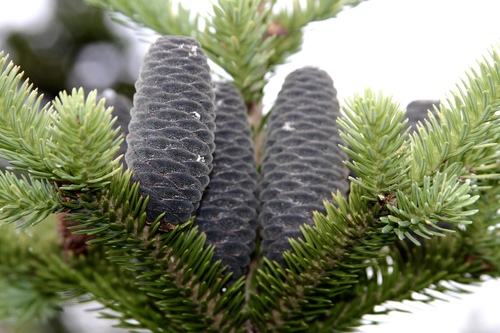
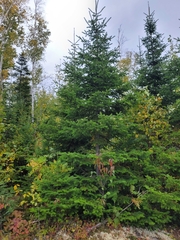
Balsam fir (Abies balsamea) is a North American conifer in the Pinaceae family, native to boreal forests and moist fir woodlands of Canada and the northeastern United States. Its flat, fragrant needles and upright cones that break apart on the tree are distinctive. It is also a leading Christmas tree species in North America.
Read moreBalsam fir, Canadian fir and Balm of Gilead


© photo
(c) Jenn Megyesi, some rights reserved (CC BY-NC), uploaded by Jenn Megyesi · cc-by-nc
Denise Alano · cc0
naturalist charlie · cc0
Taken Jun 21, 2020 by Brent Harris (cc-by-sa)
Taken Mar 31, 2019 by Dominique Roux (cc-by-sa)
Taken May 2, 2019 by Mike Williams (cc-by-sa)
Taken May 31, 2018 by Alexander Vocaet (cc-by-sa)
© copyright of the Board of Trustees of the Royal Botanic Gardens, Kew.




Global distribution
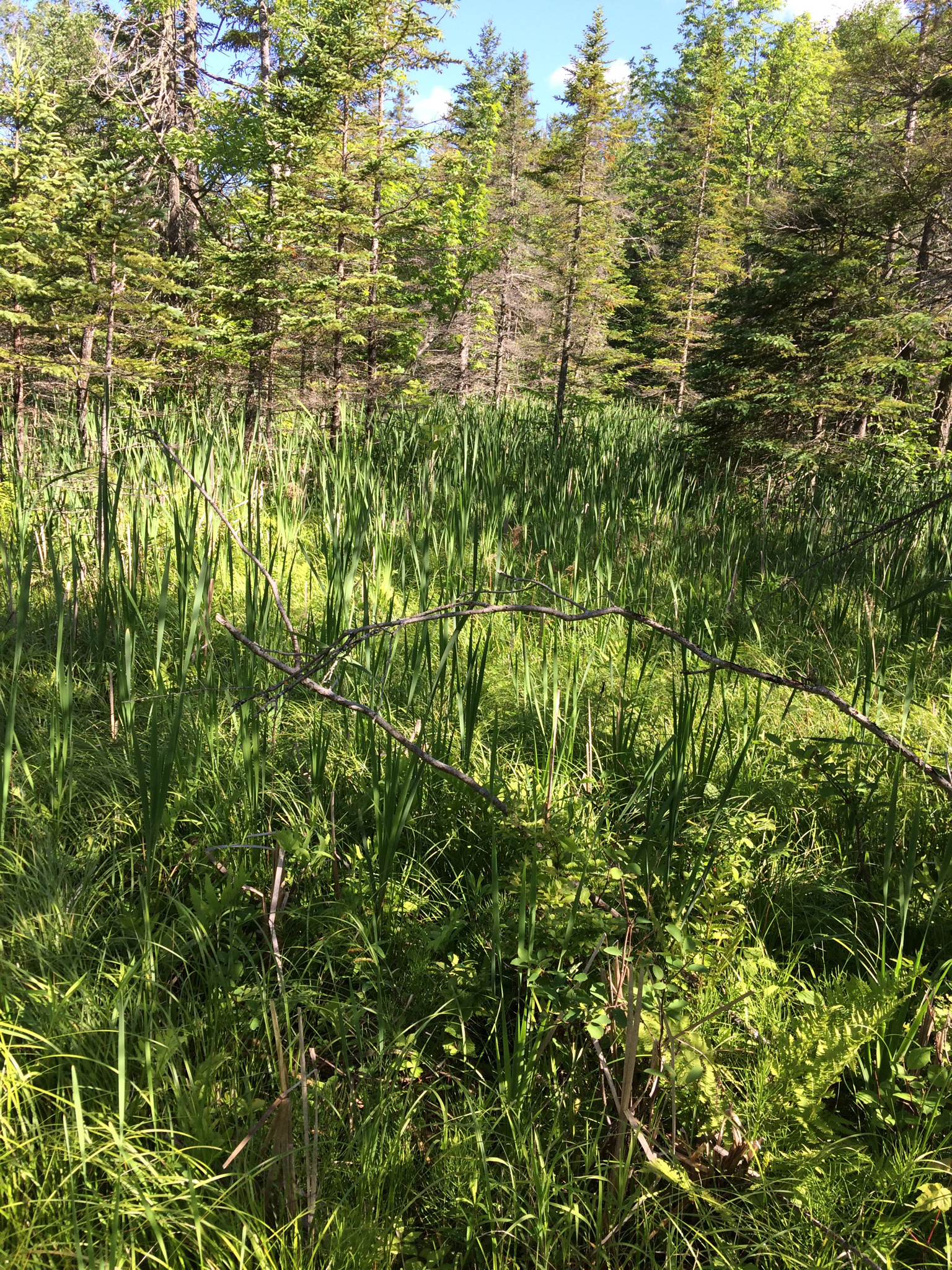
Abies balsamea is native from Labrador and Newfoundland west to Alberta, south to Minnesota, Wisconsin and New England, and along the Appalachians to Virginia. It grows in swampy lowlands as well as well-drained hillsides, as a pioneer or codominant in boreal forests. Grown for its dwarf forms, balsam fir remains uncommon outside its native range because it poorly tolerates hot, humid summers.
Identity
Balsam fir (Abies balsamea (L.) Mill., 1768), also called Canadian fir, belongs to the genus Abies in the pine family, Pinaceae. Carl Linnaeus first described it as Pinus balsamea. Philip Miller transferred the species to Abies in 1768, and that combination remains accepted today. 1 2 Two field characters are especially useful: flat needles without woody pegs and upright cones that disintegrate on the tree rather than falling whole.
Both the epithet balsamea and the common name refer to the fragrant resin that seeps from blisters in the trunk bark, long collected commercially as Canada balsam. The same feature explains the biblical nickname Balm of Gilead. That name also refers to the unrelated balsam poplar (Populus balsamifera), so it can be ambiguous without the scientific name. 7 5
Recognition
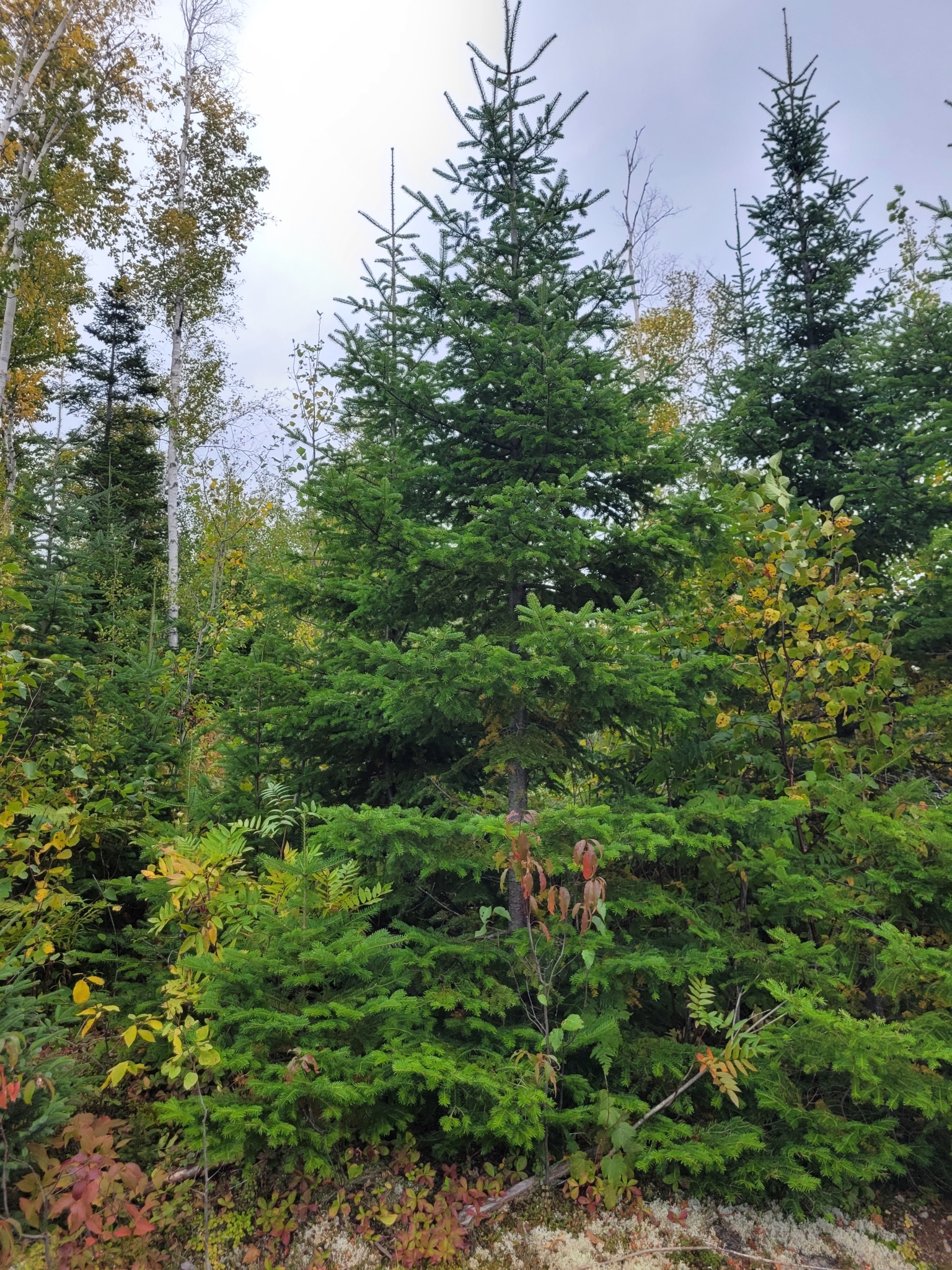
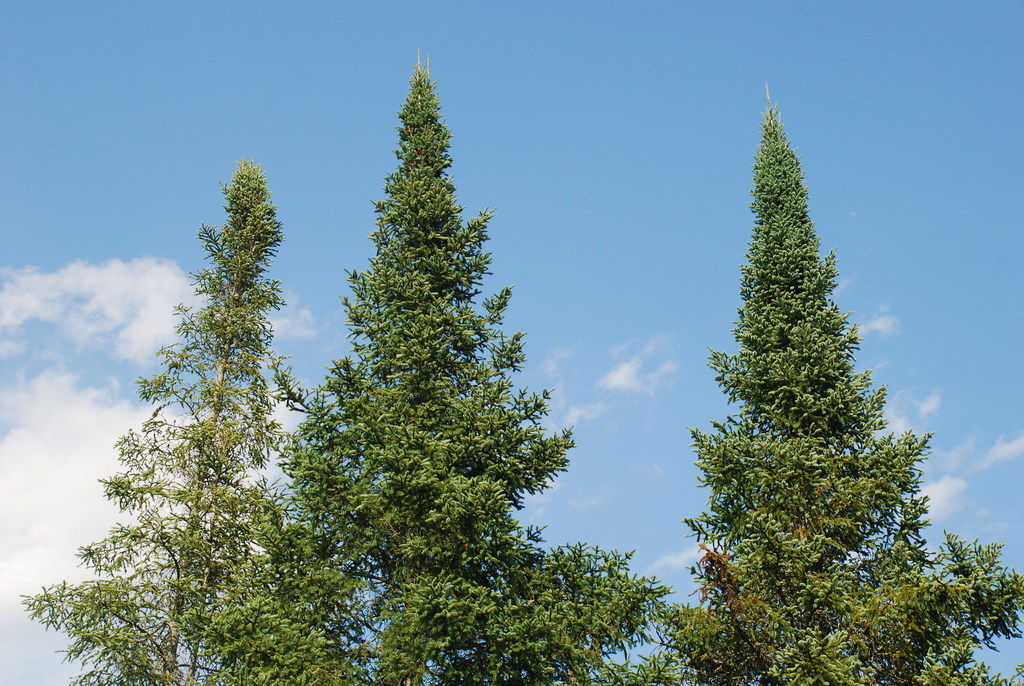
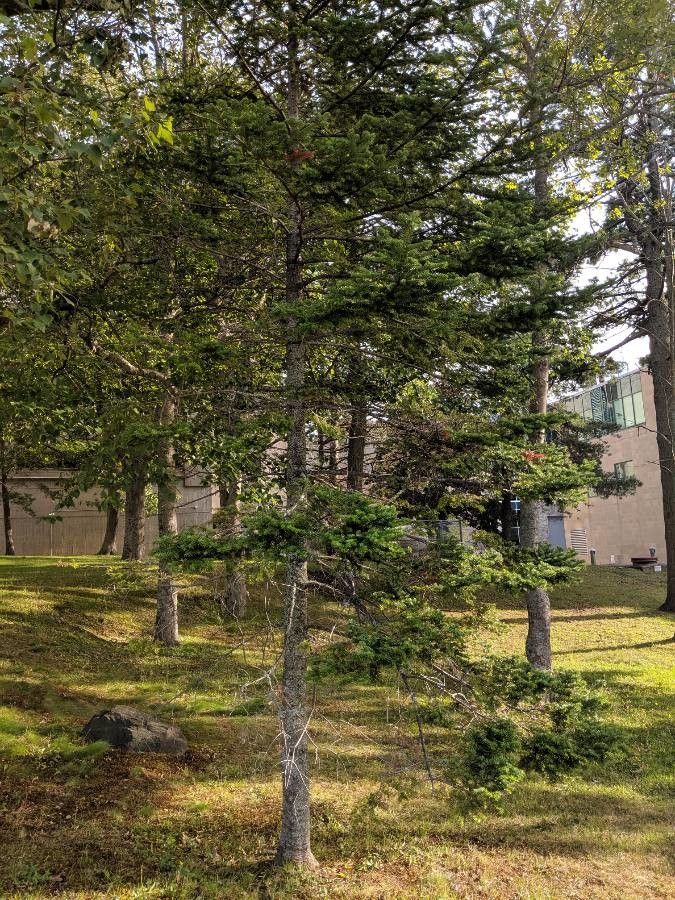
A narrow, pyramidal to conical crown with a pointed spire gives Abies balsamea its characteristic outline. Trees commonly reach 15–21 m (49–69 ft) tall, with exceptional specimens reported to 27 m (89 ft), and a spread of 4–8 m (13–26 ft). It is a forest tree in its typical form, quite different in scale from the dwarf selections grown in small gardens. 4
Soft, flat needles reach 2.5 cm (1 in) long. They are glossy dark green above, with two white stomatal bands underneath, and densely arranged around the twig. Crushing the foliage releases the resinous scent closely associated with Christmas trees. Needle texture, attachment and scent together help confirm an identification. 4
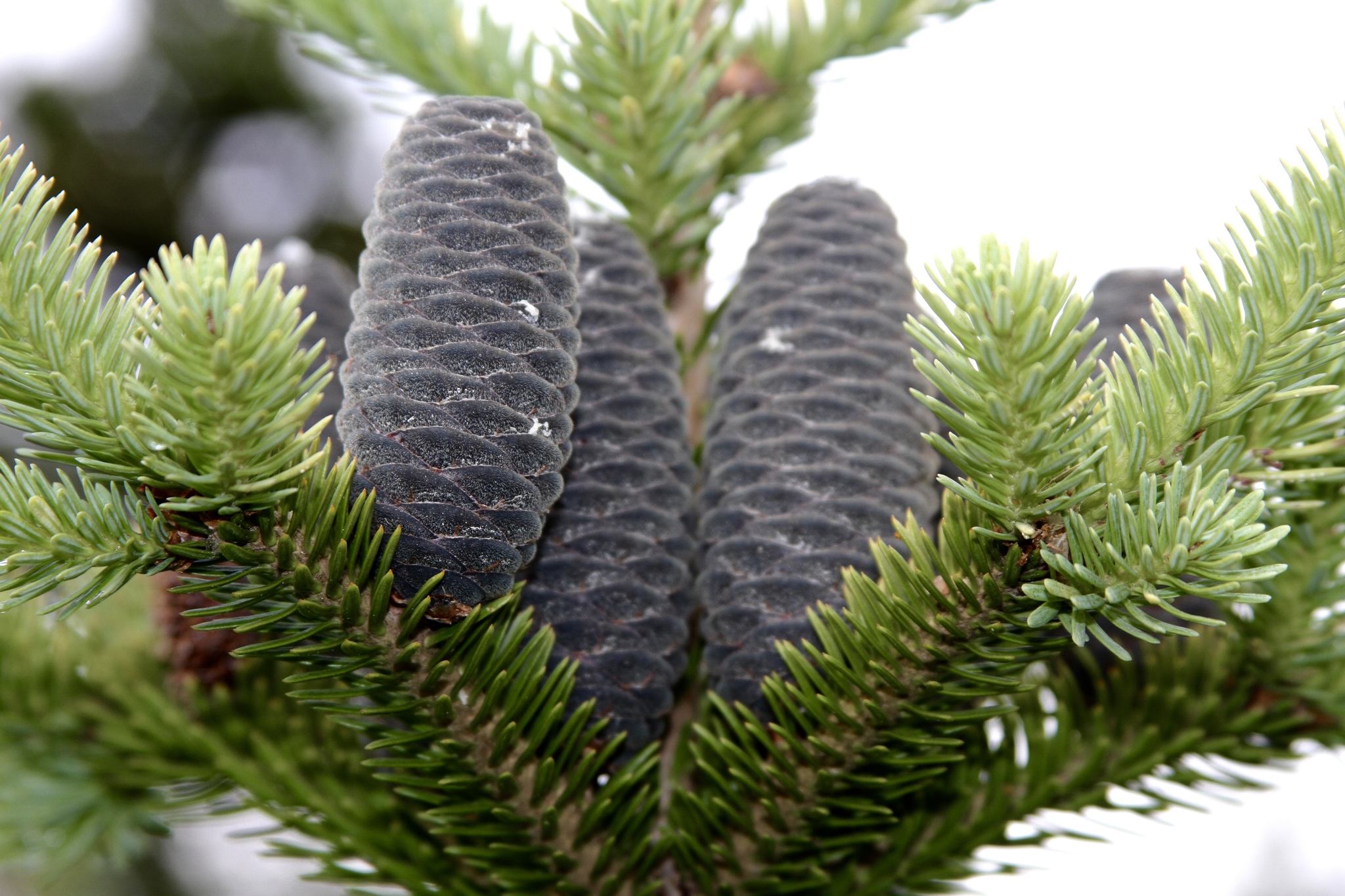
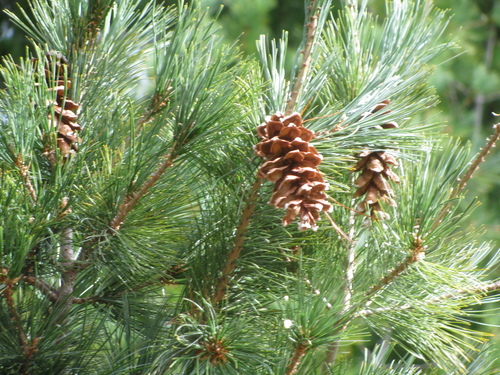
Smooth gray-brown bark on young trees carries many resin blisters, which release a sticky liquid when disturbed. Older bark turns brown and scaly. The cylindrical cones measure 5–10 cm (2–4 in) long and stand upright on the branches, changing from purple to brown as they mature. 4
Useful taxonomy
Two botanical varieties are recognized within Abies balsamea: the typical Abies balsamea var. balsamea and Abies balsamea var. phanerolepis Fernald. The latter is an Appalachian form with more conspicuous cone scales and has long been treated as intermediate with Fraser fir. These are botanical varieties, distinct from the named dwarf cultivars sold for gardens. 1
Important synonyms and historical names include:
- Pinus balsamea L., the basionym
- Abies balsamifera Michx., a historical synonym
- Abies balsamea subsp. phanerolepis (Fernald) A.E.Murray, a subspecific combination
Using the accepted name Abies balsamea provides a consistent reference across these treatments. The genus Abies includes around fifty Northern Hemisphere conifers. Its needles lack the woody pegs of Picea, and its upright cones break apart on the tree instead of falling intact. 2 9
Habitat and range
Canada and the northeastern United States form balsam fir's native range, extending from Labrador and Newfoundland west to Alberta, south to Minnesota, Wisconsin and New England, then along the Appalachians to Virginia. The species occupies swampy lowlands and well-drained hillsides alike. It can be a pioneer or a codominant tree in boreal forests and moist fir woodlands. 4 8
The International Union for Conservation of Nature assesses Abies balsamea as Least Concern. It remains abundant and widespread across its North American range, with no identified threat of extinction. Local forest damage therefore needs to be distinguished from the species' overall conservation status. 6
Outside that native range, dwarf cultivars account for much of its ornamental cultivation. Balsam fir poorly tolerates the hot, humid summers of more southerly climates. In North America, cultivation south of USDA zone 5 is generally discouraged; local summer conditions matter alongside winter hardiness when considering a garden site. 4
Life cycle and reproduction
Wind pollination links the separate male and female cones carried by every balsam fir. This makes Abies balsamea a monoecious gymnosperm. Pollination takes place in spring. By fall, the upright cones disintegrate on the branches and release their winged seeds, leaving no whole cones to drop beneath the tree. 4
Growth is rather slow, and the root system is shallow. That shallow rooting provides less protection against storms than the deep taproots of some other conifers. Windthrow is consequently an important concern, separate from the tree's ability to withstand a cold climate. 4 5
Seeds collected from mature cones are cold stratified before sowing. Dwarf cultivars such as Hudsonia are grafted onto rootstock of the species to retain their compact habit. This preserves the selected garden form rather than simply producing another seed-grown balsam fir. 3
Uses and risks
Christmas tree production is a major use of balsam fir in North America. Its strong resinous fragrance and good needle retention after cutting make it a leading species for the cut Christmas tree market. These familiar seasonal qualities are features of the species, rather than a separate kind of fir. 4
Resin collected from bark blisters in summer supplied Canada balsam. With a refractive index close to that of glass, it served as an optical adhesive for mounting microscope slides. It was also used to seal the seams of bark canoes. Buds, inner bark and resin feature in traditional Indigenous North American preparations for colds, coughs and wounds; these are historical uses. 5 7
Balsam fir is not toxic by ingestion to people or pets, although repeated skin contact with its resin may cause irritation. For forests, spruce budworm is a much greater threat: periodic outbreaks can defoliate and kill entire stands. 4
Varieties, look-alikes and related plants
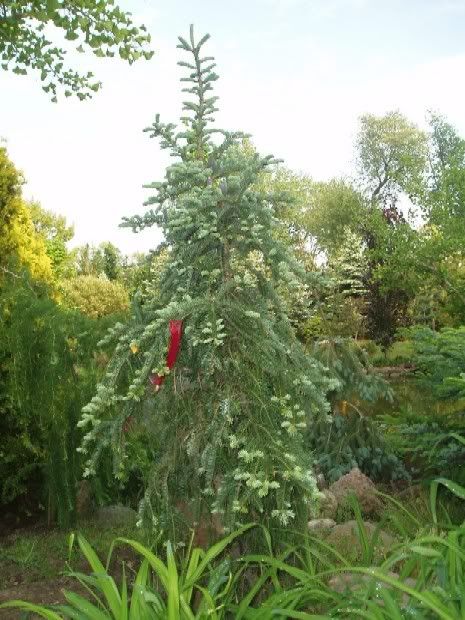
Dwarf selections dominate garden cultivation. Hudsonia forms a low, spreading cushion without cones and has received the RHS Award of Garden Merit. Nana is an old, globe-shaped dwarf, while Piccolo is a rare, very compact miniature. Their small scale should not be confused with the eventual size of a typical seed-grown tree. 3
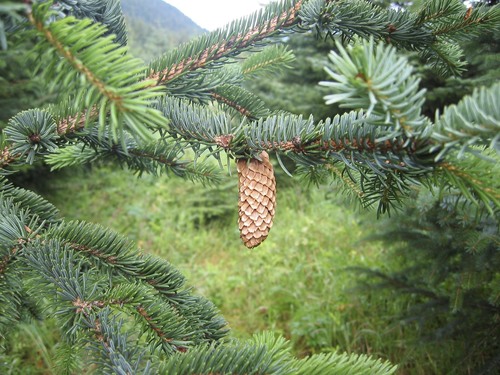
Spruces (Picea spp.) are frequent look-alikes, but their sharp, four-sided needles grow on woody pegs. These contrast with the flat, soft needles of balsam fir. Fraser fir (Abies fraseri), long treated as a variety of balsam fir, differs in its conspicuous cone scales and range restricted to the southern Appalachians. 4
Balsam poplar (Populus balsamifera) also carries the name Balm of Gilead, despite being unrelated. Checking the scientific name resolves the ambiguity between the two trees and is especially useful when reading older accounts of resin use.
Main sources
- Plants of the World Online / Kew, Abies balsamea (L.) Mill.
- International Plant Names Index, Abies balsamea (L.) Mill.
- Royal Horticultural Society, Abies balsamea (Hudsonia Group) 'Hudsonia'
- Missouri Botanical Garden, Plant Finder, Abies balsamea
- Plants For A Future, Abies balsamea
- IUCN Red List of Threatened Species, Abies balsamea assessment
- USDA GRIN Global, Taxonomy detail, Abies balsamea
- USDA PLANTS Database, Plant profile, Abies balsamea (ABBA)
- Tela Botanica, Abies balsamea (L.) Mill.
Frequently asked questions
Is balsam fir toxic?
No, it is not considered toxic to people or pets. Only the resin may irritate skin after prolonged contact, as with many resinous conifers.
Why is balsam fir such a popular Christmas tree in North America?
Its strong resinous fragrance and good needle retention after cutting make it highly valued as a cut Christmas tree, alongside the closely related Fraser fir.
Are balsam fir and Fraser fir the same species?
No. Abies fraseri is a separate species, long treated as a variety of balsam fir. It has a range limited to the southern Appalachians and more conspicuous cone scales.
How can I tell balsam fir from a spruce?
Fir needles are flat and soft, without woody pegs. Spruce needles are sharp, four-sided and attached to small woody pegs. Fir cones stand upright on the branch; spruce cones hang down and fall whole.
What is Canada balsam?
It is the commercial name for balsam fir resin, collected from blisters in the trunk bark. Its refractive index, close to that of glass, made it a standard adhesive for mounting microscope slides.
Is balsam fir endangered?
No, it is not endangered. It remains abundant and widespread across its North American range, although periodic spruce budworm outbreaks cause local losses.
Will balsam fir grow well in a temperate garden farther south?
It rarely succeeds. The species poorly tolerates hot, humid summers south of USDA zone 5; other conifers better suited to those conditions are preferable.
Similar plants
If you are unsure about a plant’s toxicity, ask a botanist or veterinarian for advice.