
Norway maple (Acer platanoides, )
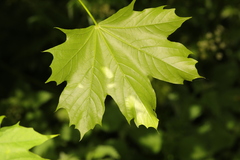
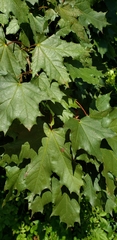
Norway maple (Acer platanoides) is a large deciduous tree in the Sapindaceae family, native to Europe and western Asia, from Spain and France to the Caucasus and northern Iran. Milky sap, five pointed leaf lobes and nearly horizontal samara wings distinguish it. Introduced to North America as an urban shade tree in the 18th century, it is now considered invasive in several states.
Read moreNorway maple

© photo
(c) tauntonguy02780, some rights reserved (CC BY-NC), uploaded by tauntonguy02780 · cc-by-nc
Stephen James McWilliam · cc0
Heather Mazzaccaro · cc0
(c) Mila C., some rights reserved (CC BY) · cc-by
(c) Patrice Dupont, some rights reserved (CC BY) · cc-by
Global distribution
Acer platanoides is native across much of Europe, from Spain and France east through Central Europe, the Balkans and Russia to the Caucasus and northern Iran. Introduced to North America in the 18th century as an urban shade tree, it has widely naturalized and is considered invasive in several states. In its native European range it remains a familiar woodland tree.
- Native6
- Introduced2
- Invasive1
- Metropolitan France
- Spain
- Germany
- Poland
- Russia
- Iran
- United Kingdom
- Canada
- United States
Hexagons: regions where the plant occurs. Green dots: native range.1
Identity
Norway maple (Acer platanoides L., 1753) is a large deciduous tree in the Sapindaceae family and the genus Acer. Milky sap beads from a broken leaf stalk, providing a distinctive clue when foliage is present. Mature trees reach 15–25 m (49–82 ft), sometimes 30 m (98 ft). Its native range spans Europe and western Asia, from Spain and France through Central Europe, the Balkans and Russia to the Caucasus and northern Iran. 1 6
The epithet platanoides means “like a plane tree.” It refers to the resemblance between its palmate leaves and those of Platanus, although the trees belong to different genera and families. In its native European range, Norway maple is a familiar woodland and urban tree, as common in France as the related sycamore maple. 6 7
Recognition
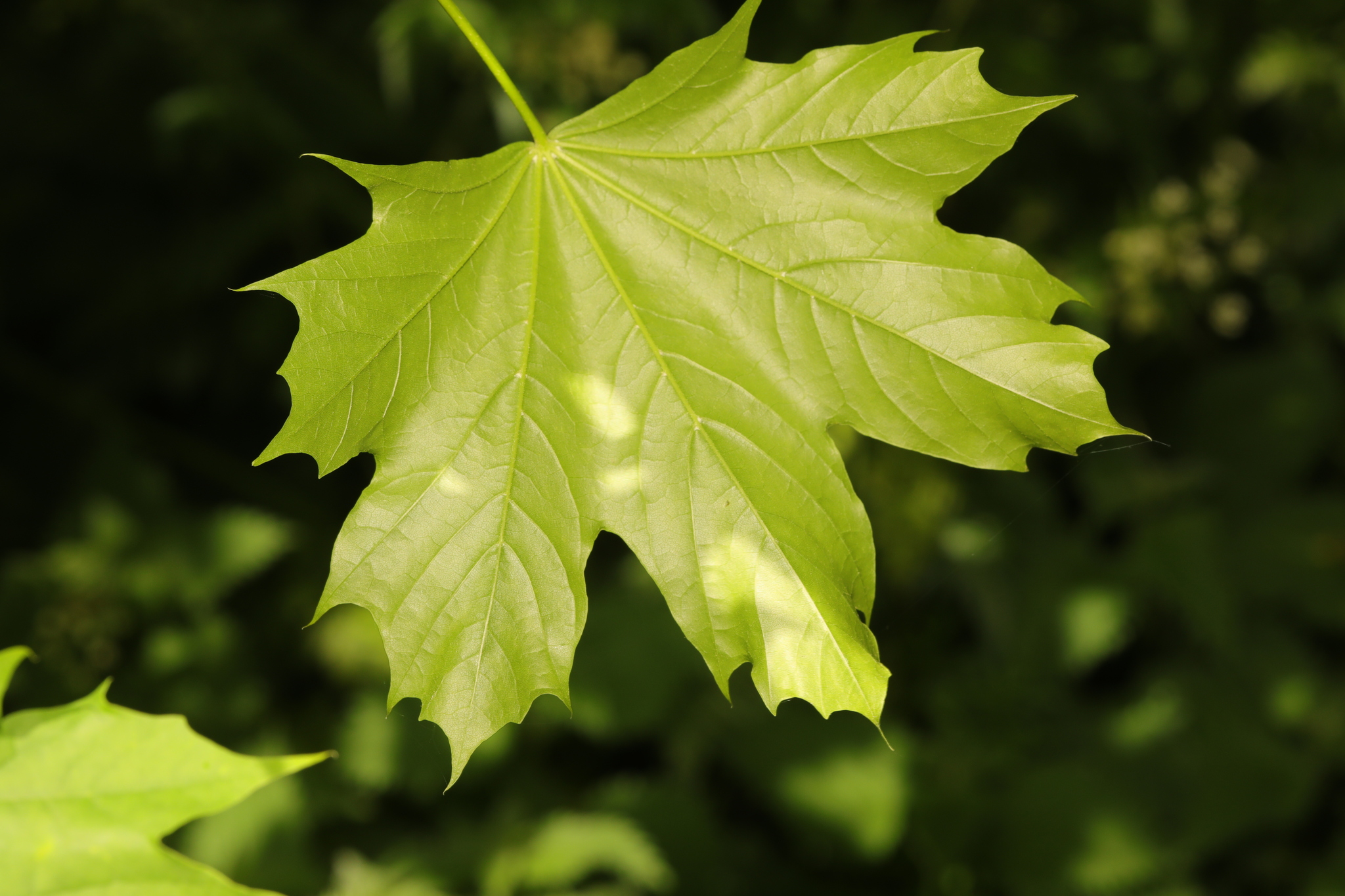
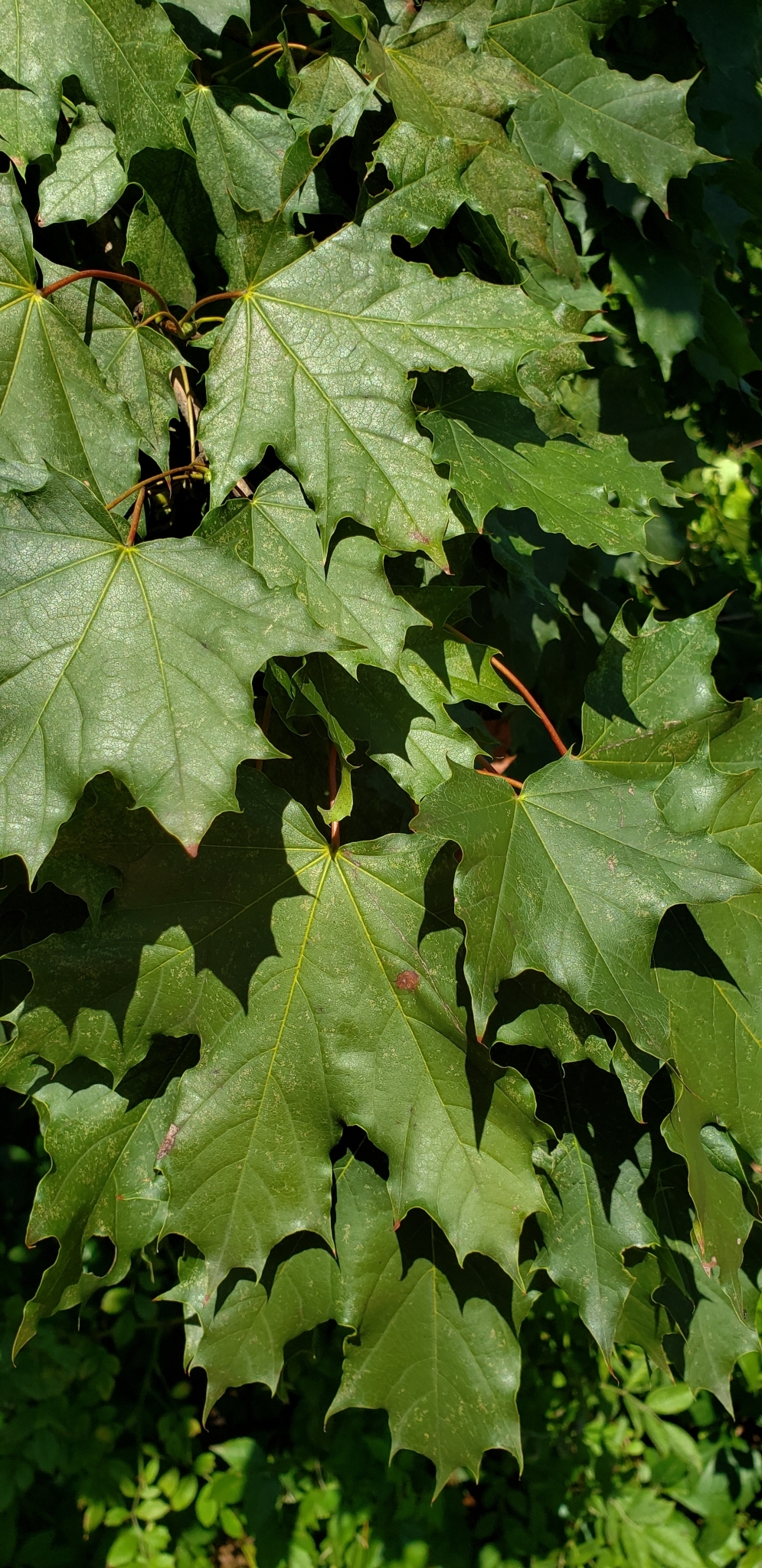
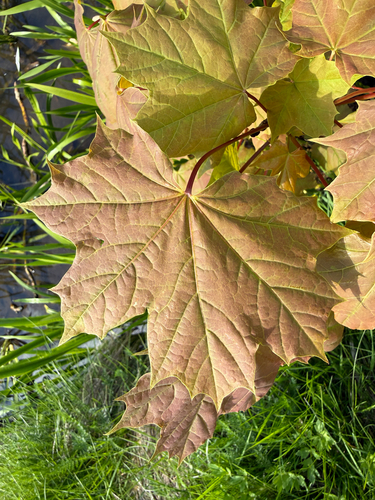
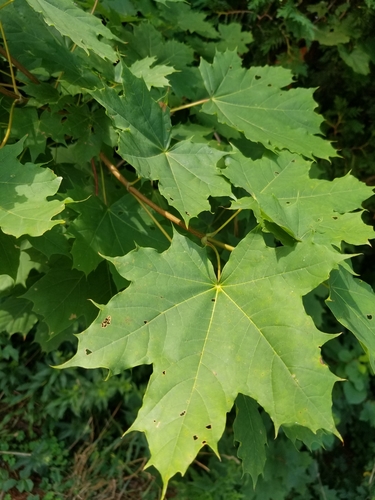
Breaking a leaf stalk provides a useful field clue: Acer platanoides immediately releases milky white sap, absent from both sycamore maple and plane trees. Opposite, palmate leaves have five, sometimes seven pointed lobes and measure 8–20 cm (3–8 in) across. Sycamore has similarly sized leaves but clear sap. 4 6
In temperate Northern Hemisphere spring, from April, upright clusters of small yellow-green flowers provide nectar before the leaves unfold. Sycamore maple instead flowers after leaf emergence. The paired samaras measure 3.5–7 cm (1.4–2.8 in), with wings spreading almost horizontally, compared with an acute angle in sycamore. 6 3
Gray-brown bark develops fine longitudinal fissures with age, without flaking in plates like plane-tree bark. A dense, rounded, symmetrical crown commonly reaches 15–25 m (49–82 ft), occasionally 30 m (98 ft) in outstanding European specimens. 6 5
Useful taxonomy
Named by Linnaeus in 1753, Norway maple is among the earliest formally named maples. Like most Acer species, it was long assigned to the former Aceraceae family before the entire genus was moved to Sapindaceae. 1
The accepted name presents few difficulties, but older names for foliage forms still appear in horticultural catalogs:
- Acer platanoides f. rubrum (Herder) Pax (red-leaved form)
- Acer platanoides f. dissectum J.Jacq. ex Schwer. (divided-leaved form)
- Acer platanoides var. drummondii (J.Drumm. ex Schwer.) Geerinck (variegated form)
- Euacer platanoides (L.) Opiz (former generic placement)
These historical names describe red foliage, divided leaves, variegation or a former generic placement.
These forms chiefly represent foliage selections rather than separate species. The accepted Acer platanoides L. remains the reliable botanical reference. 1 7
Habitat and range
Much of Europe falls within the native range, stretching from Spain and France to the Caucasus and northern Iran. The IUCN classifies the species as Least Concern, reflecting its broad range and stable population. 6 9
Within France, Norway maple grows in lowland deciduous woods, hedges and woodland edges, often with oak or ash. Its tolerance of compacted soil and air pollution also makes it a widely planted street tree. 8 7
North American introduction began in the mid-18th century, when it was planted for urban shade. It subsequently naturalized widely. Rapid growth, abundant samaras and dense shade that suppresses vegetation beneath the crown have made it invasive in several northeastern and Midwestern states, with planting restrictions in some jurisdictions. 3 4
Life cycle and reproduction
Flowering before leaf emergence makes Norway maple an early spring nectar source for bees. Pollinated flowers develop into abundant samaras in fall, which disperse on the wind. 6 3
Winter cold stratification is needed for germination; seeds sown in fall emerge the following spring. Juvenile growth is rapid, slowing markedly as the tree approaches maturity. 5 4
Seed propagation reproduces the typical species, but purple-leaved or variegated cultivars such as Crimson King do not come true from seed. These are propagated by grafting onto rootstocks of the species. 2 4
Uses and risks
Shade and street plantings draw on Norway maple’s rapid growth, dense crown and tolerance of poor, compacted or polluted urban soils. Its pale, fine-grained wood is used for turning and small household objects. Sap can be concentrated into syrup, although it is less sugary than sugar maple sap. 5 4
Unlike sycamore maple, whose seeds threaten grazing horses, Acer platanoides is classified as non-toxic to humans and common domestic animals in reference databases. Its status specifically for horses remains undocumented. 1
Ecological risk arises outside the native range. In North America, plentiful samaras and dense canopy can suppress regeneration of native trees, leading to invasive listings and, in some places, sales restrictions. In Europe, the species has long coexisted with native woodland flora. 3 4
Varieties, look-alikes and related plants
Horticultural cultivars remain members of the same species. Crimson King, recognized by the Royal Horticultural Society, keeps purple to crimson foliage throughout summer. Crimson Sentry combines that color with a narrow habit; Globosum develops a compact spherical crown grafted onto a trunk; Drummondii has broad, irregular white leaf margins. 2 4
Several related or superficially similar trees warrant comparison:
- Acer pseudoplatanus, sycamore maple, has clear rather than milky sap and samaras with wings at an acute angle;
- Platanus, the plane-tree genus, has alternate leaves and spherical fruits; despite the leaf resemblance, it is not closely related to Norway maple;
- Acer campestre, field maple, has smaller leaves with rounded lobes and often corky bark on its twigs.
Milky sap from the leaf stalk quickly distinguishes Acer platanoides from sycamore maple and plane trees. It offers a faster check on a leafy specimen than a detailed comparison of samaras or bark. 4 6
Main sources
- Plants of the World Online / Kew, Acer platanoides L.
- Royal Horticultural Society, Acer platanoides Crimson King
- Missouri Botanical Garden, Acer platanoides
- NC State Extension, Acer platanoides (Norway Maple)
- Plants For A Future, Acer platanoides
- Trees and Shrubs Online, Acer platanoides
- Tela Botanica, Acer platanoides L.
- INPN / MNHN, Acer platanoides L., 1753 (cd_nom 79779)
- IUCN Red List, Acer platanoides assessment
Frequently asked questions
Is Norway maple poisonous?
Reference databases classify Acer platanoides as non-toxic to humans, dogs and cats. Its milky sap, visible when a leaf stalk is broken, is not reported as irritating. Its status for horses remains undocumented.
How can I tell Norway maple from sycamore maple?
Norway maple releases milky sap from a broken leaf stalk; sycamore maple does not. Its samara wings spread almost horizontally, while sycamore wings form an acute angle. Norway maple also flowers before its leaves open, rather than afterward.
What does the name Acer platanoides mean?
The epithet platanoides means “like a plane tree,” describing the resemblance of its palmate leaves to those of Platanus. The trees are not close botanical relatives.
Is Norway maple invasive?
It is invasive in parts of North America, where it was introduced in the 18th century; planting restrictions apply in several northeastern states. In its native European range it remains a familiar woodland and urban tree.
How tall does Norway maple grow?
Trees commonly reach 15–25 m (49–82 ft), with a crown spreading 10–20 m (33–66 ft). Some European specimens exceed 30 m (98 ft).
Are Norway maple wood and sap useful?
Its pale, fine-grained wood is used for turning and small household objects. Sap can be concentrated into syrup, but yields much less sugar than sugar maple sap.
Are purple forms such as Crimson King different species?
No. Crimson King, Crimson Sentry and Globosum are horticultural cultivars propagated by grafting, rather than separate species or botanical varieties.
Which diseases affect Norway maple?
Verticillium wilt, often fatal, is the main threat. Tar spot and powdery mildew are mostly cosmetic and generally do not seriously harm the tree.
Similar plants
If you are unsure about a plant’s toxicity, ask a botanist or veterinarian for advice.