
Candlenut (Aleurites moluccanus, )

Candlenut (Aleurites moluccanus) is a large evergreen tree in the Euphorbiaceae family, native to the Indo-Pacific region and spread early by people to Pacific islands. Known as kukui in Hawaii, where it is the official state tree, it has lobed juvenile leaves, a silvery crown and oil-rich seeds in very hard shells. The raw seeds are toxic; roasted kernels have traditional culinary uses.
Read moreCandlenut, Indian walnut, Candleberry, Kukui and Kemiri
Place in full sun, with intense direct light all day long.


© photo
no rights reserved, uploaded by 葉子 · cc0
Wikimedia Commons · CC BY-SA or Public Domain
Wikipedia · CC BY-SA
Taken Aug 21, 2022 by Anatas (cc-by-sa)
Taken Mar 7, 2012 by Tela Botanica − Yoan MARTIN (cc-by-sa)
© copyright of the Board of Trustees of the Royal Botanic Gardens, Kew.


Global distribution
The precise native range of Aleurites moluccanus is difficult to establish because people spread it throughout the Indo-Pacific region very early. Its present distribution includes India, southern China, Southeast Asia, Papuasia and many Pacific islands, where early navigators introduced it as a useful plant long before Europeans arrived.
- Native5
- Introduced3
- Indonesia
- Malaysia
- India
- Southern China
- Papua New Guinea
- French Polynesia
- Hawaii
- Australia (Queensland, Northern Territory)
Hexagons: regions where the plant occurs. Green dots: native range.1
Identity
Candlenut (Aleurites moluccanus (L.) Willd., 1805) combines four distinctive features: a silvery crown, deeply lobed juvenile leaves, rusty star-shaped hairs on new shoots and seeds enclosed in very hard shells. This evergreen member of the Euphorbiaceae reaches 20 to 30 m (65 to 98 ft). Its raw seed has a strong purgative effect, while roasted kernels are eaten traditionally; tung-tree seeds remain toxic even when cooked. Linnaeus described it as Jatropha moluccana in 1753, and Willdenow transferred it to Aleurites in 1805. 1 6
The Greek word aleuron, meaning flour, gave the genus its name: pale hairs make new growth look dusted with flour. Its French name, bancoulier, comes from Bengkulu in Sumatra, a historic center of the nut and oil trade. 5
Regional names preserve the tree's uses. Kukui is its Hawaiian name, and it has been Hawaii's state tree since 1959. Candlenut recalls its use for lighting, while kemiri refers to the roasted seed used in Indonesian and Malay cooking. Indian walnut and candleberry are other established names. 2
Recognition
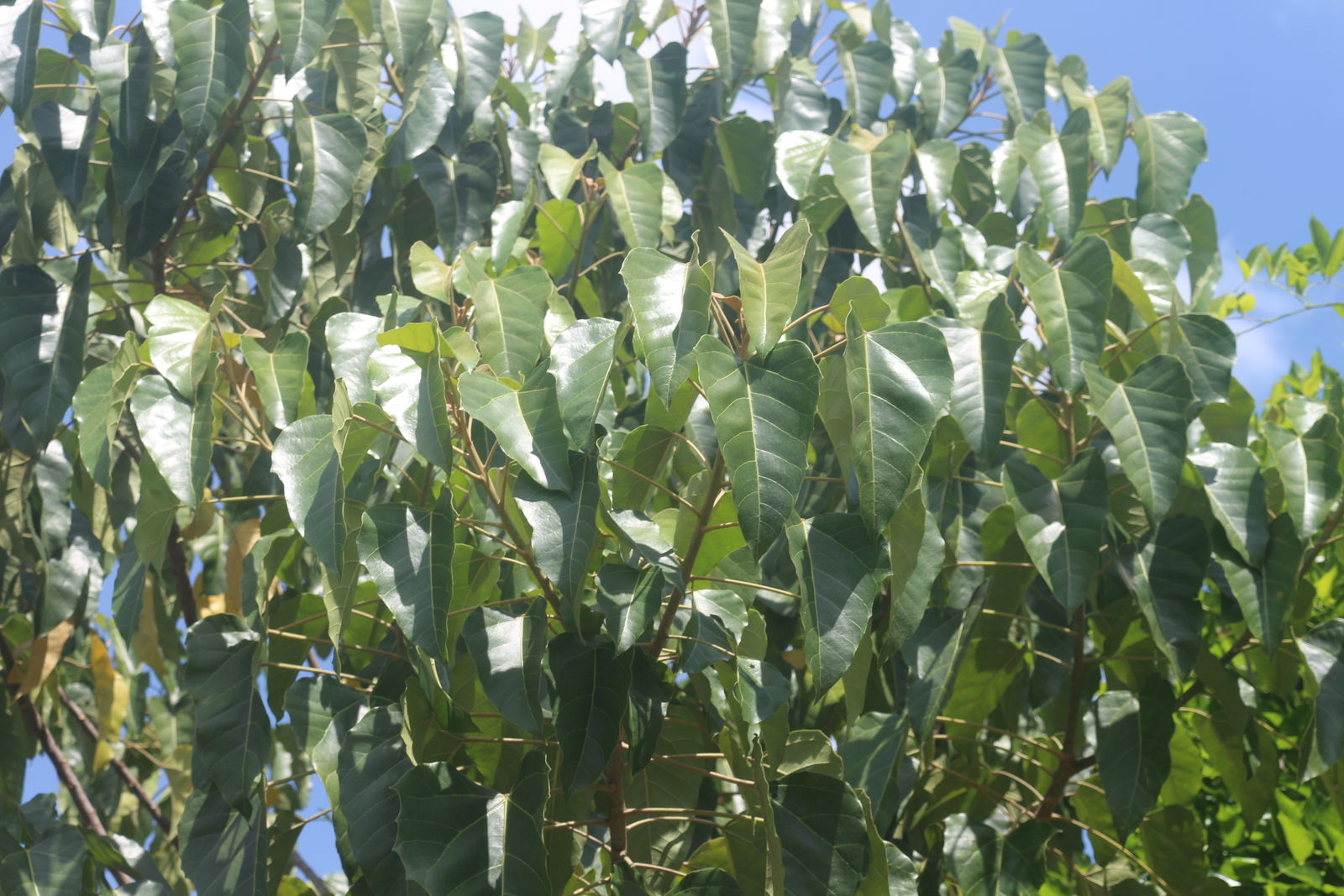
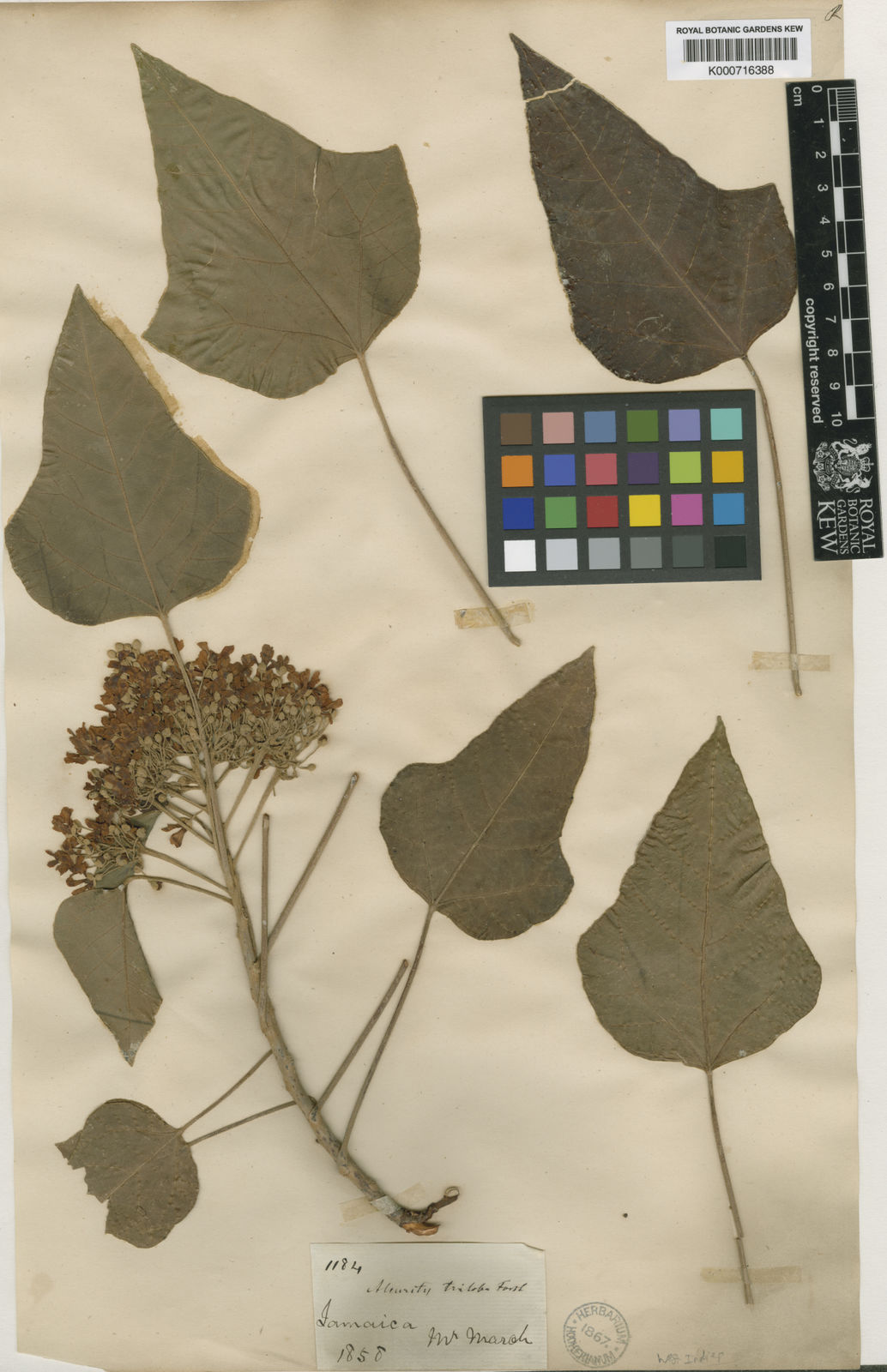
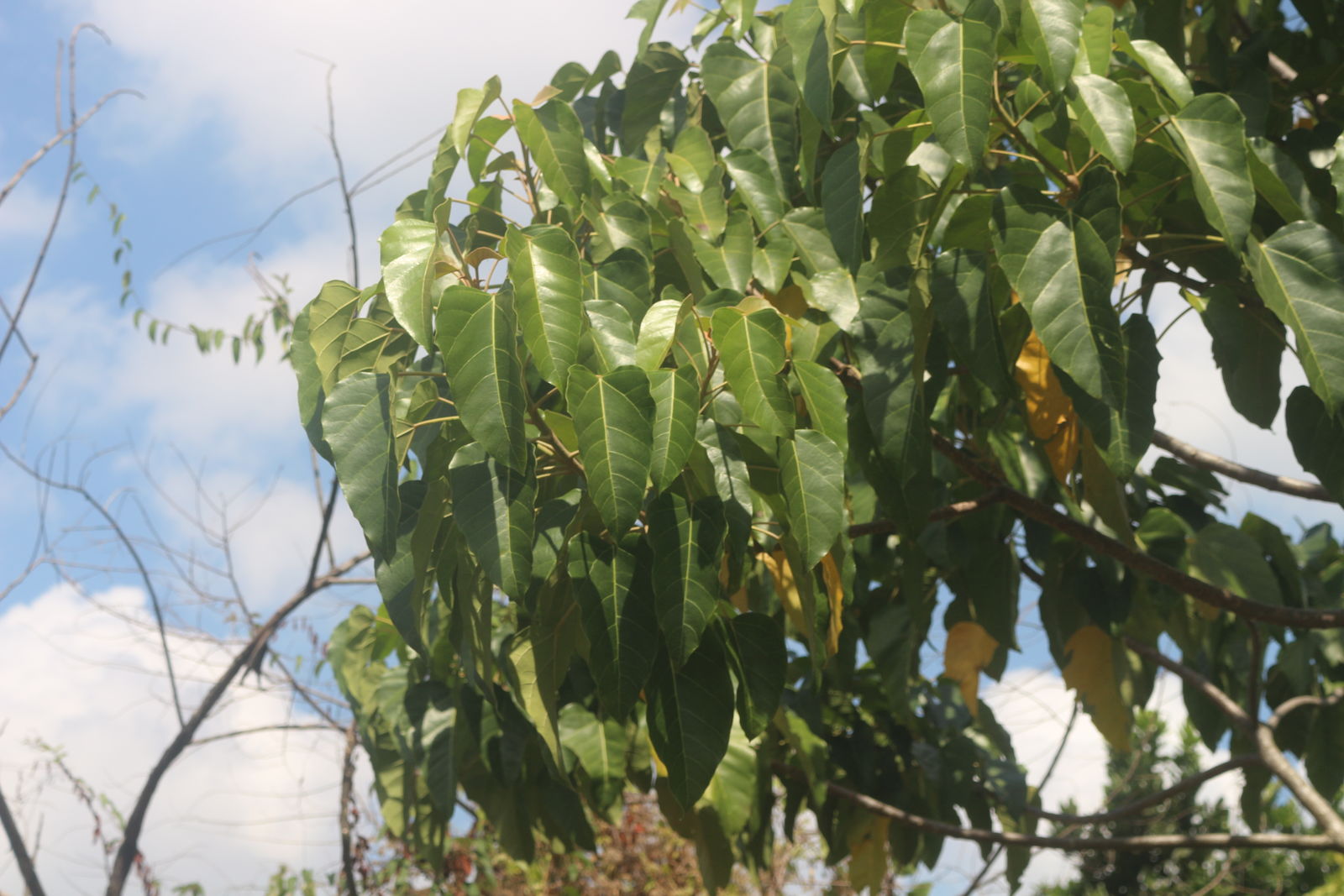
Mature candlenut trees develop gray-brown bark and a broad, spreading or drooping crown. Young plants bear leaves with 3, 5 or 7 lobes; adult shoots carry simpler oval or heart-shaped leaves, 14 to 23 cm (5.5 to 9 in) long. Favorable conditions allow the tree to reach 20 to 30 m (65 to 98 ft). 2 3
Star-shaped hairs provide a better distant clue than crown shape alone. Initially rusty, they turn whitish with age on young shoots and leaf undersides, lending the canopy its characteristic silvery cast against the darker green of neighboring tropical trees. 3
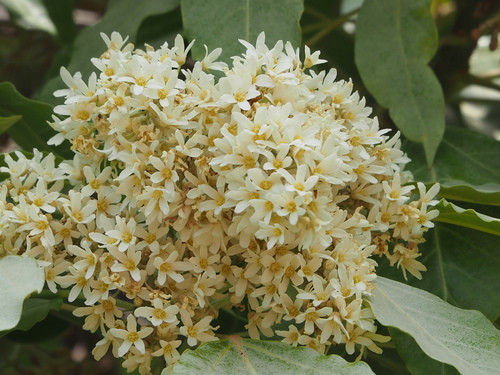
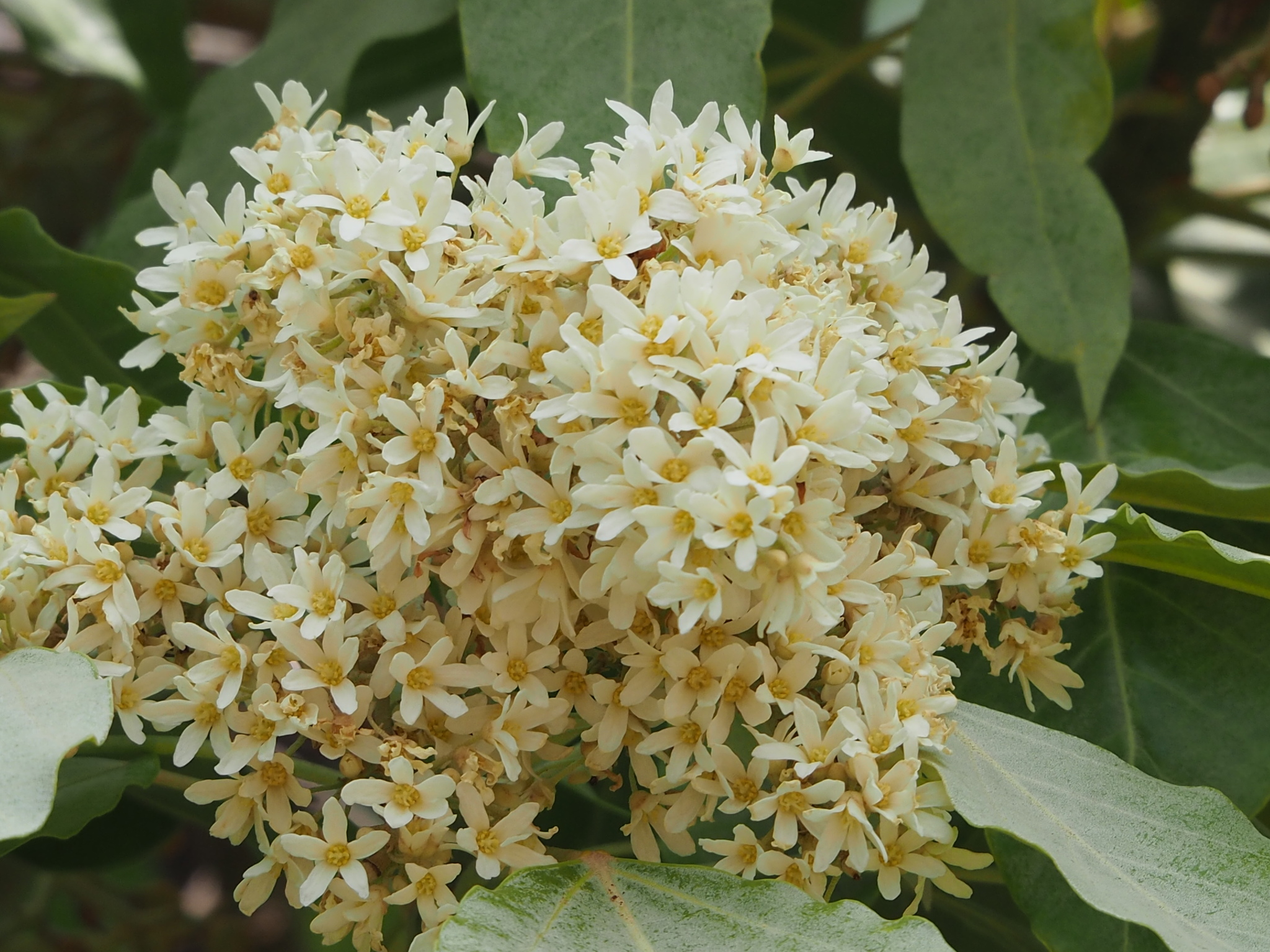
Small white flowers open in terminal panicles. Male flowers measure about 5 mm (0.2 in) across, while female flowers are larger at 9 mm (0.35 in). The fleshy drupe is 4 to 6 cm (1.5 to 2.5 in) across, with one or two lobes. Each contains a hard-shelled seed about 2 cm (0.8 in) across and a white, oil-rich kernel. 3
Useful taxonomy
Candlenut's accepted name in POWO/WCVP is Aleurites moluccanus (L.) Willd., based on Jatropha moluccana L.. Older horticultural literature often uses Aleurites moluccana. Botanical nomenclature no longer accepts that spelling, although the oil trade continues to use it. 1
Historical synonyms include the following names:
- Aleurites trilobus J.R.Forst. & G.Forst., a historical synonym
- Aleurites javanicus Gand., a historical synonym
- Aleurites pentaphyllus Benth., a historical synonym
- Camirium cordifolium Gaertn., an older generic placement
- Mallotus moluccanus (L.) Müll.Arg., an older generic placement
- Rottlera moluccana (L.) Scheff., an older generic placement
Only two species are now accepted in Aleurites. The tung trees formerly called Aleurites fordii and Aleurites cordata belong to Vernicia. This taxonomic separation helps explain lingering confusion between tung oil and candlenut oil, which come from different genera. 1
Habitat and range
Early human transport obscures candlenut's precise native range. People spread the tree so widely across the Indo-Pacific that wild and introduced populations are difficult to separate. Its current distribution stretches from India and southern China through Southeast Asia to Pacific islands and Queensland in Australia. 2
Humid tropical forests and monsoon forests support the species below 300 m (985 ft), particularly along edges and on disturbed ground that it quickly colonizes. Establishment requires annual rainfall exceeding 2,000 mm (79 in). 2
Australia's Northern Territory records candlenut as introduced in several tropical northern bioregions. Early navigators carried it throughout the Pacific as a useful tree before European arrival, and it is now widely naturalized there. The IUCN assessment lists it as Least Concern, reflecting its broad range and the absence of an identified major threat. 8 4
Life cycle and reproduction
Annual shoots can grow 1.5 m (5 ft) in favorable climates. Terminal flowering panicles carry both male and female flowers, distinguishable by size. After pollination, the female flowers develop into drupes whose ripening kernels accumulate oil. 2
An extremely hard shell protects the seed but also hampers germination. In nature, heat or physical damage may weaken it. A traditional propagation treatment covers seeds with dry leaves, burns this mulch and immediately immerses the hot seeds in cold water to crack the shell. Reported germination then exceeds 30%, compared with very poor results without treatment. 2
Australian rodents, especially the giant white-tailed rat, break fallen seeds open to reach the kernels. Broken shells beneath a tree can reveal its presence before the silvery crown comes into view. 3
Uses and risks
Raw candlenut seeds contain saponins, phorbol and toxalbumins that make them toxic and strongly purgative when swallowed. Prolonged drying or roasting destroys much of these compounds. Traditional culinary use concerns prepared kernels, never raw seeds. 2
Roasted, ground kemiri thickens curries and sauces in Indonesia and Malaysia. In Hawaii, roasted kernels made into the salted paste ʻinamona form a traditional poke ingredient. Oil extraction yields 42 to 60%, and the oil also has cosmetic uses for skin and hair, notably in Indonesia and Fiji. 2
Lighting explains the English name: Hawaiians threaded nuts onto palm midribs, then burned them in sequence, each lasting about a quarter of an hour. The wood also served for canoe construction, and the bark supplied a reddish-brown dye for traditional bark cloth. 9
Varieties, look-alikes and related plants
Aleurites rockinghamensis, restricted to Papua New Guinea and northeastern Queensland, is the other accepted species in this small genus. The former A. moluccanus var. rockinghamensis is now treated as that separate species, a distinction to check before buying seeds under the older name. 1
Tung trees are the main source of confusion. Vernicia fordii and Vernicia cordata once appeared as Aleurites fordii and Aleurites cordata. Both oils have longstanding industrial uses, but only candlenut oil has culinary uses. Tung oil must never be eaten, and its seeds are toxic even through contact. 1
Labels reading Aleurites moluccana refer to the same tree as the accepted Aleurites moluccanus. Only the ending differs, a common trap when searching older horticultural catalogs or oil-trade literature.
Main sources
- Plants of the World Online / Kew, Aleurites moluccanus (L.) Willd.
- Plants For A Future, Aleurites moluccanus
- Missouri Botanical Garden Plant Finder, Aleurites moluccanus
- IUCN Red List, Aleurites moluccanus assessment (2017)
- Tela Botanica, Aleurites moluccanus
- Integrated Taxonomic Information System, Aleurites moluccanus
- USDA GRIN Global Taxonomy, Aleurites moluccanus
- eFlora of the Northern Territory (Australia), Aleurites moluccanus
- USDA PLANTS Database, Aleurites moluccanus profile
Frequently asked questions
Is candlenut the same as a tung tree?
No. Tung trees, Vernicia fordii and Vernicia cordata, were once placed in Aleurites but now belong to a separate genus. Their oil is never eaten, unlike candlenut oil; their seeds are toxic even through contact.
Are candlenuts poisonous?
Raw seeds are toxic. Their saponins, phorbol and toxalbumins cause a strong purgative effect. Roasting or prolonged drying destroys much of these compounds, and the prepared kernels are eaten as kemiri or ʻinamona.
Why is the tree called candlenut?
The name recalls an old Hawaiian practice of threading nuts onto a palm midrib and burning them one after another for light. Extracted oil was also burned in stone lamps.
Is candlenut native to Hawaii?
No. Early Polynesian navigators introduced it as a useful plant. Known locally as kukui, it became the official state tree of Hawaii in 1959.
How can I recognize a candlenut tree from a distance?
Its silvery crown stands out against other tropical canopy trees. Whitish star-shaped hairs on young shoots and leaf undersides give the crown a pale, powdery appearance visible from a distance.
Can candlenut grow outside the tropics?
Growing it outdoors is difficult. It cannot tolerate frost and needs USDA zones 10 to 12. In temperate climates it survives only in a container brought indoors for winter or in a heated greenhouse.
Are Aleurites moluccanus and Aleurites moluccana the same plant?
Yes. Moluccana is an older spelling still common in the oil trade and horticultural catalogs. The currently accepted botanical name is Aleurites moluccanus.
Similar plants

If you are unsure about a plant’s toxicity, ask a botanist or veterinarian for advice.