
Monkey-puzzle (Araucaria araucana, )
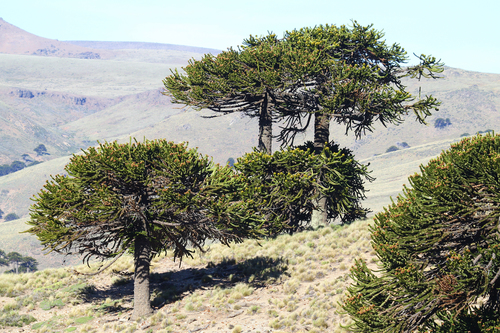
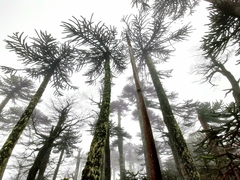
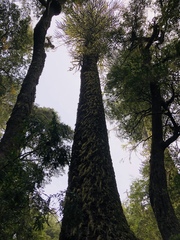
Monkey-puzzle (Araucaria araucana), also called Chile pine or pehuén, is a large conifer in the Araucariaceae family, native to volcanic slopes in central and southern Chile and western Argentina. Its sharp triangular leaves and thick, fire-resistant bark are distinctive. The hardiest member of Araucaria, it has been Chile’s national tree since 1990.
Read moreMonkey-puzzle, Monkey puzzle tree, Chile pine, Pehuén, Pewen and Piñonero




© photo
(c) joseluisblazquez, some rights reserved (CC BY-NC) · cc-by-nc
Rolando Díaz Fuentes · cc0
Francisco E. Fonturbel · cc-by
Taken Jun 7, 2022 by lucas (cc-by-sa)
Taken Aug 27, 2022 by Teresa (cc-by-sa)
Taken Oct 16, 2021 by Jörg D (cc-by-sa)
Taken Sep 30, 2022 by jorgemusm (cc-by-sa)
Taken Dec 31, 2021 by Kai Best (cc-by-sa)
© copyright of the Board of Trustees of the Royal Botanic Gardens, Kew.




Global distribution
The narrow native range covers Biobío and Araucanía in Chile and Neuquén in Argentina, across the Andes and the coastal Nahuelbuta range. Introduced to Europe in the 19th century, it is now chiefly grown as a specimen tree in temperate oceanic climates outside its native range.
Identity
Monkey-puzzle (Araucaria araucana (Molina) K.Koch, 1873), also known as Chile pine or pehuén, is a large conifer in the Araucariaceae family and the genus Araucaria. Juan Ignacio Molina first described it in 1782 as Pinus araucana. Karl Koch transferred it to Araucaria in 1873, creating the combination still accepted today. 1 2
The English name monkey puzzle tree is said to have originated around 1850 at Pencarrow in Cornwall. A visitor reportedly remarked that climbing a tree with such rigid, sharp leaves would puzzle a monkey. The Mapudungun word pehuén also gave the Pehuenche people their name, meaning “people of the pehuén.” Its seeds have long been an important food for them. 6 7
Recognition
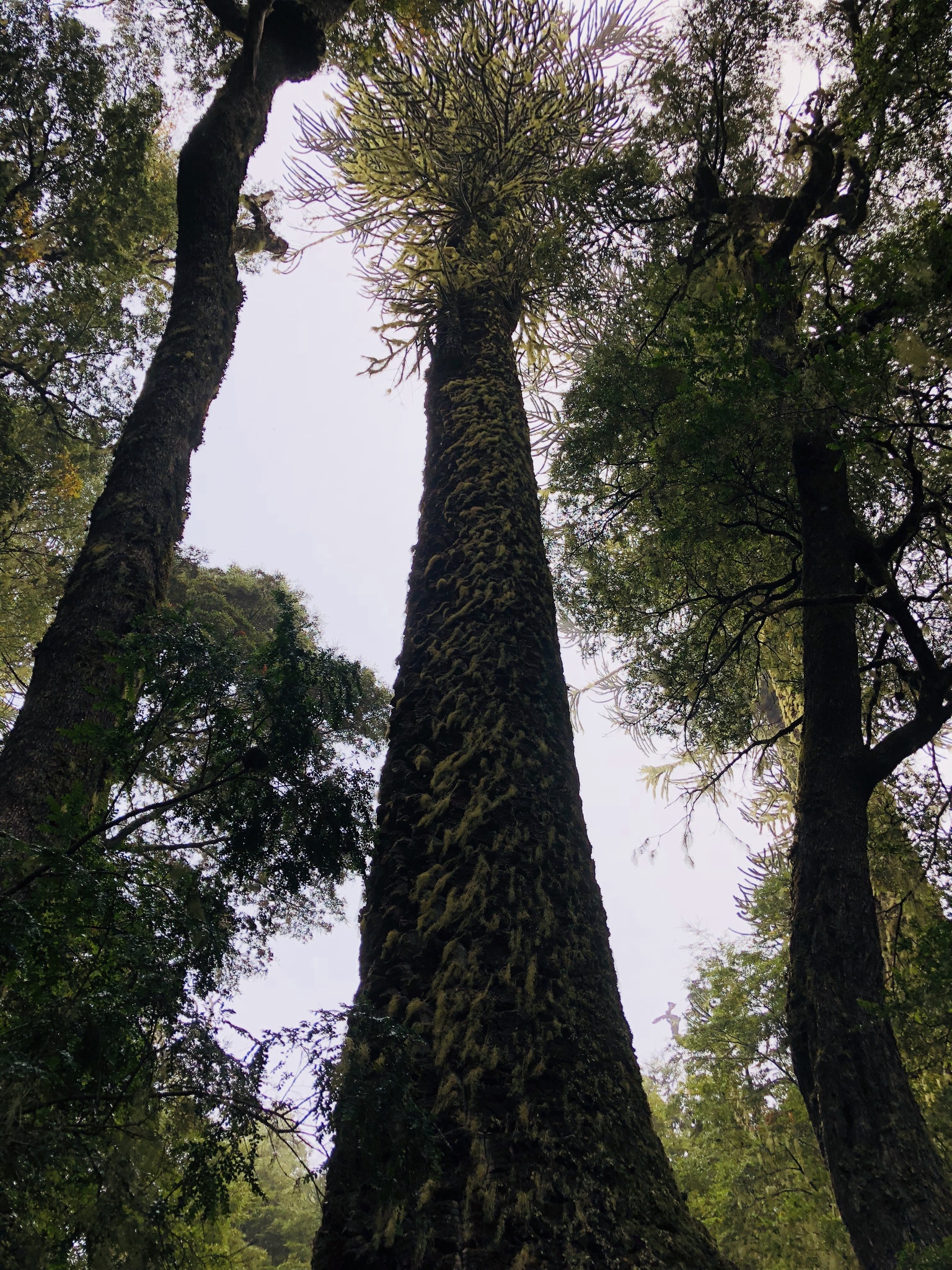
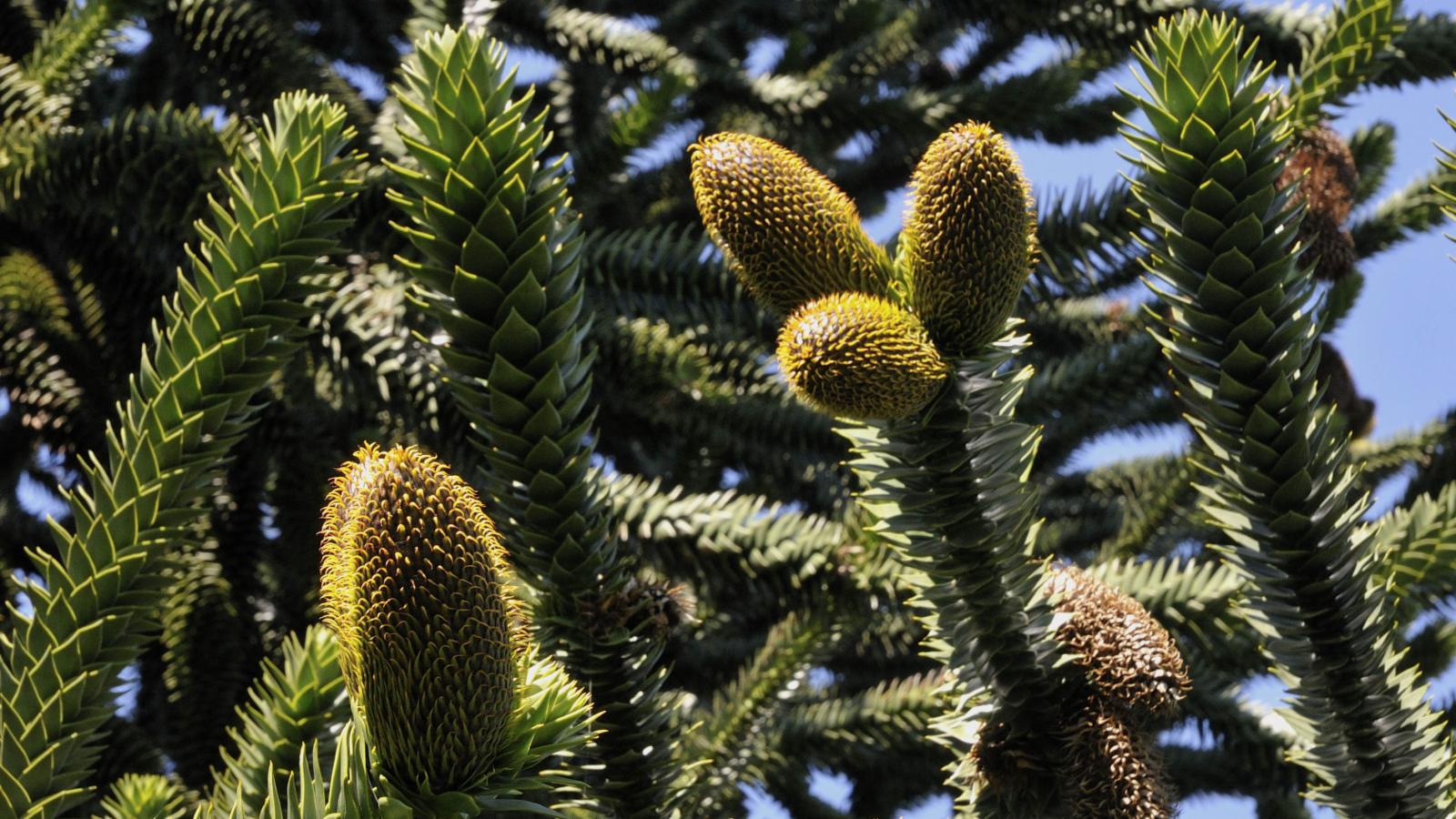
Sharp, triangular leaves distinguish Monkey-puzzle at close range. Each thick, leathery leaf measures 3–4 cm (1–1.5 in) and ends in a fierce point. The leaves spiral tightly around the branches and can remain alive on the tree for 24 years, much longer than in most conifers, producing the dense, overlapping scales of older shoots. 6
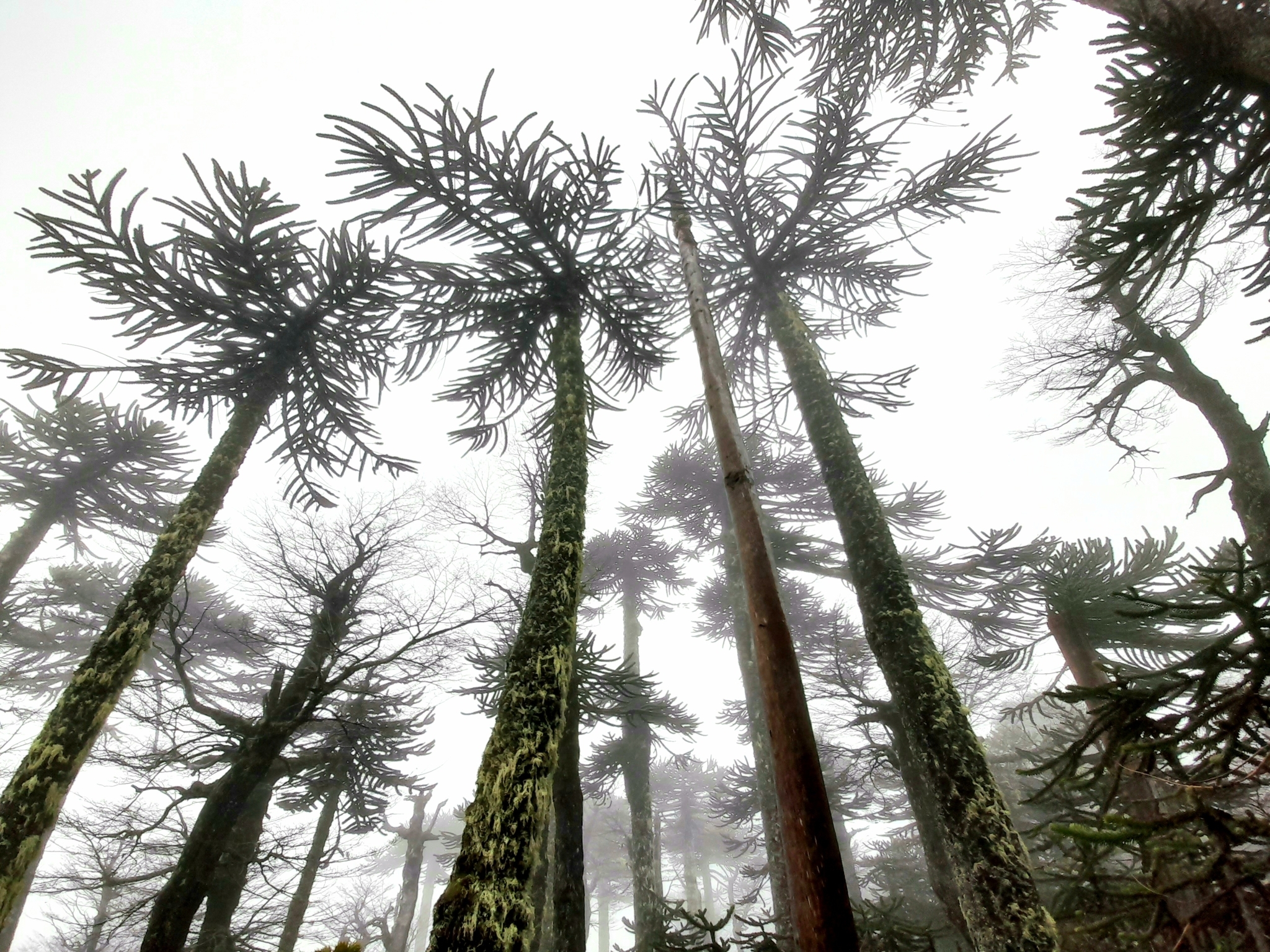
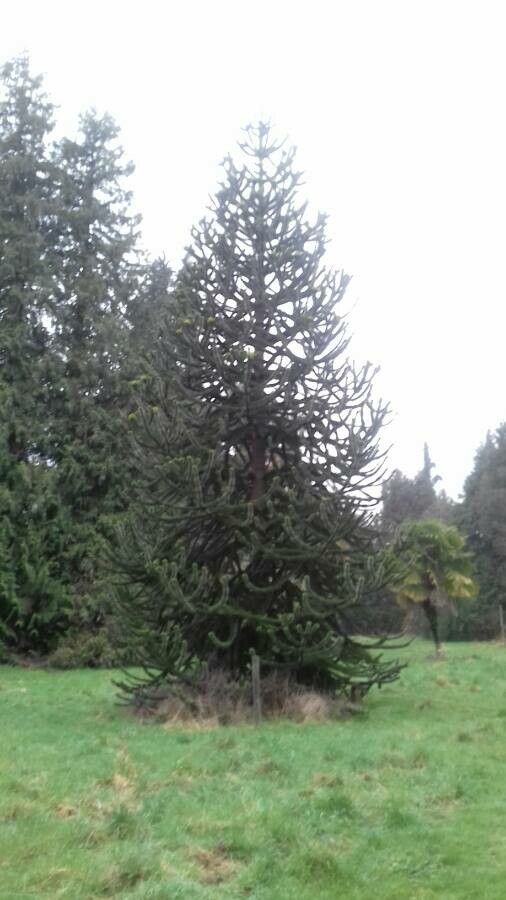
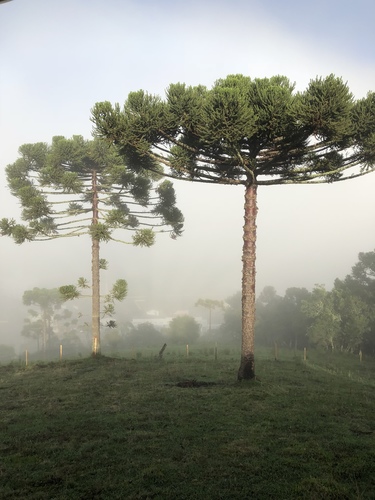
Bark reaching 15 cm (6 in) thick forms resinous, polygonal plates. This unusual thickness protects the trunk against fire. Young trees have a narrow pyramidal shape; with age, the lower branches fall away and the crown becomes a high, open umbrella. Wild trees commonly reach 30–40 m (100–130 ft), with trunks 1–1.5 m (3–5 ft) across. 6 4
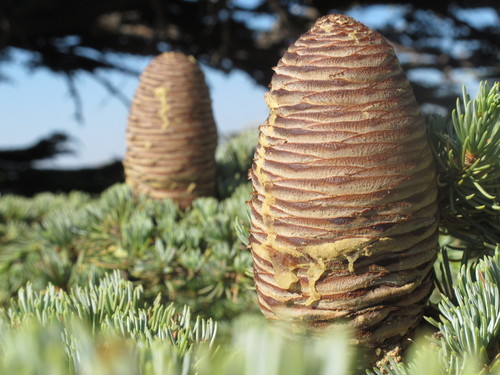
Horizontal whorls of branches create a reptilian, tail-like appearance. Rounded female cones measure 12–20 cm (5–8 in) across and hold about 200 seeds. Mature male cones are elongated, measuring 8–12 cm (3–5 in) in length. These contrasting cone shapes help distinguish reproductive trees as well as their sex. 6
Useful taxonomy
Molina’s original name, Pinus araucana, dates to 1782, although this tree does not belong to the true pine family, Pinaceae. Poiret and Mirbel subsequently placed it in other genera before Koch established the current Araucaria combination in 1873. Names encountered in historical botanical and horticultural literature include:
- Pinus araucana Molina, the basionym, 1782
- Araucaria imbricata Pav., 1797, formerly the main horticultural name
- Abies araucana (Molina) Poir., a historical combination, 1817
- Dombeya chilensis Lam., a historical name, 1786
- Araucaria chilensis Mirb., a historical name, 1825
Victorian garden records and 19th-century nursery catalogs often use Araucaria imbricata. For present-day identification, Araucaria araucana is the stable botanical reference linking those older names to the same species. 1 2
Habitat and range
Biobío and Araucanía in Chile, together with Neuquén in Argentina, contain the tree’s restricted native range. Populations occur in the Andes and the coastal Nahuelbuta range. They occupy volcanic slopes at 600–1,700 m (2,000–5,600 ft), favoring well-drained, slightly acidic volcanic soils. 7 8
Abundant rainfall and cool winters characterize its temperate oceanic habitat. Established trees tolerate temperatures down to about -20 °C (-4 °F), making this the hardiest Araucaria. Beyond South America it is chiefly planted as a specimen tree, including in Britain, France and New Zealand, where oceanic conditions broadly resemble those of its native home. 6 3
Life cycle and reproduction
Separate male and female trees make Monkey-puzzle dioecious, with pollen carried by wind. An isolated tree cannot produce viable seed: trees of both sexes must grow within pollinating distance. Cone production usually begins at 30–40 years, explaining why garden specimens can remain without a seed crop for decades. 6
Starchy seeds called piñones measure 3–4 cm (1–1.5 in) long. Gravity drops many close to the parent, while rodents such as the long-haired grass mouse (Abrothrix longipilis) bury whole seeds and help them germinate. Austral parakeets also transport seeds, extending dispersal beyond the short distances achieved by gravity alone. 6
Thick bark and epicormic buds allow the tree to resprout after wildfire, an ancient adaptation to the fires that cross its Andean habitat. A single trunk can live for more than 1,000 years, with exceptional trees approaching 2,000 years. 7
Uses and risks
Pehuenche food traditions rely on the tree’s substantial seeds. Piñones historically supplied 10–15% of the annual diet, especially during the February–May harvest in its South American home. They are eaten raw or cooked and can be stored dry for several months. This local harvest season belongs to the tree’s native Southern Hemisphere setting. 6 5
Large parks and gardens grow it mainly as a solitary specimen. British enthusiasm expanded in the mid-19th century after collector William Lobb sent thousands of seeds in 1844. No poisoning through ingestion is documented for people or domestic animals; the practical danger is physical injury from stiff, sharply pointed leaves touching the skin. 6 4
Conservation pressures are substantial. The IUCN has classified the species as Endangered since 2013, following a Vulnerable assessment in 1998, and it is listed in CITES Appendix I. About two-thirds of its forest habitat has disappeared since 1977 through logging and fire, with grazing adding further pressure. 9 7
Varieties, look-alikes and related plants
Specialist collections contain a few named forms, although stable cultivars are uncommon compared with many garden conifers. Aurea and Variegata were described in the 19th century for golden or variegated foliage and remain rare in nurseries. Angustifolia, with narrower leaves, and Virgata, with threadlike growth, chiefly interest conifer collectors. 3
Norfolk Island pine, Araucaria heterophylla, is a frequent source of confusion because it is sold as a houseplant. Its juvenile leaves are soft and it needs frost-free conditions, unlike Monkey-puzzle. Paraná pine, Araucaria angustifolia, is another South American relative, native to Brazil and northeastern Argentina, with a different ecology. A mature umbrella crown, thick bark and fiercely pointed leaves remain the clearest combination for recognizing Monkey-puzzle.
Main sources
- Plants of the World Online / Kew, Araucaria araucana (Molina) K.Koch
- International Plant Names Index, Araucaria araucana (Molina) K.Koch
- Royal Horticultural Society, Araucaria araucana
- Missouri Botanical Garden Plant Finder, Araucaria araucana (Monkey-Puzzle Tree)
- Plants For A Future, Araucaria araucana
- Wikipedia (EN), Araucaria araucana
- Wikipedia (FR), Chilean araucaria
- INPN / MNHN, Araucaria araucana (Molina) K.Koch, 1873 (cd_nom 83465)
- IUCN Red List, Araucaria araucana assessment
Frequently asked questions
Is Monkey-puzzle poisonous?
No poisoning from ingestion is documented in people or domestic animals. The main risk is physical injury: its rigid, very sharp leaves can puncture skin on contact.
Why is Araucaria araucana called Monkey-puzzle?
The name is said to date to about 1850 at Pencarrow in Cornwall, where a visitor remarked that climbing such sharp foliage would puzzle a monkey.
How long does a Monkey-puzzle live?
Individual trunks commonly live for more than 1,000 years, with exceptional trees estimated at nearly 2,000 years. Thick, fire-resistant bark contributes to this longevity.
Can you eat Monkey-puzzle seeds?
Yes. The starchy seeds, called piñones, are eaten raw or cooked. They historically supplied 10–15% of the Pehuenche people’s annual diet.
Why does my Monkey-puzzle never produce cones?
Male and female cones occur on separate trees, so an isolated tree cannot set viable seed. Cone production also takes about 30–40 years to begin.
Is Monkey-puzzle endangered?
Yes. It has been listed as Endangered on the IUCN Red List since 2013 and is included in CITES Appendix I. About two-thirds of its forest habitat has been lost since 1977.
How does Monkey-puzzle differ from Norfolk Island pine?
Araucaria araucana has very sharp leaves and tolerates cold down to about -20 °C (-4 °F). Norfolk Island pine, Araucaria heterophylla, has soft juvenile foliage and needs frost-free conditions, so it is often grown indoors.
Similar plants

If you are unsure about a plant’s toxicity, ask a botanist or veterinarian for advice.