
Scarlet milkweed (Asclepias curassavica, )
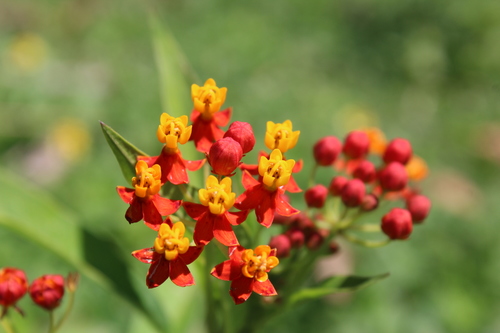
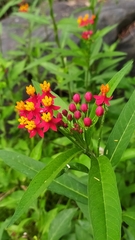
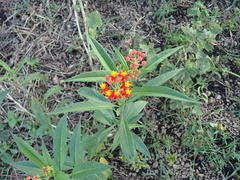
Scarlet milkweed (Asclepias curassavica) is a perennial subshrub in the Apocynaceae family, native to tropical America. Its red-and-yellow flowers attract butterflies, but its toxic milky sap and its role in the persistence of a monarch parasite call for careful choices about where to grow it.
Read moreScarlet milkweed, Bloodflower, Tropical milkweed and Wild ipecac
Allow a few hours of direct sun per day, preferably morning or evening.
Full sun; tolerates light shade
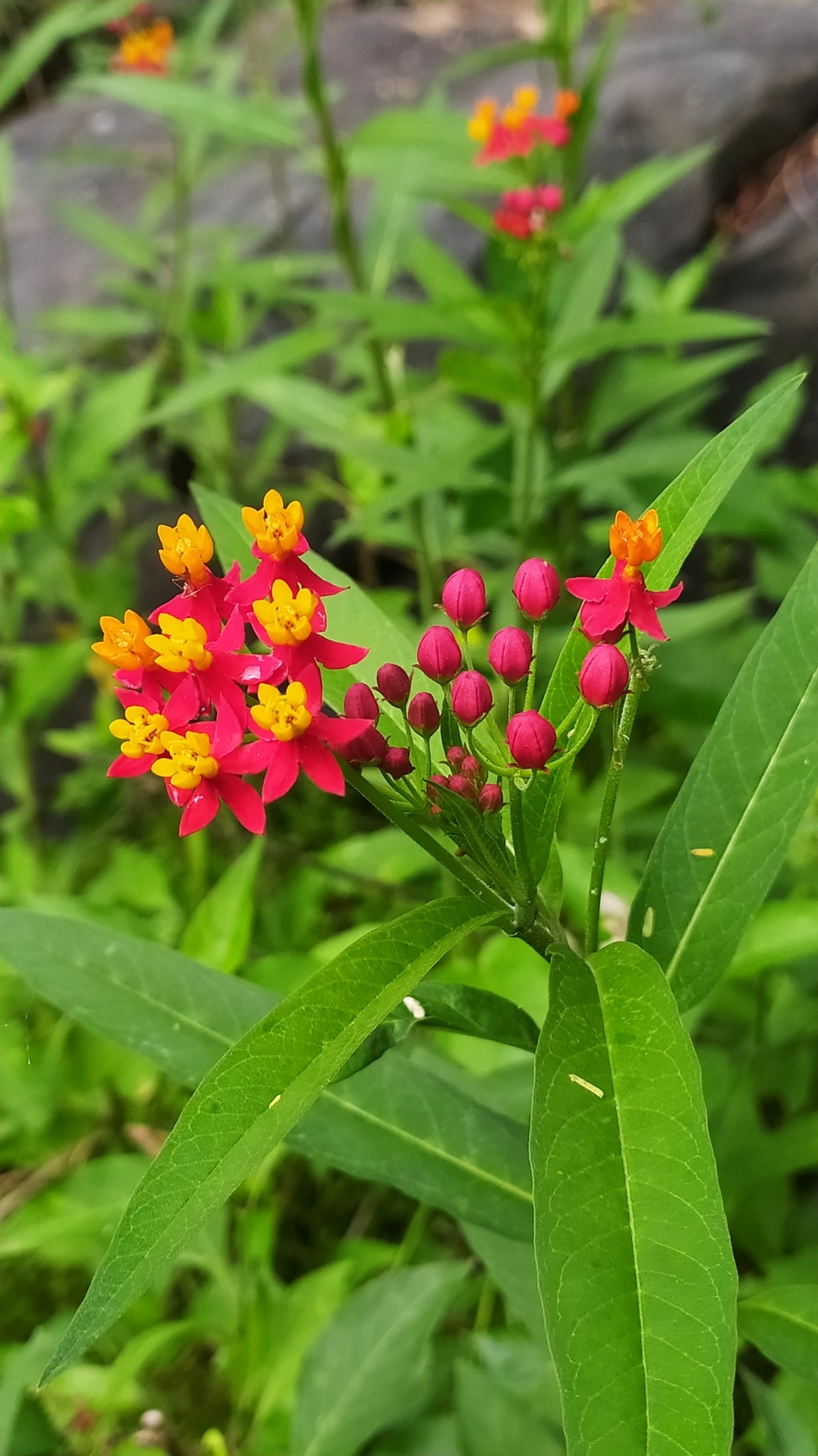


© photo
(c) Ricard Busquets Reverte, some rights reserved (CC BY), uploaded by Ricard Busquets Reverte · cc-by
Amar Bharathy · cc0
Jean-Paul Boerekamps · cc0
Taken Jul 2, 2022 by Antoine Patraldo (cc-by-sa)
Taken May 26, 2021 by Trap Hers (cc-by-sa)
Taken Dec 26, 2008 by Tela Botanica − Liliane Roubaudi (cc-by-sa)
Taken Feb 1, 2014 by Tela Botanica − Liliane Roubaudi (cc-by-sa)
Taken Oct 4, 2012 by Tela Botanica − Gérard Calbérac (cc-by-sa)
© copyright of the Board of Trustees of the Royal Botanic Gardens, Kew.


Global distribution
Botanists have not precisely delimited the native range of Asclepias curassavica, placing it broadly in tropical America, from Mexico through the Caribbean into South America. Grown worldwide as an ornamental and butterfly host plant, it has naturalized in most tropical and subtropical regions, sometimes becoming a troublesome weed.
- Native3
- Introduced4
- Invasive2
- Mexico
- Colombia
- Curaçao
- United States (Florida)
- Réunion
- Taiwan
- China
- Australia
- South Africa
Hexagons: regions where the plant occurs. Green dots: native range.1
Identity
Scarlet milkweed (Asclepias curassavica L., 1753), also known as bloodflower, tropical milkweed or wild ipecac, is a perennial subshrub in the Apocynaceae family. It belongs to Asclepiadoideae, the subfamily containing the milkweeds. 1 2
Although the scientific name points to Curaçao in the Dutch Caribbean, the plant's true origin is difficult to pin down. Botanists place it broadly within tropical America rather than at one precise locality. 6
Bloodflower describes the blood-red corolla, while tropical milkweed refers to its warm-climate habit and milky sap. A wounded stem or leaf releases white latex, a conspicuous feature of this plant. 3
Recognition
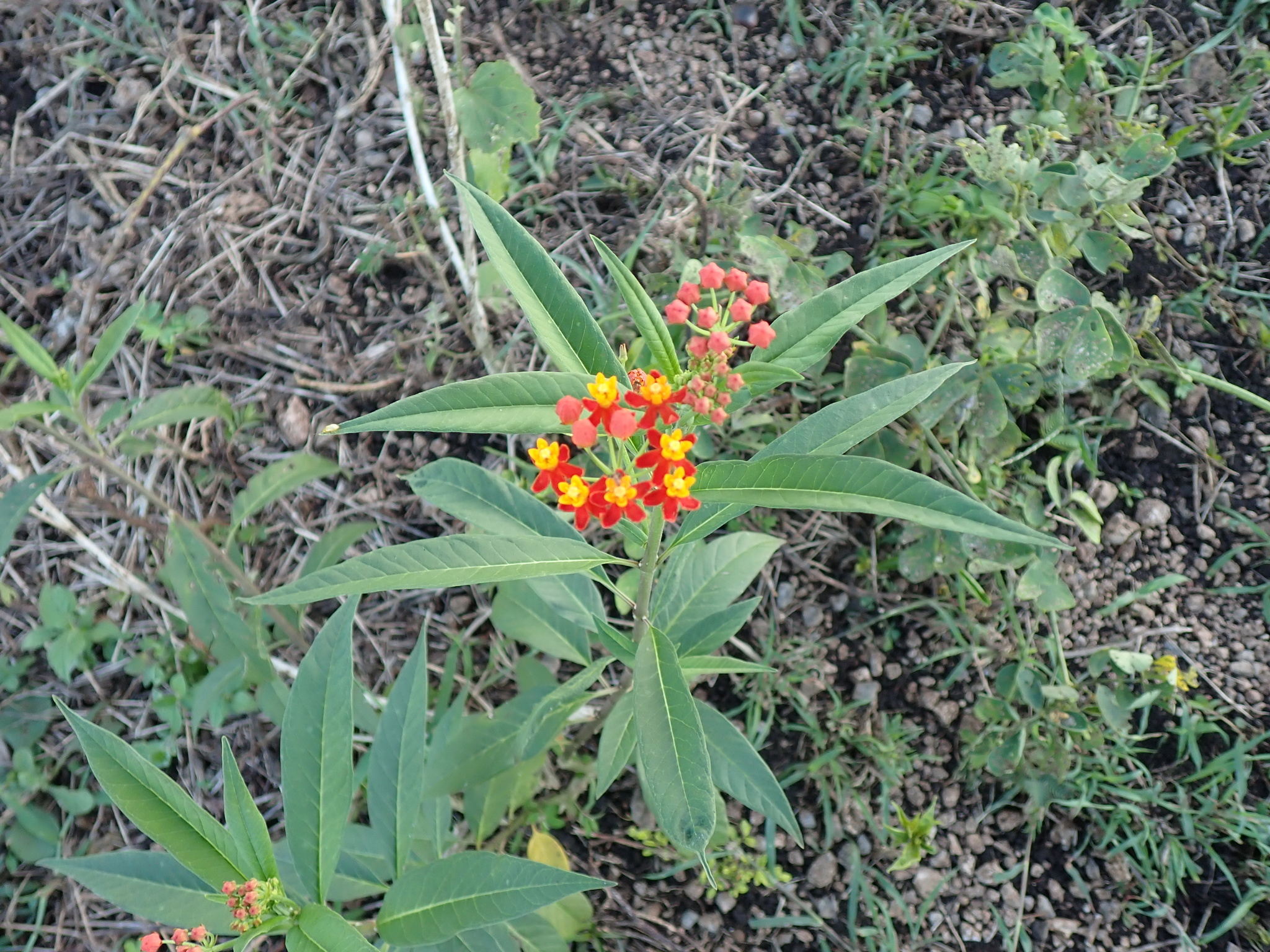
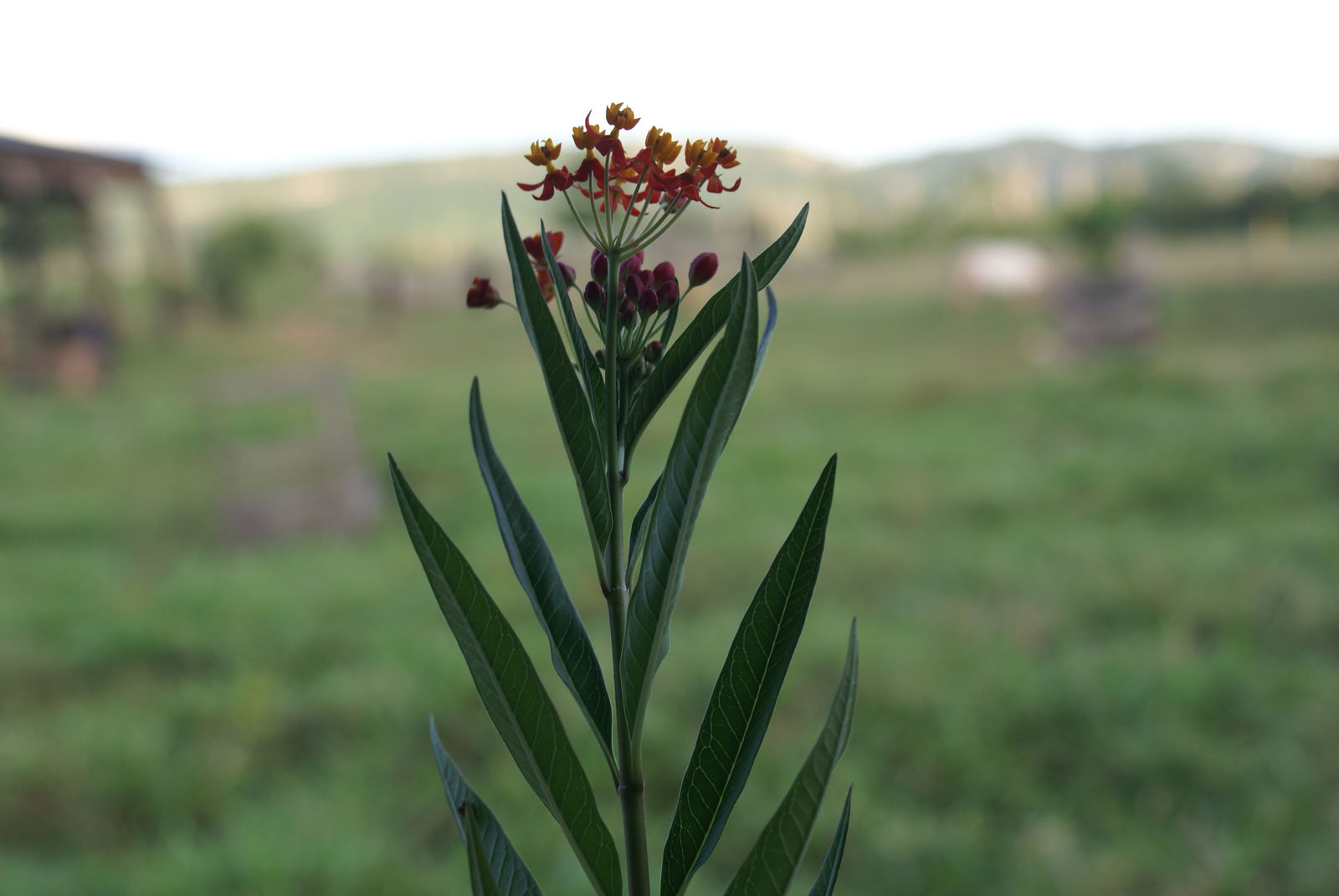
An upright, branching clump rarely exceeds 1 m (3.3 ft) tall and spreads 30–60 cm (12–24 in). The stems remain flexible and pale green; even a small cut on a young shoot promptly releases abundant white latex. 3 4
Opposite, lance-shaped leaves have pointed tips and a prominent midrib extending along the blade. Foliage alone is not enough to distinguish scarlet milkweed from other cultivated milkweeds; the flowers provide a clearer guide. 3
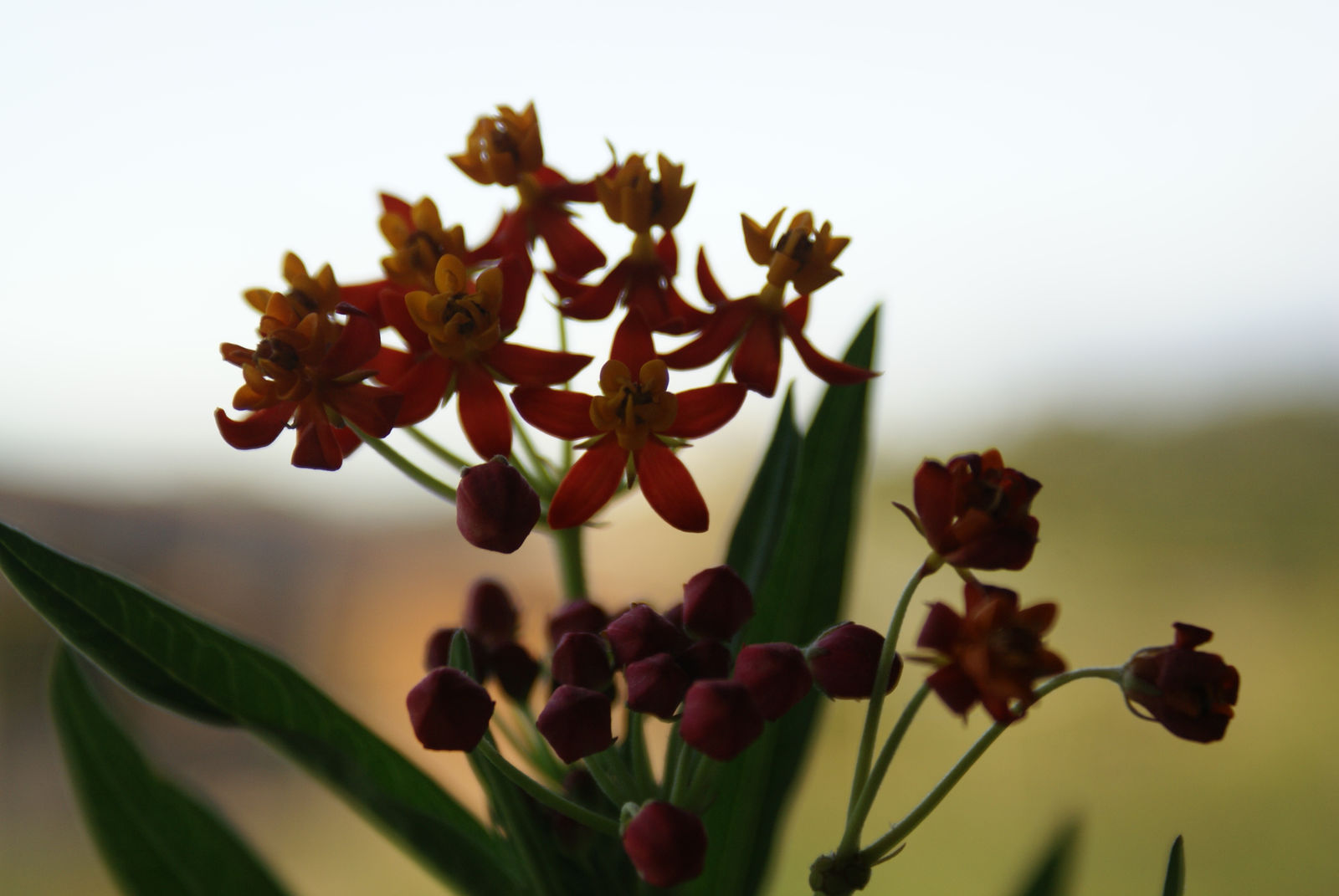
Each flower cluster holds 10–20 small flowers with the characteristic milkweed structure: a reflexed red or purple corolla beneath a crown of yellow or orange hoods associated with the pollen-bearing structures. After flowering, narrow upright follicles 5–10 cm (2–4 in) long split when ripe, releasing brown seeds topped with silky hairs that carry them on the wind. 4
Useful taxonomy
Botanical and trade names have long overlapped for this widely sold species. Taxonomic references record these principal synonyms:
- Asclepias nivea var. curassavica (L.) Kuntze (a historical combination)
- Asclepias curassavica var. concolor Krug & Urb. (a historical variety)
- Asclepias curassavica f. flaviflora Tawada (a historical form)
- Asclepias curassavica f. pallidiflora Griseb. (a historical form)
A more consequential trap is the homonym Asclepias curassavica Griseb., published in 1874, which refers to a different species and is now treated as a misapplied name. For orders or citations, the reliable reference is the accepted name with its full authority: Asclepias curassavica L., 1753. 1 2
Habitat and range
Throughout its imprecisely delimited native range, scarlet milkweed grows on waste ground, roadsides and disturbed pastures, from sea level to moderate elevations. 3 6
Worldwide cultivation as an ornamental and butterfly host plant has led to naturalization across much of the tropics and subtropics. Examples include Florida, Hawaii, Taiwan, southern China, southern Africa and eastern Australia, where it ranks among Queensland's 200 most invasive plants. 6
Where temperate winters bring sustained cold below 5 °C (41 °F), the aboveground growth is lost and recovery is prevented in the conditions described by the French source. In mainland France it is therefore grown as an annual or in containers brought indoors, with no spontaneous populations reported in that account. 4
Life cycle and reproduction
Caterpillars of two Danainae butterflies, the monarch (Danaus plexippus) and the queen (Danaus gilippus), feed almost exclusively on milkweed foliage. By eating Asclepias curassavica, they store its cardenolides and become toxic to their own predators. 6
From germination, a single juvenile stem develops into a branching clump that reaches adult size in two to three months in warm conditions. Flowering can continue almost year-round in tropical heat; in temperate cultivation it is concentrated from early summer through mid-fall. 3
Pollinated flowers develop upright follicles that take several weeks to ripen before opening. Their tufted seeds travel long distances on the wind, an efficient dispersal mechanism that partly explains the species' rapid naturalization outside its original range. 4
Uses and risks
Gardeners grow scarlet milkweed mainly for sunny flower beds and to attract butterflies, bees and hummingbirds, encouraging cross-pollination across the garden. 3
Cardiac glycosides occur throughout the plant, notably voruscharin, which accounts for nearly 40% of the cardenolides in its leaves. The ASPCA lists Asclepias as toxic to cats, dogs and horses. Ingestion causes vomiting, salivation and abnormal heart rhythms and can be fatal at high doses, especially in livestock that consume large amounts while grazing. 5
Contact with the sap can also irritate human skin and eyes. Its traditional use as an emetic under the name wild ipecac reflects an older role as a substitute for true ipecac. 3 7
Mild winters create a particular problem for migratory monarchs where this milkweed is not native, including Florida and parts of the southern United States. Without frost, foliage persists through winter, unlike local milkweeds. The protozoan parasite Ophryocystis elektroscirrha can then accumulate on leaves between seasons instead of disappearing with the host plant. Heavily infected monarchs migrate less successfully, live shorter lives and fly less efficiently. 8
Cutting plants back in fall, where winters do not kill them, artificially recreates the winter dormancy of native milkweeds. This limits the buildup of the parasite for the following season. 8
Varieties, look-alikes and related plants
Flower color and intensity distinguish the main horticultural selections. Silky Gold reproduces the entirely yellow form listed among the synonyms as Asclepias curassavica var. concolor, without a red corolla. Red Butterfly and Silky Deep Red instead intensify the red and orange of the wild form. 4
Butterfly weed, Asclepias tuberosa, is the most common source of confusion: its orange flowers resemble those of A. curassavica, but its sap is clear and almost colorless, while scarlet milkweed's sap is consistently white and milky. Balloon plant, Gomphocarpus physocarpus, has inflated follicles covered in soft hairs, very different from the smooth, tapered pods of A. curassavica. 3
Before buying a plant, checking sap color and follicle shape provides a more reliable confirmation of its identity than flower color alone.
Main sources
- Plants of the World Online / Kew, Asclepias curassavica L.
- International Plant Names Index, Asclepias curassavica L.
- Missouri Botanical Garden PlantFinder, Asclepias curassavica
- Royal Horticultural Society, Asclepias curassavica - Bloodflower
- ASPCA, Milkweed (Asclepias species) toxicity entry
- Environmental Weeds of Australia / Lucidcentral, Asclepias curassavica
- Plants For A Future, Asclepias curassavica
- Monarch Joint Venture, Q&A on tropical milkweed and monarch parasites
Frequently asked questions
Is scarlet milkweed poisonous to cats and dogs?
Yes. The entire plant contains cardiac glycosides, and the ASPCA lists the genus Asclepias as toxic to cats, dogs and horses. Ingestion can cause vomiting and abnormal heart rhythms.
Why is scarlet milkweed sometimes discouraged in monarch gardens?
In mild climates it keeps its leaves through winter, unlike local milkweeds. The parasite Ophryocystis elektroscirrha can then build up from one season to the next instead of disappearing with the host plant, weakening monarchs.
Can scarlet milkweed stay outdoors through a cold winter?
Only in the mildest conditions. It tolerates temperatures below 5 °C (41 °F) poorly and is damaged by early cold; in most of mainland France, for example, it is grown as an annual or in a pot brought indoors.
How can I tell Asclepias curassavica from Asclepias tuberosa?
Look at the sap. Asclepias curassavica has consistently white, milky sap, while the sap of Asclepias tuberosa, butterfly weed, is clear and almost colorless. Their orange flowers look more similar.
Is scarlet milkweed invasive?
It is invasive in several tropical and subtropical regions, notably Australia, where it is listed among Queensland’s most invasive plants. The source account reports that mainland France’s climate prevents lasting naturalization.
Will monarch caterpillars destroy the plant?
Heavy egg laying can lead to caterpillars stripping a clump in a few days, but the plant generally regrows from its base. Having several plants reduces the impact of a large caterpillar population on any one clump.
Does the name curassavica really refer to Curaçao?
The epithet refers to the island, but the connection remains uncertain. Botanists have not established the precise native range of the species, placing it more broadly in tropical America.
Similar plants

If you are unsure about a plant’s toxicity, ask a botanist or veterinarian for advice.